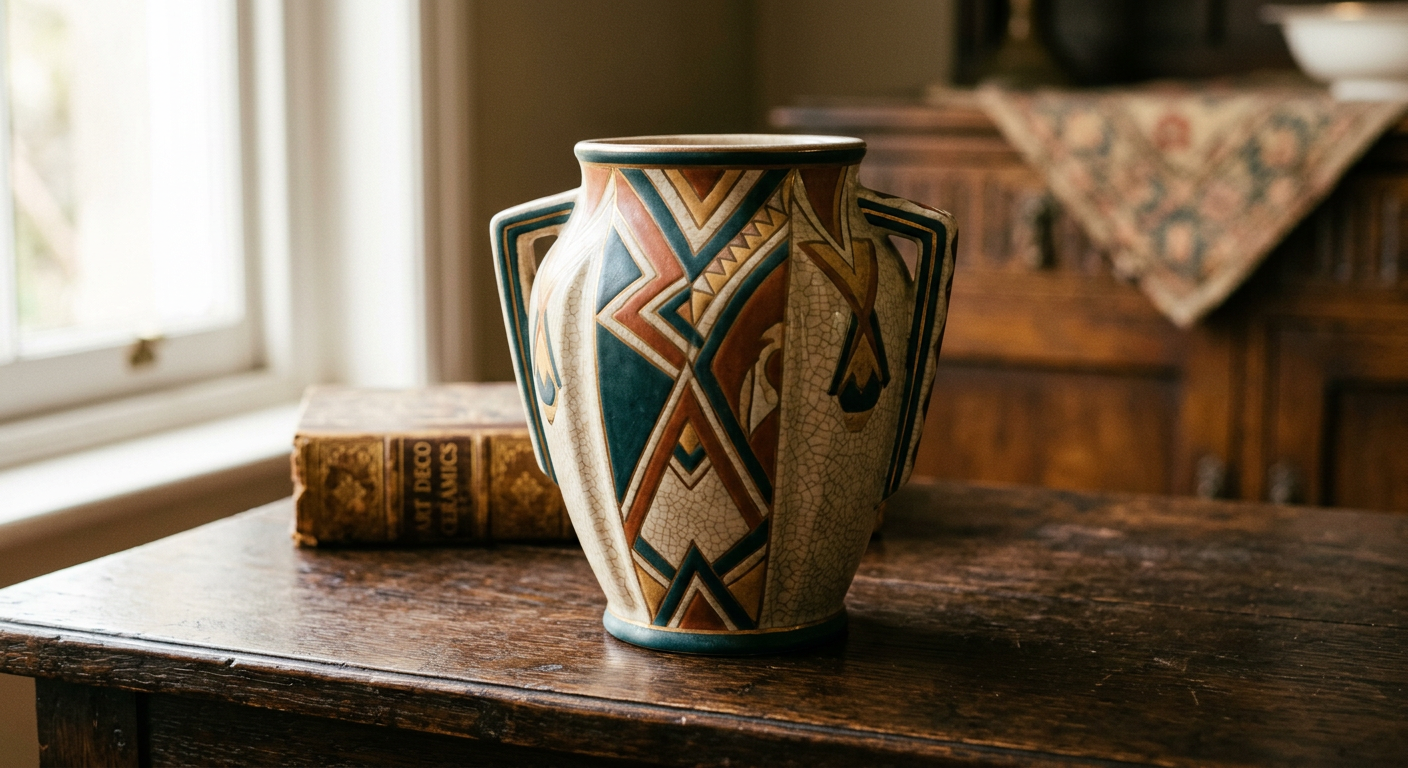
Recognising Art Deco Ceramics: Material, Form and Signature
Art Deco (roughly 1920–1940) produced some of the most distinctive ceramic objects of the 20th century. It is also one of the most imitated styles — both during the period itself and afterwards.
Recognition starts with three elements: the material, the form and the signature.
Material: What You See and Feel
Authentic Art Deco ceramics from the leading studios use specific glaze types that are recognisable once you know what to look for.
- Matte glazes — flame-matte, silk-matte or fully matte finishes are typical of the period, in contrast to the glossy 19th-century porcelain
- Craquelure — deliberate crackling of the glaze, sometimes pronounced, sometimes subtle. This was used as an aesthetic element in Art Deco
- Special colour effects — flambé glazes, soufflé techniques, crystalline glazes. Difficult to replicate and characteristic of specific studios
Feel the base: quality Art Deco earthenware often has a rough, unglazed base or a base with a distinct matte coating. This is a deliberate choice, not a finishing defect.
Form: The Geometric Signature
Art Deco breaks away from the organic, floral forms of Art Nouveau. The formal language is geometric, stylised and symmetrical.
- Clean horizontal and vertical lines
- Stylised animal and human forms — leaping deer, elegant female figures, stylised birds
- Octagonal, hexagonal and stepped forms
- Contrast between filled and empty — large smooth areas alongside detailed zones
Note: Reproduction Art Deco tends towards exaggeration — too many details, too symmetrical, too little tension. Authenticity lies in the subtlety of the composition.
Signature: What You Need to Know
Most serious Art Deco ceramicists signed their work. But a signature is not a guarantee — it is an indication that requires verification.
- Incised signatures (drawn into the unfired clay) are harder to replicate than painted ones
- Studio stamp marks are reproducible — pay attention to the quality of the stamp itself
- Compare with documented examples in catalogues or auction databases
Well-known names from the period that are frequently reproduced: Primavera, Longwy, Mougin, Chaplet. When in doubt, look up the studio in a specialised catalogue before buying.
What Makes a Piece Valuable?
- Studio provenance — a piece by Charles Catteau for Boch Frères is worth more than an anonymous piece in the same style
- Rarity of the model within the body of work
- Condition — no restorations, glaze intact
- Documented provenance
Want to have an Art Deco ceramic piece analysed?
CeramCheck on AntiqBot.com specialises in ceramics from this period. Upload a photo for an instant analysis.
Analyse your ceramics