How to Date Antique Furniture: A Practical Guide by Era, Joinery, Wood and Hardware
A field guide for collectors, dealers and anyone who inherited a piece they cannot place. No instruments needed, just attention to six categories of evidence that, together, narrow a piece down to within a decade or two.
Why dating a piece matters before anything else
The first question every appraiser asks is not "what is it worth" but "when was it made." Date sets value. A walnut chest of drawers from 1710 and a walnut chest of drawers from 1910 can look almost identical in a photograph, yet the 1710 piece may be worth twenty times the 1910 version. Sotheby's, Christie's and Bonhams all build their furniture lots around era first, attribution second, condition third. Get the date wrong and every other judgment falls apart.
Dating antique furniture is not guesswork. It rests on six categories of evidence that, taken together, narrow a piece down to within a decade or two:
- The style and silhouette (era markers)
- The wood species used for primary and secondary surfaces
- The joinery (how the parts are held together)
- The hardware (screws, nails, hinges, locks)
- The surface (patina, oxidation, wear, shrinkage)
- The finish and adhesives
A single clue is rarely enough. A reproduction can fake one or two markers easily. Faking five at once is expensive, time-consuming and very rare. That is the working principle of every professional furniture historian, and it is the principle this guide follows.
One thing worth saying upfront: dating furniture is not the same as authenticating it. A piece can be genuinely from 1820 and still be heavily restored, married from two different pieces, or repurposed from architectural salvage. Dating tells you when the wood was worked. Authentication tells you whether it is what it claims to be. For the difference between appraisal value and market value, see our companion piece on how appraisal value differs from market value.
Era markers: the periods at a glance
European and American furniture history is organised into broad style periods. The dates overlap and regions ran on slightly different calendars, but these are the conventional brackets used in auction catalogues and reference works. For a deeper visual walkthrough of each period, see our dedicated guide to identifying antique furniture by style.
British periods
William and Mary, 1689 to 1702. Walnut dominates. Cabriole legs begin to appear. Marquetry inlay is common. Turned spindles and bun feet on case furniture.
Queen Anne, 1702 to 1714. Walnut continues. The cabriole leg matures, often ending in a pad foot. Decoration becomes restrained compared to William and Mary. Veneered surfaces are common.
Georgian, 1714 to 1830. This is the longest and most important British furniture period. It is usually subdivided into Early Georgian (1714 to 1760, dominated by Thomas Chippendale and his contemporaries), Late Georgian (1760 to 1810, the age of Hepplewhite and Sheraton), and Regency (1811 to 1820, the period of George IV as Prince Regent). Mahogany replaces walnut as the prestige wood around 1720 to 1735, driven by the abolition of the British import duty on mahogany in 1721. The style moves from heavy rococo carving to lighter neoclassical lines.
William IV, 1830 to 1837. A transitional period. Heavier proportions, rosewood and mahogany, brass inlay common.
Victorian, 1837 to 1901. The longest single reign in British furniture and the most varied. Early Victorian work (1837 to 1860) continues classical lines. The mid-Victorian period revives Gothic, Elizabethan and Rococo styles in a heavier, more ornate vocabulary. Late Victorian work (1880 to 1901) is influenced by the Arts and Crafts movement and the Aesthetic Movement, and tends to be simpler and more honestly constructed.
Edwardian, 1901 to 1910. Lighter than Victorian. Satinwood, mahogany and beech are common. Inlay and string lines return. Edwardian pieces are often mistaken for Georgian originals because the style consciously revives eighteenth-century forms.
Art Nouveau, around 1890 to 1910. Curving organic lines, often with marquetry of plant forms. Strongest in France, Belgium and the German-speaking countries. Names to know include Émile Gallé, Louis Majorelle and Henry van de Velde.
Art Deco, around 1920 to 1940. Geometric, often exotic veneers (Macassar ebony, amboyna), chromed steel and lacquer. Names include Jacques-Émile Ruhlmann, Eileen Gray and Jean Dunand. For the ceramics of the same era, see our guide to Art Deco ceramics recognition.
American periods
American furniture follows a parallel but distinct calendar. The key brackets are:
- Pilgrim Century, 1620 to 1690, dominated by oak.
- William and Mary, 1690 to 1730.
- Queen Anne, 1725 to 1760.
- Chippendale, 1755 to 1790. Often called American Rococo.
- Federal, 1790 to 1820. Lighter, classical, often inlaid.
- Empire, 1815 to 1840.
- Victorian, 1840 to 1900.
A useful first instinct: if a piece looks American but the dovetails or hardware suggest a date before 1790, it is more likely a later reproduction than a survival. Genuine pre-1790 American furniture is rare and most documented examples live in museums or named collections.
Continental European periods
Continental dating uses the names of monarchs and republics:
- Louis XIV, 1643 to 1715. Heavy baroque, ormolu mounts, marquetry.
- Régence, 1715 to 1723. Transition.
- Louis XV, 1723 to 1774. Rococo, asymmetric carving, bombé case forms.
- Louis XVI, 1774 to 1792. Neoclassical, straight tapered legs, fluted columns.
- Directoire and Empire, 1795 to 1815.
- Restauration and Louis-Philippe, 1815 to 1848. Lighter classical forms.
- Second Empire, 1852 to 1870. Eclectic, often heavily upholstered.
- Belle Époque, 1871 to 1914.
For Flemish and Dutch furniture, the same broad dates apply with regional vocabulary. The Antwerp and Mechelen workshops produced cabinetry of high quality through the seventeenth century, and the Belgian Royal Archives and the FelixArchief in Antwerp hold documentation that helps trace specific pieces.
Joinery: the most reliable single clue
Style can be copied. Wood can be substituted. Joinery is harder to fake convincingly because it requires a workshop tradition and the tools that go with it. For most appraisers, joinery is the first thing they examine after lifting a drawer.
Dovetails
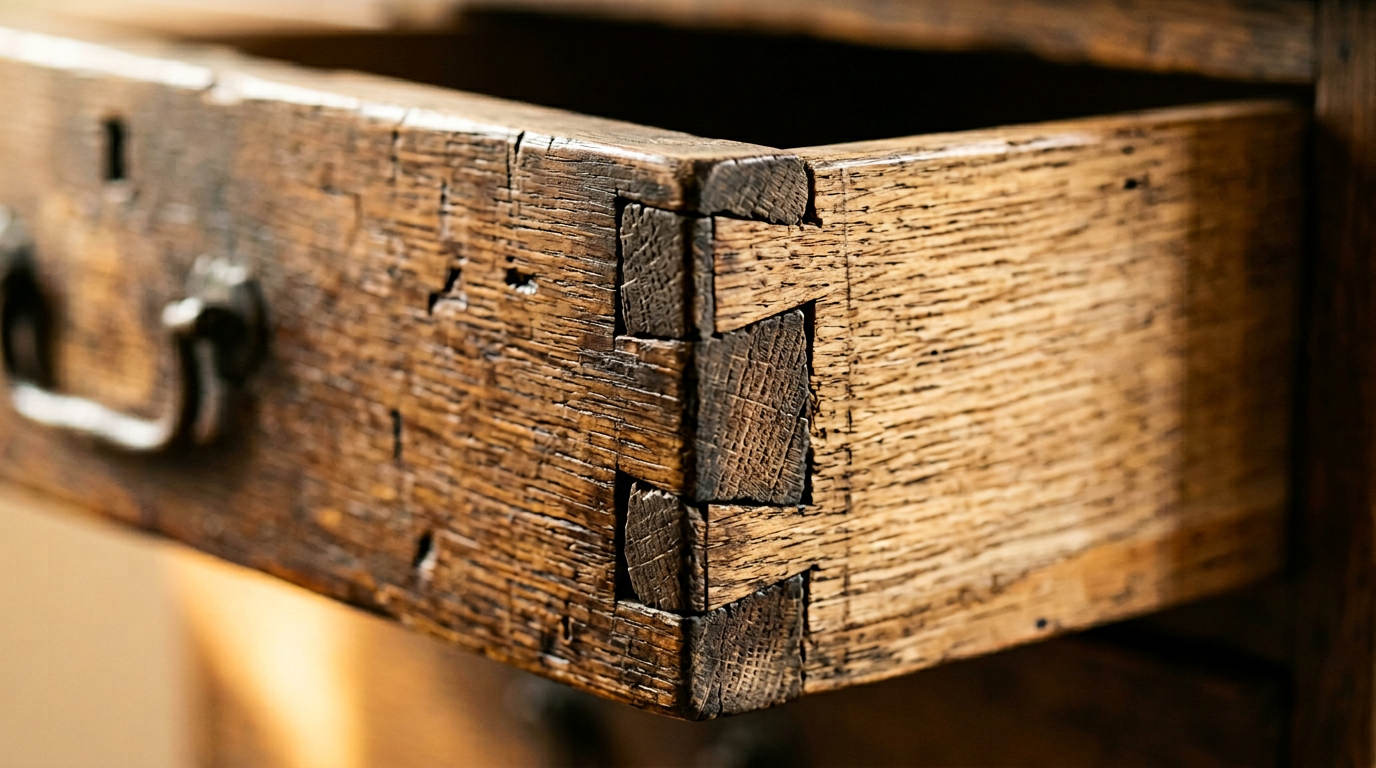
A dovetail is a wedge-shaped joint used to connect two boards at a right angle. The two halves are called the tails (the wedge shapes) and the pins (the narrow triangular cutouts that receive them).
Hand-cut dovetails (pre-1860 by rule of thumb). Made with a dovetail saw and a chisel. Recognisable by:
- Irregular spacing. Each pin and tail is laid out by eye. The spacing varies by a millimetre or two between joints.
- Narrow pins, wide tails. Hand workers minimised the number of cuts. A typical hand-cut joint on a drawer side might have three tails and four narrow pins, with the pins much narrower than the tails.
- Tool marks. Faint chisel marks at the bottom of each pin socket, and saw kerfs that overshoot the line very slightly.
- Variation between drawers. In a chest of drawers made before 1860, you should see small differences in dovetail spacing from one drawer to the next. Identical joints across all drawers suggest machine cutting.
Machine-cut dovetails (post-1860, dominant by 1880). The first practical dovetailing machine, the Knapp joint, was patented in the United States in 1867 and is itself a useful dating marker when seen. By the late 1880s, the more familiar through-dovetail machine had taken over.
- Uniform spacing. Every tail and pin is identical in width and gap.
- Wider pins. Machine cuts use wider pins because the cutter blade has a minimum width.
- No tool marks. Clean, factory-uniform joint walls.
The Knapp joint (1867 to about 1900). A distinctive American machine joint with semicircular pins that look like a row of half-moons. If you see Knapp joints, the piece is American, mass-produced, and dates between roughly 1870 and 1900.
Mortise and tenon
The classical joint for chair and table frames. A tenon is a tongue cut on the end of one piece; the mortise is the matching slot in the other. Pre-industrial joiners cut tenons by hand and pegged them through with a wooden dowel. Look at the back of a chair stretcher or under a table apron. Square or slightly irregular pegs, sometimes proud of the surface from wood shrinkage, are a good sign of pre-1850 work. Machine-set round dowels suggest later production.
Other joints worth knowing
Mitred and tongued joints appear on cabinets where a flush surface was required. The tongue and groove was machine-cut from the 1860s onward.
Finger joints (also called box joints) are square-pin equivalents of dovetails. They are a twentieth-century invention used in commercial casework. If you find finger joints on the carcass of a "Georgian" piece, the piece is a twentieth-century copy.
Biscuit joints use a flat oval biscuit of compressed beech glued into routed slots. The biscuit joiner was patented in 1956. Biscuit joints prove a piece is post-war.
Wood species by era
Knowing which wood was fashionable when is one of the fastest ways to narrow down a piece. The rule is rough but reliable: woodworkers used the best material their clients could afford, and the best material changed with trade, fashion and supply.
- Oak. The dominant European furniture wood from medieval times until around 1660. Used for Jacobean and Pilgrim Century pieces. After 1660 it dropped out of fashion for fine work but continued in country and provincial furniture across the eighteenth and nineteenth centuries.
- Walnut. Dominant for English and Continental fine furniture from about 1660 to 1735. The "walnut period" overlaps William and Mary and Queen Anne. After about 1735 walnut was largely replaced by mahogany for prestige work in Britain, but continued to be used heavily in France, Italy and southern Europe.
- Mahogany. The prestige wood of the English Georgian and Regency periods, roughly 1720 to 1830, and continued in Victorian work in heavier, denser forms. Cuban mahogany (now extinct in commercial quantities) was the prized variety until around 1840. Honduras mahogany dominated after.
- Rosewood. Used as a primary wood for Regency and early Victorian pieces, roughly 1810 to 1850, and again in Art Deco work in the 1920s and 1930s.
- Satinwood. Popular in Late Georgian and Edwardian work for inlay and as a primary veneer.
- Pine, beech, oak (as secondary woods). Found inside drawers, on backs and bottoms, and on the underside of tabletops. Secondary wood often tells you where a piece was made: English country oak in a Cotswolds chest, Baltic pine in a Scandinavian piece, tulip poplar in an American chest of drawers.
- Exotic veneers (Macassar ebony, amboyna, calamander, zebrawood). Heavy use of exotic veneers points to Art Deco or post-1980 reproduction, very rarely anything in between.
A practical check: examine the secondary wood inside a drawer. If the primary wood (the outside) is mahogany and the secondary wood (the drawer sides) is also mahogany or another expensive species, the piece is either very high quality, very late, or a reproduction. Genuine Georgian and Victorian cabinetmakers used cheap pine or oak inside.
Hardware: nails, screws, hinges, locks
Hardware is the unsung dating tool. Most reproductions get the visible carving and the proportions right, but the maker forgets that the screws inside a drawer pull or the nails in a back panel give the game away.
Nails
- Hand-wrought nails (pre-1790 in Europe and America). Made one at a time by a blacksmith. Heads are irregular, faceted, often rose-headed. Shanks are square-tapered and slightly twisted. If you see hand-wrought nails in original holes (not later repairs), the piece is almost certainly pre-1800.
- Cut nails (1790 to about 1890). Made by shearing strips from a flat iron sheet. Heads are flat or slightly rounded, shanks are rectangular in cross-section, and the taper is on two sides only. Cut nails are the workhorse of nineteenth-century American and European furniture.
- Wire nails (post-1880, dominant by 1900). Round in cross-section, uniform along the shank, machine-stamped head. If you see wire nails in what is presented as Georgian or Federal furniture, the piece has either been heavily repaired or is a reproduction.
Screws
Screws went through three clear phases:
- Pre-1812. Hand-cut threads. The slot in the head is often off-centre, the threads are uneven, and the tip is blunt (a flat end, not a point).
- 1812 to 1846. Machine-made threads but still blunt-tipped. Heads are more regular but slots are still hand-cut and slightly off-centre.
- Post-1846. The Sloan patent (US 1846) introduced the gimlet-point screw with machine-cut threads and a perfectly centred slot. From this point on, screws are uniform and pointed.
A screw with a flat (not pointed) tip in original mounting is a strong indicator of pre-1850 work.
Hinges
Hand-forged iron strap hinges and butterfly hinges are pre-1830 generally. Cast brass butt hinges came in around 1800 and remain in use today. The shape and finish matter more than the type: hand-finished brass shows faint file marks and slight asymmetry, machine-stamped brass is uniform.
Locks
Lock interiors are a goldmine for dating. The Bramah lock (1784), the Chubb detector lock (1818) and the Yale pin tumbler (1865) are all dated inventions. If you can pop the lock face and read a maker's name, you may have an exact date range. The Victoria and Albert Museum in London holds reference collections that document most named British lockmakers from 1700 onwards.
Surface clues: patina, wear and shrinkage
The surface of a genuine antique tells a story that is very hard to fake. Three things to look for:
Patina
Patina is the cumulative result of oxidation, dirt, polish residue, sunlight and handling over decades or centuries. Real patina is uneven. It is darker where the piece was rarely touched (back panels, undersides) and lighter where hands and cloths rubbed it (chair arms, drawer pulls, the front edges of tabletops). Fake patina (stained, sometimes burned, sometimes chemically darkened) is usually uniform, which is the giveaway.
On a genuine eighteenth-century mahogany piece, an unpolished back panel will be a deep purple-brown with a fine, almost matte surface. The front, polished surface will be lighter and warmer. Reversed patina, where the back is lighter than the front, suggests the piece has been turned around at some point, which often means a marriage of two different pieces.
Wear
Wear follows use. On a chair, the front edge of the seat and the front of the stretchers are worn smooth. On a desk, the front edge where forearms rest is darkened and rounded. On a chest of drawers, the runners (the wooden strips on which the drawers slide) are worn into shallow grooves on pre-1850 pieces and into deep grooves on heavily used eighteenth-century examples. New runners on an otherwise old piece are common and acceptable; brand new runners in an unworn carcase suggest the piece is itself new.
Shrinkage
Wood shrinks across the grain over decades. A round tabletop made in 1770 will today be slightly oval, narrower across the grain than along it, often by three or four millimetres on a 90 centimetre top. If you measure a "Georgian" round tabletop and find it perfectly round, it is either very recent or a heavily restored top.
Drawer bottoms are another shrinkage indicator. A solid pine drawer bottom from 1820 will have pulled away from its retaining grooves by a couple of millimetres on each side. The drawer bottom is usually held only by friction and a few small nails, allowing for shrinkage. A "Georgian" drawer bottom that is glued tight all round and shows no shrinkage gap is suspect.
Veneers, glues and finishes
Veneer thickness
Pre-1860 veneers were cut by hand with a saw. They are thick, often between 1.5 and 2.5 millimetres. After the introduction of the rotary veneer slicer in the 1840s and its widespread use from the 1860s onwards, veneers became progressively thinner. A modern veneer is typically 0.5 to 0.6 millimetres. If you can see the thickness of a veneer at a chipped edge, you have a useful clue.
Glue
Animal hide glue (made from rendered hide and bone) was the standard furniture adhesive until the 1930s. It is brown, brittle when dry, and reversible with heat and moisture. Modern PVA (white) glue and synthetic adhesives came into furniture making in the 1940s and 1950s. A piece described as "eighteenth century" with PVA visible at the joints has been repaired with modern materials at best, or is a reproduction at worst.
Finishes
- Oil and wax, the dominant finish until around 1820.
- Shellac and French polish, dominant from 1820 to 1920. French polishing was invented in France around 1810 and reached Britain in the 1820s.
- Nitrocellulose lacquer, dominant from 1920 to 1960.
- Polyurethane and acrylic, post-1960.
A piece with a hard, plastic-looking finish that does not respond to a drop of methylated spirit is finished with polyurethane and therefore either modern or refinished. A surface that softens slightly under a drop of meths is shellac, and that is consistent with anything between 1820 and the present.
Putting it together: a dating checklist
When you have a piece in front of you, work through these in order. Each step narrows the date range.
- Style and silhouette. Identify the broad era. Georgian, Victorian, Edwardian, Art Deco, or country (which sits outside the formal periods).
- Primary wood. Walnut, mahogany, rosewood, oak, satinwood. This narrows you to a 30 to 80 year window.
- Secondary wood. Look inside drawers and under tops. Pine, oak, tulip poplar, beech. This tells you region and quality grade.
- Joinery. Open a drawer and inspect the dovetails. Hand-cut or machine. This is your single most reliable clue.
- Nails and screws. Look for hardware in non-decorative positions. Hand-wrought, cut, or wire. Blunt-tipped or pointed screws. This often confirms or contradicts the joinery.
- Hinges and locks. Pop a lock and look for a maker's name. Examine hinge form and finish.
- Patina. Compare the back, sides and front. Look for uneven darkening that matches plausible use.
- Shrinkage. Measure round tops. Check drawer bottoms for retreat from grooves.
- Finish. Test an inconspicuous spot with a drop of methylated spirit. Soft means shellac. Hard means lacquer or polyurethane.
- Anomalies. Anything that does not fit. A Georgian-style chest with wire nails. A Queen Anne table with biscuit joints. A walnut piece with Phillips-head screws (Phillips was patented in 1936).
A piece that passes nine out of ten checks is consistent with its claimed date. A piece that fails three or more checks is almost certainly not what it claims to be, or has been so heavily restored that its original date is no longer the primary feature.
Common pitfalls and red flags
A few traps that catch even experienced buyers:
- Marriages. Two pieces from different periods joined together. A common version is an eighteenth-century chest with a Victorian secretaire top added later. Look for inconsistent wood, inconsistent patina between top and base, and screw holes that do not align with the visible hardware.
- Refacing. An old carcass with new veneer applied to make it look more fashionable. Examine the veneer edges. New veneer over old carcass shows machine-cut thinness sitting on hand-cut substrate, and the patina inside will not match the surface outside.
- Edwardian Georgian revivals. Around 1900 to 1910, English makers produced large numbers of consciously eighteenth-century-style pieces using period-correct mahogany and Georgian forms. These are not fakes, they are honest revivals. They are dated by joinery (machine dovetails), hardware (post-1846 screws, sometimes wire nails) and surface (less patina than 200 years would produce). Edwardian pieces are still attractive and collectable, but they sell at a fraction of genuine Georgian prices.
- Stripped and refinished pieces. A perfectly genuine antique can lose 30 to 60 percent of its market value if it has been stripped and refinished in modern materials. Look for finish that pools in carved details (a sign of brushed-on modern finish) or that has obliterated the natural patina under the wax.
- Pegged or doweled joints in the wrong place. Wooden pegs are correct on pre-1850 chair joints. They are not normally found on case furniture drawer construction. A pegged drawer side suggests rustic or country work, or sometimes a reproduction trying to look old.
When to ask for a second opinion
Even with everything in this guide, some pieces are difficult to place. The right answer is not to guess; it is to ask. Three options, in increasing order of cost:
- Send clear photographs to a specialist auction house. Christie's, Sotheby's, Bonhams and Dorotheum (Vienna) offer free informal valuations on photographs. Bernaerts in Antwerp and Drouot in Paris do the same for European furniture. Response times vary from a few days to a few weeks.
- Run an AI-assisted analysis. AntiqBot's furniture module reads photographs against thousands of dated reference pieces and returns an era estimate, a likely style attribution, a market range and a list of dating clues it identified or could not assess. It is not a replacement for a hands-on appraisal, but it gives you a structured first read in minutes rather than weeks.
- Commission a written valuation from a registered appraiser. This is the right route for insurance, probate or sale through a major auction house. Expect to pay between 150 and 500 euros per piece depending on complexity.
Try AntiqBot on your piece
Sign up and get 1 free credit for your first analysis. After that, buy credit packs starting from €0.60 per analysis. No subscription, no hidden costs.
Analyse Your FurnitureFurther reading
If you want to go deeper into furniture history, the following are the standard references:
- Christopher Gilbert, English Vernacular Furniture 1750 to 1900 (Yale University Press)
- John Gloag, A Short Dictionary of Furniture (Allen and Unwin)
- The Furniture History Society journal, published annually since 1965
- The Victoria and Albert Museum collection database (vam.ac.uk), searchable by date and form
- Christie's and Sotheby's online archives of past furniture sales, useful for comparable pricing
For Belgian and Dutch furniture, the FelixArchief in Antwerp holds workshop records and the Royal Institute for Cultural Heritage (KIK-IRPA) maintains a photographic database of inventoried pieces.