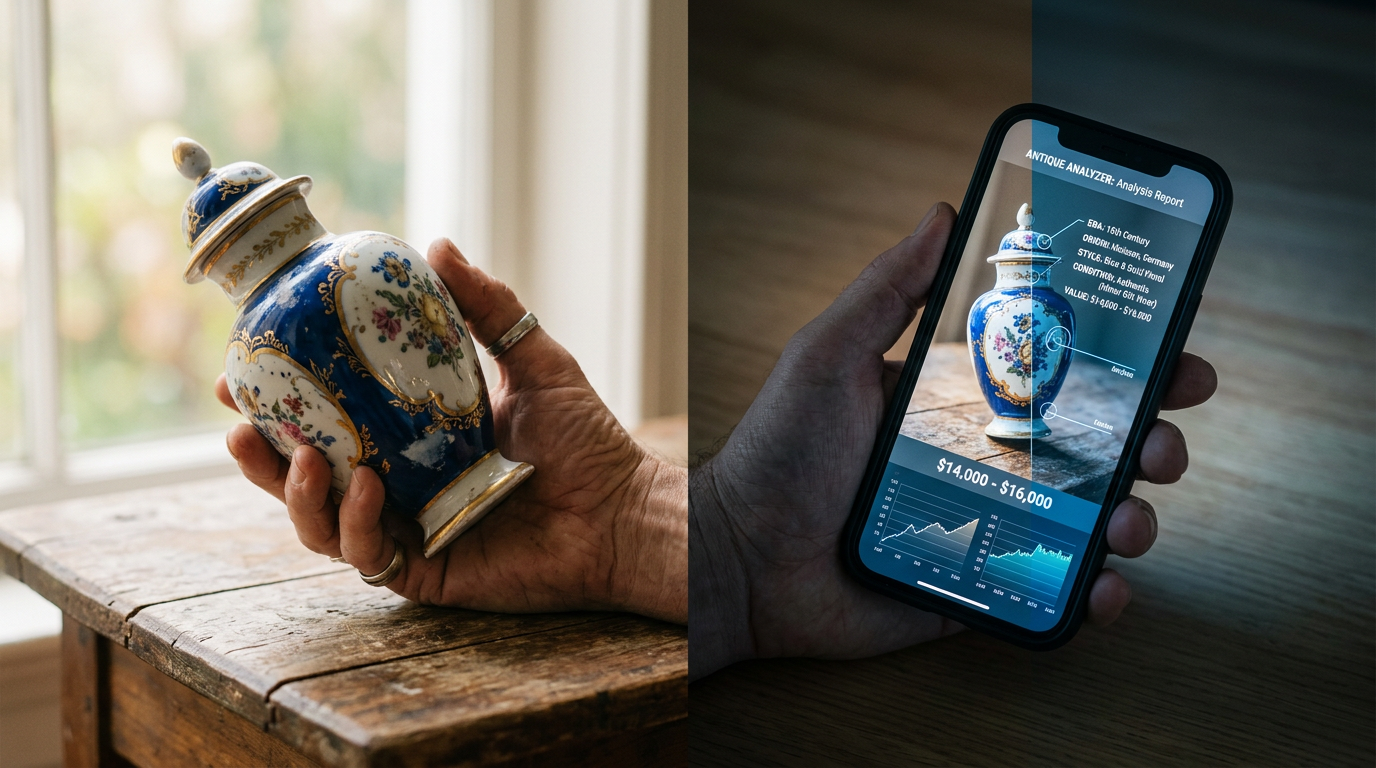
What AI cannot do in antique analysis — an honest answer from the people who built AntiqBot
We build AntiqBot. We believe in what it does. And that is precisely why we want to be crystal clear about what it cannot do.
This is not modesty. This is the honesty you deserve before making a decision based on an analysis. And it is the insight that comes from thirty years of holding, smelling, turning, weighing and assessing antiques — with every sense a human being has.
Because that is exactly what AI lacks.
AI only sees what you photograph
A photograph is a flat, two-dimensional image of one moment, from one angle, in one lighting condition. That is all. What is behind it, underneath it, inside it, on the other side — AI does not see any of it, unless you photograph it.
An expert holding a piece turns it in every direction. Examines it in raking light. Holds it upside down. Looks through the glaze against the light. Compares the top with the bottom. Checks whether the patina in the corners is consistent with the rest.
AI analyses only the photographs provided. Nothing more. What is not photographed does not exist for the analysis.
AI cannot feel
Ten seconds of holding a porcelain piece tells an experienced hand more than ten minutes of looking at photographs.
- Weight: too light for the claimed size and wall thickness? Red flag.
- Wall thickness: thin and even as fine porcelain should be, or irregular like modern cast ware?
- Temperature: old porcelain feels different from new — colder, denser.
- Texture of an unglazed base: sandy, smooth, gritty — each tells something about the clay body and the period.
- The joint of a bronze sculpture to its base: loose, soldered, screwed — felt, not seen.
All of that information is inaccessible to a system that works with pixels.
AI cannot smell
This sounds trivial. It is not.
The inside of an old drawer has a scent that is impossible to fake. Dry, slightly musty, old wood — a scent that takes decades to develop. A reproduction smells different. Sometimes of varnish. Sometimes of nothing at all.
Old silver has a specific smell after polishing that differs from recently manufactured silver. Old paper, old leather, old textiles — every material carries its age in its scent.
That is sensory information that no digital system will ever be able to process.
AI cannot weigh
A scale and a reference table are sometimes the fastest instruments. Chinese imperial porcelain has a specific density that corresponds to the clay body and the period. A reproduction in cheaper clay weighs differently.
Bronze, silver, tin, zinc — each has a specific gravity. A piece that claims to be made of a certain material but has the wrong weight does not add up. You know this in three seconds with a scale.
AI does not have a scale.
AI cannot ask questions
An expert examining a piece asks the seller questions. How long have you had this? Do you know where it came from? Has anything ever been done to it? Do you have papers, invoices, photographs of the context?
That information — the provenance, the history, the context — is sometimes more decisive than the piece itself. A piece with a demonstrable ownership history is worth more and easier to authenticate than an identical piece without any documentation.
AI does not see a seller. AI does not hear answers. AI does not smell doubt.
AI cannot negotiate
An expert knows when he doubts and translates that doubt into a lower bid. Doubt is information — and information has a price.
AI provides an analysis. That analysis can express doubt. But the translation into a negotiating position, the timing of a bid, the reading of the seller across from you — that is human work.
AI cannot enjoy
And this may be the most fundamental distinction of all.
An expert holding a beautiful piece experiences something. The beauty of a well-painted decoration. The elegance of a well-proportioned bronze sculpture. The silence of an old piece that has survived dozens of generations.
That is the reason people collect antiques. Not for the spreadsheet. For the feeling.
AI does not have that. AI assesses. It does not experience.
What AntiqBot actually is
AntiqBot is a screening tool. Fast, consistent, available at the flea market at 7am without an appointment. It recognises patterns that indicate authenticity or inconsistency. It provides direction.
It does not replace an expert for a significant purchase. It does not replace a physical assessment. It certainly does not replace thirty years of experience with antiques in hand.
But it asks the right questions. And sometimes the right question is enough to avoid an expensive mistake.
Use AntiqBot as your first step
Quick AI screening of your antiques — and know when to take the next step towards a real expert.
Start an analysis