Topic of the Week
Art Deco Jewelry: Geometry, Platinum and the Machine Age
How the 1925 Paris Exposition reshaped what a jewel could be
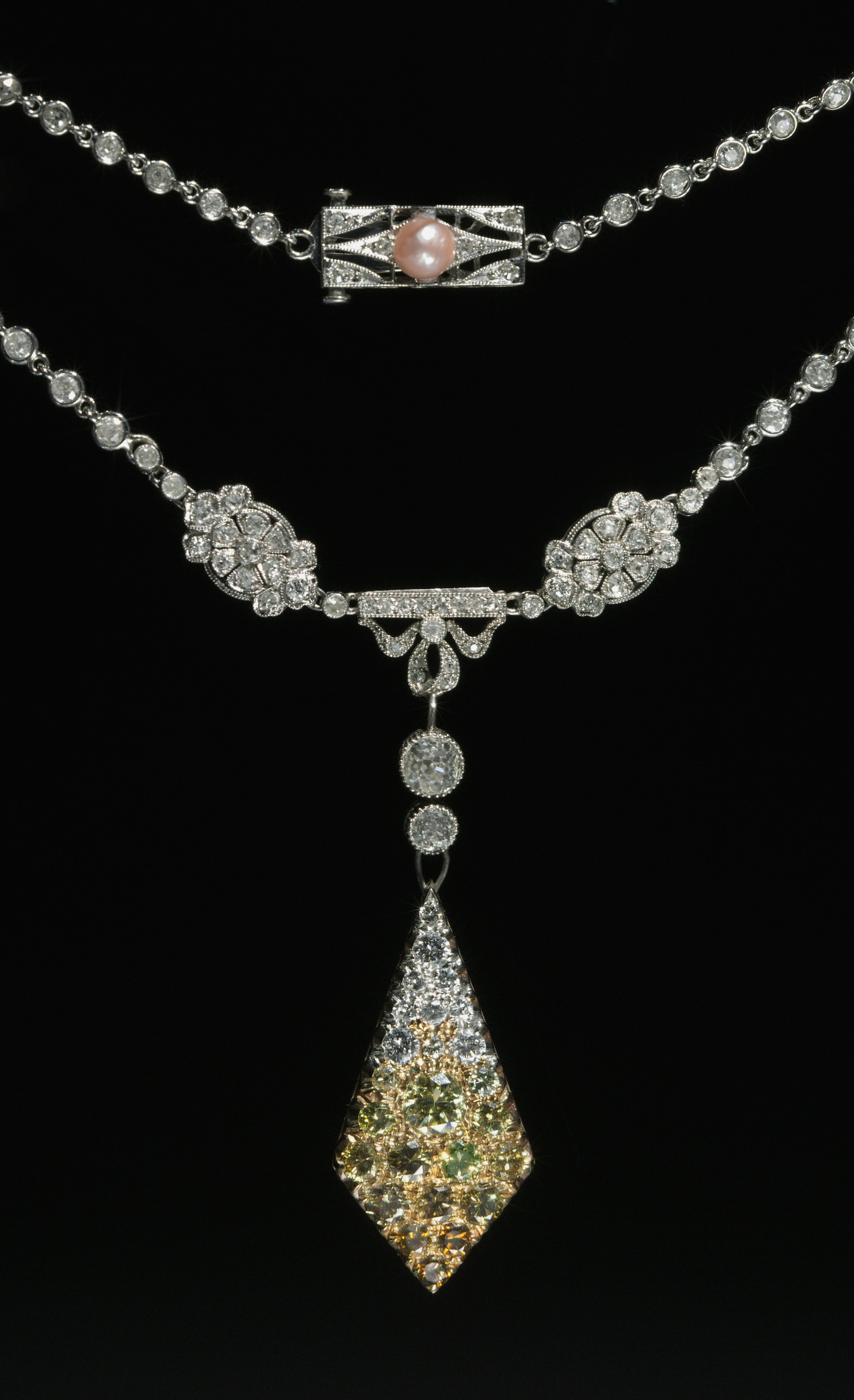
In April 1925, along the Esplanade des Invalides and the banks of the Seine, the Exposition Internationale des Arts Décoratifs et Industriels Modernes opened its gates. Over six months, more than sixteen million visitors walked through pavilions of glass, lacquer, ferronnerie and jewelry. The show gave its name, retroactively, to an entire movement. The term "Art Deco" was not coined in 1925. It was introduced by the British historian Bevis Hillier in 1968, taken directly from the Exposition's title. What visitors actually saw in 1925 was the first coordinated public statement of a new decorative language: geometry over flora, contrast over gradient, platinum over yellow gold, step-cut over rose-cut, the straight line restored to the centre of ornament. This was the moment jewelry stopped whispering about orchids and thistles, and started speaking in chevrons and Chinese lacquer screens.
For the authenticator, Art Deco is a gift. The period has sharp material and technical signatures. Platinum, almost unused in jewelry before 1900, dominates the high-end output between roughly 1915 and 1939. Step-cut stones (baguette, carré, emerald-cut, trapeze) replace the softer cuts of the Belle Époque. Calibré-cut coloured stones, cut to fit a specific setting rather than ground to a standard size, appear in the lapidary's repertoire. Platinum permits saw-pierced galleries and millegrain edges that gold cannot hold. A piece that claims to be Art Deco but shows none of these traits is not Art Deco. It is later pastiche, or Edwardian, or Retro 1940s. Learning the material grammar is the shortcut to separating the thing from its copy.
The break with what came before was sharp. Art Nouveau, which had dominated fine jewelry from roughly 1890 to 1910, worshipped the curve. Lalique bent glass into insect wings. Fouquet (Georges, the father) and Vever set enamelled orchids and peacock feathers in gold. The line was organic, asymmetrical, femininely soft. Art Deco rejected all of it. The Ballets Russes in Paris from 1909, Futurism in Italy, Cubism at Kahnweiler's gallery, the Wiener Werkstätte in Vienna, the Bauhaus after 1919: these movements were already redrawing the visual field. Jewelry, conservative by nature, caught up in stages. The 1910 to 1920 period is a transition: the curves soften into garlands, the garlands break into geometry. By 1925, the geometry is complete.
Platinum is the material story. Before electric-arc furnaces could reach its melting point of 1,768 °C reliably, platinum was almost impossible to work at scale. It was used in small quantities by Louis Cartier from 1898 onward, and by Boucheron before the First World War, but the revolution arrived with post-war industrial metallurgy. Platinum is twice as dense as silver and almost as hard. It holds a setting where gold flexes. It lets a goldsmith pierce a lattice so fine it looks like lace, hold a one-carat diamond in four claws thinner than a pinhead, and keep the structure rigid for a century. The platinum-work of the period is why an Art Deco bracelet, a hundred years later, still sits true on the wrist. Later copies in white gold sag.
The motifs are as identifiable as the materials. Tutti Frutti, Cartier's line of carved emeralds, rubies and sapphires set in platinum, was born out of Jacques Cartier's 1911 expedition to India and the house's subsequent commissions from maharajas recutting their dynastic stones in the European taste. The Panther, introduced as a decorative motif at Cartier in 1914 and developed into the signature house emblem under Jeanne Toussaint from 1933, begins in this period. Egyptomania exploded after Howard Carter opened Tutankhamun's tomb in November 1922, filling Cartier's and Van Cleef & Arpels' cases with scarabs, lotus fans and hieroglyphic plaques. Chinoiserie produced jade brooches and coral pagodas. And the Machine Age, fed by Cubism and Léger, gave the avant-garde designers (Raymond Templier, Jean Després, Gérard Sandoz, Jean Fouquet) their vocabulary of polished chrome discs, lacquer, and silvered-steel geometry.
The market today is wide. A signed, documented Cartier Tutti Frutti bracelet from the 1930s, sold at Christie's or Sotheby's in the last decade, routinely clears two to three million euros at the hammer; the ne plus ultra example, the "Collier Hindou" necklace, sold at Christie's Geneva in 2017 for over two million Swiss francs. A signed Van Cleef & Arpels Mystery-Set clip of the late 1930s sits comfortably in the 80,000 to 300,000 euro range. An unsigned but technically correct Art Deco platinum-and-diamond bracelet of the period, from a smaller Parisian or Antwerp workshop, trades at Bonhams, Drouot or Bernaerts in a 6,000 to 40,000 euro band depending on stone quality. At the other end, a 1950s or 1970s "Art Deco style" pastiche in 18-karat white gold, common on online marketplaces, is worth roughly its scrap value plus a small premium. The price gap between the real thing and the lookalike is the single largest authentication stake in 20th-century jewelry.
In this edition, we work through the authentication in layers. We begin with the Cartier Tutti Frutti bracelet as our specimen of the week, because it concentrates every Art Deco diagnostic into one object. We then walk five practical red flags that separate 1920s pieces from later copies. We compare the grand houses and the avant-garde, since confusing a Boucheron with a Mauboussin is a tax on market knowledge, not taste. We close with the market band, the AntiqBot analysis framework, a reader question, and a short update on the iOS submission.
Item of the Week
The Cartier Tutti Frutti Bracelet: Mughal India meets Rue de la Paix
The Tutti Frutti bracelet, as a type, combines carved leaves and berries of emerald, ruby and sapphire, set in platinum, often with small round or baguette diamonds as connective tissue. The name is a later coinage: Cartier itself used "Hindou", "Style Indien" and simply the stock number. What makes these bracelets instantly recognisable is the carving. The coloured stones are not faceted. They are incised in leaf, berry and flower forms, following a Mughal tradition in which ruby and emerald had been cut into vegetal shapes at Jaipur and Delhi workshops for three centuries. Louis Cartier and his brother Jacques grasped, around 1911, that these Indian carvings could be reset in platinum in the Paris atelier and sold as a new language. The result is a jewel that reads, at once, as Mughal court art and as French modernism.
Jacques Cartier's first documented trip to India was in 1911. He went to the Delhi Durbar, met maharajas, and established a supply line of Indian carved stones. Commissions followed in both directions. European clients asked Cartier for "Indian" pieces. Indian rulers, most famously the Maharaja of Patiala and the Nawab of Bahawalpur, sent their inherited stones to Paris to be recut and reset for contemporary wear. The Patiala Necklace of 1928, commissioned from Cartier, carried a 234-carat De Beers yellow diamond and 2,930 smaller stones. It is the canonical example of the dialogue between Jaipur and the Rue de la Paix.
A real 1920s or 1930s Tutti Frutti bracelet has seven technical markers. First, platinum construction with a saw-pierced, openwork gallery that allows the carved stones to sit near the skin, not on a flat plate. Second, the coloured stones are closed-set with small beads of metal, never pavé-clawed the way a modern lab would set a cabochon. Third, the carving of the stones is asymmetric and hand-done: leaves are not identical, berries are not perfectly round, the polish has soft edges. Fourth, the diamond accents are old European or transitional cuts, with a visible culet when the stone is tilted. Fifth, the reverse of the bracelet is as finished as the front, with the maker's signature, a French platinum hallmark (the "tête d'aigle" eagle head introduced in 1912 for 950 platinum), and the Cartier stock number engraved either on the safety catch or on a discreet plaque. Sixth, the catch is a tongue-and-box closure with a double safety figure-of-eight, a design that Cartier used consistently from the 1920s. Seventh, the weight in the hand: a real Tutti Frutti bracelet, the size of a cuff, weighs between roughly 50 and 90 grams because of the platinum.
Why is this so hard to fake? Because the labour input is prohibitive. The Indian-carved stones, when genuinely antique, have a market of their own and can be bought. But assembling them into a plausible 1920s gallery requires a platinum-smith trained in early-20th-century technique, and the finished object still has to explain its absence of a Cartier number, its absence of French hallmarks, or a too-clean patina in the crevices. Modern reproductions in 18-karat white gold, sometimes with glass-filled ruby cabochons replacing Mughal emeralds, are detectable in three minutes with a loupe and a magnet test for ferrous infiltration. Reproductions that use real platinum and real stones are rare because the raw materials cost more than the sale price of the pastiche.
The documented Cartier archive matters for authentication. Cartier Paris, Cartier London and Cartier New York each kept ledgers from 1899 onward, many of which survived and are now accessible to the Cartier Collection and, for client research, via the Cartier Archives. A real stock number engraved on the bracelet can be cross-referenced. The archive is the final court of appeal. Auction houses like Christie's and Sotheby's will typically decline to offer a piece as "Cartier" without archive confirmation. A seller who refuses, or cannot produce, archive confirmation and yet asks for a Cartier price should be treated as asking for a provenance price without the provenance.
One practical note. Cartier signed its 1920s and 1930s pieces in a particular hand. The word "Cartier" on a bracelet of this period is engraved, not stamped with a block punch. The letters are fine, with a slight forward lean, and always include the stock number and the country designation (Paris, London, or Made in France). A thick, squared-off "CARTIER" punch-mark is post-war at best and often modern. This alone disqualifies a large share of Rue de la Paix claims on the secondary market.
Quick Check
5 Red Flags on Art Deco Jewelry
01
White gold, not platinum. A period piece described as "1920s Art Deco" but executed in white gold is almost certainly later. White gold, a gold alloy with palladium or nickel developed to imitate platinum, entered serious commercial use around 1920 and spread after 1930, but the high-end Paris houses (Cartier, Van Cleef & Arpels, Boucheron, Chaumet, Mauboussin, Lacloche Frères) worked in platinum from the start of the period. Platinum hallmarks in France show the "tête d'aigle" (eagle head) for 950 platinum since 1912. The UK orb was introduced in 1975, so a British Art Deco piece will typically show only a maker's mark and, occasionally, "PLATINUM" spelled out. In the United States, "PLAT", "PT900" or "PT950" appears. A ring marked "18K", "750" or "585" with no platinum mark, offered as high-end 1920s work, is either low-tier of the period, post-war, or outright later. Weigh it. A platinum ring is noticeably heavier than a white-gold ring of the same size.
02
Modern brilliant cuts in a 1920s setting. Faceting styles date pieces more reliably than hallmarks. A diamond in a true 1920s piece is an old European cut, a transitional cut, or a single cut for small accents. All three show a visible culet (the flat face at the bottom of the stone) when viewed from above, a smaller table facet, and a higher crown. The modern round brilliant cut, with its pointed culet, large table and low crown, was standardised by Marcel Tolkowsky in 1919 but only became the default after 1950. A "1925" platinum ring set with a modern round brilliant is either a period ring that was re-stoned much later (common, and not necessarily fraudulent) or a recent reproduction. For coloured stones, the 1920s used step cuts (baguette, carré, emerald-cut) and calibré-cut pieces ground to fit. Pear and marquise cuts existed but are less typical. Trillion and princess cuts are later inventions.
03
Machine-smooth galleries and cast settings. Art Deco high-end work is hand-pierced. A 1925 platinum bracelet is built up from sawn, filed and hand-burnished sections, assembled with gold or platinum solder under a flame. Under a 10x loupe, you see file marks, tiny asymmetries in the lattice, and solder lines at joints. Modern lost-wax cast platinum, developed post-war and now standard, produces a uniform surface with rounded edges, no file marks, and a slightly spongy texture in enlarged areas. Period millegrain (the tiny bead-edge decoration) is hand-tooled, so each bead differs by a fraction. Machine millegrain is mathematically regular. You can train your eye on this in ten minutes with a loupe and a side-by-side comparison: once seen, it is not unseen.
04
Missing or wrong signature. Every major Art Deco house signed its pieces, and each signature has period-specific conventions. Cartier engraved "Cartier Paris" (or London, New York) plus a five to six digit stock number. Van Cleef & Arpels used "Van Cleef & Arpels" and an inventory number, often on the catch. Boucheron signed "Boucheron Paris" and carried a reference. Mauboussin and Chaumet followed similar conventions. The script is fine, consistent, and reads as engraved, not stamped. Period pieces from smaller workshops may carry only a maker's responsibility mark (two initials in a diamond-shaped cartouche in France; "MK" or initials in a lozenge in the Low Countries). A piece attributed to a major house without a signature, and without an archive letter confirming it, is attribution, not proof. It does not disqualify the piece as Art Deco, but it disqualifies the "signed by" premium.
05
Synthetic rubies and sapphires with curved growth lines. The Verneuil process, patented by Auguste Verneuil in 1902 and commercialised from around 1910, produces flame-fusion synthetic rubies and sapphires that were marketed openly at first and then used by less scrupulous makers as replacements for natural stones. Verneuil synthetics are identifiable under a 10x loupe by curved growth lines (natural corundum shows straight lines or hexagonal growth) and by small gas bubbles rather than mineral inclusions. In Art Deco jewelry they appear almost exclusively in lower-tier workshop pieces and in later restorations where a stone was replaced. A "Cartier" clip with a flawless Verneuil synthetic centre ruby is not a Cartier. For pieces of this period, any single coloured stone that is too perfect, too clean, too uniformly saturated, deserves a second look. Natural Burmese ruby and Kashmir sapphire, the standard in high-end 1920s work, are never flawless at close range.
Material, cut, technique, signature, stone origin. Five axes. A real Art Deco piece satisfies all five. Any failure on one is not fatal. Failure on two is a structural problem. Failure on three means you are looking at a later object with an Art Deco face.
Did You Know
The name "Art Deco" did not exist during the Art Deco period. Contemporaries called the style "moderne", "modernist" or "1925 style". The term was coined only in 1968 by the British art historian Bevis Hillier in his book Art Deco of the 20s and 30s, taken directly from the title of the 1925 Paris Exposition Internationale des Arts Décoratifs et Industriels Modernes. This matters for two reasons. First, any piece of jewelry stamped or inscribed with the words "Art Deco" is post-1968 by definition, regardless of whatever else it claims to be. Second, period catalogues, invoices and house ledgers from Cartier, Van Cleef & Arpels, Boucheron and the others will not use the phrase. They will use "style moderne", "bracelet articulé", "clip de corsage", or simply the stock number. When a seller or auction listing quotes "original 1925 Art Deco box", the phrase "Art Deco" on the box itself is the tell. Period boxes bear the maker's name and address in gold lettering; they do not describe their own style.
Looking Deeper
The Houses and the Avant-Garde: a Cartography
Art Deco jewelry divides neatly into two worlds. The grand houses, almost all based in Paris along the Rue de la Paix and the Place Vendôme, served royalty and the international haute bourgeoisie. Their production was exquisite, technically conservative, and evolved slowly. The avant-garde designers, younger and often trained in painting or sculpture, made jewelry as modernist objects, closer in spirit to the Bauhaus than to the Place Vendôme. They worked in smaller quantities, sold to collectors rather than courts, and today their pieces occupy a different shelf at the same auction houses.
Cartier (founded 1847, Rue de la Paix from 1899) is the dominant name. Louis Cartier, the third generation, led the house through the Art Deco years. Technical hallmarks: impeccable platinum galleries, Tutti Frutti and Indian lines, the early Panther pieces, the Mystery Clocks (not jewelry but diagnostic of the same craft). Cartier signed, numbered and archived. This is why Cartier dominates the high end of the secondary market: it is the most authenticatable house of the period.
Van Cleef & Arpels (founded 1896 at Place Vendôme from 1906) built its position on two technical innovations: the Minaudière (a rigid evening case combining compact, lipstick, cigarette holder and watch) launched in 1933, and the Serti Mystérieux, the Mystery Setting patented in 1933, in which faceted rubies or sapphires are held by invisible internal rails so that no metal shows between the stones. The Mystery Setting is a near-infallible period marker: it is almost impossible to produce convincingly without Van Cleef's proprietary technique, and modern imitations fail at the invisible-rail standard. A Mystery-Set piece with visible prongs between stones is not a Van Cleef.
Boucheron (founded 1858, Place Vendôme from 1893) worked in a slightly more chromatic register than Cartier, with more enamel, more use of coloured semi-precious stones (lapis, coral, turquoise), and a freer hand with geometric composition. Chaumet, older than both and supplier to Napoleon's court, was somewhat more conservative, specialising in tiaras and high jewelry for European nobility. Mauboussin made its reputation in coloured-stone parures in the late 1920s and produced one of the period's most distinctive emerald-and-diamond lines. Lacloche Frères, founded 1897 and dissolved 1930, produced a short but exceptional Art Deco output, with carved crystal, jade and onyx work now very sought after. A signed Lacloche piece is rarer than a signed Cartier, not because it was better, but because the firm stopped trading mid-period.
The avant-garde is a separate planet. Raymond Templier (1891-1968) made geometric silver, gold and platinum pieces with sharp angles and contrasting lacquer. Jean Després (1889-1980), who spent the First World War as an aircraft-engine draftsman, transposed Machine Age shapes into jewelry: bolts, gears, polished metal. Gérard Sandoz (1902-1995) produced some of the most visually reduced pieces of the movement, closer to Constructivist painting than to traditional jewelry. Jean Fouquet (1899-1984), son of Georges Fouquet, worked in the Cubist tradition with Jean Lambert-Rucki and made pieces in lacquer, chrome, onyx and rock crystal. Suzanne Belperron (1900-1983), who worked at Boivin and then independently, refused to sign her work on principle, declaring "my style is my signature". Belperron pieces are authenticated by her distinctive biomorphic forms and by archival photographs in the house archive now held by Olivier Baroin. Jean Dunand (1877-1942), a Swiss-born lacquer master based in Paris, contributed a small but diagnostic body of lacquer-and-metal pieces.
Outside France, the Art Deco language was adopted with regional inflection. In Belgium, jewelers such as Wolfers Frères in Brussels (one of the most important Belle Époque and Art Deco houses, with pieces now held at the Musée Art & Histoire and periodically at Bernaerts) produced platinum work of Parisian quality at Belgian prices. In the Netherlands, the Amsterdamse Diamantmaatschappij tradition fed period work by makers later redistributed through Veilinghuis AAG. In London, Asprey and Collingwood produced period pieces, and Tiffany & Co. continued its New York output. Harry Winston, founded 1932 in New York, is technically at the tail end of the period. A piece signed Harry Winston from this decade is a structural transition object between Art Deco and Retro.
Market & Value
What an Art Deco Piece is Worth, Actually
The Art Deco secondary market is stratified sharply by signature, documentation and condition. Approximate bands, based on Christie's, Sotheby's, Bonhams, Drouot and Bernaerts results over the past decade, look roughly like this. A signed, archived Cartier Tutti Frutti bracelet of the 1920s or 1930s sits between 500,000 and several million euros, with the top examples clearing two million at Christie's Geneva and New York. A signed Cartier platinum-and-diamond bracelet of the same period without the Tutti Frutti carving, simpler but impeccable, trades between 80,000 and 400,000 euros. A signed Van Cleef & Arpels Mystery-Set piece falls in the 100,000 to 400,000 range for a clip, higher for a necklace. A signed Boucheron, Mauboussin or Chaumet bracelet of the period is typically 40,000 to 200,000. A signed Lacloche Frères piece, thanks to scarcity, can reach Cartier-adjacent pricing for comparable complexity.
The avant-garde numbers are different in shape. A documented Raymond Templier brooch trades between 10,000 and 80,000. A Jean Després bracelet, depending on size and metal, ranges 4,000 to 30,000. Gérard Sandoz pieces are rarer and clear 20,000 to 100,000 when the design is strong. Jean Fouquet pieces trade in roughly the same band. Suzanne Belperron's unsigned work, once authenticated by Olivier Baroin through the archive photography, has been a spectacular market since the early 2010s, with a single bracelet clearing over 600,000 euros at Christie's in recent years. Jean Dunand pieces, especially the lacquered bangles, reach 15,000 to 60,000.
Unsigned period pieces of good technical quality form the middle market. An anonymous platinum-and-diamond bracelet from a Parisian or Antwerp workshop of the 1920s, with step-cut diamonds and intact hand-pierced galleries, sells at Drouot or Bernaerts in the 6,000 to 40,000 band. Stone quality and total carat weight are the primary levers. A platinum brooch with a single large old-European-cut diamond and calibré sapphires, unsigned but period, sits in the 4,000 to 25,000 range. Rings are cheaper, 1,500 to 10,000 for comparable quality.
This is where authentication pays for itself. A signed Cartier with archive confirmation trades at five to ten times the price of a technically identical unsigned piece, because the signature is what the market is buying. Moving from unsigned to signed changes the insurance valuation, the resale liquidity, and the client's appetite to keep the piece rather than trade it. For a collector or dealer, every hour spent on archive verification before the acquisition is worth it.
Condition compounds signature. A Cartier bracelet with original catch and original stones commands the archive price. The same bracelet with replaced stones, a post-war re-polish, or a repaired joint trades at a 20 to 50 percent discount. Disclosure of repair history at auction is the rule at Christie's and Sotheby's. On Catawiki and smaller online markets, disclosure is often partial. The assumption for any piece without documented service history is that it has been worked on at least once; price accordingly.
The Belgian and Dutch market deserves a specific note. Pieces of comparable quality trade at Bernaerts in Antwerp and at Veilinghuis AAG in Amsterdam at a 15 to 30 percent discount to Paris results, because the international bidders are fewer and the domestic base is smaller. This is consistent across the last decade. For a buyer with an eye, a Wolfers Frères bracelet at Bernaerts can offer Parisian technique at a regional price. The asymmetry closes only when the auction platform is international (Christie's or Sotheby's selling Belgian consignments) or when the piece is a top lot with a guarantee. For ordinary Art Deco production, the discount holds.
One closing calibration. The online flea market, from Marktplaats to local vide-greniers, is awash with "Art Deco style" white-gold copies from the 1960s and 1970s, and with recent Asian reproductions in silver and cubic zirconia. These are worth 50 to 500 euros. The path from that base to a real 4,000-euro period piece is narrow. Most pieces sold between 500 and 2,000 euros online as "Art Deco" are in this transitional zone, where genuine but technically modest period work sits next to pastiche that mimics it well enough to fool the rapid scroll. This is the zone where a loupe, a scale and a hallmark reference save money.
Behind the Scenes
AntiqBot analyses Art Deco jewelry across eight dimensions. Metal identification: the visible surface and any hallmarks are scored for consistency with platinum, white gold, silver or later alloys. Cut analysis: diamonds and coloured stones are examined for period-appropriate faceting, with old European, transitional, single, baguette and calibré cuts flagged as period-consistent and modern rounds or princesses flagged as later. Construction: hand-pierced gallery work, solder lines, file marks and hand-tooled millegrain are scored against the cast-smooth appearance of post-war work. Signature and hallmarks: each visible mark is matched against the archive of maker's responsibility marks and national assay marks for the declared country and period. Motif consistency: Tutti Frutti, Egyptian, Chinoiserie, Panther and Machine-Age motifs are checked against their documented period of use. Synthetic-stone detection: curved growth lines, gas bubbles and too-uniform colour are flagged from high-resolution photography. Weight and proportion: the declared metal, volume and weight are cross-checked for platinum density. Provenance: archive letters, auction records and published literature are weighted where provided. We produce a five-tier verdict and a coherent narrative. Where the photography is insufficient or a hallmark is ambiguous, we say so. We do not speculate beyond what the object and its documentation support.
Question of the Week
"How can I tell if my Art Deco ring is platinum or white gold, without sending it to a jeweler?"
Four home tests, in order of reliability. First, the hallmark. Look inside the shank under a 10x loupe. A French platinum ring of the period carries the "tête d'aigle" eagle head in a hexagonal punch. A British piece (post-1975) carries the orb; earlier British platinum often carries "PLATINUM" spelled out. An American piece carries "PLAT", "PT900" or "PT950". White gold carries "18K", "750", "14K", "585" or a national fineness mark for gold. Second, weight. At identical volume, platinum is roughly 60 percent heavier than 18-karat white gold. A 1920s platinum ring in your hand feels denser than you expect; a white-gold ring of the same size feels normal. Third, wear pattern. Platinum does not lose metal under abrasion; it displaces. Edges soften but do not thin. White gold thins at the contact points. A 1920s ring worn for a century shows rounded, not worn-through, shoulders if it is platinum. Fourth, colour at the tarnish line. White gold is rhodium-plated, and the rhodium wears off to reveal a warmer, yellowish underlay. Platinum, unplated, stays uniformly grey-white. If the ring is two-tone at the back and uniform at the front, it is almost certainly plated white gold. Any single test can be wrong; two tests in agreement is a good signal; three in agreement is decisive. If you want a definitive answer, the acid-touch test or XRF spectrometry at a jeweler is the final word, but in most cases the four home checks are enough to separate a real platinum piece from a white-gold imitation.
Send your question to info@antiqbot.com
Have an Art Deco piece you want to authenticate? Sign up and get 1 free credit for your first analysis. After that, buy credit packs starting from €0.60 per analysis.
Get your analysis →
AntiqBot on iOS
We submitted the AntiqBot iOS app to the App Store this week. It is currently with Apple for review. Until the app is approved, it is not yet available for download on iPhone or iPad. We will announce the moment the app goes live. Pricing will match the web: 5 credits for €4.99, 10 for €8.99, 25 for €17.99, 50 for €29.99, with one free credit on registration. The web application at antiqbot.com remains fully available in the meantime.
Next Week
Chinese Export Porcelain: the Blue-and-White Trade
From the late Ming dynasty through Qing, vast quantities of blue-and-white porcelain crossed the oceans on Dutch, Portuguese and English ships to European markets. Much of it now sits in the world's attics. Next week in AntiqBot Weekly #11: how to read Qing reign marks, how to tell Kangxi from Kangxi-style, and why the six-character mark is the single most abused marker in the entire field.
Next week: Chinese export porcelain, reign marks, and the line between genuine 18th-century kraak-ware and 20th-century Jingdezhen production for the tourist trade.
Het onderwerp van de week
Art Deco Juwelen: Geometrie, Platina en het Machinetijdperk
Hoe de Parijse Expositie van 1925 opnieuw bepaalde wat een juweel kon zijn
In april 1925 opende langs de Esplanade des Invalides en de oevers van de Seine de Exposition Internationale des Arts Décoratifs et Industriels Modernes haar poorten. In zes maanden bezochten meer dan zestien miljoen mensen de paviljoenen van glas, lak, ferronnerie en juwelen. De tentoonstelling gaf, achteraf, een hele beweging haar naam. De term "Art Deco" bestond niet in 1925. Ze werd pas in 1968 geïntroduceerd door de Britse historicus Bevis Hillier, rechtstreeks afgeleid van de titel van de Expositie. Wat bezoekers in 1925 werkelijk zagen, was de eerste gecoördineerde publieke verklaring van een nieuwe decoratieve taal: geometrie boven flora, contrast boven gradiënt, platina boven geel goud, step-cut boven roosslijpsel, de rechte lijn hersteld in het hart van het ornament. Dit was het moment waarop juwelen ophielden te fluisteren over orchideeën en distels, en begonnen te spreken in chevrons en Chinese lakschermen.
Voor de authenticator is Art Deco een geschenk. De periode heeft scherpe materiaal- en techniek-handtekeningen. Platina, vóór 1900 nauwelijks gebruikt in juwelen, domineert de top-productie tussen ruwweg 1915 en 1939. Step-cut stenen (baguette, carré, emerald-cut, trapeze) vervangen de zachtere slijpvormen van de Belle Époque. Calibré geslepen gekleurde stenen, geslepen om precies in een specifieke zetting te passen in plaats van op een standaardmaat, verschijnen in het repertoire van de steensnijder. Platina laat zaagwerk, gegraveerde galerijen en millegrain-randen toe die goud niet vasthoudt. Een stuk dat beweert Art Deco te zijn maar geen van deze kenmerken toont, is geen Art Deco. Het is latere pastiche, Edwardiaans, of Retro jaren 1940. De materiaal-grammatica leren is de snelste weg om het echte van de kopie te scheiden.
De breuk met wat voorafging was scherp. Art Nouveau, dat de fijne juwelenkunst beheerste van ongeveer 1890 tot 1910, aanbad de kromme lijn. Lalique boog glas in insectenvleugels. Fouquet (Georges, de vader) en Vever zetten geëmailleerde orchideeën en pauwenveren in goud. De lijn was organisch, asymmetrisch, vrouwelijk zacht. Art Deco verwierp dat alles. De Ballets Russes in Parijs vanaf 1909, het Futurisme in Italië, het Kubisme bij galerie Kahnweiler, de Wiener Werkstätte in Wenen, het Bauhaus vanaf 1919: deze bewegingen hertekenden al het visuele veld. Juwelen, conservatief van aard, volgden in fasen. De periode 1910 tot 1920 is een overgang: de krommen verzachten tot guirlandes, de guirlandes breken in geometrie. Tegen 1925 is de geometrie compleet.
Platina is het materiaalverhaal. Voordat elektrische vlambogen het smeltpunt van 1.768 °C betrouwbaar konden bereiken, was platina op schaal bijna onbewerkbaar. Het werd in kleine hoeveelheden gebruikt door Louis Cartier vanaf 1898, en door Boucheron vóór de Eerste Wereldoorlog, maar de revolutie kwam met de naoorlogse industriële metallurgie. Platina is twee keer zo dicht als zilver en bijna even hard. Het houdt een zetting vast waar goud buigt. Het laat een goudsmid een rasterwerk zagen dat er als kant uitziet, een diamant van één karaat vasthouden in vier klauwen dunner dan een speldenkop, en de structuur rigide houden gedurende een eeuw. Het platinawerk van de periode is de reden waarom een Art Deco armband, honderd jaar later, nog recht op de pols zit. Latere kopieën in witgoud zakken.
De motieven zijn even herkenbaar als de materialen. Tutti Frutti, Cartier's lijn van gesneden smaragden, robijnen en saffieren gezet in platina, ontstond uit de expeditie van Jacques Cartier naar India in 1911 en de daaropvolgende opdrachten van maharaja's die hun dynastieke stenen in Europese smaak lieten hersnijden. De Panter, geïntroduceerd als decoratief motief bij Cartier in 1914 en ontwikkeld tot het huisembleem onder Jeanne Toussaint vanaf 1933, begint in deze periode. Egyptomanie explodeerde nadat Howard Carter in november 1922 het graf van Toetanchamon opende, en vulde de vitrines van Cartier en Van Cleef & Arpels met scarabeeën, lotuswaaiers en hiëroglyfische platen. Chinoiserie produceerde jaden broches en koralen pagodes. En het Machinetijdperk, gevoed door het Kubisme en Léger, gaf de avant-garde ontwerpers (Raymond Templier, Jean Després, Gérard Sandoz, Jean Fouquet) hun vocabulaire van gepolijste chromen schijven, lak en verzilverd-stalen geometrie.
De markt vandaag is breed. Een gesigneerde, gedocumenteerde Cartier Tutti Frutti armband uit de jaren 1930, verkocht bij Christie's of Sotheby's in het voorbije decennium, haalt routinematig twee tot drie miljoen euro bij hamerslag; het topvoorbeeld, het Collier Hindou, werd in 2017 in Genève geveild voor meer dan twee miljoen Zwitserse frank. Een gesigneerde Van Cleef & Arpels Mystery-Set clip uit de late jaren 1930 zit comfortabel in de band 80.000 tot 300.000 euro. Een niet-gesigneerde maar technisch correcte Art Deco armband van platina en diamant uit een kleinere Parijse of Antwerpse werkplaats, verhandelt bij Bonhams, Drouot of Bernaerts in een band van 6.000 tot 40.000 euro afhankelijk van de steenkwaliteit. Aan de andere kant, een jaren 1950 of 1970 pastiche in 18-karaats witgoud, massaal aanwezig op online marktplaatsen, is zo goed als zijn schrootwaarde plus een kleine premie. Het prijsverschil tussen het echte stuk en de look-alike is de grootste authenticatie-inzet in 20e-eeuwse juwelen.
In deze editie gaan we de authenticatie in lagen door. We beginnen met de Cartier Tutti Frutti armband als item van de week, omdat die elke Art Deco diagnose in één object concentreert. We lopen vervolgens vijf praktische rode vlaggen langs die stukken uit de jaren 1920 onderscheiden van latere kopieën. We vergelijken de grote huizen en de avant-garde, want een Boucheron voor een Mauboussin aanzien is een belasting op marktkennis, niet op smaak. We sluiten af met de marktband, het AntiqBot analyse-kader, een lezersvraag, en een korte update over de iOS-app.
Item van de Week
De Cartier Tutti Frutti armband: Mogol-India ontmoet de Rue de la Paix
De Tutti Frutti armband, als type, combineert gesneden bladeren en bessen van smaragd, robijn en saffier, gezet in platina, vaak met kleine ronde of baguette diamanten als verbindend weefsel. De naam is een latere uitvinding: Cartier zelf gebruikte "Hindou", "Style Indien" en gewoon het voorraadnummer. Wat deze armbanden onmiddellijk herkenbaar maakt, is de snijding. De gekleurde stenen zijn niet gefacetteerd. Ze zijn gekerfd in blad-, bes- en bloemvormen, volgens een Mogol-traditie waarin robijn en smaragd al drie eeuwen lang in Jaipur- en Delhi-werkplaatsen tot plantaardige vormen werden geslepen. Louis Cartier en zijn broer Jacques begrepen, rond 1911, dat deze Indiase snijsels in het Parijse atelier in platina konden worden herzet en als een nieuwe taal verkocht. Het resultaat is een juweel dat tegelijk leest als Mogolhofkunst en als Franse moderniteit.
Jacques Cartier's eerste gedocumenteerde reis naar India vond plaats in 1911. Hij ging naar de Delhi Durbar, ontmoette maharaja's, en bouwde een aanvoerlijn van Indiase gesneden stenen. Opdrachten volgden in beide richtingen. Europese klanten vroegen Cartier om "Indiase" stukken. Indiase vorsten, het bekendst de Maharaja van Patiala en de Nawab van Bahawalpur, stuurden hun geërfde stenen naar Parijs om ze te laten hersnijden en herzetten voor hedendaags draagwerk. Het Patiala-halssnoer van 1928, in opdracht van Cartier, bevatte een De Beers gele diamant van 234 karaat en 2.930 kleinere stenen. Het is het canonieke voorbeeld van de dialoog tussen Jaipur en de Rue de la Paix.
Een echte Tutti Frutti armband uit de jaren 1920 of 1930 heeft zeven technische merktekens. Ten eerste, platinaconstructie met een gezaagde, opengewerkte galerij waardoor de gesneden stenen dicht bij de huid liggen, niet op een vlakke plaat. Ten tweede, de gekleurde stenen zijn gesloten gezet met kleine metalen kraaltjes, nooit pavé geklauwd zoals een modern atelier een cabochon zou zetten. Ten derde, de snijding van de stenen is asymmetrisch en met de hand gedaan: bladeren zijn niet identiek, bessen zijn niet perfect rond, de polijsting heeft zachte randen. Ten vierde, de diamant-accenten zijn old European of transitional cuts, met een zichtbare culet wanneer de steen gekanteld wordt. Ten vijfde, de achterkant van de armband is even afgewerkt als de voorkant, met de signatuur van de maker, een Frans platina keurmerk (de "tête d'aigle" of arendskop, ingevoerd in 1912 voor 950 platina), en het Cartier voorraadnummer gegraveerd op de veiligheidsklep of op een discreet plaatje. Ten zesde, de sluiting is een tong-in-doos sluiting met een dubbele achtcijfer-veiligheid, een ontwerp dat Cartier consistent gebruikte vanaf de jaren 1920. Ten zevende, het gewicht in de hand: een echte Tutti Frutti armband, de maat van een manchet, weegt tussen ruwweg 50 en 90 gram door het platina.
Waarom is dit zo moeilijk te vervalsen? Omdat de arbeidsinput verbiedend hoog is. De Indiaas gesneden stenen, indien werkelijk antiek, hebben een eigen markt en zijn te kopen. Maar ze samenbrengen in een geloofwaardige galerij uit de jaren 1920 vereist een platinasmid getraind in vroege 20e-eeuwse techniek, en het afgewerkte object moet nog steeds zijn afwezigheid van een Cartier-nummer, zijn afwezigheid van Franse keurmerken, of een te schone patina in de spleten verklaren. Moderne reproducties in 18-karaats witgoud, soms met glas-gevulde robijn cabochons die Mogol-smaragden vervangen, zijn in drie minuten detecteerbaar met een loupe en een magneettest voor ferro-infiltratie. Reproducties die echt platina en echte stenen gebruiken, zijn zeldzaam omdat de grondstoffen meer kosten dan de verkoopprijs van de pastiche.
Het gedocumenteerde Cartier-archief is belangrijk voor authenticatie. Cartier Parijs, Cartier Londen en Cartier New York hielden elk grootboeken vanaf 1899, waarvan vele bewaard bleven en nu toegankelijk zijn voor de Cartier Collection en, voor klantenonderzoek, via de Cartier Archives. Een echt voorraadnummer gegraveerd op de armband kan worden gekruiscontroleerd. Het archief is het laatste hof van beroep. Veilinghuizen als Christie's en Sotheby's zullen een stuk doorgaans niet als "Cartier" aanbieden zonder archiefbevestiging. Een verkoper die weigert, of geen archiefbevestiging kan produceren, en toch een Cartier-prijs vraagt, vraagt een provenance-prijs zonder de provenance.
Een praktische opmerking. Cartier signeerde zijn stukken uit de jaren 1920 en 1930 op een specifieke manier. Het woord "Cartier" op een armband uit deze periode is gegraveerd, niet gestempeld met een blokpons. De letters zijn fijn, met een lichte voorwaartse helling, en bevatten altijd het voorraadnummer en de landaanduiding (Paris, London, of Made in France). Een dikke, kantige "CARTIER" pons-markering is naoorlogs op zijn best en vaak modern. Dat alleen al diskwalificeert een groot deel van de Rue de la Paix claims op de secundaire markt.
Snelle Check
5 Rode Vlaggen bij Art Deco Juwelen
01
Witgoud, geen platina. Een periode-stuk dat als "Art Deco jaren 1920" wordt beschreven maar in witgoud is uitgevoerd, is vrijwel zeker later. Witgoud, een goudlegering met palladium of nikkel ontwikkeld om platina na te bootsen, kwam rond 1920 in serieus commercieel gebruik en verspreidde zich na 1930, maar de Parijse tophuizen (Cartier, Van Cleef & Arpels, Boucheron, Chaumet, Mauboussin, Lacloche Frères) werkten vanaf het begin van de periode in platina. Franse platina keurmerken tonen de "tête d'aigle" (arendskop) voor 950 platina sinds 1912. De Britse orb werd ingevoerd in 1975, dus een Brits Art Deco stuk toont doorgaans enkel een maker's mark en soms "PLATINUM" voluit. In de Verenigde Staten verschijnt "PLAT", "PT900" of "PT950". Een ring gemerkt "18K", "750" of "585" zonder platina-merk, aangeboden als topwerk uit de jaren 1920, is ofwel lagere periode-klasse, naoorlogs, of ronduit later. Weeg hem. Een platina ring is merkbaar zwaarder dan een witgouden ring van dezelfde maat.
02
Moderne briljant-slijpvormen in een zetting uit de jaren 1920. Slijpstijlen dateren stukken betrouwbaarder dan keurmerken. Een diamant in een echt jaren 1920 stuk is een old European cut, een transitional cut, of een single cut voor kleine accenten. Alle drie tonen een zichtbare culet (het platte vlak aan de onderkant van de steen) wanneer van bovenaf bekeken, een kleiner tafelfacet en een hogere kroon. De moderne ronde briljantslijpsel, met zijn spitse culet, grote tafel en lage kroon, werd gestandaardiseerd door Marcel Tolkowsky in 1919 maar werd pas de standaard na 1950. Een "1925" platina ring gezet met een moderne ronde briljant is ofwel een periode-ring die veel later herstenen werd (gebruikelijk, en niet noodzakelijk frauduleus) ofwel een recente reproductie. Voor gekleurde stenen gebruikten de jaren 1920 step cuts (baguette, carré, emerald-cut) en calibré geslepen stukken op maat. Peer- en marquise-slijpvormen bestonden wel maar zijn minder typisch. Trillion- en princess-slijpvormen zijn latere uitvindingen.
03
Machinaal gladde galerijen en gegoten zettingen. Art Deco topwerk is met de hand gezaagd. Een platina armband uit 1925 is opgebouwd uit gezaagde, gevijlde en handmatig gebruineerde secties, geassembleerd met goud- of platinasoldeer onder een vlam. Onder een 10x loupe zie je vijlsporen, kleine asymmetrieën in het rasterwerk, en soldeerlijnen op verbindingen. Modern lost-wax gegoten platina, naoorlogs ontwikkeld en nu standaard, produceert een uniforme oppervlak met afgeronde randen, geen vijlsporen, en een licht sponzige textuur in uitvergrote gebieden. Periode-millegrain (de kleine kraal-randversiering) is met de hand gegereedschapt, dus elke kraal verschilt een fractie. Machine-millegrain is wiskundig regelmatig. Je traint je oog hierop in tien minuten met een loupe en een vergelijking naast elkaar: eenmaal gezien, niet meer ongezien.
04
Ontbrekende of foute signatuur. Elk groot Art Deco huis signeerde zijn stukken, en elke signatuur heeft periode-specifieke conventies. Cartier graveerde "Cartier Paris" (of London, New York) plus een voorraadnummer van vijf tot zes cijfers. Van Cleef & Arpels gebruikte "Van Cleef & Arpels" en een inventarisnummer, vaak op de sluiting. Boucheron signeerde "Boucheron Paris" en droeg een referentie. Mauboussin en Chaumet volgden gelijkaardige conventies. Het schrift is fijn, consistent, en leest als gegraveerd, niet als gestempeld. Periode-stukken uit kleinere werkplaatsen dragen soms enkel een verantwoordelijkheidsmerk van de maker (twee initialen in een ruitvormige cartouche in Frankrijk; "MK" of initialen in een ruit in de Lage Landen). Een stuk toegeschreven aan een groot huis zonder signatuur, en zonder archiefbrief die het bevestigt, is toeschrijving, geen bewijs. Het diskwalificeert het stuk niet als Art Deco, maar het diskwalificeert wel de "gesigneerd door" premie.
05
Synthetische robijnen en saffieren met gebogen groeilijnen. Het Verneuil-procedé, gepatenteerd door Auguste Verneuil in 1902 en gecommercialiseerd vanaf ongeveer 1910, produceert vlam-fusie synthetische robijnen en saffieren die aanvankelijk openlijk werden aangeboden en later door minder scrupuleuze makers als vervanging voor natuurlijke stenen werden gebruikt. Verneuil-synthetica zijn onder een 10x loupe herkenbaar aan gebogen groeilijnen (natuurlijk korund toont rechte lijnen of hexagonale groei) en aan kleine gasbellen in plaats van minerale insluitsels. In Art Deco juwelen verschijnen ze vrijwel uitsluitend in werkstukken van de lagere segment en in latere restauraties waar een steen werd vervangen. Een "Cartier" clip met een vlekkeloze Verneuil-synthetica als middenrobijn is geen Cartier. Voor stukken uit deze periode verdient elke enkele gekleurde steen die te perfect is, te zuiver, te gelijkmatig verzadigd, een tweede blik. Natuurlijke Birmaanse robijn en Kasjmir saffier, de standaard in topwerk uit de jaren 1920, zijn nooit vlekkeloos van dichtbij.
Materiaal, slijpvorm, techniek, signatuur, herkomst van de steen. Vijf assen. Een echt Art Deco stuk voldoet aan alle vijf. Eén falen is niet fataal. Falen op twee is een structureel probleem. Falen op drie betekent dat je naar een later object met een Art Deco gezicht kijkt.
Wist je dat
De naam "Art Deco" bestond niet tijdens de Art Deco periode. Tijdgenoten noemden de stijl "moderne", "modernistisch" of "stijl 1925". De term werd pas in 1968 gemunt door de Britse kunsthistoricus Bevis Hillier in zijn boek Art Deco of the 20s and 30s, rechtstreeks ontleend aan de titel van de Parijse Exposition Internationale des Arts Décoratifs et Industriels Modernes van 1925. Dit is om twee redenen belangrijk. Ten eerste: elk juweelstuk gestempeld of geïnscribeerd met de woorden "Art Deco" is per definitie na 1968, ongeacht wat het verder beweert te zijn. Ten tweede: periode-catalogi, facturen en huisgrootboeken van Cartier, Van Cleef & Arpels, Boucheron en de anderen zullen de term niet gebruiken. Zij gebruiken "style moderne", "bracelet articulé", "clip de corsage", of eenvoudigweg het voorraadnummer. Wanneer een verkoper of veilinglijst spreekt over "originele 1925 Art Deco doos", is de zin "Art Deco" op de doos zelf het verraad. Periode-dozen dragen de naam en het adres van de maker in goudletters; zij beschrijven hun eigen stijl niet.
Dieper kijken
De huizen en de avant-garde: een cartografie
Art Deco juwelen splitsen zich netjes in twee werelden. De grote huizen, bijna allemaal in Parijs langs de Rue de la Paix en de Place Vendôme gevestigd, bedienden royalty en de internationale haute bourgeoisie. Hun productie was voortreffelijk, technisch conservatief, en evolueerde traag. De avant-garde ontwerpers, jonger en vaak opgeleid in schilder- of beeldhouwkunst, maakten juwelen als modernistische objecten, dichter in geest bij het Bauhaus dan bij de Place Vendôme. Ze werkten in kleinere oplagen, verkochten aan verzamelaars eerder dan hoven, en vandaag staan hun stukken op een ander schap bij dezelfde veilinghuizen.
Cartier (opgericht 1847, vanaf 1899 op de Rue de la Paix) is de dominante naam. Louis Cartier, de derde generatie, leidde het huis door de Art Deco jaren. Technische kenmerken: onberispelijke platina galerijen, Tutti Frutti en Indiase lijnen, de vroege Panter stukken, de Mystery Clocks (geen juwelen maar diagnostisch voor hetzelfde vakmanschap). Cartier signeerde, nummerde en archiveerde. Daarom domineert Cartier het top-segment van de secundaire markt: het is het best authenticeerbare huis van de periode.
Van Cleef & Arpels (opgericht 1896, vanaf 1906 aan de Place Vendôme) bouwde zijn positie op twee technische innovaties: de Minaudière (een stevige avondkoffer die poederdoos, lippenstift, sigarettenhouder en horloge combineert) gelanceerd in 1933, en de Serti Mystérieux of Mystery Setting, gepatenteerd in 1933, waarin gefacetteerde robijnen of saffieren worden vastgehouden door onzichtbare interne rails zodat geen metaal tussen de stenen te zien is. De Mystery Setting is een bijna-onfeilbaar periode-kenmerk: het is vrijwel onmogelijk om overtuigend te produceren zonder Van Cleef's eigen techniek, en moderne imitaties falen op de onzichtbare-rail standaard. Een Mystery-Set stuk met zichtbare pinnen tussen de stenen is geen Van Cleef.
Boucheron (opgericht 1858, vanaf 1893 aan de Place Vendôme) werkte in een iets chromatischer register dan Cartier, met meer email, meer gebruik van gekleurde halfedelstenen (lapis, koraal, turkoois), en een vrijere hand in geometrische compositie. Chaumet, ouder dan beide en leverancier van het hof van Napoleon, was wat conservatiever, gespecialiseerd in tiara's en haute joaillerie voor Europese adel. Mauboussin bouwde zijn reputatie op gekleurde-steen parures in de late jaren 1920 en produceerde een van de meest herkenbare smaragd-en-diamant lijnen van de periode. Lacloche Frères, opgericht 1897 en ontbonden 1930, produceerde een korte maar uitzonderlijke Art Deco output, met gesneden kristal, jade en onyx werk dat nu zeer gezocht is. Een gesigneerd Lacloche-stuk is zeldzamer dan een gesigneerde Cartier, niet omdat het beter was, maar omdat het huis midden in de periode stopte.
De avant-garde is een aparte planeet. Raymond Templier (1891-1968) maakte geometrische stukken in zilver, goud en platina met scherpe hoeken en contrasterende lak. Jean Després (1889-1980), die de Eerste Wereldoorlog doorbracht als vliegtuigmotor-tekenaar, transponeerde Machine Age vormen naar juwelen: bouten, tandwielen, gepolijst metaal. Gérard Sandoz (1902-1995) produceerde enkele van de meest visueel gereduceerde stukken van de beweging, dichter bij Constructivistische schilderkunst dan bij traditionele juwelenkunst. Jean Fouquet (1899-1984), zoon van Georges Fouquet, werkte in de Kubistische traditie met Jean Lambert-Rucki en maakte stukken in lak, chroom, onyx en bergkristal. Suzanne Belperron (1900-1983), die werkte bij Boivin en daarna zelfstandig, weigerde principieel haar werk te signeren, met de uitspraak "mijn stijl is mijn signatuur". Belperron-stukken worden geauthenticeerd door haar herkenbare biomorfe vormen en door archieffoto's in het huisarchief nu beheerd door Olivier Baroin. Jean Dunand (1877-1942), een in Zwitserland geboren lakmeester gevestigd in Parijs, leverde een klein maar diagnostisch corpus van lak-en-metaalstukken.
Buiten Frankrijk werd de Art Deco taal overgenomen met regionale inflectie. In België produceerden juweliers als Wolfers Frères in Brussel (een van de belangrijkste Belle Époque en Art Deco huizen, met stukken nu bewaard bij het Museum Kunst & Geschiedenis en periodiek bij Bernaerts) platinawerk van Parijse kwaliteit aan Belgische prijzen. In Nederland voedde de traditie van de Amsterdamse diamantindustrie periode-werk door makers die later herverdeeld werden via Veilinghuis AAG. In Londen produceerden Asprey en Collingwood periode-stukken, en Tiffany & Co. zette zijn New Yorkse productie voort. Harry Winston, opgericht 1932 in New York, staat technisch aan het einde van de periode. Een gesigneerd Harry Winston stuk uit dit decennium is een structureel overgangsobject tussen Art Deco en Retro.
Markt & Waarde
Wat een Art Deco stuk werkelijk waard is
De Art Deco secundaire markt is scherp gelaagd naar signatuur, documentatie en toestand. Benaderende banden, gebaseerd op resultaten bij Christie's, Sotheby's, Bonhams, Drouot en Bernaerts over het voorbije decennium, zien er ruwweg als volgt uit. Een gesigneerde, gearchiveerde Cartier Tutti Frutti armband uit de jaren 1920 of 1930 zit tussen 500.000 en enkele miljoenen euro's, met topexemplaren die twee miljoen overschrijden bij Christie's Genève en New York. Een gesigneerde Cartier armband van platina en diamant uit dezelfde periode zonder de Tutti Frutti snijding, eenvoudiger maar onberispelijk, verhandelt tussen 80.000 en 400.000 euro. Een gesigneerd Van Cleef & Arpels Mystery-Set stuk valt in de band 100.000 tot 400.000 voor een clip, hoger voor een halssnoer. Een gesigneerde Boucheron, Mauboussin of Chaumet armband uit de periode is doorgaans 40.000 tot 200.000. Een gesigneerd Lacloche Frères stuk kan, dankzij zeldzaamheid, Cartier-nabije prijzen halen voor vergelijkbare complexiteit.
De avant-garde getallen hebben een andere vorm. Een gedocumenteerde Raymond Templier broche verhandelt tussen 10.000 en 80.000. Een Jean Després armband, afhankelijk van formaat en metaal, ligt tussen 4.000 en 30.000. Gérard Sandoz stukken zijn zeldzamer en halen 20.000 tot 100.000 wanneer het ontwerp sterk is. Jean Fouquet stukken verhandelen in ruwweg dezelfde band. Suzanne Belperron's niet-gesigneerde werk, eens geauthenticeerd door Olivier Baroin via de archief-fotografie, is sinds begin jaren 2010 een spectaculaire markt, met één armband die meer dan 600.000 euro haalde bij Christie's in recente jaren. Jean Dunand stukken, vooral de gelakte armbanden, halen 15.000 tot 60.000.
Niet-gesigneerde periode-stukken van goede technische kwaliteit vormen de middenmarkt. Een anonieme platina-en-diamant armband uit een Parijse of Antwerpse werkplaats van de jaren 1920, met step-cut diamanten en intacte handgezaagde galerijen, verkoopt bij Drouot of Bernaerts in de band 6.000 tot 40.000. Steenkwaliteit en totaal karaatgewicht zijn de primaire hefbomen. Een platina broche met één grote old-European-cut diamant en calibré saffieren, niet gesigneerd maar periode, zit in de band 4.000 tot 25.000. Ringen zijn goedkoper, 1.500 tot 10.000 voor vergelijkbare kwaliteit.
Hier verdient authenticatie zichzelf terug. Een gesigneerde Cartier met archiefbevestiging verhandelt aan vijf tot tien keer de prijs van een technisch identiek niet-gesigneerd stuk, omdat de signatuur is wat de markt koopt. De stap van niet-gesigneerd naar gesigneerd verandert de verzekeringswaarde, de doorverkoopliquiditeit, en de wil van de klant om het stuk te behouden in plaats van door te verkopen. Voor een verzamelaar of handelaar is elk uur besteed aan archiefverificatie vóór de aankoop het waard.
Toestand versterkt signatuur. Een Cartier armband met originele sluiting en originele stenen haalt de archiefprijs. Dezelfde armband met vervangen stenen, een naoorlogse herpolijsting of een herstelde verbinding verhandelt met een korting van 20 tot 50 procent. Openbaarmaking van reparatiegeschiedenis op veilingen is de regel bij Christie's en Sotheby's. Op Catawiki en kleinere online markten is de openbaarmaking vaak gedeeltelijk. De aanname voor elk stuk zonder gedocumenteerde servicegeschiedenis is dat er minstens eenmaal aan gewerkt is; prijs daarnaar.
De Belgische en Nederlandse markt verdient een specifieke noot. Stukken van vergelijkbare kwaliteit verhandelen bij Bernaerts in Antwerpen en Veilinghuis AAG in Amsterdam met een korting van 15 tot 30 procent op Parijse resultaten, omdat de internationale bieders minder talrijk zijn en de binnenlandse basis kleiner. Dit is consistent over het voorbije decennium. Voor een koper met een oog kan een Wolfers Frères armband bij Bernaerts Parijse techniek bieden aan een regionale prijs. De asymmetrie sluit enkel wanneer het veilingplatform internationaal is (Christie's of Sotheby's die Belgische consignaties verkopen) of wanneer het stuk een toplot is met een garantie. Voor gewone Art Deco productie houdt de korting stand.
Een slotcalibratie. De online rommelmarkt, van Marktplaats tot lokale rommelmarkten, is overspoeld met "Art Deco stijl" witgouden kopieën uit de jaren 1960 en 1970, en met recente Aziatische reproducties in zilver en zirkoon. Deze zijn 50 tot 500 euro waard. Het pad van die basis naar een echt periode-stuk van 4.000 euro is smal. Het merendeel van wat online tussen 500 en 2.000 euro als "Art Deco" verkocht wordt, zit in deze overgangszone, waar echte maar technisch bescheiden periode-werken naast pastiche staan die dat goed genoeg nabootst om bij de snelle scroll te overtuigen. Dit is de zone waar een loupe, een weegschaal en een keurmerk-referentie geld besparen.
Achter de schermen
AntiqBot analyseert Art Deco juwelen over acht dimensies. Metaal-identificatie: het zichtbare oppervlak en eventuele keurmerken worden gescoord op consistentie met platina, witgoud, zilver of latere legeringen. Slijpanalyse: diamanten en gekleurde stenen worden onderzocht op periode-gepaste facettering, met old European, transitional, single, baguette en calibré slijpvormen gevlagd als periode-consistent en moderne ronde of princess slijpvormen gevlagd als later. Constructie: handgezaagd galerijwerk, soldeerlijnen, vijlsporen en handgetooid millegrain worden gescoord tegen het gegoten-glad uiterlijk van naoorlogs werk. Signatuur en keurmerken: elk zichtbaar teken wordt gematcht tegen het archief van maker's verantwoordelijkheidsmerken en nationale keurmerken voor het opgegeven land en de periode. Motief-consistentie: Tutti Frutti, Egyptische, Chinoiserie, Panter en Machine-Age motieven worden gecheckt tegen hun gedocumenteerde gebruiksperiode. Synthetische-steen detectie: gebogen groeilijnen, gasbellen en te uniforme kleur worden gevlagd vanuit hoge-resolutie fotografie. Gewicht en verhouding: het opgegeven metaal, volume en gewicht worden gekruisd gecontroleerd op platinadichtheid. Provenance: archiefbrieven, veilingresultaten en gepubliceerde literatuur worden gewogen waar aangeboden. We leveren een vijf-tier verdict en een coherent verhaal. Waar de fotografie onvoldoende is of een keurmerk dubbelzinnig, zeggen we dat. We speculeren niet voorbij wat het object en zijn documentatie ondersteunen.
Vraag van de Week
"Hoe weet ik of mijn Art Deco ring platina is of witgoud, zonder naar een juwelier te moeten?"
Vier thuistests, in volgorde van betrouwbaarheid. Ten eerste, het keurmerk. Kijk in de ring-schouder onder een 10x loupe. Een Franse platina ring uit de periode draagt de "tête d'aigle" arendskop in een zeshoekige pons. Een Brits stuk (na 1975) draagt de orb; eerder Brits platina draagt vaak "PLATINUM" voluit. Een Amerikaans stuk draagt "PLAT", "PT900" of "PT950". Witgoud draagt "18K", "750", "14K", "585" of een nationaal goud-zuiverheidsmerk. Ten tweede, gewicht. Bij identiek volume is platina ongeveer 60 procent zwaarder dan 18-karaats witgoud. Een platina ring uit de jaren 1920 in je hand voelt dichter dan je verwacht; een witgouden ring van dezelfde maat voelt normaal. Ten derde, slijtpatroon. Platina verliest geen metaal onder slijtage; het verplaatst. Randen worden zachter maar worden niet dunner. Witgoud wordt dunner op de contactpunten. Een ring uit de jaren 1920 een eeuw gedragen toont afgeronde, niet doorgesleten schouders als het platina is. Ten vierde, kleur bij de tarnish-lijn. Witgoud is rhodium-geplateerd, en de rhodium slijt af waardoor een warmere, geelachtige onderlaag zichtbaar wordt. Platina, ongeplateerd, blijft uniform grijs-wit. Als de ring tweekleurig is aan de achterkant en uniform aan de voorkant, is het bijna zeker geplateerd witgoud. Elke enkele test kan fout zijn; twee tests in overeenstemming is een goed signaal; drie in overeenstemming is beslissend. Wil je een definitief antwoord, dan is de zuur-contacttest of XRF-spectrometrie bij een juwelier het laatste woord, maar in de meeste gevallen volstaan de vier thuischecks om een echt platina stuk van een witgouden imitatie te onderscheiden.
Stuur je vraag naar info@antiqbot.com
Heb je een Art Deco stuk dat je wilt laten authenticeren? Maak gratis een account aan en doe je eerste analyse zonder kosten. Daarna koop je credits per pakket, vanaf €0,60 per analyse.
Krijg je analyse →
AntiqBot op iOS
We hebben de AntiqBot iOS app deze week ingediend bij de App Store. Die wacht momenteel op review bij Apple. Tot de app is goedgekeurd, is hij nog niet beschikbaar om te downloaden op iPhone of iPad. We laten het weten zodra de app live gaat. De prijzen zijn gelijk aan het web: 5 credits voor €4,99, 10 voor €8,99, 25 voor €17,99, 50 voor €29,99, met één gratis credit bij registratie. De webapplicatie op antiqbot.com blijft ondertussen volledig beschikbaar.
Volgende week
Chinees Exportporselein: de Blauw-Witte Handel
Van de late Ming-dynastie tot de Qing staken enorme hoeveelheden blauw-wit porselein de oceanen over op Nederlandse, Portugese en Engelse schepen naar Europese markten. Veel ervan zit nu op de zolders van de wereld. Volgende week in AntiqBot Weekly #11: hoe je Qing regeringsmerken leest, hoe je Kangxi van Kangxi-stijl onderscheidt, en waarom het zes-tekens merk de meest misbruikte marker in het hele veld is.
Volgende week: Chinees exportporselein, regeringsmerken, en de lijn tussen echt 18e-eeuws kraakporselein en 20e-eeuwse Jingdezhen-productie voor de toeristenhandel.