|
Edition #12 · Week 19, May 2026 |
|||||
|
|||||
|
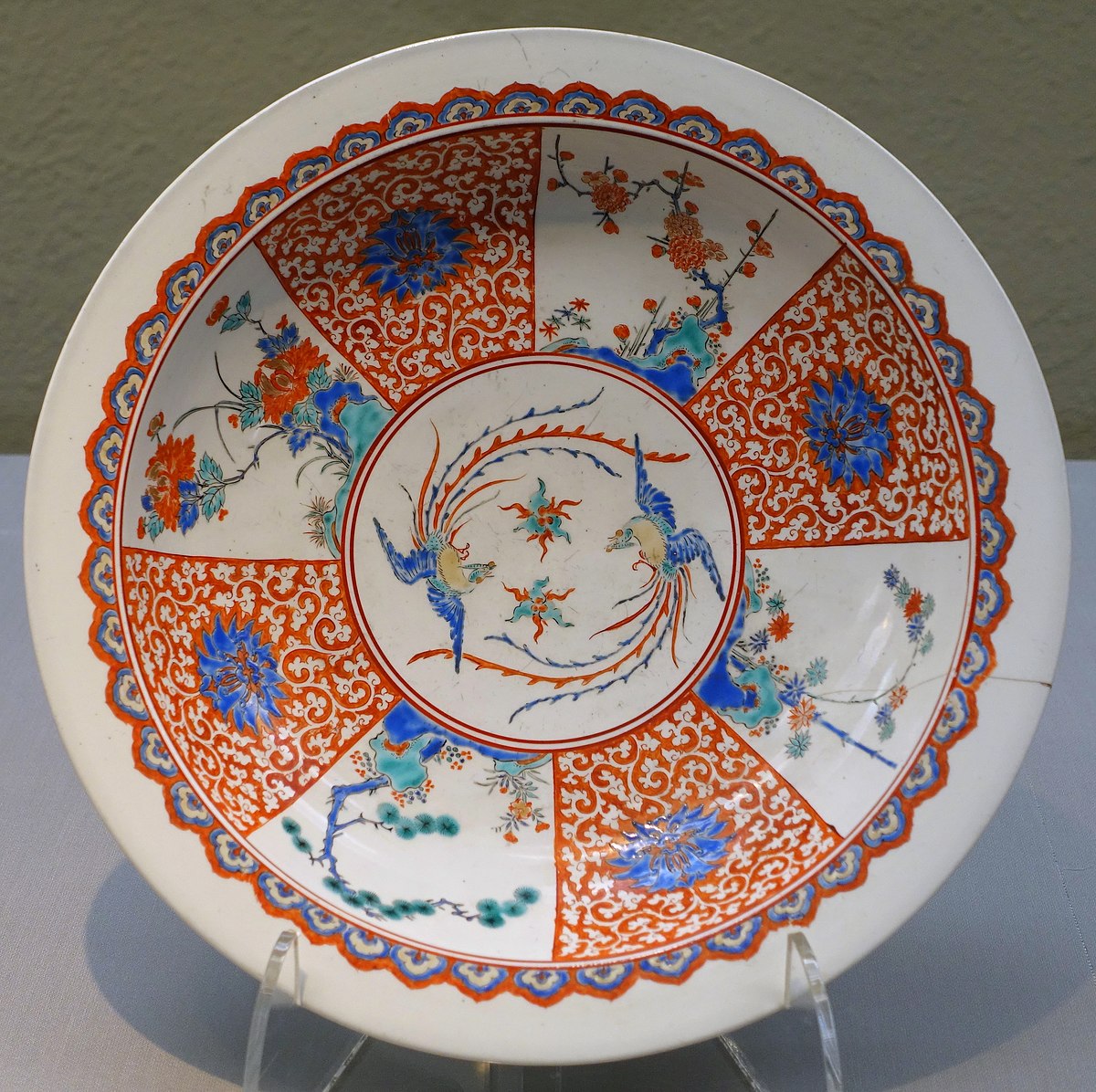
Large Imari ware dish, Kakiemon type, Edo period 17th century. Paired phoenixes with the 'three friends of winter' (pine, bamboo, plum) and peony in overglaze enamel, the canonical Kakiemon palette and motif inventory that Meissen and Chantilly would later copy. / Grote Imari schaal, Kakiemon-type, Edo-periode 17e eeuw. Gepaarde feniksen met de 'drie vrienden van de winter' (pijnboom, bamboe, pruim) en pioen in overglazuur emaille, het canonieke Kakiemon-palet dat Meissen en Chantilly later zouden kopiëren. Foto: Tokyo National Museum, via Wikimedia Commons (publiek domein). |
|||||
|
|
|||||
Topic of the WeekJapanese Porcelain: Imari, Arita and the Kakiemon SchoolHow a teabowl from Arita gave Europe its first true porcelain industry, and why Meissen owes Japan more than it ever paid back. Between 1644 and the 1650s, the Ming-Qing transition shut down the Jingdezhen kilns. The VOC, accustomed to shipping Chinese blue-and-white in tens of thousands of pieces per voyage, suddenly had nothing to load. The merchants in Batavia turned, almost by accident, to a kiln site they had been ignoring on the southern Japanese island of Kyushu. Out of Arita, through the export port of Imari, the Dutch began carrying a porcelain that filled the gap and then defined a market of its own. Between 1659 and roughly 1740, an estimated 7 million pieces of Japanese export porcelain reached Europe through the VOC factory at Deshima. For the authenticator, Japanese export porcelain is one of the cleanest period categories in Asian ceramics, and one of the most confused on the secondary market. Clean because the production was concentrated in a small geographic area, in a narrow time window, with a recognisable palette and a documented kiln structure. Confused because by the 19th century, both Chinese and European producers were copying Imari at industrial scale, and the resulting pieces sit in antique shops today labelled simply as "Imari" with no further distinction. Genuine 17th-century Arita, late-19th-century Meiji-period commercial Imari, Chinese Imari from Jingdezhen, and European Imari from Meissen, Chantilly, Worcester and Delft are four entirely different objects with three centuries of price gap between them. The single most useful distinction to internalise is between Arita (the kiln site) and Imari (the export port). All early Japanese export porcelain was made in and around Arita on Kyushu and shipped from the nearby port of Imari. In European trade language, "Imari" became the name of the style: the underglaze cobalt blue plus overglaze iron-red plus gilt palette that the VOC bought in volume. "Arita" stayed as the geographic and technical reference. A piece described in catalogue language as "Arita" is being placed by region of production. A piece described as "Imari" is being placed by style. The distinction matters because Chinese kilns in Jingdezhen, by the early 18th century, were making "Chinese Imari", Chinese blue-red-gilt porcelain in the Japanese style, and shipping it through Canton to Europe. A 1720s Chinese Imari plate and a 1720s Arita Imari plate look superficially identical and trade for very different prices. Within Arita production, three style families dominate the period. First, the Imari style proper: underglaze cobalt blue, overglaze iron-red enamel, and gold leaf, in dense floral and geometric patterns, often with panels and reserves. Second, the Kakiemon style, named after the Sakaida Kakiemon family of potters: a sparser palette of red, blue, green, yellow and turquoise enamels on a cream-white "nigoshide" body, with reserved decoration leaving large areas of background visible. Third, the Nabeshima style, made for the daimyo of the Nabeshima clan and rarely exported in the period: extreme refinement, blue-and-white or polychrome, often with the underside decorated as carefully as the face. Imari is the volume style. Kakiemon is the connoisseur style. Nabeshima is the rarity. The European reception was immediate and consequential. Augustus the Strong of Saxony built one of the great Asian porcelain collections at the Japanisches Palais in Dresden in the early 18th century, with documented Kakiemon pieces still in the Porzellansammlung today. His obsession with replicating the body led directly to the Meissen breakthrough of 1709 under Johann Friedrich Böttger, the first European hard-paste porcelain. The earliest Meissen production copied Kakiemon palette and motifs almost line-for-line; this is documented in the Meissen archive and visible in any sale of early Meissen at Bonhams or Sotheby's. Chantilly, founded 1730, is even more directly Kakiemon-derived. Worcester from 1751 and Bow from 1747 made English Kakiemon-style pieces with characteristic English bone-ash bodies. By 1760 European porcelain had absorbed the Japanese palette and made it European; Japan, meanwhile, had moved into the Meiji-era commercial production that defines what most people today think of as "Imari". In this edition we walk the authentication in layers. We begin with the Kakiemon palette as the specimen of the week, because it concentrates the period diagnostics into the most recognisable visual signature. We then walk five practical red flags. We look more deeply at the kiln history, the VOC contracts, and the line between 17th-century period production and 19th-century Meiji commercial revival. We close with the market band, the AntiqBot analysis framework, a reader question, and a short update on the iOS launch. |
|||||
|
|
|||||
Item of the WeekThe Kakiemon Palette: How to Read It, How It Was CopiedThe palette, first. Kakiemon overglaze enamel uses five canonical colours: iron-red (a warm, slightly orange red, not the cooler red of European enamels), underglaze cobalt blue, leaf green, lemon yellow, and turquoise. Gold is used sparingly when used at all, in contrast to the dense gilding of the Imari style proper. The colours are applied as transparent washes that let the white body show through, not as opaque overglaze. Under 10x magnification, the iron-red shows a faintly granular surface where the iron oxide has fused into the enamel matrix; modern synthetic reds look glassy and uniform. The body is the second test. Kakiemon-period Arita porcelain uses a body called nigoshide, a milky-white kaolin clay fired at around 1300 °C that produces a soft, slightly off-white surface different from the cooler, harder white of Jingdezhen export ware. A piece offered as Kakiemon with a pure cold-white body is either later Meiji-period production using a refined clay, or non-Japanese (Meissen, Chantilly, English bone-ash). The nigoshide tone is best seen on the unglazed foot rim, which on Kakiemon period pieces is hand-trimmed, faintly creamy, and often shows small "spur marks": three small unglazed spots on the inside of the foot where the piece rested on tripod kiln supports during firing. Spur marks on the foot rim or on the underside of a plate are a strong period indicator. They disappear by the late 18th century. The decoration is the third test. Kakiemon composition is asymmetric and reserved. A typical Kakiemon plate shows a single botanical or figural motif (a quail, a tiger and bamboo, a pine and crane, the "three friends of winter" (pine, plum, bamboo)) placed off-centre, with large areas of the white body left undecorated. This restraint is unmistakable once you have seen it. Imari-style production by contrast fills the surface with dense panels and borders. A piece offered as Kakiemon that is densely decorated with little white showing is mislabelled. It is Imari style, possibly Arita, possibly Chinese Imari, possibly Meiji-period commercial. Kakiemon is restraint; Imari is abundance. The mark is the fourth test, and here the news is mostly negative. Genuine 17th and early-18th-century Arita pieces are largely unmarked. The Sakaida Kakiemon mark, Kakiemon-yō (柿右衛門様), appears later and is most reliable on 19th and 20th-century pieces from the continuing Sakaida workshop, which is still in operation under the 15th-generation Kakiemon today. A "Kakiemon" mark on a piece offered as 17th century is suspect by definition; period pieces did not carry the family name as a mark. Pieces marked with the Fuki Choshun (富貴長春, "wealth, honour, lasting spring") four-character mark in a double square are typically late-Edo to Meiji commercial Imari, not Kakiemon and not 17th century. The "Zoshuntei Sanpo" (蔵春亭三浦) seal-script mark dates pieces to the late 19th century from the Meiji commercial revival kilns. Mark literacy on Japanese export porcelain is a separate study; for the field authenticator, body, palette and decoration grammar resolve more pieces than marks ever will. Now the European copies. The Meissen Kakiemon-style production from the 1720s and 1730s is excellent and very close to the Japanese original. The distinction lies in the body (Meissen body is harder and colder white than nigoshide), in the foot (Meissen feet are usually unmarked but mechanically perfect, with no spur marks), and in the iron-red, which on early Meissen has a slightly cooler, less orange tone than period Arita. Chantilly Kakiemon-style pieces from 1730 to 1750 use a soft-paste body that under loupe shows a granular, slightly chalky texture entirely different from any Asian porcelain. Worcester and Bow Kakiemon-style pieces from 1750 to 1770 use English bone-ash bodies that fluoresce strongly under UV light, where Japanese hard-paste does not. UV is the single fastest test to distinguish English soft-paste copies from Japanese hard-paste originals. The literature reference is Soame Jenyns, Japanese Porcelain (Faber, 1965, still the standard work), and the catalogues of the Bonhams Hong Kong and Christie's Amsterdam Asian art sales over the last two decades. |
|||||
|
|
|||||
Quick Check5 Red Flags on Japanese Export Porcelain
Spur marks, decoration density, enamel quality, UV fluorescence, mark literacy. Five axes. A genuine 17th-century Kakiemon piece satisfies all five. Failure on one is recoverable. Failure on two is a structural problem. Failure on three means you are looking at later work, European copy, or a mislabelled piece in the wrong category. |
|||||
|
|
|||||
Did You Know
|
|||||
|
|
|||||
Looking DeeperArita, Deshima and the VOC ContractsThe Arita kilns were established around 1616 by the Korean potter Yi Sam-pyeong, brought to Kyushu after the Hideyoshi invasions of Korea (1592 to 1598). Korean expertise in high-fire stoneware combined with locally discovered kaolin at Izumiyama produced the first true Japanese porcelain by the 1620s. Initial production was domestic, supplying the daimyo households of Saga and the tea ceremony market. The export turn came in 1659, when the VOC, locked out of China by the Ming-Qing wars, signed a contract with the Saga clan for an experimental shipment of Arita porcelain. The first cargoes were modest. By the 1670s the trade was running at tens of thousands of pieces per year through the artificial island of Deshima in Nagasaki Bay, the only legal point of foreign trade in Tokugawa Japan. The VOC contracts shaped what was made. Dutch merchants supplied the Arita potters with wooden models of European tableware forms (chargers, dish sets for European table service, ewers, garniture vases for European mantelpieces) and the Arita kilns produced these alongside their domestic Japanese forms. By the late 17th century, "shapes for Holland" and "shapes for Japan" were running in parallel through the same kilns. This is why genuine 17th-century Arita export pieces often have unmistakably European silhouettes: the form is European, the body, palette and brushwork are Japanese. The hybrid is documented in the VOC archive at the Nationaal Archief in The Hague, where the Deshima factory ledgers list orders by shape, quantity and intended European market. The Kakiemon family workshop emerged within Arita as a distinct producer in the late 17th century. Sakaida Kakiemon I (1596 to 1666) is credited with developing the polychrome enamel-on-white-body technique that became the Kakiemon style, working in collaboration with Chinese émigré technicians who brought overglaze enamel knowledge. The successive generations refined the palette and decoration grammar, and the workshop continues today under the 15th-generation Sakaida Kakiemon, recognised by the Japanese government as a Living National Treasure tradition. Authentic 17th and early-18th-century Kakiemon pieces are rare; the workshop output was small, the European demand exceeded supply, and surviving period pieces are mostly in museum collections (the British Museum, the Burghley House collection, the Dresden Porzellansammlung). The decline came with the Chinese recovery. By the 1720s, Jingdezhen was back in full production and could supply the European market at lower cost. The VOC progressively reduced its Japanese orders, and by 1757 the Japanese export trade was effectively over. The Arita kilns turned back to the domestic market and entered a long quiet period. The Meiji Restoration of 1868 changed everything. Japan reopened to international trade, and the Arita kilns commercialised aggressively for the new Western export market. Late-19th and early-20th-century Meiji-period Imari, made for Victorian and Edwardian buyers, fills antique shops across Europe today. It is well-made, often pleasing, and entirely different in market terms from the 17th-century period production. Meiji Imari from 1880 to 1910 trades in the 80 to 600 euro band for plates, the 200 to 1,500 band for vases, and the 500 to 4,000 band for large chargers. Period 17th-century Arita is one to two orders of magnitude more expensive across the same forms. Chinese Imari complicates the field further. From the 1710s onward, Jingdezhen kilns made blue-red-gilt porcelain in the Japanese style, exported through Canton to Europe under the same VOC and East India Company channels. Chinese Imari uses Chinese cobalt (a slightly different blue tone), Chinese iron-red (a cooler red than the Japanese), and Chinese gilding (denser and more uniform). The body is Jingdezhen kaolin, harder and colder white than Arita nigoshide. Under 10x loupe and with a UV torch, the distinction is consistent. In catalogue language, "Imari" without qualifier increasingly refers to Chinese Imari in the 18th-century European market, with "Japanese Imari" or "Arita" used to specify Japanese production. Read auction catalogue language carefully: Christie's and Sotheby's are precise about origin; lower-tier sales often use "Imari" loosely for both. |
|||||
|
|
|||||
Market & ValueWhat Japanese Porcelain is Worth, ActuallyThe Japanese export porcelain market is sharply stratified by period, by style family, and by attribution clarity. Approximate bands, based on Christie's, Sotheby's, Bonhams, Drouot and Bernaerts results over the past decade, look as follows. A documented 17th-century Kakiemon piece with strong condition, attributed by a major auction house to "Arita, late 17th century, Kakiemon style", trades at Christie's London, Sotheby's New York or Bonhams Hong Kong in the 8,000 to 50,000 euro band for plates and dishes, and the 25,000 to 200,000 band for figural pieces and large chargers. The exemplars (the Burghley House-type pieces, period Kakiemon figural groups) clear half a million for the rare survivors with full provenance. A 17th-century Arita Imari plate of standard export quality, in good condition with intact gilt and clear period diagnostics, sits in the 1,500 to 8,000 euro band. Period Arita garniture vases (sets of three or five), where the set is intact and the gilt is preserved, reach 15,000 to 80,000 at the major houses. Damaged or restored period pieces drop sharply: a 17th-century Arita charger with rim chips and rubbed gilt that would clear 12,000 in perfect condition trades for 2,000 to 4,000 with the damage disclosed. Meiji-period Imari (1868 to 1912) is the volume market in Europe today. A Meiji Imari plate of standard 25 to 30 cm diameter, decorated in the dense panelled style with iron-red, blue and gilt, trades for 80 to 400 euros at Bernaerts, Drouot or Veilinghuis AAG. Larger Meiji chargers (35 to 50 cm) reach 300 to 1,500. Meiji garniture vases trade 500 to 4,000 depending on size, condition and decoration quality. The Meiji period also produced a high-end studio segment under makers like Makuzu Kozan, Seifu Yohei and the Kinkozan workshop in Kyoto: signed studio Meiji pieces by these makers trade an order of magnitude higher, often 2,000 to 30,000 euros at the right auction. Chinese Imari (Jingdezhen production, Japanese style, 18th century) trades parallel to the equivalent Chinese export blue-and-white. A Chinese Imari plate of the Yongzheng or Qianlong period sits in the 200 to 1,500 band, similar to standard Chinese export but with the additional palette making it more decoratively desirable to some buyers. The Belgian and Dutch market shows the same 15 to 30 percent regional discount on equivalent quality as we noted for Chinese blue-and-white in edition #11. A Kakiemon-style piece at Bernaerts in Antwerp can offer Hong Kong-quality goods at a regional price. European Kakiemon-style copies have their own market. Early Meissen Kakiemon-style production from the 1720s and 1730s is collectable in its own right and trades 3,000 to 25,000 euros for plates, more for figural groups. Chantilly soft-paste Kakiemon pieces from 1730 to 1750 trade 1,500 to 8,000. Worcester and Bow English Kakiemon-style work from 1750 to 1770 trades 800 to 5,000. The 19th-century Continental Imari production (Samson of Paris is the famous name) made deliberate reproductions of both Chinese and Japanese Imari with sufficient quality to deceive non-specialists; Samson pieces are now collected as 19th-century French ceramics and trade 200 to 2,000 in their own category. Identifying a Samson piece (the body, the palette, the small "S" sometimes present in the decoration) is its own subspeciality. The online and regional flea market reality is straightforward. The vast majority of "Imari" pieces offered between 50 and 500 euros at vide-greniers, rommelmarkten, Marktplaats and Catawiki regional sales are Meiji-period commercial production. They are honest 19th-century Japanese porcelain, often pleasant to live with, and worth what they are priced at. The path from that base to a 17th-century Arita piece is narrow and requires the five tests above. Most online listings labelled "antique Imari" without further period claim are correctly describing Meiji production; listings claiming "17th century" or "early Edo" without provenance documentation are usually incorrect, and the price is the tell. Period Arita does not show up at 200 euros. If it appears to, something is wrong with the attribution. |
|||||
|
|
|||||
Behind the ScenesAntiqBot analyses Japanese export porcelain across eight dimensions. Body and foot rim: the unglazed foot is scored for nigoshide tone, spur-mark presence, hand-trimmed irregularity, and consistency with the claimed period. Palette analysis: the iron-red, cobalt blue, leaf green, lemon yellow and turquoise enamels are scored individually for tonal character, transparency, and brushwork application. Gilt inspection: leaf-applied period gilt versus printed or decal gilt is scored under loupe magnification. Decoration grammar: the composition is matched against the documented period repertoire: Kakiemon restraint versus Imari density, period motif inventory (pine-and-crane, three friends of winter, quail, tiger and bamboo), and panel structure. Mark reading: where present, the mark is examined for period appropriateness, character set, and cross-reference with documented family seals and commercial workshop marks. Form and proportion: the silhouette is checked against period typology, with attention to European-export forms versus Japanese-domestic forms. Wear and use: rim wear, foot abrasion, and gilt rub are scored for consistency with the claimed age. UV inspection: where photography permits, fluorescence under UV is noted as a key discriminator between Japanese hard-paste and European soft-paste copies. We produce a five-tier verdict and a coherent narrative. Where photography is insufficient or a piece is borderline between Arita and Chinese Imari, we say so. We do not speculate beyond what the object and its documentation support. |
|||||
|
|
|||||
Question of the Week"I bought an Imari plate at a Belgian estate sale labelled 'antique Japanese, 18th century'. The dealer says it is Arita. How can I tell if it really is 18th-century Arita, or just Meiji-period commercial?" Four home tests, in order of reliability. First, turn the plate over and look at the foot rim. Period 17th and early-18th-century Arita shows three small unglazed spots on the inside of the foot (or sometimes on the underside near the foot ring) where the piece rested on tripod kiln supports during firing. These are the spur marks and they are decisive. Meiji-period production from the 1880s onward used saggar firing, which leaves no spur marks. A clean foot ring with no spur marks is almost always Meiji or later. Second, examine the body colour at the foot rim. Period Arita nigoshide is creamy off-white; Meiji-period Arita uses a refined clay that is whiter and harder. The difference is subtle but visible side by side. Third, check the iron-red under 10x loupe. Period red is transparent enamel showing the body through; Meiji red can be opaque and more uniform. Fourth, look at the gilt. Period gilt is leaf-applied with visible irregularity at the edges; late-Meiji gilt sometimes shows the geometric perfection of stencil application. If two of four tests indicate Meiji, it is Meiji. If three indicate period, it is worth a second opinion at Bernaerts or a specialist. The price tell is also informative: a real 18th-century Arita plate at a Belgian estate sale should not be priced under 1,500 euros. If it was priced at 200, it is almost certainly Meiji. Send your question to info@antiqbot.com |
|||||
|
|
|||||
|
Have a Japanese porcelain piece you want to authenticate? Sign up and get 1 free credit for your first analysis. After that, buy credit packs starting from €0.60 per analysis.
|
|||||
|
|
|||||
AntiqBot on iOSThe AntiqBot iOS app is now live in the App Store. Pricing matches the web: 5 credits for €4.99, 10 for €8.99, 25 for €17.99, 50 for €29.99, with one free credit on registration. Search "AntiqBot" in the App Store, or use the web application at antiqbot.com. |
|||||
|
|
|||||
Next WeekMurano Glass: Venice, Murrine and the Modern Counterfeit Wave |
|||||
|
|||||
Het onderwerp van de weekJapans Porselein: Imari, Arita en de Kakiemon-schoolHoe een theekommetje uit Arita Europa zijn eerste echte porseleinindustrie gaf, en waarom Meissen meer aan Japan te danken heeft dan ooit werd terugbetaald. Tussen 1644 en de jaren 1650 legde de Ming-Qing-overgang de Jingdezhen-ovens stil. De VOC, gewend Chinees blauw-wit te verschepen in tienduizenden stuks per reis, had plotseling niets om te laden. De handelaren in Batavia wendden zich, bijna bij toeval, tot een ovenstreek die ze hadden genegeerd op het zuidelijke Japanse eiland Kyushu. Uit Arita, via de exporthaven Imari, begonnen de Nederlanders een porselein te vervoeren dat de leemte vulde en vervolgens een eigen markt definieerde. Tussen 1659 en ongeveer 1740 bereikten naar schatting 7 miljoen stuks Japans exportporselein Europa via de VOC-factorij op Deshima. Voor de authenticator is Japans exportporselein een van de meest heldere periode-categorieën in Aziatische keramiek, en een van de meest verwarde op de secundaire markt. Helder omdat de productie geconcentreerd was in een klein geografisch gebied, in een nauw tijdsvenster, met een herkenbaar palet en een gedocumenteerde ovenstructuur. Verward omdat tegen de 19e eeuw zowel Chinese als Europese producenten Imari op industriële schaal kopieerden, en de resulterende stukken vandaag in antiekzaken staan, simpelweg gelabeld als "Imari" zonder verdere onderscheiding. Echte 17e-eeuwse Arita, laat-19e-eeuwse Meiji-periode commerciële Imari, Chinese Imari uit Jingdezhen, en Europese Imari uit Meissen, Chantilly, Worcester en Delft zijn vier volledig verschillende objecten met drie eeuwen prijsverschil ertussen. Het belangrijkste onderscheid om te internaliseren is dat tussen Arita (de ovenstreek) en Imari (de exporthaven). Al het vroege Japanse exportporselein werd gemaakt in en rond Arita op Kyushu en verscheept vanuit de nabijgelegen haven Imari. In Europese handelstaal werd "Imari" de naam van de stijl: het palet van onderglazuur kobaltblauw plus overglazuur ijzerrood plus goud dat de VOC in volume kocht. "Arita" bleef de geografische en technische referentie. Een stuk omschreven in catalogustaal als "Arita" wordt geplaatst naar productieregio. Een stuk omschreven als "Imari" wordt geplaatst naar stijl. Het onderscheid telt omdat Chinese ovens in Jingdezhen tegen het begin van de 18e eeuw "Chinese Imari" maakten, Chinees blauw-rood-goud porselein in de Japanse stijl, en dit via Kanton naar Europa verscheepten. Een Chinees Imari-bord uit de jaren 1720 en een Arita Imari-bord uit de jaren 1720 zien er oppervlakkig identiek uit en verhandelen voor heel verschillende prijzen. Binnen de Arita-productie domineren drie stijlfamilies de periode. Eerst, de Imari-stijl zelf: onderglazuur kobaltblauw, overglazuur ijzerrood emaille, en bladgoud, in dichte bloem- en geometrische patronen, vaak met panelen en reserves. Tweede, de Kakiemon-stijl, genoemd naar de Sakaida Kakiemon-pottenbakkersfamilie: een soberder palet van rode, blauwe, groene, gele en turquoise emailles op een crèmewit "nigoshide"-lichaam, met terughoudende decoratie die grote oppervlaktes van de achtergrond zichtbaar laat. Derde, de Nabeshima-stijl, gemaakt voor de daimyo van de Nabeshima-clan en zelden geëxporteerd in de periode: extreme verfijning, blauw-wit of polychroom, vaak met de onderzijde even zorgvuldig gedecoreerd als de voorzijde. Imari is de volumestijl. Kakiemon is de kennerstijl. Nabeshima is de zeldzaamheid. De Europese ontvangst was onmiddellijk en consequent. Augustus de Sterke van Saksen bouwde een van de grote Aziatische porseleincollecties in het Japanisches Palais in Dresden in het begin van de 18e eeuw, met gedocumenteerde Kakiemon-stukken nog vandaag in de Porzellansammlung. Zijn obsessie met het repliceren van het lichaam leidde rechtstreeks tot de Meissen-doorbraak van 1709 onder Johann Friedrich Böttger, het eerste Europese hardpasta-porselein. De vroegste Meissen-productie kopieerde het Kakiemon-palet en -motieven bijna één-op-één; dit is gedocumenteerd in het Meissen-archief en zichtbaar in elke veiling van vroege Meissen bij Bonhams of Sotheby's. Chantilly, opgericht in 1730, is nog directer Kakiemon-afgeleid. Worcester vanaf 1751 en Bow vanaf 1747 maakten Engelse Kakiemon-stijl stukken met karakteristieke Engelse beenderasse-lichamen. Tegen 1760 had Europees porselein het Japanse palet opgenomen en het Europees gemaakt; Japan was ondertussen overgegaan op de Meiji-periode commerciële productie die definieert wat de meeste mensen vandaag denken bij "Imari". In deze editie gaan we de authenticatie in lagen door. We beginnen met het Kakiemon-palet als item van de week, omdat dat de periode-diagnose concentreert in de meest herkenbare visuele signatuur. We lopen vervolgens vijf praktische rode vlaggen langs. We kijken dieper naar de ovengeschiedenis, de VOC-contracten, en de lijn tussen 17e-eeuwse periode-productie en 19e-eeuwse Meiji commerciële opleving. We sluiten af met de marktband, het AntiqBot analyse-kader, een lezersvraag, en een korte update over de iOS-lancering. |
|||||
|
|
|||||
Item van de WeekHet Kakiemon-palet: hoe je het leest, hoe het werd gekopieerdEerst het palet. Kakiemon overglazuur emaille gebruikt vijf canonieke kleuren: ijzerrood (een warm, licht oranje rood, niet het koelere rood van Europese emailles), onderglazuur kobaltblauw, bladgroen, citroengeel, en turquoise. Goud wordt spaarzaam gebruikt wanneer het al gebruikt wordt, in tegenstelling tot de dichte vergulding van de Imari-stijl zelf. De kleuren worden aangebracht als transparante wassingen die het witte lichaam laten doorschijnen, niet als ondoorzichtige overglazuur. Onder 10x vergroting toont het ijzerrood een licht korrelig oppervlak waar het ijzeroxide is versmolten in de emaille-matrix; moderne synthetische roden zien er glasachtig en uniform uit. Het lichaam is de tweede test. Kakiemon-periode Arita-porselein gebruikt een lichaam genaamd nigoshide, een melkwitte kaolien-klei gebakken op ongeveer 1300 °C die een zachte, licht gebroken-witte oppervlakte produceert die verschilt van het koelere, hardere wit van Jingdezhen exportgoed. Een stuk aangeboden als Kakiemon met een zuiver koudwit lichaam is ofwel latere Meiji-periode productie met een verfijnde klei, ofwel niet-Japans (Meissen, Chantilly, Engelse beenderas). De nigoshide-tint is het best te zien op de niet-geglazuurde voetring, die op Kakiemon-periode stukken handgetrimd is, licht crèmig, en vaak kleine "spur marks" toont: drie kleine niet-geglazuurde plekken op de binnenkant van de voet waar het stuk rustte op driepoot ovensteunen tijdens het bakken. Spur marks op de voetring of op de onderzijde van een bord zijn een sterke periode-indicator. Ze verdwijnen tegen het einde van de 18e eeuw. De decoratie is de derde test. Kakiemon-compositie is asymmetrisch en terughoudend. Een typisch Kakiemon-bord toont een enkel botanisch of figuratief motief (een kwartel, een tijger met bamboe, een pijnboom met kraanvogel, de "drie vrienden van de winter": pijnboom, pruim, bamboe) gepositioneerd uit het midden, met grote oppervlaktes van het witte lichaam onversierd. Deze terughoudendheid is onmiskenbaar zodra je ze hebt gezien. Imari-stijl productie daarentegen vult de oppervlakte met dichte panelen en boorden. Een stuk aangeboden als Kakiemon dat dicht versierd is met weinig wit zichtbaar is verkeerd gelabeld; het is Imari-stijl, mogelijk Arita, mogelijk Chinese Imari, mogelijk Meiji-periode commercieel. Kakiemon is terughoudendheid; Imari is overvloed. Het merk is de vierde test, en hier is het nieuws meestal negatief. Echte 17e en vroeg-18e-eeuwse Arita-stukken zijn grotendeels ongemerkt. Het Sakaida Kakiemon-merk, Kakiemon-yō (柿右衛門様), verschijnt later en is het meest betrouwbaar op 19e en 20e-eeuwse stukken uit het voortbestaande Sakaida-atelier, dat vandaag nog steeds opereert onder de 15e-generatie Kakiemon. Een "Kakiemon"-merk op een stuk aangeboden als 17e-eeuws is per definitie verdacht; periode-stukken droegen de familienaam niet als merk. Stukken gemerkt met het Fuki Choshun (富貴長春, "rijkdom, eer, blijvende lente") vier-tekens merk in een dubbel vierkant zijn typisch laat-Edo tot Meiji commerciële Imari, geen Kakiemon en geen 17e-eeuws. Het "Zoshuntei Sanpo" (蔵春亭三浦) zegelschrift-merk dateert stukken naar de late 19e eeuw uit de Meiji commerciële opleving-ovens. Merklezing op Japans exportporselein is een aparte studie; voor de veld-authenticator lossen lichaam, palet en decoratie-grammatica meer stukken op dan merken ooit zullen doen. Nu de Europese kopieën. De Meissen Kakiemon-stijl productie uit de jaren 1720 en 1730 is uitstekend en zeer dicht bij het Japanse origineel. Het onderscheid ligt in het lichaam (Meissen-lichaam is harder en kouder wit dan nigoshide), in de voet (Meissen-voeten zijn meestal ongemerkt maar mechanisch perfect, zonder spur marks), en in het ijzerrood, dat op vroege Meissen een iets koelere, minder oranje tint heeft dan periode Arita. Chantilly Kakiemon-stijl stukken uit 1730 tot 1750 gebruiken een zachtpasta-lichaam dat onder loupe een korrelige, licht krijtachtige textuur toont die volledig verschilt van enig Aziatisch porselein. Worcester en Bow Kakiemon-stijl stukken uit 1750 tot 1770 gebruiken Engelse beenderasse-lichamen die sterk fluoresceren onder UV-licht, waar Japans hardpasta dat niet doet. UV is de snelste enkele test om Engelse zachtpasta-kopieën te onderscheiden van Japanse hardpasta-originelen. De literatuurreferentie is Soame Jenyns, Japanese Porcelain (Faber, 1965, nog steeds het standaardwerk), en de catalogi van de Bonhams Hong Kong en Christie's Amsterdam Aziatische kunst-veilingen van de afgelopen twee decennia. |
|||||
|
|
|||||
Snelle Check5 Rode Vlaggen bij Japans Exportporselein
Spur marks, decoratie-dichtheid, emaille-kwaliteit, UV-fluorescentie, merklezing. Vijf assen. Een echt 17e-eeuws Kakiemon-stuk voldoet aan alle vijf. Falen op één is recupereerbaar. Falen op twee is een structureel probleem. Falen op drie betekent dat je naar later werk, een Europese kopie, of een verkeerd gelabeld stuk in de verkeerde categorie kijkt. |
|||||
|
|
|||||
Wist je dat
|
|||||
|
|
|||||
Dieper kijkenArita, Deshima en de VOC-contractenDe Arita-ovens werden rond 1616 opgericht door de Koreaanse pottenbakker Yi Sam-pyeong, naar Kyushu gebracht na de Hideyoshi-invasies van Korea (1592 tot 1598). Koreaanse expertise in hooggebakken steengoed gecombineerd met lokaal ontdekte kaolien bij Izumiyama produceerde tegen de jaren 1620 het eerste echte Japanse porselein. Initiële productie was binnenlands, voor de daimyo-huishoudens van Saga en de markt voor de theeceremonie. De exportwending kwam in 1659, toen de VOC, buitengesloten van China door de Ming-Qing-oorlogen, een contract tekende met de Saga-clan voor een experimentele zending Arita-porselein. De eerste ladingen waren bescheiden. Tegen de jaren 1670 liep de handel op tienduizenden stuks per jaar via het kunstmatige eiland Deshima in de baai van Nagasaki, het enige legale punt van buitenlandse handel in Tokugawa-Japan. De VOC-contracten vormden wat er werd gemaakt. Nederlandse handelaren leverden de Arita-pottenbakkers houten modellen van Europees tafelgoed: schotels, bordensets voor Europees tafelservies, kannen, garnituurvazen voor Europese schoorsteenmantels, en de Arita-ovens produceerden deze naast hun binnenlandse Japanse vormen. Tegen het einde van de 17e eeuw liepen "vormen voor Holland" en "vormen voor Japan" parallel door dezelfde ovens. Dit verklaart waarom echte 17e-eeuwse Arita-exportstukken vaak onmiskenbaar Europese silhouetten hebben: de vorm is Europees, het lichaam, palet en penseelvoering zijn Japans. De hybride is gedocumenteerd in het VOC-archief in het Nationaal Archief in Den Haag, waar de Deshima-factorijregisters bestellingen lijsten naar vorm, hoeveelheid en bestemd Europees marktdeel. Het Kakiemon familieatelier ontstond binnen Arita als een onderscheiden producent in de late 17e eeuw. Sakaida Kakiemon I (1596 tot 1666) wordt gecrediteerd met het ontwikkelen van de polychrome emaille-op-wit-lichaam techniek die de Kakiemon-stijl werd, in samenwerking met Chinese émigré-technici die overglazuur emaille-kennis brachten. De opeenvolgende generaties verfijnden het palet en de decoratie-grammatica, en het atelier gaat vandaag verder onder de 15e-generatie Sakaida Kakiemon, erkend door de Japanse regering als een Living National Treasure-traditie. Authentieke 17e en vroeg-18e-eeuwse Kakiemon-stukken zijn zeldzaam; de output van het atelier was klein, de Europese vraag overschreed het aanbod, en overlevende periode-stukken zijn meestal in museumcollecties (het British Museum, de Burghley House-collectie, de Dresden Porzellansammlung). De achteruitgang kwam met het Chinese herstel. Tegen de jaren 1720 was Jingdezhen weer in volle productie en kon de Europese markt bedienen tegen lagere kost. De VOC verminderde geleidelijk haar Japanse bestellingen, en tegen 1757 was de Japanse exporthandel effectief voorbij. De Arita-ovens keerden terug naar de binnenlandse markt en gingen een lange stille periode in. De Meiji-Restauratie van 1868 veranderde alles. Japan heropende zich voor internationale handel, en de Arita-ovens commercialiseerden agressief voor de nieuwe Westerse exportmarkt. Laat-19e en vroeg-20e-eeuwse Meiji-periode Imari, gemaakt voor Victoriaanse en Edwardiaanse kopers, vult vandaag antiekzaken door heel Europa. Het is goed gemaakt, vaak aangenaam, en in markttermen volledig verschillend van de 17e-eeuwse periode-productie. Meiji Imari uit 1880 tot 1910 verhandelt in de band 80 tot 600 euro voor borden, de band 200 tot 1.500 voor vazen, en de band 500 tot 4.000 voor grote schotels. Periode 17e-eeuws Arita is één tot twee orden van grootte duurder over dezelfde vormen. Chinese Imari compliceert het veld verder. Vanaf de jaren 1710 maakten Jingdezhen-ovens blauw-rood-goud porselein in de Japanse stijl, geëxporteerd via Kanton naar Europa via dezelfde VOC- en Oost-Indische Compagnie-kanalen. Chinese Imari gebruikt Chinees kobalt (een licht andere blauwe tint), Chinees ijzerrood (een koeler rood dan het Japanse), en Chinese vergulding (dichter en uniformer). Het lichaam is Jingdezhen-kaolien, harder en kouder wit dan Arita-nigoshide. Onder 10x loupe en met een UV-zaklamp is het onderscheid consistent. In catalogustaal verwijst "Imari" zonder kwalificatie in de 18e-eeuwse Europese markt steeds vaker naar Chinese Imari, met "Japanese Imari" of "Arita" om Japanse productie te specificeren. Lees auctiecatalogustaal zorgvuldig: Christie's en Sotheby's zijn precies over oorsprong; veilingen van een lager niveau gebruiken "Imari" vaak losjes voor beide. |
|||||
|
|
|||||
Markt & WaardeWat Japans porselein werkelijk waard isDe Japanse exportporselein-markt is scherp gelaagd naar periode, stijlfamilie en toeschrijvings-helderheid. Benaderende banden, gebaseerd op resultaten bij Christie's, Sotheby's, Bonhams, Drouot en Bernaerts over het voorbije decennium, zien er als volgt uit. Een gedocumenteerd 17e-eeuws Kakiemon-stuk met sterke toestand, toegeschreven door een groot veilinghuis aan "Arita, late 17e eeuw, Kakiemon-stijl", verhandelt bij Christie's Londen, Sotheby's New York of Bonhams Hong Kong in de band 8.000 tot 50.000 euro voor borden en schotels, en de band 25.000 tot 200.000 voor figuratieve stukken en grote schotels. De topvoorbeelden (de Burghley House-type stukken, periode Kakiemon-figuurgroepen) overschrijden een half miljoen voor de zeldzame overlevers met volledige provenance. Een 17e-eeuws Arita Imari-bord van standaard exportkwaliteit, in goede toestand met intact goud en duidelijke periode-diagnose, zit in de band 1.500 tot 8.000 euro. Periode Arita garnituurvazen (sets van drie of vijf), waar de set intact is en het goud bewaard, halen 15.000 tot 80.000 bij de grote huizen. Beschadigde of gerestaureerde periode-stukken vallen scherp: een 17e-eeuwse Arita-schotel met rand-chips en gewreven goud die in perfecte staat 12.000 zou halen, verhandelt voor 2.000 tot 4.000 met de schade vermeld. Meiji-periode Imari (1868 tot 1912) is de volumemarkt in Europa vandaag. Een Meiji Imari-bord van standaard 25 tot 30 cm diameter, gedecoreerd in de dichte paneelstijl met ijzerrood, blauw en goud, verhandelt voor 80 tot 400 euro bij Bernaerts, Drouot of Veilinghuis AAG. Grotere Meiji-schotels (35 tot 50 cm) halen 300 tot 1.500. Meiji-garnituurvazen verhandelen 500 tot 4.000 afhankelijk van grootte, toestand en decoratie-kwaliteit. De Meiji-periode produceerde ook een hoogwaardig studio-segment onder makers als Makuzu Kozan, Seifu Yohei en het Kinkozan-atelier in Kyoto: gesigneerde studio-Meiji stukken door deze makers verhandelen een orde van grootte hoger, vaak 2.000 tot 30.000 euro op de juiste veiling. Chinese Imari (Jingdezhen-productie, Japanse stijl, 18e eeuw) verhandelt parallel aan het equivalent Chinees export blauw-wit. Een Chinees Imari-bord uit de Yongzheng of Qianlong-periode zit in de band 200 tot 1.500, gelijkaardig aan standaard Chinees export maar met het bijkomende palet dat het decoratief begeerlijker maakt voor sommige kopers. De Belgische en Nederlandse markt toont dezelfde 15 tot 30 procent regionale korting op equivalent kwaliteit als we noteerden voor Chinees blauw-wit in editie #11. Een Kakiemon-stijl stuk bij Bernaerts in Antwerpen kan Hong Kong-kwaliteit goederen bieden aan een regionale prijs. Europese Kakiemon-stijl kopieën hebben een eigen markt. Vroege Meissen Kakiemon-stijl productie uit de jaren 1720 en 1730 is op zich verzamelbaar en verhandelt 3.000 tot 25.000 euro voor borden, meer voor figuurgroepen. Chantilly zachtpasta Kakiemon-stukken uit 1730 tot 1750 verhandelen 1.500 tot 8.000. Worcester en Bow Engels Kakiemon-stijl werk uit 1750 tot 1770 verhandelt 800 tot 5.000. De 19e-eeuwse Continentale Imari-productie (Samson uit Parijs is de bekende naam) maakte bewuste reproducties van zowel Chinese als Japanse Imari met voldoende kwaliteit om niet-specialisten te misleiden; Samson-stukken worden nu verzameld als 19e-eeuwse Franse keramiek en verhandelen 200 tot 2.000 in hun eigen categorie. Een Samson-stuk identificeren (het lichaam, het palet, de kleine "S" die soms aanwezig is in de decoratie) is een eigen subspecialiteit. De online en regionale rommelmarkt-realiteit is rechttoe rechtaan. De overgrote meerderheid van "Imari"-stukken aangeboden tussen 50 en 500 euro op vide-greniers, rommelmarkten, Marktplaats en Catawiki regionale veilingen is Meiji-periode commerciële productie. Het is eerlijk 19e-eeuws Japans porselein, vaak aangenaam om mee te leven, en waard wat het geprijsd is. Het pad van die basis naar een 17e-eeuws Arita-stuk is smal en vereist de vijf tests hierboven. De meeste online listings gelabeld als "antiek Imari" zonder verdere periode-claim beschrijven correct Meiji-productie; listings die "17e eeuw" of "vroege Edo" claimen zonder provenance-documentatie zijn meestal onjuist, en de prijs is de verraadtruc. Periode Arita verschijnt niet voor 200 euro. Als het lijkt op te duiken voor die prijs, is er iets mis met de toeschrijving. |
|||||
|
|
|||||
Achter de schermenAntiqBot analyseert Japans exportporselein over acht dimensies. Lichaam en voetring: de niet-geglazuurde voet wordt gescoord op nigoshide-tint, aanwezigheid van spur marks, handgetrimde onregelmatigheid, en consistentie met de geclaimde periode. Palet-analyse: het ijzerrood, kobaltblauw, bladgroen, citroengeel en turquoise emaille worden individueel gescoord op tonaal karakter, transparantie en borstel-aanbrenging. Goud-inspectie: bladgoud aangebracht in periode versus gedrukt of decal-goud wordt gescoord onder loupe-vergroting. Decoratie-grammatica: de compositie wordt afgestemd op het gedocumenteerde periode-repertoire: Kakiemon-terughoudendheid versus Imari-dichtheid, periode-motief inventaris (pijnboom-met-kraanvogel, drie vrienden van de winter, kwartel, tijger met bamboe), en paneelstructuur. Merklezing: waar aanwezig wordt het merk onderzocht op periode-passendheid, karakterset, en kruisreferentie met gedocumenteerde familiezegels en commerciële atelier-merken. Vorm en verhouding: het silhouet wordt gecheckt tegen periode-typologie, met aandacht voor Europees-export vormen versus Japans-binnenlandse vormen. Slijtage en gebruik: rand-slijtage, voet-schuring en goud-wrijving worden gescoord op consistentie met de geclaimde leeftijd. UV-inspectie: waar fotografie het toelaat wordt fluorescentie onder UV genoteerd als een belangrijke discriminator tussen Japans hardpasta en Europese zachtpasta-kopieën. We leveren een vijf-tier verdict en een coherent verhaal. Waar de fotografie onvoldoende is of een stuk grenst tussen Arita en Chinese Imari, zeggen we dat. We speculeren niet voorbij wat het object en zijn documentatie ondersteunen. |
|||||
|
|
|||||
Vraag van de Week"Ik kocht een Imari-bord op een Belgische nalatenschap-veiling, gelabeld 'antiek Japans, 18e eeuw'. De handelaar zegt dat het Arita is. Hoe kan ik weten of het echt 18e-eeuws Arita is, of gewoon Meiji-periode commercieel?" Vier thuistests, in volgorde van betrouwbaarheid. Ten eerste, draai het bord om en kijk naar de voetring. Periode 17e en vroeg-18e-eeuwse Arita toont drie kleine niet-geglazuurde plekken op de binnenkant van de voet (of soms op de onderzijde nabij de voetring) waar het stuk rustte op driepoot ovensteunen tijdens het bakken. Dit zijn de spur marks en ze zijn beslissend. Meiji-periode productie vanaf de jaren 1880 gebruikte saggar-bakken, dat geen spur marks achterlaat. Een schone voetring zonder spur marks is bijna altijd Meiji of later. Ten tweede, onderzoek de lichaamskleur aan de voetring. Periode Arita-nigoshide is crèmig gebroken-wit; Meiji-periode Arita gebruikt een verfijnde klei die witter en harder is. Het verschil is subtiel maar zichtbaar zij aan zij. Ten derde, check het ijzerrood onder 10x loupe. Periode rood is transparant emaille dat het lichaam doorlaat; Meiji rood kan ondoorzichtig en uniformer zijn. Ten vierde, kijk naar het goud. Periode goud is bladgoud aangebracht met zichtbare onregelmatigheid aan de randen; laat-Meiji goud toont soms de geometrische perfectie van stencil-aanbrenging. Als twee van de vier tests Meiji aangeven, is het Meiji. Als drie periode aangeven, is het een tweede mening waard bij Bernaerts of een specialist. De prijs-tell is ook informatief: een echt 18e-eeuws Arita-bord op een Belgische nalatenschap-veiling zou niet onder 1.500 euro geprijsd moeten zijn. Was het 200 euro, dan is het bijna zeker Meiji. Stuur je vraag naar info@antiqbot.com |
|||||
|
|
|||||
|
Heb je een Japans porseleinen stuk dat je wilt laten authenticeren? Maak gratis een account aan en doe je eerste analyse zonder kosten. Daarna koop je credits per pakket, vanaf €0,60 per analyse.
|
|||||
|
|
|||||
AntiqBot op iOSDe AntiqBot iOS-app is nu live in de App Store. De prijzen zijn gelijk aan het web: 5 credits voor €4,99, 10 voor €8,99, 25 voor €17,99, 50 voor €29,99, met één gratis credit bij registratie. Zoek "AntiqBot" in de App Store, of gebruik de webapplicatie op antiqbot.com. |
|||||
|
|
|||||
Volgende weekMurano-glas: Venetië, murrine en de moderne namaak-golf |
|||||
|
|
|||||
|
AntiqBot.com · AI-Powered Antique Identification You receive this newsletter because you signed up via AntiqBot.com. Je ontvangt deze nieuwsbrief omdat je je hebt aangemeld via AntiqBot.com. © 2026 AntiqBot · Erwin Truyts · KBO 0826.004.290. All rights reserved. |