|
Edition #14 · Week 21, May 2026 |
|||||
|
|||||
|
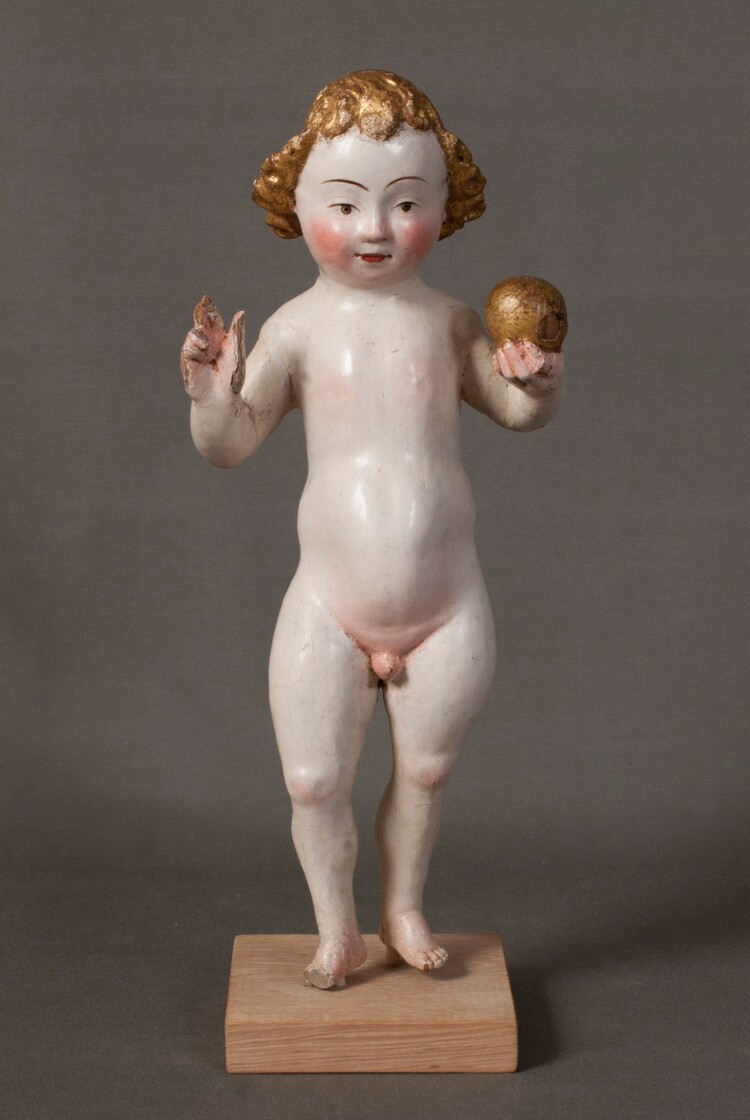
Blessing Christ Child holding a globe, 16th century, polychromed wood, 34.5 cm. From the collection of Museum Hof van Busleyden, Mechelen, inventory B0728. A characteristic example of the Mechels popje exported from Mechelen between 1450 and 1530. / Zegenend Jezuskindje met wereldbol, 16e eeuw, gepolychromeerd hout, 34,5 cm. Uit de collectie van Museum Hof van Busleyden, Mechelen, inventarisnummer B0728. Een typisch voorbeeld van het Mechels popje dat tussen 1450 en 1530 vanuit Mechelen werd geëxporteerd. |
|||||
|
|
|||||
Topic of the WeekFlemish Wooden Religious Sculpture: The Mechelse Popjes and the Hof van BusleydenHow the Mechelen workshops between 1450 and 1530 supplied half of Catholic Europe with small polychromed Madonnas, and why the surviving period pieces still command a quiet kind of authority. Among the objects that have passed through my hands over the years, the Mechelse popjes of the early sixteenth century remain the ones that hold me by a quality rarely captured in a single word: tenderness. A Marian figurine of thirty-two centimetres in walnut, with a rounded face and a high forehead, painted by a polychromer who was not the carver, holding a child in a way that turns the entire body on its axis. No Borreman monumentality, no retable pathos, no Italian contrapposto. Stillness, intimacy, and a precision that belongs at the top of late-Gothic devotional sculpture. The production was concentrated in Mechelen between roughly 1450 and 1530, in workshops whose names are largely lost but whose collective output has survived in volume across European church inventories, private collections and the major museums. The standard form is a freestanding statuette of twenty-six to thirty-eight centimetres, carved ideally from a single piece of walnut (notelaar in the Flemish term still used by Belgian specialists), with applied polychromy and, on the better pieces, leaf gilding on hair, hems and the carved drapery edges. The subjects are saints, predominantly the Virgin and Child but also Saint Anne, Saint Catherine, Saint Barbara, the Christ Child blessing with a globe, and the seated Madonnas with the infant in various postures. They were made for private devotion, not for monumental retable sculpture, and the difference shows in the scale and in the inward turn of the carving. Mechelen between 1473 and 1530 was the capital of the Habsburg Netherlands. Charles the Bold established the Grand Council of Mechelen as the supreme judicial body of the Burgundian lands in 1473. From 1506 to 1530 Margaret of Austria, aunt and regent for the young Charles V, kept her court at Mechelen and made the city the political and cultural centre of the Low Countries. Her court drew the humanists, the painters (Bernard van Orley, Jan Gossaert), the sculptors (Conrad Meit, the younger Jan Borreman), the musicians. The future Charles V was raised at this court. Hieronymus van Busleyden, friend and correspondent of Erasmus, built the Hof van Busleyden palace there between 1503 and 1517 and bequeathed the foundation of the Collegium Trilingue in Leuven, the first European university programme to teach Greek, Latin and Hebrew systematically. The Mechelse popjes were not made in a peripheral craft town. They were made in the workshop quarters of the capital. The export trade was substantial. Beguines in the Mechelen beguinages clothed many of the figures in fabric vestments, sometimes embroidered with silver or gold brocade, for use in private chapels and small home altars. The figurines reached Spain and Portugal in volume through the Antwerp shipping routes, where they were called poupées de Malines in the French inventories and muñecas de Malinas in Iberian sources. The persistent tradition that Ferdinand Magellan carried a Mechels popje on his circumnavigation between 1519 and 1521 is recorded by the Hof van Busleyden museum and is supported by the documented Iberian market for these objects in exactly those years. Whether or not the particular Magellan story is documented in primary sources, the export pattern that it illustrates is real and quantified in Antwerp customs records. The decline came with the Reformation and the Antwerp economic shift. By 1530 the workshop output had begun to thin, and by mid-century the rise of Antwerp as the new commercial capital, combined with the Protestant iconoclasm that swept the Low Countries from 1566 onward, eroded both the supply and the domestic demand. Surviving period popjes therefore concentrate in southern European collections (Spain and Portugal kept the objects through the iconoclasm), in Belgian and Dutch museums (the Hof van Busleyden in Mechelen, the KMSKA in Antwerp, the Rijksmuseum in Amsterdam, the M Leuven), and in the major European medieval and early modern collections (the Victoria and Albert Museum in London, the Bode-Museum in Berlin, The Cloisters in New York). The market for these pieces, when they come up for sale, is concentrated at the European Sculpture sales of Sotheby's and Christie's, at Bonhams, at Drouot, and at the Belgian houses with strong sculpture sections, particularly Bernaerts in Antwerp. In this edition we walk the authentication of these pieces in layers. We begin with a specific case from the Hof van Busleyden collection, the Blessing Christ Child with the globe, as the specimen of the week. We then walk five practical red flags that separate period work from nineteenth-century neo-Gothic revival and twentieth-century reproduction. We look more deeply at the Hof van Busleyden palace, Hieronymus van Busleyden himself, and the political moment that gave Mechelen its place. We close with the market bands across the relevant tiers, the AntiqBot analysis framework, a reader question, and the iOS update. |
|||||
|
|
|||||
Item of the WeekThe Blessing Christ Child of the Hof van BusleydenThe Hof van Busleyden in Mechelen holds, under inventory number B0728, a sixteenth-century Blessing Christ Child of thirty-four and a half centimetres in height. The figure holds a small globe in the left hand, the symbol of divine sovereignty over the world, and forms a blessing gesture with the right hand, derived from the Roman orator's sign for speech. The body is polychromed wood, the surface still showing the original layered build of gesso ground, paint layers and selective gilding. The piece is anonymous, donated to the city of Mechelen in 2013 from the Joseph Jacobs and Josée Broos bequest. It is described by the museum as a fine example of a popular sixteenth-century export product: het Mechels popje. Walk the diagnostic features of this piece in order. The wood is walnut, the dense fine-grained timber preferred in the Mechelen workshops for figural carving at this scale. Walnut takes the chisel cleanly, holds detail in the small features (the curls of hair, the fingers, the folds of cloth) and ages to a warm reddish-brown beneath the polychromy when the paint is later removed or worn through. The carving is from a single block where possible, with limited additional pieces for protruding elements such as outstretched hands or extending drapery. The joinery is pegged where joins are required, never glued or screwed in the modern sense. The carving tools are hand-driven, with the gouge marks and small irregularities visible under raking light or in macro photography. The polychromy is the second diagnostic. Mechelen polychromed sculptures of this period were produced under a strict guild separation: the carver carved, and a different specialist polychromer applied the painted surface, often working under a separate commission and signed in different guild records. The standard build is a gesso ground (a mixture of gypsum or chalk in animal-skin glue) applied in multiple thin layers to the wood, then a coloured ground in red ochre or bole where gilding would be applied, then leaf gilding, then the painted surfaces in oil or egg tempera, then glazes for transparency, then the final detailing of eyes, lips and brows. Period polychromy shows this build at the edges where wear has occurred: gesso visible beneath, gilding partially abraded, paint thinning at the high points. A figurine offered as Mechels popje that shows a single thick uniform paint layer with no gesso visible at the edges is repainted, often in the nineteenth century, and the original polychromy is lost. The face is the third diagnostic and, for the trained eye, the most decisive. The Mechelen face from approximately 1490 to 1530 has a recognisable grammar: a rounded forehead, slightly high in relation to the lower face, eyes set with a small but visible inward turn that gives the figure its inward gaze, a small straight nose, a soft mouth with the corners barely lifted into a half-smile, and a chin that is full rather than pointed. The hairlines are carved in incised parallel lines, often originally gilt, and the headdress (a veil, a crown, a flowered band) is integral to the carving rather than a later addition. The proportions of head to body are larger than in classical sculpture, with the head taking roughly one-fifth of the total height, a deliberate choice that gives the figures their characteristic childlike quality even in adult subjects. The mark is the fourth diagnostic and, where present, the most authoritative single piece of evidence. The Mechelen guild from approximately 1500 onward stamped many of its products with the city mark of three vertical pales on a shield, sometimes accompanied by a workshop mark, on the underside of the base or on the back of the figure. The mark is small and easy to miss. It is also not always present, since smaller workshops produced unmarked work and earlier pieces predate the systematic marking practice. Absence of mark is not proof of inauthenticity; presence of mark is strong evidence of Mechelen production within the marked period. The Blessing Christ Child at the Hof van Busleyden does not carry a guild mark, and the museum attributes the piece on the strength of style, material and provenance. Reference works for the marks are Vandevivere and Marijnissen, De polychromie van de Mechelse beelden, and the Hof van Busleyden museum publications. |
|||||
|
|
|||||
Quick Check5 Red Flags on Flemish Wooden Religious Sculpture
Wood, polychromy build, fixing holes, face grammar, age traces. Five axes. A genuine period Mechels popje passes most or all of them. Failure on one is sometimes explainable through restoration history. Failure on two is structural. Failure on three means the piece is most likely nineteenth-century neo-Gothic or twentieth-century reproduction, regardless of how convincing the silhouette appears at first glance. |
|||||
|
|
|||||
Did You Know
|
|||||
|
|
|||||
Looking DeeperHof van Busleyden and the Mechelen RenaissanceHieronymus van Busleyden was born around 1470, probably in Bouillon, into a family that rose through legal and ecclesiastical service to the Burgundian and Habsburg dukes. He studied law at Leuven, Padua and Bologna, took orders, accumulated benefices, and served in the highest councils of the Habsburg Netherlands. He was a humanist of the first rank in the northern European circle that took Erasmus as its central figure. The correspondence between Busleyden and Erasmus survives and shows the warmth and erudition of their friendship. When Busleyden died in 1517 he left, in his will, the foundation of the Collegium Trilingue in Leuven: a teaching institution for Greek, Latin and Hebrew, the first European university programme to treat all three classical and biblical languages as systematic disciplines, and a turning point in the humanist transformation of European higher education. The palace he built between 1503 and 1517 in Mechelen, the Hof van Busleyden, was designed by Antoon I Keldermans and completed by his nephew Rombout II Keldermans, the leading architects of the Burgundian-Habsburg court. The Keldermans family had already worked on the unfinished Sint-Romboutstoren cathedral tower of Mechelen and on multiple ducal palaces. The Hof van Busleyden combined late-Gothic structural vocabulary with early Renaissance ornamental detail in a way that was, at the time, genuinely new in the Low Countries. The arcaded courtyard, the proportioned facades and the ornamental sculpture point to Italian models that Busleyden had encountered during his Padua and Bologna years and that Keldermans translated into Flemish brick and stone. The palace was, by general consensus among art historians of the Burgundian-Habsburg period, one of the first true Renaissance buildings north of the Alps. The Mechelen of those years was the political centre of the Burgundian-Habsburg Netherlands. The Grand Council of Mechelen, established in 1473 by Charles the Bold as the supreme judicial body of the Burgundian lands, sat in the city through this period. From 1506 to 1530 Margaret of Austria, daughter of Maximilian I and aunt of the young Charles V, kept her court at the Hof van Savoye, also designed by Rombout II Keldermans. Margaret was regent of the Netherlands for the minor Charles V, and her court at Mechelen was where the future emperor was raised and where Habsburg policy for the Low Countries was made. The court attracted humanists, painters, sculptors, musicians and tapestry weavers, and the city's workshops served both the court directly and the wider European market. The Mechelen popjes were produced in this environment, by workshops a short walk from the palaces of Busleyden, Margaret of Austria and the Grand Council. The decline of Mechelen as a political capital came in the second half of the sixteenth century, when Brussels absorbed the central administrative functions of the Habsburg Netherlands and Antwerp absorbed the commercial centre. The Hof van Busleyden palace passed through various uses, including a period as a Mont-de-Piété (municipal pawn shop and welfare institution) from the 17th century onward, and a long period of neglect in the 19th and 20th centuries. The building was renovated and reopened as the Museum Hof van Busleyden in 2018, dedicated to the Burgundian-Habsburg art and culture of the Low Countries, with the Mechelse popjes occupying a central place in the collection. The museum is, on the strength of its building, its collection and its scholarly programme, one of the essential destinations for anyone studying late-medieval and early Renaissance Flemish art. It is, as anyone who has visited can tell you, worth the trip. For the present-day collector and authenticator, the Hof van Busleyden serves three functions. First, the building itself is the architectural marker of the period in which the popjes were made: walk through the palace and the cultural context becomes physical. Second, the collection contains reference specimens against which contested pieces on the market can be compared: face grammar, polychromy build, scale, drapery, mark practice, all visible on confirmed period objects. Third, the museum's publications and conservation reports document the technical analysis of period polychromy and joinery in detail that is useful for any authenticator working in this category. The catalogue, the wall texts and the published research are accessible and unusually clear for a museum publication. |
|||||
|
|
|||||
Market & ValueWhat the Mechelse Popjes are Worth, ActuallyThe market for Flemish late-Gothic and early Renaissance wooden religious sculpture is narrower and more specialist than the porcelain or glass markets covered in earlier editions. Period pieces appear at the European Sculpture sales at Sotheby's, Christie's and Bonhams; at the Old Masters and Medieval Art auctions at Drouot in Paris; and at the Belgian houses with strong sculpture sections, particularly Bernaerts in Antwerp. Catawiki carries the lower end of the market with a wide quality spread. The bands below are based on results from these houses over the past decade. A period Mechels popje of standard quality, polychromed walnut of twenty-six to thirty-eight centimetres, with the original polychromy preserved and intact at sixty per cent or better, with attributable period style and ideally with the guild mark of three pales, trades in the band of four thousand to twenty-five thousand euros. The wide range reflects the spread between modest workshop output and refined master pieces. A figurine in the lower part of the band is typically a standard production piece with some loss of polychromy and minor restoration. A figurine in the upper part is a museum-quality survivor with well-preserved surface, documented provenance and consensus on its period attribution. Major workshop pieces attributable to a documented master, or pieces of exceptional carving quality and condition, trade significantly higher. A Mechels popje attributable to the workshop of one of the documented sculptors of the period (the names that recur in guild records and surviving inventories), with strong provenance and intact original polychromy, can clear fifty thousand to one hundred and fifty thousand euros at the major European sculpture sales. The exceptional pieces (very large scale, documented royal or noble provenance, complete and undisturbed period polychromy) reach higher still, with the rare survivors of unambiguous master quality occasionally exceeding two hundred thousand euros. Heavily restored or repainted period pieces drop sharply. A genuine fifteenth or sixteenth-century walnut figure with later polychromy from the nineteenth century, where the original surface is lost and the carving alone remains, trades in the band of fifteen hundred to six thousand euros. The piece is honest and is real period sculpture, but the polychromy attribution that drives the higher band is no longer recoverable. Buyers of repainted pieces are buying the carving, not the surface, and the market correctly distinguishes the two. Nineteenth-century neo-Gothic revival sculpture is a separate market in its own right. The Belgian and Dutch sculptural revival of the second half of the nineteenth century, driven by the restoration of medieval churches and by the Romantic interest in pre-Reformation devotional art, produced very large numbers of wooden Madonnas, saints and Christ figures in deliberate imitation of late-Gothic models. These pieces are documented, honest in their own period, and trade in the band of one hundred to two thousand euros depending on quality and condition. They are not, and should not be sold as, fifteenth or sixteenth-century work. A nineteenth-century neo-Gothic figure presented as period Mechels popje is a misattribution, sometimes innocent and sometimes deceptive, and the prices in the period market do not apply to it. Twentieth-century reproductions, ecclesiastical supply company pieces and tourist reproductions complete the market below the neo-Gothic band. These pieces trade in the band of thirty to three hundred euros depending on size and quality. They are not investments and are not, in any meaningful sense, antique. The trap for collectors is that a well-made early twentieth-century ecclesiastical supply piece, in the right condition with the right surface aging, can appear convincingly old at first glance. The five red flags resolve the question in a few minutes. The Belgian and Dutch market shows the same regional discount of fifteen to thirty per cent on equivalent quality as in other categories. A Mechels popje at Bernaerts in Antwerp can offer documented period work at a lower hammer than the same quality piece would clear in Paris or London. The Hof van Busleyden museum store and similar institutional outlets also occasionally sell deaccessioned or duplicate material, although the volume is small. The collector market for these pieces is small, knowledgeable and stable. Documented period work appreciates steadily; misattributed work struggles to find buyers once the question of attribution is raised. |
|||||
|
|
|||||
Behind the ScenesOur analysis of a Flemish wooden religious sculpture runs along seven tracks at once. Which wood, and does it fit Mechelen around 1500. The build of the polychromy: gesso ground, gilding where present, paint layers, glazes. On a real period piece these layers should be visible at the edges where wear has occurred. The way the figure is constructed, pegged rather than glued or screwed. The proportions of the face: rounded forehead, soft eyes, the small half-smile, the Mechelen signature. Any guild marks on the base, the three pales that indicate Mechelen production. Age traces: worm channels, patina, dryness of the inner wood. And finally whatever documentation comes with it: old labels, inscriptions, restoration letters. The verdict comes in five levels, from AUTHENTIC to NOT AUTHENTIC, with the reasoning. What we cannot see in the photo, we say so. If we need more photos, we ask. We do not sell judgements we cannot support. For the attribution itself we do not work from our own knowledge alone. For every Dutch, Flemish or Belgian artist we automatically consult the RKD, the Netherlands Institute for Art History (Rijksbureau voor Kunsthistorische Documentatie) in The Hague, the standard reference for Dutch and Flemish art. Does the RKD recognise the artist? Strong argument for authenticity. No record? Warning signal. For marks on tapestries, paintings and silver we cite the same public sources any serious appraiser consults: the RKD Marks on Art, the FelixArchief in Antwerp, the work of Delmarcel on the Brussels and Audenaarde workshops. Our conclusion can be traced back to sources you can check yourself. That is the difference between an AI making a claim, and authentication. |
|||||
|
|
|||||
Question of the Week"I inherited a small wooden Madonna from my grandmother. She always said it was fifteenth-century, possibly Mechelen. How do I check whether it is period or a later piece?" Four home tests, in order of reliability. First, identify the wood. Walnut is the expected timber for a period Mechels popje, with limewood and oak as the documented secondary options. Pine and modern lime suggest a nineteenth or twentieth-century piece. Wood identification is straightforward by inspecting an unpainted edge under 10x magnification: walnut shows fine even grain with darker streaks, oak shows pronounced medullary rays, pine shows soft uneven grain with visible resin canals. Second, inspect the polychromy at the edges of wear. Period polychromy shows a built-up sequence: gesso, bole and gilding where applicable, paint, glazes. A single uniform paint layer with no substrate visible at the edges is repaint, often nineteenth-century. Third, turn the figure over and inspect the base. Look for the Mechelen guild mark of three vertical pales, which appears on many but not all marked workshop pieces from approximately 1500 onward. Check for original wooden peg holes (irregular, hand-bored) versus modern drilled holes (clean cylindrical, sometimes showing electric drill spiral). Fourth, study the face against documented examples in the Hof van Busleyden online collection, in the M Leuven collection, and in The Cloisters in New York. The Mechelen face grammar is recognisable once trained: rounded forehead, soft inward eyes, small straight nose, barely-raised half-smile. Faces with sharp cheekbones, exaggerated expression or theatrical pathos are not from the Mechelen tradition. If two of these four tests indicate period, the piece is worth a second opinion. Send your question to info@antiqbot.com |
|||||
|
|
|||||
|
Have a Flemish wooden religious sculpture you want to authenticate? Sign up and get 1 free credit for your first analysis. After that, buy credit packs starting from €0.60 per analysis.
|
|||||
|
|
|||||
AntiqBot on iOSThe AntiqBot iOS app is live in the App Store. Pricing matches the web: 5 credits for €4.99, 10 for €8.99, 25 for €17.99, 50 for €29.99, with one free credit on registration. Search "AntiqBot" in the App Store, or use the web application at antiqbot.com. |
|||||
|
|
|||||
Next WeekAudenaarde Tapestries: Flemish Wool from the Tournai-Audenaarde Workshops, 1450 to 1700 |
|||||
|
|
|||||
|
AntiqBot.com · AI-Powered Antique Identification You receive this newsletter because you signed up via AntiqBot.com. Je ontvangt deze nieuwsbrief omdat je je hebt aangemeld via AntiqBot.com. © 2026 AntiqBot · Erwin Truyts · KBO 0826.004.290. All rights reserved. |