|
Edition #15 · Week 22, May 2026 |
|||||
|
|||||
|
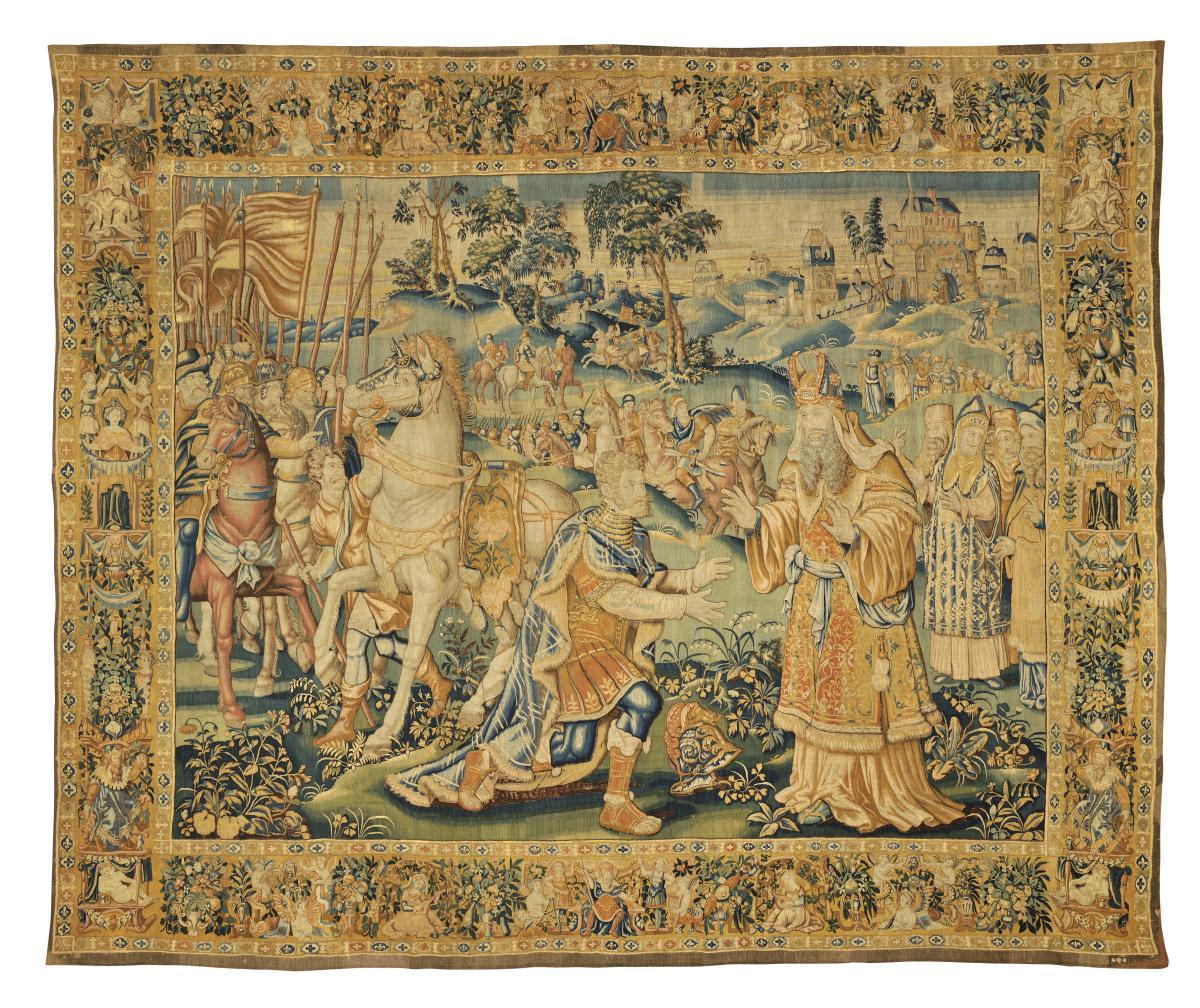
Figural Flemish tapestry, late 16th century, possibly from a History of Alexander or an Old Testament cycle. An armoured ruler bows before a mitred priest, with cavalry and retinue, in a Flemish Renaissance border with foliage, fruit, putti and corner figures. / Figuratief Vlaams wandtapijt, late zestiende eeuw, mogelijk uit een Geschiedenis-van-Alexander- of een Oudtestamentische cyclus. Een gepantserde vorst buigt voor een gemijterde priester, met cavalerie en gevolg, in een Vlaamse renaissance-rand met groenwerk, vruchten, putti en hoekfiguren. |
|||||
|
|
|||||
Topic of the WeekOudenaarde Tapestries: Flemish Wool from the Tournai-Oudenaarde Workshops, 1450 to 1700How a small Scheldt city wove green landscapes and biblical cycles for the courts of Europe, and why the surviving period pieces still appear at Belgian and French regional auctions for prices that a trained eye recognises as honest. An Oudenaarde verdure tapestry is a thing you learn to read, not a thing you learn to see. It was woven by a team of six weavers on a single high-warp loom, nine months from the first thrown shuttle to the cut of the last warp thread, in a city where the smell of dyed wool never quite left the streets between the Scheldt and the Walburga church. Whoever hangs one on a wall today and thinks only that it is decorative misses half of what is in the room. The production was concentrated in Oudenaarde, on the river Scheldt between Ghent and Tournai, from the middle of the fifteenth century to the long decline of the eighteenth. The sixteenth century was the peak: in the words of the MOU Museum Oudenaarde itself, the city "caused an uproar in tapestry art" and "the production and worldwide export of this luxury product enjoyed prosperous times." Oudenaarde was one of the most important centres of the tapestry industry alongside Antwerp, Brussels, Ghent and Bruges, and, in the broader Southern Netherlands tradition, in continuity with the older Tournai workshops thirty-five kilometres to the south. Together the Tournai and Oudenaarde workshops formed the southern axis of Flemish tapestry production for two and a half centuries, exchanging cartoons, weavers, dye recipes and trade routes. The signature product of Oudenaarde was the verdure: a tapestry of foliage, sometimes with small animals or mythological creatures, sometimes with grotesques in the decorative ornamental sense, occasionally with a small figural scene set into the greenery. The MOU's own description names the technical vocabulary still used by specialists today: groenwerk, verdure, bosschage, feuillage. Decorative tapestries of this kind were technically the most accessible to weave and lent themselves to standardised production, which is why Oudenaarde could supply the European market at a scale the more elaborate Brussels figural cycles could not. The verdures reached the highest social circles. They covered the walls of the courts in Spain, France, Italy and the Empire, and they did so in tens of thousands. The figural tapestries were the other half of the workshop output. Old Testament cycles (Solomon, David, Joseph in Egypt, the Story of Esther), Greek and Roman histories (the History of Alexander, the History of Caesar, the History of Scipio), pastoral and allegorical scenes, were woven from cartoons supplied by painters in Brussels, Antwerp or Oudenaarde itself. The MOU collection holds five panels from a sixteenth-century History of Alexander series, the most recent acquired in 2023 from a French auction. Many of the Oudenaarde figural cycles were produced from cartoons that also circulated in the Brussels workshops, and attribution to one centre or the other is sometimes a matter of city mark in the selvedge, sometimes a matter of weaver signature, sometimes a matter of weave density and dye chemistry. The mark is the diagnostic that anchors authentication. In the early sixteenth century the Holy Roman Emperor Charles V, who was, in the MOU's phrase, "an ardent lover of tapestries" as well as the ruler of an empire on which the sun never set, issued an ordinance that gave Oudenaarde its city mark: a coat of arms with spectacles, woven into the selvedge of every piece produced in a registered workshop. The mark was a quality label avant la lettre. It protected the city's product against English and German imitations, it allowed inventories to record provenance, and it allows the modern authenticator, five centuries later, to read a tapestry by reading first its selvedge and only second its image. A tapestry presented as sixteenth or seventeenth-century Oudenaarde without the mark is not automatically a fake. Unmarked period work exists, particularly from before the ordinance and from smaller workshops outside the registered guild. But the burden of proof shifts: weave density, dye chemistry, cartoon attribution and provenance documentation become decisive in the absence of the mark. In this edition we walk the authentication of Oudenaarde tapestries in layers. We begin with a specific case from the MOU collection, the 2023 acquisition from the History of Alexander, as the specimen of the week. We then walk five practical red flags that separate period Oudenaarde production from Aubusson, from nineteenth-century revival work, and from modern reproduction. We look more deeply at the city itself in 1525, at the relationship with Tournai, at Charles V as customer, and at the architecture of the cartoon trade. We close with the market bands across the relevant tiers, the AntiqBot analysis framework, a reader question, and the iOS update. |
|||||
|
|
|||||
Item of the WeekThe History of Alexander, MOU Oudenaarde, panel returned 2023The MOU Museum Oudenaarde, housed in the late-Gothic Lakenhalle on the Markt of Oudenaarde, holds a collection of thirty-seven tapestries, eighteen of which are on permanent display. Among them sit five panels from a sixteenth-century History of Alexander cycle, the most recent of which was acquired in 2023 after appearing at a French auction. The museum already held four panels from the same series. The fifth was tracked, bid on, and brought back to the city where it had been woven roughly four hundred and sixty years earlier. The MOU describes the homecoming in plain Flemish: "in 2023 het bestuur bracht nog een verloren buit terug naar huis." Found loot, brought home. The History of Alexander as a tapestry subject runs through the sixteenth and seventeenth centuries from Brussels to Oudenaarde to the French royal workshops. Alexander the Great, in the late-medieval and Renaissance imagination, was the model of the just ruler, the patron of arts and learning, the conqueror who treated his defeated enemies with magnanimity, the prince who carried Aristotle's library with him through the Persian campaigns. A History of Alexander cycle on the walls of a great hall was a programme of princely virtue. The cycles typically ran to eight, ten or twelve panels: the youth of Alexander, the conquest of Darius, the family of Darius before Alexander, the battle of the Granicus, the entry into Babylon, the marriage with Roxane, the death of Alexander. The MOU panels carry the standard iconography and the standard verdure-bordered figural composition of the Oudenaarde sixteenth-century workshops. Walk the diagnostic features of the kind of panel the MOU holds. The wool is Flemish, almost certainly from English raw wool imported through Antwerp and dyed in Oudenaarde or Ghent with the period palette: indigo for blues, weld and dyer's broom for yellows, madder and brazilwood for reds, woad as the alternative blue, walnut hulls and oak galls for browns and blacks. The silk highlights, where present, were imported from Italy through Antwerp and used for the brighter passages: a king's robe, a flash on a sword, the gleam of an eye. The warp is wool throughout, with weft of wool, silk, and on the most ambitious pieces, silver-gilt and silver thread for the hardware and the heraldic accents. The weave density is the second diagnostic. A standard Oudenaarde figural tapestry of the sixteenth century runs at five to eight wefts per centimetre, with the finest work reaching ten or even twelve in passages of facial detail and hands. Modern reproductions and nineteenth-century revival tapestries tend toward more uniform density and often coarser weave. The MOU panels show the period spread: tighter in the faces and hands of Alexander and his generals, looser in the verdure borders and the architectural backgrounds, with the small irregularities of hand-thrown shuttle work visible across the surface in raking light. A perfect mechanical uniformity is a signal of nineteenth or twentieth-century manufacture, regardless of the visual subject. The mark is the third diagnostic and, on the MOU panels, decisive. The Oudenaarde city mark of arms and spectacles is woven into the selvedge, with the workshop monogram of the master weaver typically adjacent. The MOU has been able to attribute the History of Alexander panels to the Oudenaarde production on the strength of the mark, the cartoon, the weave and the provenance trail back through European collections. The 2023 acquisition reunites a dispersed sixteenth-century cycle, which is the kind of art-historical event that rarely makes the front pages but matters for the long-term legibility of a regional production tradition. Once five of an original eight or ten panels are reassembled in the city of origin, the cycle becomes readable again as a cycle, and the question of where the remaining panels are sleeping becomes a documented research problem rather than a guess. |
|||||
|
|
|||||
Quick Check5 Red Flags on Oudenaarde Tapestries
Mark, fade, selvedge, dye signature, weave regularity. Five axes. A genuine period Oudenaarde tapestry passes most or all of them. Failure on one is sometimes explainable through later restoration or selvedge replacement. Failure on two is structural. Failure on three means the piece is most likely Aubusson misattributed, nineteenth-century revival, or twentieth-century mechanical reproduction, regardless of how convincing the foliage appears at first glance. |
|||||
|
|
|||||
Did You Know
|
|||||
|
|
|||||
Looking DeeperOudenaarde in 1525, and the Tournai connectionOudenaarde in 1525 was a city of perhaps six to eight thousand inhabitants on a bend in the Scheldt, halfway between Ghent and Tournai. By estimates that draw on the surviving guild records, a quarter to a third of the population worked directly or indirectly in the tapestry industry: weavers at the high-warp looms, spinners preparing the wool and silk, dyers in the dye-houses along the river, painters and cartoonists drawing the templates, woodworkers building the looms, merchants moving the finished pieces to Antwerp and onward to the European markets. The Scheldt itself was the artery: English raw wool came up the river from Antwerp, finished tapestries returned down the river to the same port and from there to Spain, Italy, Portugal and beyond. The city had three gates, two parish churches (Sint-Walburga and the former Pamelekerk, now Sint-Maarten), and a town hall that, in 1525, was still in the planning stage. Construction of the present Stadhuis of Oudenaarde began in 1526 and was completed in 1537. It was designed by Hendrik van Pede, the son of an Oudenaarde tapestry weaver, in a late-Gothic Brabantine style with early Renaissance ornamental details. The building survives today as the home of the MOU Museum Oudenaarde and of the city's administrative offices, and it is one of the finest examples of late-medieval Flemish civic architecture in existence. The Tournai connection runs deeper than geography. Tournai, the older Walloon city thirty-five kilometres south of Oudenaarde on the same Scheldt-Escaut system, had been a major tapestry centre since the fourteenth century. The Tournai workshops produced, among other works, the surviving examples of the Lady and the Unicorn type and the early secular and religious cycles that survive in the great European collections. Tournai's leading period ran from the late fourteenth century to roughly 1480, after which a combination of plague, political instability and the rise of Brussels and Oudenaarde shifted the centre of gravity northward. The Tournai weavers did not disappear. They moved. Some went to Brussels, where they joined the workshops that produced the great early sixteenth-century figural cycles for the courts of Burgundy and Habsburg. Some went to Oudenaarde, where the verdure specialisation and the new generation of master weavers gave them work. The Tournai-Oudenaarde lineage that runs through the late fifteenth and early sixteenth century is documented in the guild records of both cities and in the cartoon-book records of the workshops. The two cities did not merge into a single production centre, but they shared a craft tradition, a market, an export network and, on some surviving pieces, the same cartoons used in slightly different translations. Charles V as customer shaped the upper end of the market. The emperor commissioned tapestry cycles from Brussels and Oudenaarde for his palaces in Brussels, Madrid, Toledo and Vienna. The most famous of his commissions, the Conquest of Tunis cycle, was woven in Brussels in the 1540s after cartoons by Jan Cornelisz Vermeyen, who travelled with the imperial expedition to North Africa in 1535 and made drawings on the spot. The cycle still survives in Madrid and in Vienna and is one of the foundational documents of sixteenth-century imperial Habsburg art. Oudenaarde's role in the imperial commissions was secondary in scale but consistent in quality. The Oudenaarde workshops supplied the second-rank palaces, the noble households allied to the imperial court, and the export market that the Brussels workshops could not satisfy at the volume the empire demanded. The ordinance that gave Oudenaarde its city mark was, among other things, a recognition that the imperial market required a Flemish second source with quality control on a par with Brussels. Charles V got his second source. The mark guaranteed it. The architecture of the cartoon trade is a feature of Flemish tapestry production that bears mentioning. A tapestry cartoon was a full-scale painting, reversed left-to-right because the weaver worked from behind, on which the weavers based their work. The cartoons were the property of the workshop or of the commissioning patron, and they were expensive: a major figural cartoon for an eight-panel cycle could cost the equivalent of the workshop's annual rent. Cartoons were lent, copied, modified, occasionally lost in fires, and at the high end of the trade they were the work of named painters. Bernard van Orley (1487-1541), the Brussels court painter to Margaret of Austria, supplied cartoons for the Brussels workshops that were also woven, in copies and adaptations, in Oudenaarde. Pieter Coecke van Aelst (1502-1550), Mechelen-born, Antwerp-based, designed cartoons that circulated through both centres. The painter Michiel Coxcie (1499-1592), called the Flemish Raphael by his contemporaries, supplied cartoons to Brussels and Oudenaarde for biblical and classical cycles. When an Oudenaarde tapestry can be linked to a documented cartoon by one of these painters, the attribution premium is substantial and the piece moves into the upper market band. For the present-day collector and authenticator, the city of Oudenaarde serves three functions. First, the MOU Museum is the reference collection: thirty-seven tapestries, eighteen on permanent display, with the History of Alexander cycle reunited to five panels, and a published catalogue that documents the technical analysis of period weave and dye in a level of detail accessible to working specialists. Second, the city itself remains the architectural marker of the period in which the tapestries were made: walk the Markt, the Stadhuis, the streets behind the Walburga church, and the urban scale of a sixteenth-century weaving city becomes physical. Third, the conservation programmes at the MOU and the regional research at the Universities of Ghent and Leuven, in continuation of the work of Guy Delmarcel, professor emeritus at KU Leuven and former curator of textiles at the Royal Museums of Art and History in Brussels, produce the published references against which contested attributions are tested. |
|||||
|
|
|||||
Market & ValueWhat Oudenaarde tapestries are worth, actuallyThe market for Oudenaarde tapestries is layered and reads differently at every tier. Period pieces appear at the European Furniture and Tapestry sales at Sotheby's and Christie's, at Bonhams (which holds the most consistent international catalogue presence for Flemish tapestries), at Drouot in Paris for the French-routed circulation of pieces, and at the Belgian houses with strong textile sections, particularly Bernaerts in Antwerp and AAG in Amsterdam. Catawiki carries the lower end of the market at high volume, where Oudenaarde attribution is often a hopeful claim that the careful buyer reads with scepticism. The bands below are based on results from these houses over the past decade, with note that the upper bands fluctuate substantially with the quality and provenance of the specific piece. A small period verdure of under two square metres, late seventeenth or early eighteenth century, in worn condition with some restoration, with or without selvedge mark, trades in the band of fifteen hundred to four thousand euros. This is the volume segment, where most of the market activity occurs and where the regional Belgian and French houses move dozens of pieces per year. A medium-format verdure of two to five square metres, similar period, in good condition with original colour visible, with selvedge mark or strong attribution, trades in the band of four thousand to twelve thousand euros. A large verdure of five to ten square metres, mid-seventeenth or early eighteenth century, signed or marked, in good or better condition, clears twelve thousand to thirty thousand euros at the major European sales. Figural Oudenaarde tapestries from the late sixteenth or early seventeenth century, with Old Testament or mythological subject matter and the city mark, trade in the band of twenty-five thousand to eighty thousand euros. The range reflects the spread between standard workshop output (lower end) and high-quality master weaver pieces (upper end). Figural cycles from the mid-sixteenth century, attributable to documented cartoonists like Van Orley, Coecke or Coxcie, in good condition with provenance, run sixty thousand to two hundred thousand euros for single panels and substantially more for complete cycles. Exceptional period pieces with royal or noble provenance, complete cycles, undisturbed condition and consensus attribution, exceed two hundred thousand euros and have, in recent years, cleared seven figures at the major European house sales for the very rare top pieces. Heavily restored or partially reworked period pieces drop sharply. A genuine seventeenth-century Oudenaarde verdure that has been re-woven in significant passages, overdyed, or restored beyond the conservative limits, trades at half to a third of the equivalent intact-condition price. The piece is still period in origin, but the surface that drives the upper band is no longer entirely original. Buyers in this segment are conscious of the trade-off and the market correctly prices the difference. Aubusson verdures of the late seventeenth and eighteenth centuries trade in the band of fifteen hundred to eight thousand euros for typical pieces, with the higher end reserved for documented master work and unusually well-preserved surface. The market correctly distinguishes Aubusson from Oudenaarde when the selvedge and the dye chemistry are checked, and the prices follow the distinction. The challenge for the buyer is that the visual subject matter is sometimes near-identical and the categorisation by sellers is sometimes optimistic. A trained eye reads the selvedge first. Nineteenth-century revival tapestries, mostly French in production, occupied the same wall space in late-Victorian and Belle Epoque interiors that the period verdures had occupied in the seventeenth century. These pieces are documented, honest in their own period, and trade in the band of three hundred to two thousand euros depending on quality, condition and the freshness of the reproduction. They are not, and should not be sold as, sixteenth, seventeenth or eighteenth-century work. A nineteenth-century revival tapestry presented as period Oudenaarde is a misattribution that the synthetic dye signature resolves in seconds under appropriate examination. Twentieth-century mechanical reproductions, mostly produced for the decorator trade in France, Belgium and Spain through the twentieth century, complete the market below the revival band. These pieces trade at fifty to four hundred euros depending on size and quality and are not, in any meaningful sense, antique. The Belgian and French regional auction market remains, for the patient buyer with a trained eye, the segment of greatest opportunity. Regional houses in East Flanders, the Belgian Walloon provinces and the French departments along the old Scheldt-Escaut route handle Oudenaarde and related Flemish tapestries at hammer prices that, on documented period work with selvedge mark, frequently sit fifteen to thirty per cent below the equivalent Sotheby's or Christie's price in London or Paris. The MOU's 2023 acquisition of the History of Alexander panel from a French auction is one published example of the pattern. The pattern repeats. Documented period pieces continue to appear at regional auctions in France and Belgium, attributed and unattributed, sometimes mistaken for Aubusson, sometimes catalogued without mark documentation, occasionally with a price guide that the careful buyer can recognise as a bargain. |
|||||
|
|
|||||
Behind the ScenesOur analysis of an Oudenaarde tapestry runs along seven tracks at once. The selvedge first, looking for the city mark of arms and spectacles and any adjacent weaver monogram. The weave density across multiple zones, distinguishing the looser verdure passages from the tighter figural passages, looking for the spread that signals hand work. The dye chemistry as far as visual inspection allows, watching for the characteristic fade patterns of indigo, weld and madder, watching against the signature brightness of synthetic anilines. The cartoon attribution, comparing the iconography against documented cartoons from Bernard van Orley, Pieter Coecke van Aelst, Michiel Coxcie and the working cartoonists of the Oudenaarde and Brussels workshops. The condition, mapping repairs, re-weaving, overdyeing and lining additions. The provenance, where documentation exists, against the FelixArchief in Antwerp for export records and against the published collection histories. And finally the question of whether the piece reads as a coherent member of a documented Oudenaarde cycle, or as a fragment, or as a misattributed work from another centre. The verdict comes in five levels, from AUTHENTIC to NOT AUTHENTIC, with the reasoning. What we cannot see in the photograph, we say so. If we need additional photographs of the selvedge, the reverse, or specific zones at higher resolution, we ask. We do not sell judgements we cannot support. For the attribution itself we do not work from our own knowledge alone. The Oudenaarde mark is checked against the RKD Marks on Art database in The Hague and against the glossary of fifty-five town marks in Guy Delmarcel's standard reference, Flemish Tapestry from the 15th to the 18th Century. The cartoon attribution is checked against the published records of the Brussels and Oudenaarde workshops and against the surviving cartoons in the Royal Museums of Art and History in Brussels and the MOU in Oudenaarde. The provenance is checked against the FelixArchief in Antwerp, the long-arm export record of Flemish luxury production. Our conclusion can be traced back to sources you can check yourself. That is the difference between an AI making a claim, and authentication. |
|||||
|
|
|||||
Question of the Week"I bought a large verdure tapestry at a regional auction in Northern France. The catalogue called it eighteenth-century Aubusson. The dealer at the next stall told me afterward it could be Oudenaarde and worth four times what I paid. How do I find out which it is?" Four steps, in order. First, photograph the selvedge along all four sides at the highest resolution your camera allows. The selvedge is the woven edge of the tapestry, often hidden when the piece is hung or framed. Aubusson typically used a red or burgundy selvedge with no marks. Oudenaarde typically used a blue or yellow selvedge with the city mark of arms and spectacles woven into the band, usually in the lower selvedge near a corner. The mark is small, often three to six centimetres in size, and easy to miss on first inspection. If the selvedge has been trimmed away in a later restoration or framing, the diagnostic is lost and you fall back on weave density and dye chemistry. Second, measure the weave density in three to five different zones: a verdure passage, a figural passage if present, and an architectural or landscape detail. Count wefts per centimetre with a magnifying glass. Aubusson typically runs at four to six wefts per centimetre. Oudenaarde runs at five to eight, with tighter passages reaching ten or twelve in fine detail. Third, examine the colour palette under good natural light. The Oudenaarde greens, after three to four centuries, have shifted to deeper, slightly blue-tinged greens with characteristic fade asymmetry between the wall-facing and the room-facing sides. Aubusson greens tend to be brighter and more uniform in fade. Fourth, photograph the reverse of the tapestry. The back of a period tapestry shows the brightness of the original colours protected from light, and the contrast with the faded front is the most direct visual evidence of true age and natural dye chemistry. Send the photographs through AntiqBot and we run the seven-track analysis. If the piece is Oudenaarde, you will know within hours and you will have a document you can use at insurance and at resale. If it is Aubusson, you will know that too, and the value at what you paid will be honest information rather than wishful thinking. Send your question to info@antiqbot.com |
|||||
|
|
|||||
|
Have an Oudenaarde tapestry, an Aubusson verdure, or any Flemish woven piece you want to authenticate? Sign up and get 1 free credit for your first analysis. After that, buy credit packs starting from €0.60 per analysis.
|
|||||
|
|
|||||
AntiqBot on iOSThe AntiqBot iOS app is live in the App Store. Pricing matches the web: 5 credits for €4.99, 10 for €8.99, 25 for €17.99, 50 for €29.99, with one free credit on registration. Search "AntiqBot" in the App Store, or use the web application at antiqbot.com. |
|||||
|
|
|||||
Next WeekFlemish Silver: Antwerp and Brussels Hallmarks, 1500 to 1800 |
|||||
|
|
|||||
|
AntiqBot.com · AI-Powered Antique Identification You receive this newsletter because you signed up via AntiqBot.com. Je ontvangt deze nieuwsbrief omdat je je hebt aangemeld via AntiqBot.com. © 2026 AntiqBot · Erwin Truyts · KBO 0826.004.290. All rights reserved. |