|
Edition #16 · Week 23, May 2026 |
|||||
|
|||||
|
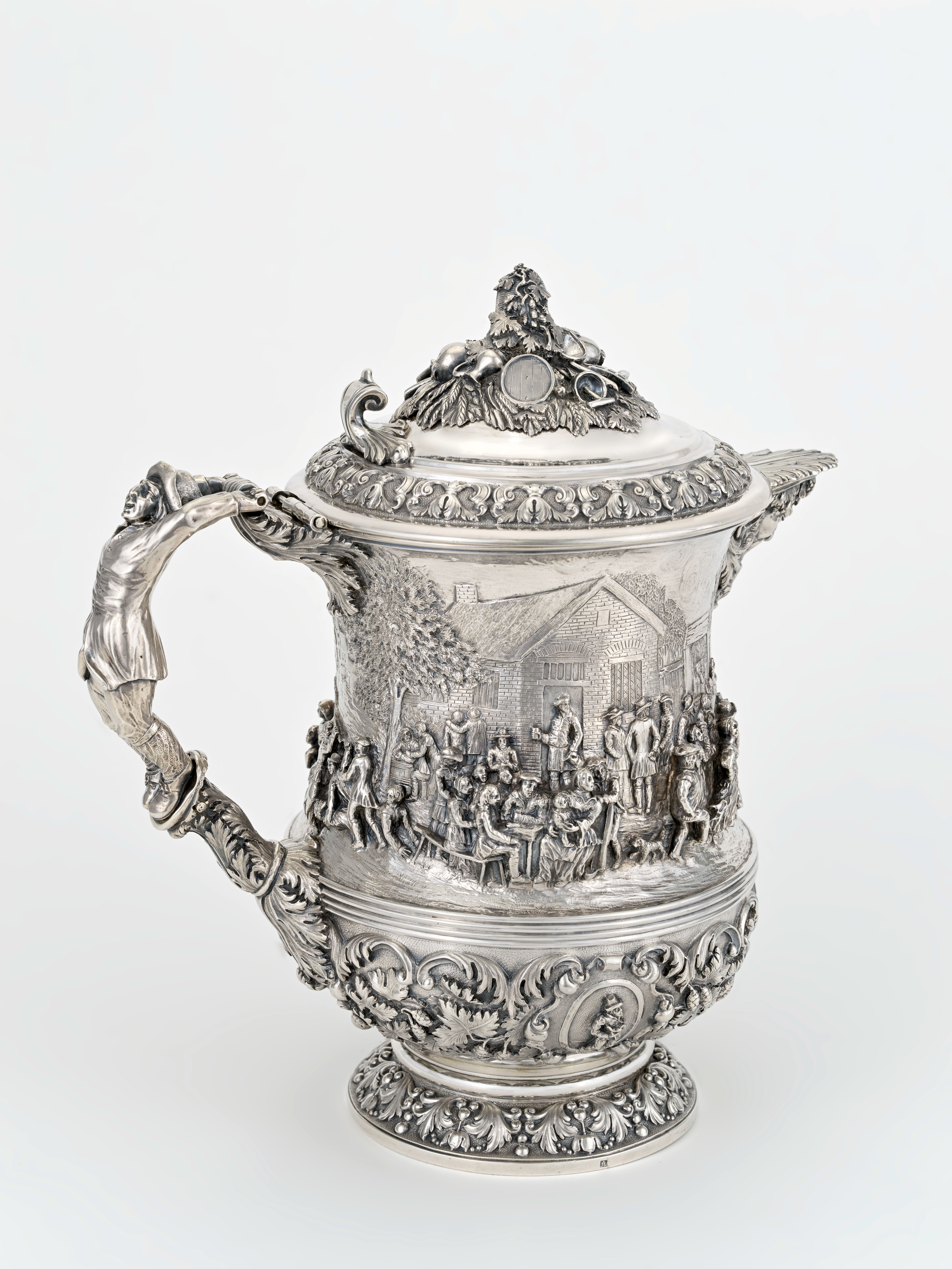
Brussels silver tankard with figural relief decoration, hinged lid and cast handle. Silver and gilding. Collection of DIVA Antwerp, inv. S2020-30, CC0 / Public Domain. The type of Flemish guild silver, struck on the underside with city mark, master mark, date letter and assay mark, that anchors Antwerp and Brussels authentication. |
|||||
|
|
|||||
Topic of the WeekFlemish Silver: Antwerp and Brussels Hallmarks, 1500 to 1800How two Brabantine cities built one of the strictest hallmarking systems in early-modern Europe, why a Flemish silver piece without a city mark is almost never what the seller claims, and where the Belgian regional market still hides documented seventeenth-century work behind generic descriptions and honest prices. A piece of Flemish silver is not authenticated from its surface. It is authenticated from its base, its rim, the inside of a lid, the underside of a foot, the place where the guild assayer struck the marks four centuries ago in cold metal and where those marks still sit, smaller than a fingernail, harder than the silver around them, waiting for the eye that knows what to look for. Anyone who turns a Flemish piece over and sees nothing has stopped looking too early. The marks are there if the piece is what it claims to be. If the marks are not there, the piece is something else. The Antwerp and Brussels silversmiths' guilds built, between roughly 1456 and the French annexation of 1795, one of the strictest hallmarking systems in early-modern Europe. The system rested on four obligatory marks struck on every finished piece by the guild assayer before the piece could be legally sold: the city mark, the master mark of the silversmith, the date letter of the guild year, and the assay mark that certified the silver content. Four marks, struck in a fixed order, in fixed positions on the piece, by an officer of the guild who answered to the city magistrate. The system was an instrument of consumer protection avant la lettre, an instrument of taxation, and an instrument of professional control. It also, four centuries later, became the instrument of authentication. A Flemish silver piece with the four marks present, correctly positioned, in mutually consistent date letter and master attribution, is reading itself out loud. A piece missing the marks, or with marks that conflict, is reading itself out loud too. Both readings are honest. The authenticator's job is to listen. Antwerp received its guild charter in 1382 under the patronage of Saint Eligius, the seventh-century French goldsmith who is the universal patron of the metalworking trades. The Brussels guild followed a similar trajectory, formalised in the fourteenth century, reorganised under Burgundian rule in the fifteenth, and stabilised under Habsburg administration from Charles V onward. By the early sixteenth century both guilds operated obligatory hallmarking, both maintained guild registers of admitted masters with their personal marks, both kept date letter cycles that allowed any later examination to place a piece within a single year of its production, and both submitted to the assay officer who certified the silver content against the legal standard. The standard itself varied by period and by piece type, with the Antwerp guild operating principally at 875 thousandths for hollow ware and 925 thousandths for the finest work, and the Brussels guild operating at comparable bands. The numbers are not nine hundred and twenty-five for decoration. They are the legal minimum content of pure silver in the alloy, certified by a guild officer with his name in a register and his liability on the line. The Antwerp city mark is a stylised right hand, palm forward, taken directly from the city coat of arms. The hand of Antwerp carries with it the legend of the Roman soldier Silvius Brabo, who threw the severed hand of the giant Druon Antigoon into the Scheldt, and the city took its name from that throw: hand-werpen, hand-throwing. The hand mark appears on Antwerp silver from the second half of the fifteenth century onward. Before approximately 1582 the hand carries two stars above the fingers. From 1582 onward the hand carries three stars, and the change is one of the more useful internal dating boundaries for any piece showing only the city mark. The Brussels city mark is the figure of Saint Michael the Archangel slaying the dragon, the same Saint Michael who stands on top of the Brussels town hall spire. Saint Michael appears on Brussels silver from the fifteenth century onward, in stylised form within an oval or shaped cartouche, sometimes more legible, sometimes worn down by four centuries of polishing and use. The date letter is the second diagnostic. The Antwerp guild instituted its date letter cycle in 1582 and ran it as an alphabetical sequence of twenty-five letters, restarting at A with a new font style every twenty-five years. The shape of the letter, the font of the cartouche, the orientation, all encode the specific year within a published table that runs from the late sixteenth century to the abolition of the guilds at the French annexation. The Brussels cycle followed a similar logic with its own letter assignments. A trained eye reads the date letter and pins the piece to a calendar year. An untrained eye reads the date letter as decoration. The published tables in the standard references, principally the Belgian guild registers reissued in the modern silver mark encyclopaedias, resolve the ambiguity in seconds for anyone who consults them. The master mark is the third diagnostic, and the one that separates a documented workshop piece from a piece by an unknown hand. Every silversmith admitted to the Antwerp or Brussels guild deposited his personal mark with the guild, a punch usually combining initials with a symbol or device, sometimes purely figurative. The deposited marks survive in the guild registers and have been published in standard reference works. Adriaen Boeckx, active in Antwerp at the end of the seventeenth century, struck his mark with the initials AB and a device that the reference works document. Pieter Couwenbergh, active in Antwerp through the middle of the seventeenth century, struck a different mark documented in the same registers. The Brussels masters, the Cailleau workshops, the Beerinx family, the eighteenth-century Verleysen workshop, are documented in the same way. When a Flemish silver piece carries a master mark that matches a documented register entry, the attribution moves from generic to specific, the dating tightens from a guild year to the active years of a known workshop, and the market value reads accordingly. When the master mark is unclear or unrecognised, the piece falls back to attribution by city and date letter alone, with the workshop noted as unidentified. The assay mark is the fourth and last of the obligatory marks, and the simplest in function. The assay officer of the guild struck a separate mark certifying that the silver content had been tested against the legal standard. The assay mark protected the buyer against debased or plated work and protected the silversmith against the accusation of debasement. From the late eighteenth century onward, under successive Austrian and French administrations, the assay system was overlaid with state tax marks. The piece you turn over today carries the layered marks of the system that produced it, and reading those layers is the work that an honest authentication does. In this edition we walk the authentication of Flemish silver in the same layers we walked the Oudenaarde tapestries last week. We begin with a specific case, a late seventeenth-century Antwerp tankard of the type that anchors the surviving Antwerp production. We then walk five practical red flags that separate period Flemish silver from later imitation, from continental work misattributed, and from silver-plated reproduction. We look more deeply at the guilds themselves, at the Saint Eligius foundation, at the relationship between Antwerp and Brussels, and at why the Belgian regional auction market remains, for the trained eye, the most productive hunting ground in Europe for documented Flemish silver. We close with the market bands, the AntiqBot SilverCheck analysis framework, a reader question, and the iOS update. |
|||||
|
|
|||||
Item of the WeekAn Antwerp tankard, late seventeenth century, master mark of the Boeckx workshopThe Antwerp tankard of the late seventeenth century is the silver equivalent of the Oudenaarde verdure: not the most exalted production of the city, not the great showpieces commissioned by the cathedral chapters or the imperial court, but the consistent middle-class output that defines the bulk of the surviving Antwerp work and that fills the catalogues of the European silver sales. A tankard of this type is between twenty and twenty-five centimetres in height, weighs between seven and nine hundred grams of silver, carries a hinged lid with a thumb-piece in scrolled or shell form, and stands on a moulded foot with a curved profile that the Antwerp workshops varied slightly from year to year but kept within a recognisable family of shapes. The body is plain or lightly ornamented with strap-work, the handle is cast separately and applied, and the marks are struck on the underside in the regulation Antwerp position: the hand of the city, then the date letter, then the master mark, then the assay mark, in the order that the guild assayer worked through them. Adriaen Boeckx was admitted to the Antwerp silversmiths' guild in the second half of the seventeenth century and produced through the closing decades of that century into the early eighteenth. The Boeckx mark is documented in the published Antwerp guild register. When a tankard of this type carries the Antwerp hand with three stars, a date letter in the band that places the piece between approximately 1680 and 1700, and the Boeckx master mark in the correct position, the attribution holds without further evidence. The piece reads itself: Antwerp, post-1582 hand, that specific guild year, Boeckx workshop. The reading takes minutes for someone who knows the marks and the registers, and the conclusion is documented against published sources that any serious buyer can verify independently. The diagnostic features of a Boeckx-period Antwerp tankard run beyond the marks themselves. The silver content tests, on assay, at the guild standard for hollow ware of the period, approximately 875 thousandths fine. The hammered surface shows the characteristic planishing texture of hand-raised work, visible under raking light as a fine pattern of overlapping facets across the body. The handle is cast in a two-part mould and shows the seam where the two halves were joined, finished by file and polished but not erased. The hinge of the lid is hand-cut, the pin is original silver wire of the same alloy as the body, and the thumb-piece is cast separately and soldered in. None of these features can be faithfully reproduced by twentieth-century mechanical methods at a cost that makes the reproduction commercially worthwhile. The economics of forgery do not favour the patient reconstruction of the seventeenth-century workshop process. A piece of this type, struck and documented, in good original condition with the marks legible and the surface honest, carries an auction estimate of three thousand to seven thousand euros at the European silver sales. A comparable piece by an unidentified Antwerp master, otherwise of the same period and quality, carries an estimate one band lower, in the area of fifteen hundred to three thousand five hundred euros. The Boeckx attribution adds a documented workshop premium that the market consistently pays. The same Antwerp guild year by a master whose mark is recorded but whose oeuvre is sparse can carry a higher premium still, because the rarity is documentable. The Boeckx tankard is also instructive in what it is not. It is not a sacred object, not commissioned by a chapter or a religious house, not part of the great Counter-Reformation altar silver that the Antwerp workshops produced for the southern Netherlands churches. It is a domestic piece, made for use, intended for a prosperous Antwerp burgher household, and surviving today through three or four centuries of careful preservation and occasional polishing. The surface carries the small dents of use, the foot shows wear from being set down on hard surfaces, the lid shows the polish lines of careful cleaning. These traces are part of the authentication, not subtractions from it. A Boeckx tankard with no visible wear, perfectly mirror-polished, with sharp-edged marks and no surface dents, has either been comprehensively restored to the point of refinishing or is not what it claims to be. Honest age leaves its trace in the metal as it leaves its trace in the dye of an Oudenaarde verdure. |
|||||
|
|
|||||
Quick Check5 Red Flags on Flemish Silver
City mark, fineness convention, hand iconography, strike character, hand-feel and resonance. Five axes. A genuine period Flemish silver piece passes all five. Failure on one is sometimes explainable through later restoration or partial repair. Failure on two is structural. Failure on three means the piece is misattributed, post-1850 continental work, twentieth-century reproduction, or silver plate over base metal, regardless of how convincing the surface appears under a quick first look. |
|||||
|
|
|||||
Did You Know
|
|||||
|
|
|||||
Looking DeeperThe Saint Eligius guilds and the political economy of Flemish silverSaint Eligius (588 to 660), the Frankish goldsmith and bishop of Noyon, was the universal patron of the metalworking trades across late-medieval and early-modern Europe. Antwerp, Brussels, Mechelen, Ghent, Bruges, all of the Flemish cities organised their gold and silversmiths under the patronage of Eligius, with chapels in the parish churches and altarpieces commissioned by the guilds. The Antwerp guild chapel sat in the cathedral of Our Lady, the Brussels guild chapel in the collegiate church of Saints Michael and Gudula (today the cathedral of Brussels). The guilds were religious confraternities as much as professional corporations, and the religious framing carried with it obligations of honesty in measurement, transparency in pricing, and submission to internal discipline that the guild courts enforced through fines, suspension and, in extreme cases, expulsion from the trade. A silversmith expelled from his guild could not legally produce. The guild was the licence. The political economy of the system reached far beyond the guild itself. Antwerp in the sixteenth century was the largest port and the largest financial centre in Northern Europe, the destination of South American silver from the Spanish trade and the staging point for the silver's redistribution into the European money system. The Antwerp silversmiths sat at the intersection of the bullion trade and the luxury trade. They worked, in part, with the same silver that flowed through the Antwerp Exchange and the Antwerp Mint. The guild standard of 875 or 925 thousandths fine was, in this context, not a craft choice but a political agreement: a level of silver content that the guild could certify, that the city magistrate could enforce, that the customer could trust, and that the foreign buyer could compare against the standards of his own city's guild. The hand of Antwerp on a tankard was a Bordeaux merchant's, a London merchant's, a Hamburg merchant's guarantee that the piece held the silver it claimed. Brussels played a different role. The court of the Habsburgs sat in Brussels through most of the sixteenth and seventeenth centuries, and the Brussels silversmiths supplied the court, the ducal household, the foreign ambassadors and the religious establishments associated with the court. The Brussels production was, on average, more elaborate, more figural, more given to ceremonial silver and ecclesiastical work, where Antwerp leaned more toward the commercial-domestic output. The two cities did not compete directly. They occupied complementary positions in the southern Netherlands silver economy and, between them, they produced the bulk of the documented Flemish silver of the early modern period. Mechelen, the third pole, produced a smaller volume of high-quality work principally for the Mechels poppekes culture and the religious commissions of the Mechelen-Antwerp ecclesiastical province. Ghent and Bruges held smaller guilds with their own marks and date letters, contributing a regional production that the modern reference works document alongside Antwerp and Brussels but at a smaller scale. The reference architecture for reading Flemish silver marks today rests principally on the published Belgian silver mark encyclopaedias, on the surviving guild registers preserved in the Antwerp city archive (the FelixArchief) and the Brussels state archive, and on the secondary literature that has grown up around these primary sources. The standard reference for Antwerp is the published register of admitted masters with their deposited marks, reissued in modern editions with photographic plates of the deposited punches. The standard reference for Brussels is the comparable register published by the Brussels city archive and the relevant academic specialists. The international cross-reference is the online silver mark databases (925-1000.com and the Online Encyclopedia of Silver Marks, Hallmarks and Makers' Marks), which carry the Antwerp and Brussels marks within their European mark tables with image plates that anyone with a smartphone camera and a magnifying loupe can match against the marks on a piece in hand. The system is not a black box. It is open, published, and verifiable. The MOU Museum Oudenaarde, where last week's tapestry edition began, holds in the same Lakenhalle a substantial collection of period Flemish silver alongside its tapestries, with pieces from the Oudenaarde, Ghent and broader East-Flemish silver tradition. The combination is not coincidental. The same Burgundian and Habsburg cities that built the tapestry industry built the silver industry, drawing on the same merchant networks for materials and the same export routes for finished work. To stand in the Lakenhalle today, with the verdure walls of the History of Alexander on one side and the showcases of period East-Flemish silver on the other, is to read the political economy of the Southern Netherlands from two angles at once. The Sint-Niklaaskerk in Ghent, the cathedral treasuries of Antwerp and Mechelen, the silver collections of the Royal Museums of Art and History in Brussels, and the regional museum collections in Bruges and Tournai, complete the public reference network for anyone who wants to compare a piece in hand against the documented corpus. For the present-day collector and authenticator, the Belgian silver landscape serves three functions. First, the published registers and the surviving guild archives are the documentary backbone: every admitted master is traceable, every mark is documented, every guild year is published. Second, the museum collections are the visual reference: the KMSKB in Brussels, the MOU in Oudenaarde, DIVA in Antwerp (opened in 2018 as the successor to the former Sterckshof Provincial Silver Museum in Deurne, which closed in 2016, and now the principal Belgian silver, diamond and jewellery museum), and the cathedral treasuries provide the comparative material against which any contested attribution can be tested. Third, the regional Belgian auction market continues to circulate documented period work at prices that the trained eye reads as opportunities. Bernaerts in Antwerp, the Brussels auction houses, and the smaller East-Flemish and Limburg houses handle Antwerp and Brussels silver of the seventeenth and eighteenth centuries at prices that frequently sit fifteen to thirty per cent below the equivalent hammer at Christie's or Sotheby's in London or Paris. |
|||||
|
|
|||||
Market & ValueWhat Antwerp and Brussels silver is worth, actuallyThe market for Flemish silver reads differently at every tier. Period pieces appear at the European silver sales at Sotheby's, Christie's, Bonhams (which carries the most consistent international Belgian silver catalogue presence), Drouot in Paris, and the strong Belgian houses with dedicated silver sessions: Bernaerts in Antwerp, the Brussels auction houses with regular silver catalogues, and the East-Flemish and Limburg houses with regional silver sections. Catawiki carries the lower end of the market at high volume, where the Antwerp and Brussels attributions are often hopeful claims that the careful buyer reads with the published mark tables open in another tab. The bands below are based on results from these houses over the past decade, with the understanding that the upper bands fluctuate substantially with the quality, the condition and the documented provenance of the specific piece. A small Antwerp or Brussels piece of the late seventeenth or early eighteenth century, in plain or lightly ornamented form, by an unidentified guild master, in good usable condition with the city mark legible, trades in the band of six hundred to two thousand euros. This is the volume segment, where small spoons, basic salt cellars, simple beakers and modest religious silver clear at the regional Belgian houses by the dozen each year. A medium Antwerp or Brussels piece of the same period, by a documented but middle-rank master, in good condition with all four marks legible, trades in the band of fifteen hundred to five thousand euros. A documented Antwerp or Brussels tankard, coffee pot, chocolate pot, or comparable hollow-ware piece by a recognised seventeenth-century master (Boeckx, Couwenbergh, Vermeulen, Cailleau, Beerinx), in good condition with full marks, trades in the band of three thousand to ten thousand euros. Antwerp or Brussels ceremonial and ecclesiastical silver of the seventeenth century, including chalices, ciboria, monstrances, processional crosses and altar candlesticks, with the city mark and a documented master mark, trades in the band of five thousand to twenty-five thousand euros for typical pieces, with the upper end reserved for documented master work in good condition with cathedral or major monastic provenance. Exceptional pieces by the top seventeenth-century Antwerp masters or by the top Brussels court silversmiths, with court or cathedral provenance, complete sets where the original ensemble survives intact, exceed twenty-five thousand euros and have, in recent years, cleared into the six-figure range at the major European house sales for the rare top documented pieces. Eighteenth-century Antwerp and Brussels domestic silver follows a parallel structure with the Louis XIV, Régence, Louis XV and Louis XVI taste profiles. A documented Antwerp or Brussels rococo coffee pot, chocolate pot or pair of candlesticks, fully marked and in good condition, trades in the band of two thousand to eight thousand euros for typical pieces and substantially more for documented master work by the leading mid-century masters. The transition from rococo to neoclassical in the 1770s and 1780s, with the corresponding shift in form vocabulary, produced a body of Antwerp and Brussels work that the market values at comparable bands to the equivalent period French silver, with the regional discount that affects most non-Paris production. Heavily restored or refinished pieces drop sharply. A genuine seventeenth-century Antwerp tankard that has been re-polished to a high mirror finish, with the marks worn to the point of needing magnification, or with substantial replacement of the lid, handle or foot, trades at half to a third of the equivalent intact-condition price. The piece is still period in origin, but the surface and the structural integrity that drive the upper band are compromised. The market correctly prices the difference. Continental silver of the nineteenth century, particularly German "800" silver and Austro-Hungarian silver, is regularly catalogued at Belgian regional houses as "Flemish style", which is a description of the form vocabulary, not of the production origin. These pieces trade at three hundred to twelve hundred euros depending on size, quality and workshop. They are honest nineteenth-century work in their own right and have their own market, but they are not Antwerp or Brussels guild silver and should not be confused with it. The published mark plates resolve the question in seconds and the price difference between correctly attributed nineteenth-century German "800" and correctly attributed seventeenth-century Antwerp tends to be a factor of three to ten. Silver plate of the late nineteenth and twentieth century, in the various Sheffield plate and electroplate forms, occupies the floor of the market at fifty to three hundred euros for typical pieces, regardless of how Flemish the form vocabulary appears. The weight test, the plate wear patterns on high-touch surfaces, and the absence of any guild mark resolve the categorisation. Plate is not silver in the legal sense and is not Flemish guild work in any sense. The Belgian regional auction market remains, for the patient buyer with the published mark tables and a trained eye, the segment of greatest opportunity. Antwerp and Brussels period silver continues to appear at regional auctions across Belgium and northern France, sometimes catalogued precisely with full attribution and price guide, sometimes catalogued generically with "European silver, eighteenth century" against the hand of Antwerp staring out of the lot photograph. The opportunity for the trained eye is exactly that gap: the documented piece sold at the undocumented price. The discipline that captures the gap is reading the mark photographs in the catalogue before the auction and being in the room or on the platform when the lot opens. |
|||||
|
|
|||||
Behind the ScenesOur SilverCheck analysis runs along six tracks at once. The city mark first, against the published Antwerp hand plates (pre-1582 and post-1582 variants) and the Brussels Saint Michael plates, looking for the specific iconography, the cartouche shape, the star count, the proportion of the figure within the punch. The master mark second, against the published Antwerp and Brussels guild registers, with cross-reference to the deposited mark photographs preserved in the city archives. The date letter third, against the published year tables, with attention to the font, the cartouche shape and the orientation that pin the piece to a specific guild year. The assay mark fourth, confirming the silver content claim and locating the piece against the Habsburg, Austrian or French assay overlay systems where applicable. The strike character fifth, looking at the depth, the symmetry and the wear of the marks themselves against expectation for the claimed period. The metal sixth, with attention to the weight-to-volume ratio, the surface character of the hammered or cast work, the planishing pattern of hand-raised hollow ware, and the structural details (hinge construction, handle attachment, foot moulding) that mechanical reproduction does not faithfully replicate. The verdict comes in five levels, from AUTHENTIC to NOT AUTHENTIC, with the reasoning. What we cannot see in the photograph we say so. If we need additional photographs of the underside marks at higher resolution, of the hinge from the side, or of the interior of the lid, we ask. We do not sell judgements we cannot support. For the attribution itself we do not work from our own knowledge alone. The Antwerp marks are checked against the FelixArchief guild register and against the standard published Belgian silver mark references. The Brussels marks are checked against the Brussels city archive register. The international cross-reference runs through the 925-1000.com silver mark database and the Online Encyclopedia of Silver Marks, Hallmarks and Makers' Marks. The mark plates from these sources are integrated into the SilverCheck prompt structure as the authority signal: when a mark matches a documented register entry, the attribution is confirmed; when a mark does not match, the attribution is flagged as unrecognised. Our conclusion can be traced back to sources you can check yourself. That is the difference between an AI making a claim, and authentication. |
|||||
|
|
|||||
Question of the Week"I inherited a silver beaker from my grandmother. On the underside there is a small hand stamp with stars above it, and what looks like a tiny letter in a shaped frame. No other marks I can see. Is this Antwerp, and from what year?" The hand with stars is the Antwerp city mark, the strongest single piece of evidence you can have. The number of stars tells you the broad period: two stars before 1582, three stars from 1582 onward. The letter in the shaped frame is the date letter, and it pins the piece to a single guild year inside the cycle that the Antwerp guild ran from 1582 to the French annexation in 1795. To read the date letter you need the published Antwerp date letter table, which assigns a specific font and a specific shape of cartouche to each year. The same letter A appears in 1582, in 1607, in 1632, in 1657, and so on through the cycle, but the font and the cartouche differ. A photograph of the date letter, taken in raking light against a dark background at high resolution, is sufficient to make the identification. Three steps, in order. First, photograph the underside marks at the highest resolution your phone allows, with raking light from one side to bring out the depth of the strike. Include a millimetre scale next to the marks if you can. Second, count the stars above the hand and note whether the hand carries any other associated devices (rare but informative). Third, send the photograph through AntiqBot's SilverCheck. We run the mark against the published Antwerp guild plates, identify the date letter against the published year tables, locate the master mark in the deposited register, and return the attribution with the documented source references. If the master mark is unclear in the photograph, we ask for a tighter close-up. If the mark is clear and matches a documented Antwerp master, the attribution is firm. Send your question to info@antiqbot.com |
|||||
|
|
|||||
|
Have an Antwerp tankard, a Brussels chalice, a beaker with a hand stamp, or any Flemish silver piece you want to authenticate? Sign up and get 1 free credit for your first analysis. After that, buy credit packs starting from €0.60 per analysis.
|
|||||
|
|
|||||
AntiqBot on iOSThe AntiqBot iOS app is live in the App Store. Pricing matches the web: 5 credits for €4.99, 10 for €8.99, 25 for €17.99, 50 for €29.99, with one free credit on registration. Search "AntiqBot" in the App Store, or use the web application at antiqbot.com. |
|||||
|
|
|||||
Next WeekAfrican Art and the Missionary Import Routes from Congo, 1885 to 1960 |
|||||
|
|
|||||
|
AntiqBot.com · AI-Powered Antique Identification You receive this newsletter because you signed up via AntiqBot.com. Je ontvangt deze nieuwsbrief omdat je je hebt aangemeld via AntiqBot.com. © 2026 AntiqBot · Erwin Truyts · KBO 0826.004.290. All rights reserved. |