|
Edition #18 · Week 24, June 2026 |
|||||
|
|||||
|
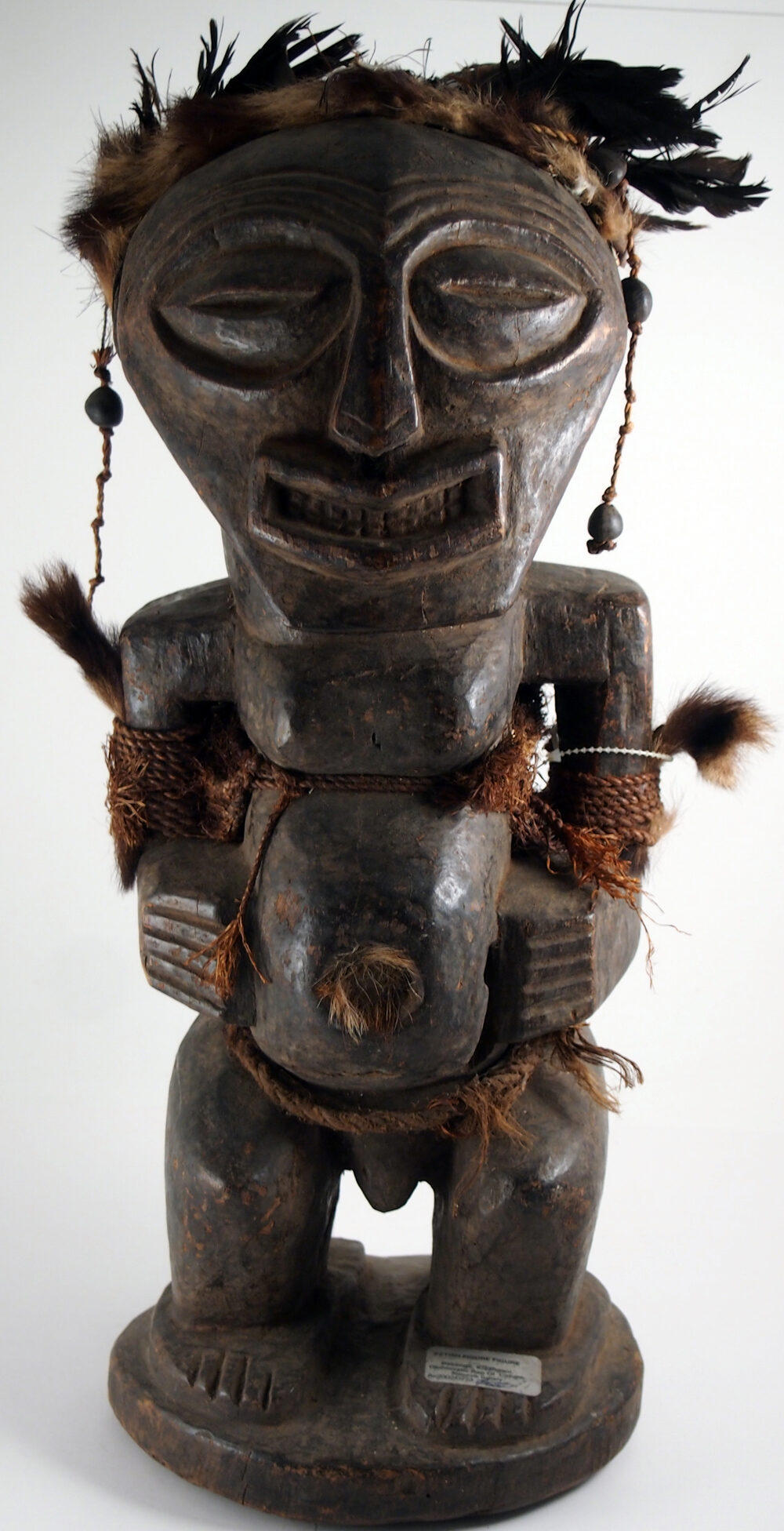
Songye power figure (nkishi), Democratic Republic of the Congo. Carved hard wood, feathers, fibre, beads, leather and fur. The angular, surface-charged Songye idiom set against the rounded, serene sculpture of the neighbouring Luba is the single most common confusion in the Congolese field. Photo: Ann Porteus, CC BY 2.0, via Wikimedia Commons (commons.wikimedia.org/wiki/File:020273_189a_Power_figure,_Songye,_DRC_(6651186349).jpg), licence creativecommons.org/licenses/by/2.0. |
|||||
|
|
|||||
Topic of the WeekSongye or Luba? Telling Two Neighbouring Congo Traditions ApartTwo peoples of south-central Congo who share a founding hero, a border region and the striated kifwebe mask, yet carve in two opposite registers. Why dealers and estate sales confuse them so often, what the modern authenticator reads to separate them, and why the answer changes the value of a piece by a factor of ten. Last week we walked the missionary import routes that carried Congolese sculpture into Belgian collections between 1885 and 1960, and we promised that this week we would go inside two of the traditions that travelled those routes most often. The Songye and the Luba sit side by side in the savanna of south-central Democratic Republic of the Congo, between the Sankuru and the Lualaba, and the catalogues of every European tribal-art sale carry their work in quantity. They are also, for the untrained buyer, the two traditions most reliably mistaken for one another. A figure described in an estate inventory as "Luba, carved African statue" turns out, on examination, to be Songye. A striated mask sold as "Songye kifwebe" turns out to be Luba. The confusion is old, it is built into the history of the two peoples themselves, and it is expensive. The confusion is not the fault of careless sellers alone. The Songye and the Luba are related. The Metropolitan Museum, in its catalogue of a Songye community power figure, states the relationship plainly: the Songye "are related to the neighboring Luba and like them, share the belief in a founding culture hero." The two peoples intermarried, traded, raided and influenced one another across a long shared frontier, and in the border zone the styles blend into the hybrid forms that specialists call Eastern Songye, where the Luba aesthetic is felt inside Songye work. On top of that, the two peoples share an entire mask tradition: the striated kifwebe mask belongs to both, and almost certainly originated in the mixed Songye and Luba country of northern Katanga. So a buyer who reaches for the single feature, the mask shape, the wood, the patina, and expects it to settle the question, is reaching for the wrong tool. The traditions overlap precisely where the amateur looks first. And yet, once you know the two registers, they are not subtle. Songye sculpture is angular. It is built from faceted geometric planes, a sectioned body where head, torso and legs are stacked like a column of blocks, a face pulled into a sharp V by closed semicircular eyes and brows that sweep down to the jaw, a short horizontal chin, a brass or copper plate riveted over the nose. The Songye power figure is loaded with material the carver never touched: feathers, fur, hide, snakeskin belts wound around the torso, a horn driven into the top of the head, a charge of magical matter packed into a cavity in the abdomen. It is aggressive, otherworldly, deliberately not-quite-human, and it is masculine in its register of power. Luba sculpture is the opposite of all of this. It is rounded, swelling, smooth, built from soft full volumes and serene downcast faces, finished to a glossy patina, crowned with an elaborate stepped or cascading coiffure that the carver lavished his finest work upon. And it is, overwhelmingly, female. The caryatid stools, the bowl-bearing oracle figures, the staffs of office, the bow stands, all turn on the female body, because among the Luba power itself descends through the female line. That single sentence is the key that unlocks most of the field. Songye is the art of communal protection, of the ritual specialist and the magical charge, of the village in crisis calling on a power object too potent to be touched with bare hands. Luba is the art of kingship, of the court, of memory and divination, an art that idealises rather than terrifies, and that places the woman at the centre of the symbolism of rule. Angular against rounded. Magical against courtly. Masculine power against female-centred kingship. Hold those three oppositions in your head and you will out-read most of the auction descriptions you encounter. This edition walks a specific Songye power figure, then five practical red flags that separate the two traditions and separate both from the tourist carving that floods the lower market, then the deeper history of why the two are so entangled, the market bands, the AfroCheck framework, a reader question and the iOS update. |
|||||
|
|
|||||
Item of the WeekA Songye power figure, nkishi, and the two hands that made itThe object on this week's cover is a Songye power figure, an nkishi (plural mankishi), and it is the single most instructive object in the whole Songye and Luba field, because it carries on its surface almost everything that separates Songye from its neighbour. Begin with the most important fact about it, a fact that has no parallel in European art and that the market still routinely forgets: a Songye power figure had two makers. The carver shaped the wooden body, and that was only half the work. The figure was then handed to a ritual specialist, the nganga, who decided its features and the type of wood, who assembled and inserted the charge of magical matter, the bishimba, and who, in the judgement of the anthropologist Dunja Hersak after her fieldwork in the region, was considered the true creator of the figure. The carver made the shell. The nganga made the power. A Songye figure without its charge, its horn, its accumulated surface, is a body without its animating principle, and the market values it accordingly. The diagnostic form runs through the whole figure. The body is divided into clear sections, head over torso over legs, each one a distinct geometric mass. The face is the Songye signature: semicircular eyes closed under high arched brows that continue down toward the jaw, pulling the whole face into a V that the short horizontal chin cuts across. A strip of brass or copper sheet is set over the length of the nose. The neck is long and ringed, often carrying a heavy forged-iron pendant in the shape of a hoe, a reference to the blacksmith's craft that holds special status in Songye thought alongside hunting. The shoulders are squared, the abdomen protrudes, the navel is prominent and often topped with fur and brass studs, the thighs and calves telescope down into the feet and the integral base. Around the torso run belts of snakeskin, meant to bind and protect the inner essence of the figure. Feathers, fur and rope build an elaborate hairdo cascading down the back of the neck. None of this is decoration. Every element is a statement of power, of leadership, of the hunt and the forge, and of the wild non-human potency that made the figure effective. Community figures of this kind, up to a metre tall, belonged to a whole village, not to an individual. They were commissioned by chiefs and elders, carved from a tree the community itself felled, kept in a dedicated enclosure at the centre of the village or beside the chief's house, and consulted in collective crisis: epidemic, crop failure, sorcery accusation, threat from outside. At the appearance of the new moon the figure was taken out to be recharged by the moon's life-force, sprinkled with the blood of a sacrificed chicken and anointed with palm oil, which over years built the dark shiny patina on the head and upper body. It was too potent to touch, so it was carried in procession on wooden poles lashed under the arms with raffia. Smaller personal figures, a few centimetres high, served individuals and families and circulate today in much greater numbers than the great community pieces. Now set this figure beside a Luba caryatid stool and the contrast does the teaching for you. The Luba stool is a seat of kingship that was never sat upon, a sacred receptacle for the ruler's spirit, kept wrapped in cloth and revealed only at an investiture. It rests on the shoulders and upraised arms of a kneeling or standing female figure, carved in full rounded volumes, her face serene, her eyes heavy-lidded and downcast, her coiffure worked into the stepped cascade that is the carver's showpiece. Where the Songye figure is loaded with added matter and bristling with animal power, the Luba stool is clean, finished, glossy and idealised. Where the Songye figure protects a village, the Luba stool maps and embodies a kingship. The same hand region, the same century, two opposite philosophies of what a carved human figure is for. Read the two side by side once and the catalogues stop fooling you. |
|||||
|
|
|||||
Quick Check5 Red Flags on Songye and Luba Sculpture
Mask form, carving register, patina logic, tooling and story, regulated materials. Five axes. A genuine, correctly attributed Songye or Luba object reads consistently across all five. A failure on one is sometimes a question of later repair or a worn surface. A failure on two or three means the piece is mislabelled between the two traditions, is decorative carving sold as ritual sculpture, or is a constructed fake wearing the right shape. |
|||||
|
|
|||||
Did You Know
|
|||||
|
|
|||||
Looking DeeperWhy the two traditions are so hard to pull apartThe entanglement is real history, not a museum convenience. The Songye and the Luba are neighbours in the south-central savanna, and the published scholarship treats them as a related cultural family that shares a founding culture hero and a deep set of ideas about chieftaincy, the ancestors and the sacred. Where two such peoples meet along a long frontier, the styles do not stop at a line on a map. They bleed. Specialists describe an Eastern Songye tendency in which the Luba sense of rounded volume and serene surface softens the hard Songye geometry, and the literature, including the surveys of regional style by François Neyt and the synthesis of Luba, Songye and neighbouring traditions by Constantine Petridis, maps these zones of influence rather than drawing hard walls between them. The image of a figure supporting a stool, the very Luba caryatid idea, was probably carried into Songye art in the nineteenth century by the neighbouring Luba. The borrowing went in both directions, and the border objects are the ones that defeat a quick label. The kifwebe mask is the clearest case of a shared tradition. The word kifwebe means mask, and the striated mask that the word usually conjures, with its fine parallel grooves over a domed face, is made and danced by both the Songye and the Luba. The form most likely originated in the mixed Songye and Luba country of northern Katanga, which is exactly why the two traditions overlap on it. Hersak built her classification of these masks from material collected in the Luba and Songye border region in the early twentieth century, and divided them along two axes at once: a functional axis of male youth, male elder and female types, and a regional axis of differing local styles. A buyer who has internalised only the slogan "kifwebe equals Songye" is missing half the tradition and most of the nuance. The mask form is a meeting point of two peoples, not a fingerprint of one. Against this shared ground the deep difference of purpose still holds, and it is the most reliable thing the authenticator has. Songye sculpture serves protection and ritual medicine. Its great objects are community power figures animated by a ritual specialist, charged with bishimba, recharged at the new moon, consulted in crisis. Its register is power, otherness and the wild. Luba sculpture serves kingship, court, memory and divination. Its great objects are the regalia of rule: caryatid and prestige stools, the mboko bowl-bearing figures that served royal diviners as oracles, staffs and bow stands and the lukasa memory boards that court historians read like a map to recall the names, places and origins of Luba authority. Its register is order, idealisation and continuity, and the female body sits at the centre of it because the Luba inherit the right to rule through the female line. When you cannot decide a border piece on form alone, you can often decide it on function. Ask what the object was for, and the answer usually leans Songye or Luba even when the carving hesitates between them. For both traditions the documentary backbone in Europe is the same institution. The Royal Museum for Central Africa at Tervuren, the AfricaMuseum, holds the largest documented collection of Congolese material in the world and the field records, the collection histories and the published catalogues that let a modern examiner compare a piece in hand against objects of known origin. Provenance through the old Belgian colonial and missionary networks, through the Scheut, Mill Hill, Redemptorist and Jesuit collections we walked last week, and through Tervuren itself, is the strongest single signal a Songye or Luba object can carry. That same provenance now comes with a second weight that an honest newsletter has to name. The colonial-era acquisition of Central African objects is under active research and debate, the AfricaMuseum is itself investigating the violent histories behind parts of its collection, and the question of restitution sits over the whole field. None of this changes how an object is authenticated. It does change the conversation a responsible seller and buyer have around it, and it is part of reading a Congolese piece honestly in 2026. The method that ties it all together is the oldest one in the discipline. The Belgian scholar Frans Olbrechts, working in the 1930s, grouped a body of related Luba and Hemba sculptures by the hand that made them and gave the field the celebrated Buli Master, now thought to be the carver Ngongo ya Chintu of Kateba, or possibly a workshop around him. Scholars still disagree on the detail, and that honest disagreement is the point. The connoisseur reads the object against the published corpus, against the museum collections, against the named hands and regional styles that a century of scholarship has documented, and reaches a conclusion that can be checked. That is the difference between a guess dressed up as expertise and an attribution that rests on sources another person can open and verify. |
|||||
|
|
|||||
Market & ValueWhat Songye and Luba work is worth, actuallyNo field of African art is more sharply split by provenance than this one, and any honest set of bands has to say so first. The same form, a Songye power figure or a Luba caryatid stool, can be worth a hundred euros or a hundred thousand, and the carving is often the smaller part of the difference. What separates the bands is age, field use and a documented chain of ownership reaching back into the colonial period or earlier. The headline results come from the dedicated African and Oceanic art sales at Christie's and Sotheby's in Paris, at Bonhams, and through Drouot, with the strong Belgian houses, Bernaerts among them, handling Congolese material regularly given the country's history, and Catawiki carrying the high-volume lower end where attributions are frequently hopeful. Read the bands below as orientation, not as a price list. Every serious piece is valued on its own body and its own paperwork. At the floor sits the decorative and tourist carving, the twentieth-century and contemporary market and airport art made for sale rather than use. Songye-style and Luba-style figures of this kind, with machine tooling, new wood and applied patina, trade from roughly fifty to three hundred euros, and they are honest objects at that price as long as no one pretends they are field sculpture. Above them, genuine mid-twentieth-century pieces that show real workmanship and some age but carry no provenance and no clear field history, small personal Songye figures, modest Luba pieces, run from a few hundred euros into the low thousands, with the ceiling set by the absence of documentation rather than the quality of the carving. The picture changes the moment provenance enters. A genuine, older Songye personal power figure with a credible collection history, or a good kifwebe mask with documented prior ownership, moves into the band of roughly two thousand to fifteen thousand euros depending on quality, age, completeness of the charge and the strength of the paper trail. Documented Luba prestige objects, caryatid and prestige stools, mboko bowl-bearers, fine staffs of office, with real age and a named provenance, occupy a higher band again, frequently from the low tens of thousands upward at the specialist sales. The great community Songye mankishi and the masterwork Luba court sculptures, the field-collected, fully provenanced, published pieces, reach well into the six figures, and the recognised masterpieces of the named hands, the Buli Master foremost among them, stand among the most valuable objects in all of African art. The lesson for the buyer at a Belgian estate sale, brocante or regional auction is the inverse of the one that applies to silver or porcelain, where the mark settles the question. Here there is no hallmark and no factory stamp. There is only the object, its surface and its history, and the history is the part most often missing from the lot description. A Songye or Luba piece catalogued generically as "African carved figure" with no provenance is a piece whose value cannot be read from the catalogue alone, in either direction. It may be a decorative carving worth fifty euros wearing an old patina, or it may be a genuine field object whose worth runs into the thousands once the history is established. The discipline that protects you is the same in both cases. Establish what the object is before you establish what it is worth, and never let a confident label in a sale description stand in for the examination you have not yet done. |
|||||
|
|
|||||
Behind the ScenesOur AfroCheck analysis works the Congolese field along several tracks at once, and the first of them is the one this edition is built on: which tradition is this, actually. The module reads the carving register before anything else, the angular sectioned geometry and V-face and brass-clad nose of Songye against the rounded volumes, serene downcast face and stepped coiffure of Luba, and it treats the border zone honestly, flagging Eastern Songye and Luba-influenced forms as the hybrids they are rather than forcing a clean label the object does not support. For masks it reads the kifwebe form, the crest and colour that separate the male kilume from the female kikashi, and it refuses the lazy shortcut that every striated mask is Songye. The second track is age and use against manufacture. AfroCheck is instructed to read the logic of the patina, where wear and oil and handling should concentrate on a genuinely used object, and to weigh that against the even, brushed, all-over coatings of constructed age, the machine tooling, the new wood and the recent "magical" matter that mark decorative carving and outright fakes. A red flag here is not compensated by a beautiful surface elsewhere. If the signs of manufactured age are present, the analysis says so and the verdict moves, rather than letting one persuasive feature talk over the evidence against the piece. The third track is provenance and reference. For attribution AfroCheck does not work from its own impression alone. It is built to weigh the published corpus and the documented collections behind these traditions, the holdings and field records of the Royal Museum for Central Africa at Tervuren above all, alongside the standard literature, Hersak on Songye, Neyt on regional style, Petridis on the Luba and Songye savanna. Provenance through the old Belgian colonial and missionary networks is treated as a strong positive signal, and its absence as a question the object then has to answer on its own body. The verdict comes in the same five levels we use across every module, from AUTHENTIC to NOT AUTHENTIC, with the reasoning attached and the limits stated. What the photograph cannot show, we say we cannot see, and we ask for the angle, the underside, the surface detail that would let us see it. We do not sell a judgement we cannot support, and on a field this entangled and this sensitive, that restraint is the whole value of the tool. |
|||||
|
|
|||||
Question of the Week"My father brought back a carved wooden figure from Congo in the 1960s. It is rounded and smooth, with a calm face and a tall stepped hairstyle, and the dealer at the fair told me it is Songye. Is he right?" On the description alone, the dealer is probably wrong. Rounded and smooth, a calm idealised face, a tall stepped coiffure that the carver clearly worked hardest on, those are the marks of Luba sculpture, not Songye. Songye work is the opposite register: angular, faceted, sectioned, often with a brass strip over the nose and a charged accumulated surface, built for power rather than serenity. What you describe reads as Luba, or possibly as a border Eastern Songye piece where Luba influence softens the form, which is exactly the kind of object that gets mislabelled in both directions at fairs. The 1960s date your father gives it is genuinely useful, because it places the piece before much of the modern reproduction industry and gives you a real collection history to build on, which most pieces in the market never have. Three steps, in order. First, photograph the whole figure from the front, the side and the back in even daylight, then add close-ups of the face, the coiffure, the hands and feet, the base, and any surface where you can see wear or old handling. Second, write down everything you actually know about its history: where your father acquired it, roughly when, any old labels, receipts or names, because that 1960s provenance is part of the object's value and you do not want to lose it. Third, send the photographs and the history through AntiqBot's AfroCheck. We read the carving register to place it between Songye and Luba, weigh the surface and wear for age and use, compare it against the documented Congolese corpus, and return a verdict on the five-level scale with the reasoning and the limits stated. If we need a tighter shot of the face or the base, we ask. Send your question to info@antiqbot.com |
|||||
|
|
|||||
|
Have a Congolese figure, a striated mask, a carved stool or any African piece you want to place between Songye, Luba and the decorative market? Sign up and get 1 free credit for your first analysis. After that, buy credit packs starting from €0.60 per analysis.
|
|||||
|
|
|||||
AntiqBot on iOSThe AntiqBot iOS app is live in the App Store. Pricing matches the web: 5 credits for €4.99, 10 for €8.99, 25 for €17.99, 50 for €29.99, with one free credit on registration. Search "AntiqBot" in the App Store, or use the web application at antiqbot.com. |
|||||
|
|
|||||
Next WeekKongo Power Figures: the Nail and Mirror nkisi |
|||||
|
|
|||||
|
AntiqBot.com · AI-Powered Antique Identification You receive this newsletter because you signed up via AntiqBot.com. Je ontvangt deze nieuwsbrief omdat je je hebt aangemeld via AntiqBot.com. © 2026 AntiqBot · Erwin Truyts · KBO 0826.004.290. All rights reserved. |