|
Edition #19 · Week 25, June 2026 |
|||||
|
|||||
|
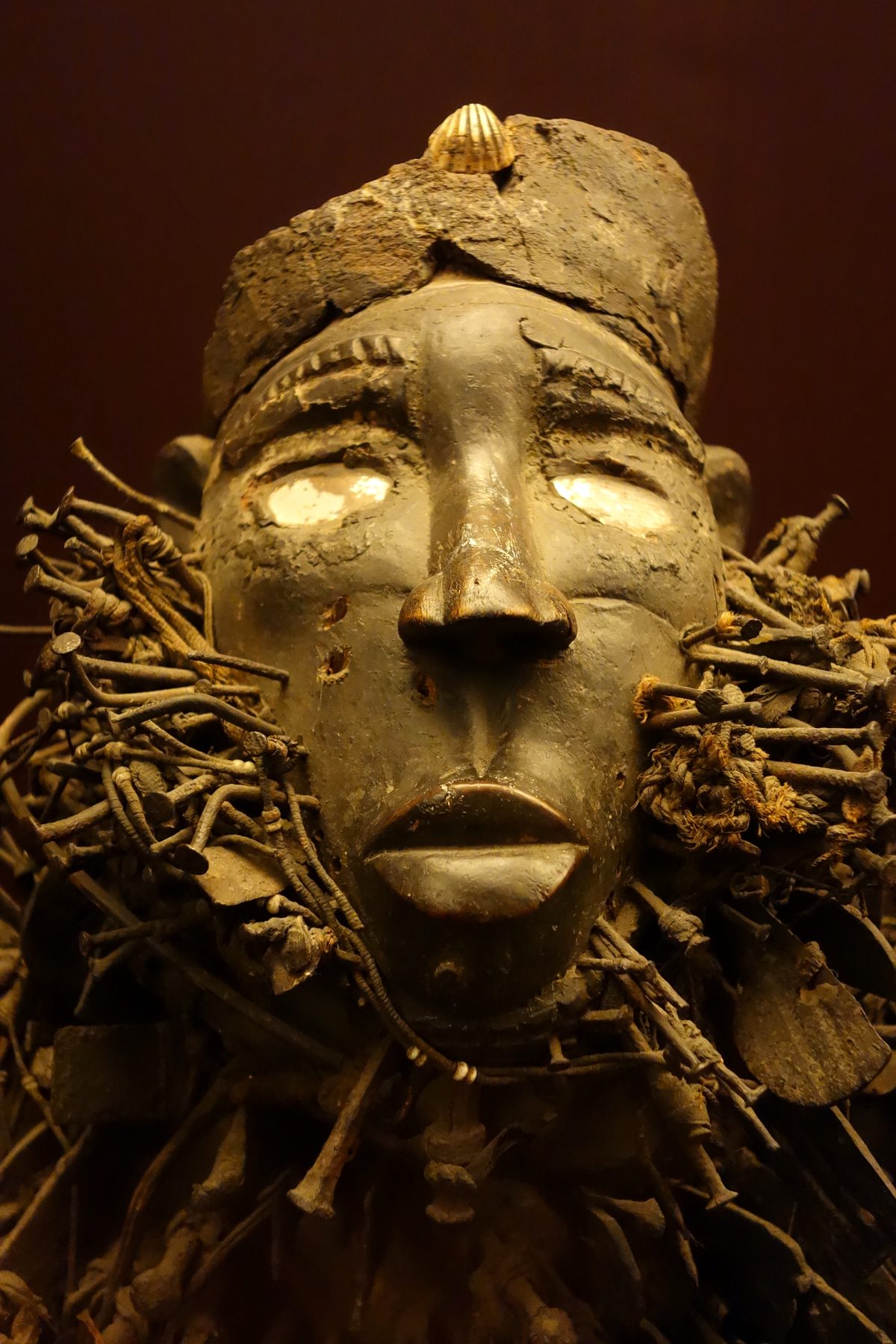
Kongo power figure (nkisi nkondi), Mayombe region, Lower Congo, Democratic Republic of the Congo, collection of the Royal Museum for Central Africa, Tervuren. Carved wood studded with forged iron nails and blades, with a resin and mirror sealed cavity for the empowering charge. Each piece of iron marks a separate oath or case brought before the figure. Photo: Daderot, CC0 1.0 (public domain dedication), via Wikimedia Commons (commons.wikimedia.org/wiki/File:Nkisi_nkondi_statue_-_Kongo,_Mayombe_region,_Lower_Congo,_DRC_-_Royal_Museum_for_Central_Africa_-_DSC06677.JPG). |
|||||
|
|
|||||
Topic of the WeekKongo Power Figures: the Nail and Mirror nkisiThe nail-studded figures of the Lower Congo are the single most copied object in African art, and the single most misread. Why the nails are not decoration, what the mirror over the belly actually seals, and how the modern authenticator separates a genuine instrument of justice from the carving made by the thousand for the curiosity trade. Last week we stayed in the savanna of south-central Congo and learned to read the angular Songye power figure against the rounded Luba court sculpture. This week we travel west, down to the Atlantic coast and the forested valleys of the Lower Congo, to meet the most famous and the most faked object in the entire African field. The Kongo power figure bristling with iron nails and blades is the image that most people in Europe carry in their heads when they hear the words "African fetish," and almost everything that popular image contains is wrong. The nails are not violence for its own sake, not decoration, not the marks of a curse laid on an enemy by sticking pins in a doll. They are the opposite of all of that, and understanding why is the first step to telling a real one from the reproduction that has flooded fairs, estate sales and online listings for a hundred years. Start with the right words, because the market gets them wrong constantly. The object is a nkisi (plural minkisi). The word does not mean statue. A nkisi is a container, an instrument that holds and directs spiritual forces, and it can take the form of a carved figure, but it can equally be a bundle, a pot, a shell or a cloth packet. What makes any of these a nkisi is not the carving but the charge inside it and the ritual specialist who assembled and activated it. That specialist is the nganga, the same role we met among the Songye last week, and as with the Songye the nganga, not the carver, was held to be the true maker of the working object. The aggressive, nail-studded type that everyone pictures is one specific class of nkisi: the nkondi (plural minkondi), from a verb meaning to hunt. A nkondi is a hunter. Its job is to track down wrongdoers, witches and oath-breakers, and the iron driven into its body is what sets it to work. Here is the part that changes everything. Each nail, blade, screw and shard of iron hammered into a nkondi marks a separate act. When two parties swore an oath, sealed a treaty, opened a contract or brought a dispute before the figure, a piece of iron was driven in to wake the nkisi and bind it to that specific case. People sometimes licked the blade first, sealing the agreement with their own saliva. If the oath was kept, nothing happened. If it was broken, or if someone fell ill and suspected witchcraft, the nkondi was roused again to hunt the guilty party and afflict them. A nkondi covered in hundreds of nails is therefore not a more decorated object than one with a dozen. It is an older and busier one, a public register of every agreement and grievance a community brought to it over years or decades. The surface is an archive. Read that way, the figure stops being a horror-film prop and becomes what it was: an instrument of law, justice and social order in a society that had no courthouse. The second diagnostic feature is the cavity. Somewhere on the figure, most often in the abdomen and sometimes in the top of the head, sits a sealed packet of empowering matter called bilongo. This is the medicine that does the work, assembled by the nganga from materials chosen for what they mean and what they sound like in the local language, earths from a grave, seeds, claws, stones, all packed into a hollow and closed over. And it is sealed, very often, with a piece of mirror or glass. That reflective disc is not an eye and not an ornament. It is a window onto the land of the dead, the boundary between the living and the spirit world that empowers the figure, and through it the spirit is understood to watch for the enemies it has been sent to find. A genuine Kongo power figure is built around that cavity and that seal. A figure made for sale very often forgets it, or fakes it with a modern mirror glued to a hollow that holds nothing. This edition walks a documented example, then five practical red flags, then the deeper history of the Kongo kingdom and the great judicial figures called mangaaka, the market bands, the AfroCheck framework, a reader question and the iOS update. |
|||||
|
|
|||||
Item of the WeekA nkisi nkondi, and the figure of Chief Ne KukoThe figure on this week's cover is a Kongo nkisi nkondi from the Mayombe, the forested region of the Lower Congo, and it sits today in the Royal Museum for Central Africa at Tervuren, the same Belgian institution that anchors so much of this field. It carries the diagnostic features on its surface. The body is carved in the rounded, naturalistic Kongo manner, far softer and more lifelike than the geometric Songye work of last week, often with an open mouth showing filed teeth, inset eyes of glass or ceramic, and a raised arm that once held a spear or blade. The torso and limbs are dense with iron, nails of different ages and shapes, flat blades, twists of metal, each one a case the figure was asked to judge. And the abdomen carries the resin-packed cavity sealed with its reflective disc. Nothing here is ornament. Every element is functional, and the function is justice. As with the Songye nkishi, the most important fact about this object is that it had two makers. The sculptor carved the wooden body, the receptacle, and that was only the start. The figure was then handed to the nganga, who assembled the bilongo, packed and sealed the cavity, and through ritual activated the inert carving into a working nkisi. Without that charge the figure is a body with no spirit in it. This is why a stripped, cleaned, "tidied up" power figure with its cavity emptied and its mirror gone has lost not just material but the very thing that made it a nkisi, and why a serious collector reads the completeness of the charge as carefully as the quality of the carving. The reason this tradition has a documentary backbone at all comes down to a handful of early figures collected while the practice was still living. The most famous of them is the great nkondi associated with Chief Ne Kuko of Boma, collected in 1878 by the Belgian agent Alexandre Delcommune and now at Tervuren, one of the earliest securely dated Kongo power figures in any museum. It matters out of all proportion to its size, because it is a fixed point. An object of known type, known place and known date against which everything later can be measured. When a specialist looks at an undocumented nail figure today, the Ne Kuko figure and its few early companions are part of the yardstick. They establish what the real thing looked like before the curiosity trade began turning out copies for European buyers, which it did almost from the moment these objects became famous. And they became famous fast, which is the root of the whole authentication problem. No African object captured the colonial European imagination like the nail fetish. It was photographed, exhibited, written up, and badly misunderstood as an instrument of dark magic rather than law, and the demand that followed was met, as demand always is, by supply. Carvers produced nail figures for sale. Genuine but exhausted figures had fresh nails added to look more dramatic. Whole pieces were invented. The result is that the nkisi nkondi is at once one of the most powerful and best documented traditions in African art and the single most reproduced and faked, and the two facts are the same fact. The figure on our cover is valuable precisely because its history places it on the right side of that line, and most of what you will meet in the trade sits on the other. |
|||||
|
|
|||||
Quick Check5 Red Flags on Kongo Nail Figures
Nail logic, the sealed cavity, patina that grows from use, the quality of the carving under the iron, and history plus regulated materials. Five axes. A genuine nkisi nkondi reads consistently across all of them. A failure on one can be a worn or restored detail. A failure on two or three means you are looking at decorative carving dressed as ritual sculpture, a tired figure freshly re-nailed to sell, or an outright fake wearing the most famous shape in African art. |
|||||
|
|
|||||
Did You Know
|
|||||
|
|
|||||
Looking DeeperThe kingdom, the medicine, and the great judgesThe Kongo were not a scattered forest people but the heirs of one of the great states of central Africa. The Kingdom of Kongo, centred on the Lower Congo and the Atlantic coast, was a powerful and centralised kingdom that the Portuguese reached at the end of the fifteenth century and whose ruler converted to Christianity, opening four centuries of contact, trade and upheaval long before the colonial period proper. The minkisi tradition lived inside this world, not outside it. The naturalism of Kongo carving, the modelled faces and confident anatomy that set it apart from the geometric styles of the interior, belongs to a society with a long history of sculpture, regalia and court art, and the nail figure is the product of that skill turned to the work of justice and protection. It helps to see the nail figure as one member of a large family. A nkisi could be aggressive or protective, public or personal, a carved human figure, an animal such as the two-headed dog nkisi kozo that hunted across the boundary of the living and the dead, or simply a bundle or pot. What unites them is the logic of the charge: a nkisi works because of the medicine sealed inside it and the spirit drawn to that medicine, not because of its shape. The nkondi, the hunter, is the dramatic public end of this spectrum, the figure of law and oath that received the nails. Understanding that the carving is the container and not the power is the single most useful idea a collector can carry into this field, because it reframes every question. You are not grading a sculpture. You are asking whether an instrument was ever built and used as one. Within the nkondi class stand the masterpieces, the large judicial figures known as mangaaka. These commanding works, carved in the Chiloango River region near the coast in the second half of the nineteenth century, stand with hands on hips or an arm raised, wearing the chiefly cap, the beard and the fierce inset-eyed gaze of an authority that brooks no argument. The Metropolitan Museum of Art, studying its own celebrated mangaaka, has connected a group of these large figures to a single workshop and, scholars argue, very likely a single master carver active in the 1880s, a rare case where the hand behind a body of African sculpture can be traced as clearly as a European master's. They were communal instruments of the highest order, set up to guarantee treaties and police the gravest offences, and they are among the supreme achievements of African art. For all of this the documentary anchor in Europe is, once again, the Royal Museum for Central Africa at Tervuren, holder of the largest documented collection of Congolese material in the world, together with the early field records and the few securely dated figures such as the Ne Kuko nkondi collected in 1878. Provenance through the old Belgian colonial and missionary networks, the routes we walked two editions ago, is the strongest single signal a Kongo power figure can carry. And that same provenance now comes with the weight an honest newsletter has to name. The colonial-era acquisition of Central African objects is under active research and debate, the AfricaMuseum is itself investigating the violent histories behind parts of its collection, and the question of restitution sits over the whole field. None of this changes how an object is authenticated. It does change the conversation a responsible seller and buyer have around it, and it is part of reading a Kongo piece honestly in 2026. The discipline that ties it together is the one we have come back to every week. You read the object against a published corpus and a documented collection that another person can open and check, the early figures, the museum holdings, the scholarship of MacGaffey and others on Kongo religion, the Met's reconstruction of the mangaaka workshop. An attribution that rests on those sources can be tested. A confident label in a sale catalogue that rests on nothing cannot. With the most copied object in African art, that difference is not academic. It is the whole game. |
|||||
|
|
|||||
Market & ValueWhat a Kongo power figure is worth, actuallyNo object in African art has a wider spread between its floor and its ceiling than the nail figure, and any honest set of bands has to say so first. The same silhouette can be worth a hundred euros or a seven-figure sum, and the carving is often the smaller part of the difference. Age, genuine ritual use and a documented chain of ownership reaching back into the colonial period decide almost everything. The headline results come from the dedicated African and Oceanic art sales at Christie's and Sotheby's in Paris, at Bonhams, and through Drouot, with the strong Belgian houses, Bernaerts among them, handling Congolese material regularly given the country's history, and Catawiki carrying the high-volume lower end where attributions are frequently hopeful. Read the bands below as orientation, not as a price list. Every serious piece is valued on its own body and its own paperwork. At the floor sits the decorative and tourist nail figure, the twentieth-century and contemporary carving made for sale rather than use, the kind produced in quantity precisely because the type is so famous. With its uniform modern nails, bright wood and applied patina, this material trades from roughly one hundred to five hundred euros, and it is an honest object at that price as long as no one pretends it is a field-used nkisi. Above it, older pieces that show real workmanship and some genuine age but carry no provenance and no clear field history run from a few hundred euros into the low thousands, with the ceiling set by the missing documentation rather than the quality of the carving. The picture changes the moment provenance enters. A genuine, older nkisi with a credible collection history, an intact charge and an honest accumulation of iron moves into a band that can run from the low tens of thousands upward at the specialist sales, depending on quality, age, completeness and the strength of the paper trail. The great judicial figures, the documented and published minkondi and above all the mangaaka masterworks with early collection histories, occupy the top of the field and reach well into the six figures, with the finest and best-provenanced examples standing among the most valuable objects in all of African art. The gap between a five-hundred-euro curiosity and a six-figure masterwork is not the number of nails. It is age, use and history. The lesson for the buyer at a Belgian estate sale, brocante or regional auction is the inverse of the one that applies to silver or porcelain, where the mark settles the question. Here there is no hallmark and no factory stamp. There is only the object, its surface, its charge and its history, and the history is the part most often missing from the lot description. A nail figure catalogued generically as "Congolese fetish, nail figure" with no provenance is a piece whose value cannot be read from the catalogue alone, in either direction. It may be a decorative carving worth a couple of hundred euros, or, far more rarely, a genuine field object whose worth runs into the thousands once the history is established. The discipline that protects you is the same in both cases. Establish what the object is before you establish what it is worth, and never let a dramatic surface or a confident label stand in for the examination you have not yet done. |
|||||
|
|
|||||
Behind the ScenesOur AfroCheck analysis treats the Kongo nail figure as the high-risk object it is, and works it along several tracks at once. The first is the iron itself. The module is built to read the hardware as a record rather than a decoration, weighing the variety, age and corrosion of the nails and blades, the way they cluster and the way they have aged into the wood, against the tell-tale uniformity of a figure covered in identical bright modern nails set in a single decorative pass. A dramatic surface does not earn the object a pass. The pattern of the iron either reads like decades of separate decisions or it does not. The second track is the charge and the carving. AfroCheck looks for the evidence that a real cavity of bilongo was built into the abdomen or head and sealed, with old resin and an aged mirror or glass disc as part of the original construction, and it flags the empty hollow, the missing cavity and the bright modern mirror glued on as the warning signs they are. Then it judges the body under the iron, the quality of the face, the hands, the proportions, the inset eyes and the modelled mouth, because a master Kongo carver is hard to fake even when the silhouette is easy to copy. A red flag on one track is not compensated by a strong showing on another. If the signs of manufacture are present, the verdict moves. The third track is provenance, reference and law. For attribution AfroCheck weighs the published corpus and the documented collections behind the tradition, the holdings and field records of the Royal Museum for Central Africa at Tervuren above all, the early dated figures, and the scholarship of MacGaffey and the Met's work on the mangaaka workshop. Early Belgian collection provenance is treated as a strong positive signal, and its absence as a question the object then has to answer on its own body. Animal materials such as ivory, teeth and claws are flagged for CITES at once. The verdict comes in the same five levels we use across every module, from AUTHENTIC to NOT AUTHENTIC, with the reasoning attached and the limits stated. What the photograph cannot show, we say we cannot see, and we ask for the angle, the cavity, the underside, the close detail that would let us see it. On the most copied object in the field, that restraint is the whole value of the tool. |
|||||
|
|
|||||
Question of the Week"I bought a wooden figure at a brocante covered in nails and metal, with a little mirror on the belly. The seller said it is a genuine Congolese nail fetish. It looks dramatic, but how do I know if it is real?" The honest answer is that the great majority of nail figures in the brocante and online trade are decorative carvings made for sale, not field-used minkisi, because this is the single most reproduced object in African art. That is not a verdict on yours, it is the base rate you start from. Three things will tell you most of what you need. First, look hard at the iron: a real figure carries varied, hand-forged, differently aged nails and blades with corrosion bleeding into the wood, while a reproduction tends to wear uniform bright modern wire nails set evenly all over. Second, look at the cavity behind that mirror: a genuine charge shows old resin and packed medicine, while a fake is usually a clean empty hollow with a new mirror glued on. Third, look at the carving under the hardware, the face, the hands, the proportions, because a master Kongo carver is hard to imitate even when the nails are easy. Then do it properly. Photograph the whole figure from front, side and back in even daylight, and add close-ups of the face, the hands, the base, the cavity and its seal, and several nails so the iron can be read. Write down everything you know about where it came from, any old label, name or receipt, because with this object more than any other, history is value. Then send the photographs and the history through AntiqBot's AfroCheck. We read the nail pattern, the cavity and the carving, weigh the surface for genuine age against manufacture, compare the piece against the documented Kongo corpus, flag any regulated materials for CITES, and return a verdict on the five-level scale with the reasoning and the limits stated. If we need a tighter shot of the cavity or a nail, we ask. Send your question to info@antiqbot.com |
|||||
|
|
|||||
|
Have a nail figure, a carved nkisi or any Congolese piece you want to place between a genuine field object and the decorative market? Sign up and get 1 free credit for your first analysis. After that, buy credit packs starting from €0.60 per analysis.
|
|||||
|
|
|||||
AntiqBot on iOSThe AntiqBot iOS app is live in the App Store. Pricing matches the web: 5 credits for €4.99, 10 for €8.99, 25 for €17.99, 50 for €29.99, with one free credit on registration. Search "AntiqBot" in the App Store, or use the web application at antiqbot.com. |
|||||
|
|
|||||
Next WeekThe Kuba Kingdom: the ndop king, the cut-pile cloth and the faked palm-wine cup |
|||||
|
|
|||||
|
AntiqBot.com · AI-Powered Antique Identification You receive this newsletter because you signed up via AntiqBot.com. Je ontvangt deze nieuwsbrief omdat je je hebt aangemeld via AntiqBot.com. © 2026 AntiqBot · Erwin Truyts · KBO 0826.004.290. All rights reserved. |