The Kuba Kingdom: the ndop king and the forged palm wine cup
| ||
|
A Kuba ndop is not a portrait in our sense of the word. It is an idealised royal figure, carved to hold the spirit of a nyim beside the emblem of his reign, and almost every genuine example has ended up in a museum. What the market sells you is rarely an ndop, but the palm wine cup, the tukula box and the woven Kasai velvet that made the Kuba court famous, and that for exactly that reason are reproduced in their thousands. How to read real court work against the decorative carving made for sale. | ||
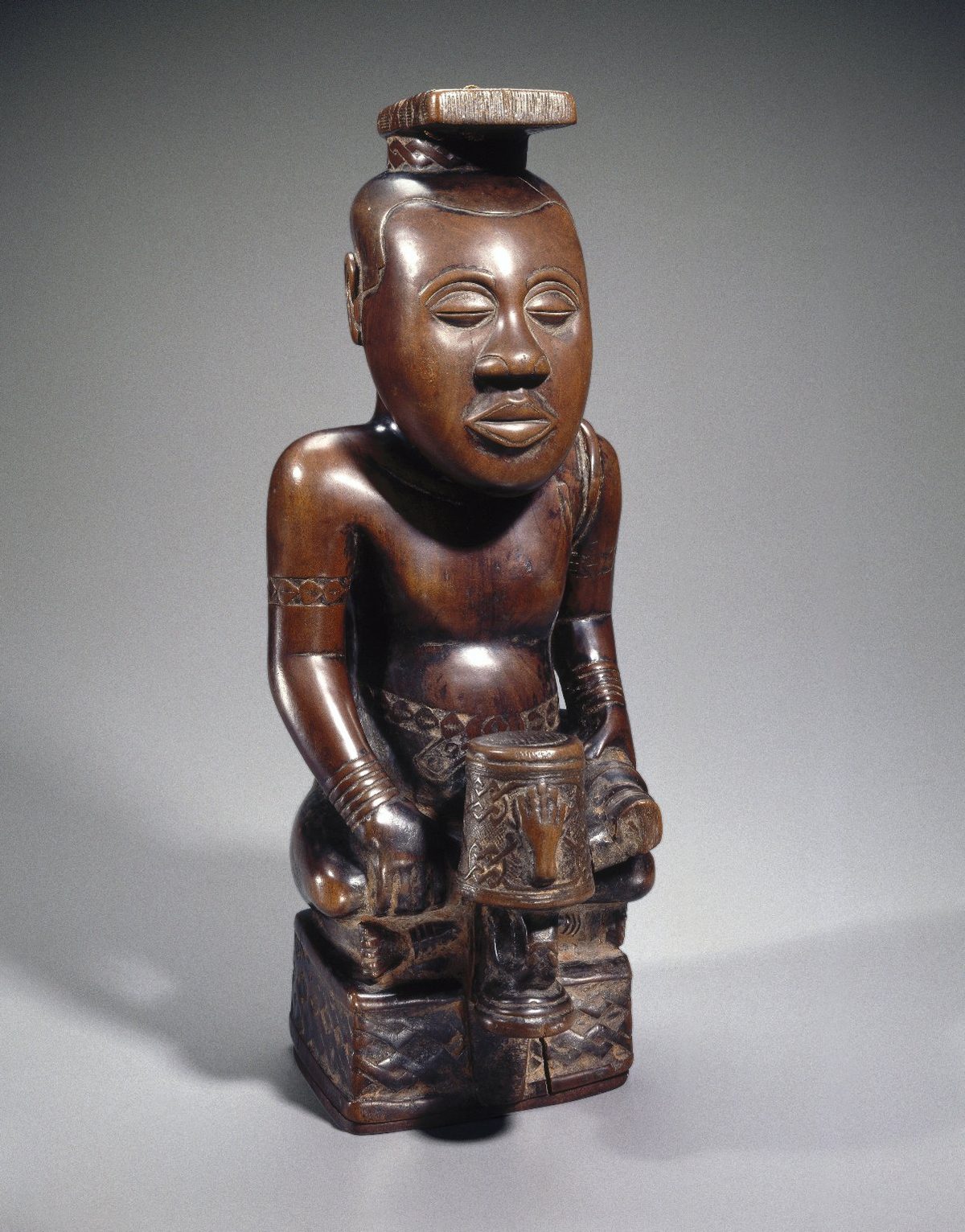
Kuba royal figure (ndop) of the Bushoong, depicting the nyim Mishe miShyaang maMbul. Hardwood with tukula, circa 1760-1780, Brooklyn Museum collection (accession 61.33), one of the oldest surviving wood sculptures from the African continent. The king sits cross-legged on a platform, wears the headdress and holds the ikul knife, and on the front of the base stands the ibol, the personal emblem that identifies his reign: a drum with a severed hand. Photo: Brooklyn Museum, Creative Commons Attribution, via Wikimedia Commons. | ||
|
Topic of the week
A court of carvers and weavers
Last week we stood in the forested valleys of Lower Congo with the nail figure. This week we travel east to the Kasai, to the Kuba kingdom, one of the great court cultures of Central Africa and perhaps the most ornamental. The Kuba were not a scattered forest people but the heirs of a centralised kingdom of carvers and weavers, and their signature is the surface: a dense, never exactly repeating geometric interlace that covers cups, boxes, headrests and cloth. That ornament is both their hallmark and the trap. The same pattern that graces real court work is slapped onto reproductions, and no object in this field is copied more often than the Kuba palm wine cup and tukula box. This edition reads the most famous Kuba object, the ndop royal figure, then five red flags, then the kingdom and the Kasai velvet, the market values, the AfroCheck framework, a reader question and the iOS update. | ||
|
Item of the week
The ndop, and the emblem that names a king
The figure on the cover is an ndop, an idealised royal portrait of the Bushoong, the dominant Kuba group. An ndop does not try to capture a likeness. It shows the ideal qualities of kingship: the nyim sits cross-legged on a platform, a posture that is rare in African sculpture, with a calm inward gaze that conveys courtly composure, the long-brimmed headdress, the ikul peace knife in the hand and a belt of cowries, the shell motif that points to Woot, the mythical founder. What separates one figure from another is not the face but the ibol, a personal emblem the king chose at his investiture and which was carved in relief on the front of the base. On this figure the ibol is a drum with a severed hand, and that is what makes the attribution to Mishe miShyaang maMbul possible. Without that key, an ndop is a formal figure with no name. Like last week's power figure, the ndop had more than one maker. The sculptor cut the body with the adze into its rounded, burnished form, but the object gained meaning only through the king who commissioned it and the regalia it carries. One ndop per king, and only while the ruler was present to be carved. If the figure decayed, an exact replica could replace it. And its role went beyond memory: the ndop was believed to house the king's double, the counterpart of his soul, so that a wound to the ruler would appear on the figure. It was placed beside women of the court about to give birth, to ensure a safe delivery, and in the king's absence it was anointed and stroked as his surrogate. That we know this tradition so sharply is owed to a handful of early figures. The Brooklyn ndop was collected in 1909 in what was then the Belgian Congo and acquired by the museum in 1961, and it ranks among the oldest surviving wood sculptures from the continent. The Royal Museum for Central Africa in Tervuren holds comparable pieces, and the British Museum has three ndop documented by the explorer Emil Torday around 1909, one of which is counted among the oldest wood sculptures from Sub-Saharan Africa. Those fixed points are the measuring rod. They show what real court work looked like before the market began to copy the type, and they explain at once why you almost never see a genuine ndop for sale: they sit in museums, not at the flea market. | ||
| ||
|
Did you know
The ndop was not treated as a statue but as a living surrogate of the king. The historical and ethnographic work on the Kuba, above all that of Jan Vansina and of Joseph Cornet in Tervuren, describes how the figure was held to house the ruler's double, anointed in his absence and placed at court during childbirth. Hold that thought, and the object rearranges itself. It is not about the beauty of the carving but about the identity the ibol records and the role the figure played. An ndop with no legible emblem is a figure that has lost its name, and in a field where the copy is the rule, that name, with the provenance that supports it, is the difference between heritage and decoration. | ||
|
A closer look
The kingdom, the velvet and the ornament
The Kuba kingdom took shape in the seventeenth century around its capital Nsheng, and tradition credits its founding to the great king Shyaam aMbul aNgoong. It was a centralised court state with a long tradition of sculpture, regalia and weaving, and that explains the confident naturalism of Kuba carving, so different from the geometric styles of the interior. Scholars place the rise of the ndop tradition in the late eighteenth century, and the few dated early figures in Brooklyn, London and Tervuren together form the backbone against which everything later is measured. As famous as the figures is the woven Kasai velvet, often called Shoowa cloth after the group best known for it. It is made from raffia palm fibre, with a technique in which cut pile creates a velvet-like surface filled with geometric patterns that never exactly repeat. The labour was divided: men wove the raffia ground, women embroidered and cut the pile. These cloths served as prestige goods and status objects, and their interlocking geometry astonished modern Western artists long before the market sold them as decoration. The same feel for surface returns in the carved work: the palm wine cup, often in the form of a head, the tukula box for the red camwood powder, the headrest and the friction oracle. Dense geometric interlace is the Kuba signature, and for that very reason the first thing a forger copies. At the summit of the court arts stand the three royal masks, the Mwaash aMbooy that embodies the founder Woot, the female Ngaady aMwaash and the Bwoom, dressed with beads, cowries and raffia. The documentary anchor is again European: the Royal Museum for Central Africa in Tervuren with the largest documented Congo collection in the world, Torday's fieldwork, and exhibitions such as the Metropolitan's Heroic Africans, which placed the ndop in a wider story of African court figures. And that provenance comes, as every week, with the weight an honest newsletter must name. The colonial acquisition of Central African heritage is under active research and debate, the AfricaMuseum is itself examining the histories behind parts of its collection, and the question of restitution hangs over the whole field. None of this changes how an object is authenticated. It does change the conversation a responsible buyer and seller have around it. | ||
|
Market & value
What Kuba work is really worth
Read the bands below as orientation, not a price list. At the base sits the decorative palm wine cup and tukula box, twentieth-century and contemporary carving made for sale, produced in quantity precisely because the type is so recognisable. With applied patina this material runs from a few tens to a few hundred euro, and it is an honest object at that price as long as no one pretends it saw court use. Above it sit older pieces that show real craftsmanship and some age but carry no provenance, from a few hundred to the low thousands, with the ceiling set by the missing documentation. Fine old Kasai velvet moves on a similar logic: single panels stay modest, large early examples of quality climb. The ndop sits off that scale. Almost every known example is in museum hands, and a genuine, documented ndop coming to market would be an event in itself, with a value reaching well into six and toward seven figures. The vast majority of what is offered as ndop is later or decorative. The leading results for Kuba court work come from the specialist African and Oceanic art sales at Christie's and Sotheby's in Paris, at Bonhams and through Drouot, with the strong Belgian houses, Bernaerts among them, handling Congolese material regularly, and Catawiki carrying the lower end at high volume where attributions are often hopeful. The lesson is the reverse of the one for silver or porcelain. Here no hallmark settles the question. There is only the object, its surface, its function and its history, and the beauty of the ornament is never proof of authenticity, because the pattern is exactly the easiest thing to copy. | ||
|
Behind the scenes
Our AfroCheck analysis reads a Kuba object along several tracks at once. The first is the surface. The module weighs the geometric interlace on its wear logic, the smoothed high points and the tukula residue in the recesses against the telling uniformity of machine-sharp ornament applied in a single decorative pass. A beautifully decorated surface earns the object no free pass. The second track is form and function: on a cup or box the evidence of real use, on an ndop the posture, the proportions, the regalia and above all the ibol that names a particular king. A red flag on one track is not offset by a strong showing on another. If the signs of fabrication are present, the verdict moves. The third track is provenance and reference. AfroCheck weighs the published corpus and the documented collections behind the tradition, Tervuren above all, the early ndop in Brooklyn and the British Museum, and the work of Vansina and Cornet. Early Belgian or Torday provenance counts as a strong positive signal, its absence as a question the object must answer on its own body. Animal material such as ivory, tooth or claw is flagged at once for CITES. The verdict comes in the same five tiers we use across every module, from AUTHENTIC to NOT AUTHENTIC, with the reasoning attached and the limits stated. What the photo cannot show, we say we cannot see, and we ask for the base with the ibol, the inside of the cup, the close detail that would let us see it. | ||
|
Question of the week
"I bought a wooden cup at a flea market, covered all over in geometric patterns, sold as Kuba from Congo. It looks beautiful. How do I know if it is real court work?" The honest starting point is that the great majority of Kuba cups and boxes in the flea-market and online trade is decorative carving made for sale, because this type is among the most reproduced in Central Africa. That is not a judgment on yours, it is where you begin. Three things tell you most. Look first at the ornament: real interlace is hand-cut, slightly irregular, and worn smooth on the high points, while a reproduction is usually uniformly sharp and unworn. Look then at the inside and the patina: a used cup carries residue and colour in the recesses, a forgery is fresh and clean under an even dark coat. Look finally at whether the surface follows the form or simply lies over it. Then do it properly. Photograph the whole object in even daylight, from every side, with close-ups of the rim, the interior, the base and the pattern. Write down whatever you know about its history, any old label or name, because with Kuba history is value. Then run it through AntiqBot's AfroCheck. We read the ornament and the patina, weigh the surface for real age against fabrication, compare it with the documented Kuba corpus, flag regulated material for CITES, and give a verdict on the five-tier scale with the reasoning and the limits attached. Send your question to info@antiqbot.com. | ||
| ||
|
AntiqBot on iOS
The AntiqBot iOS app is live in the App Store. Prices match the web: 5 credits for €4.99, 10 for €8.99, 25 for €17.99, 50 for €29.99, with one free credit on registration. Search "AntiqBot" in the App Store, or use the web app at antiqbot.com. | ||
|
Next week
Chokwe: the hero Chibinda Ilunga, the mwana pwo and the chief's chair
Next week in AntiqBot Weekly #21 we travel south to the Chokwe of Angola and eastern Congo. The famous figure of the founding hunter-hero Chibinda Ilunga, the serene mwana pwo female mask and the finely carved chief's chair, and how to read real Chokwe court work against the decorative carving that floods the market. | ||
|
AntiqBot.com • AI-powered antique identification You receive this newsletter because you signed up via AntiqBot.com. © 2026 AntiqBot • Erwin Truyts • KBO 0826.004.290. All rights reserved. |