Chryselephantine: the bronze that was given ivory hands
| ||
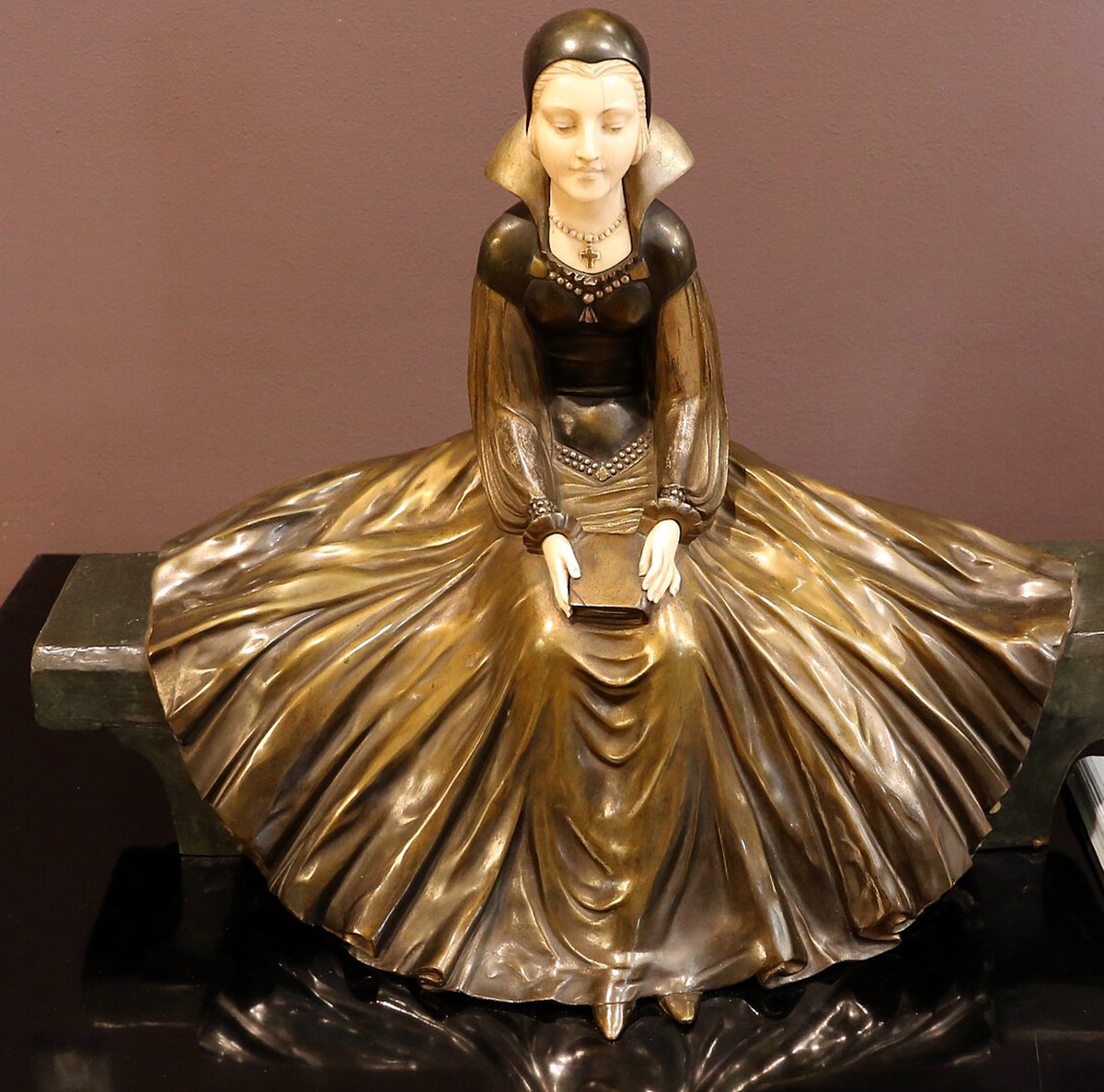 | ||
Demetre Chiparus, figure in bronze, silver and ivory, circa 1920-1940. Photo: Sailko, CC BY 3.0, via Wikimedia Commons. | ||
|
A dancer stretches her arms above a base of green onyx, the bronze cold painted in a geometric costume, the face and hands in something smooth and white. The seller says Chiparus, the price says Chiparus, and yet most figures that look like this are spelter under paint, celluloid instead of ivory, or a recast that shrank in the mould. Recognising the pose is easy. Knowing whether the metal, the hands and the cast are what they claim to be, that is the work of this week. | ||
Topic of the week The last edition was about Memphis: plastic laminate, loud colour, and a group of designers who decided in 1981 that cheap materials were allowed to carry an expensive idea. This week we go back half a century, to the exact opposite proposition. Expensive materials, an expensive idea, and a method of production that has been copied endlessly for precisely that reason. Chryselephantine is an old word for an old combination. Gold and ivory, literally. In the 1920s and 1930s it acquired a new meaning: a bronze figure, usually a dancer or an athlete, in which the face, the hands and sometimes the legs are carved from ivory. The bronze is patinated, gilded, silvered or cold painted. The base is marble or onyx. The whole thing sits on a mantelpiece and announces that somebody spent money. Three names carry the category. Demetre Chiparus, born in 1886 in Dorohoi in Romania, died in 1947 in Paris, where he worked for almost his entire career. He studied under Raffaello Romanelli in Italy and, from 1912, at the Ecole des Beaux-Arts in Paris. Ferdinand Preiss, born in 1882 in Erbach im Odenwald, died in 1943 in Berlin, trained as an ivory carver under Philipp Willmann. And Josef Lorenzl, 1892 to 1950, Vienna, who learned bronze casting at the Arsenal and later became one of the principal designers at Goldscheider. What the three of them share is not only a style. It is that their work has been copied, over the intervening century, in every way anyone could think of: in spelter instead of bronze, in resin instead of either, with celluloid instead of ivory, and as a recast taken from an existing example rather than from the artist’s own model. Anyone who runs into a dancer on green onyx today is, statistically speaking, more likely to be looking at one of those copies than at the original. That is not a reason to walk away from the category. It is a reason to look at it in a fixed order, because the order in which you ask the questions decides how much the answers are worth. | ||
Object of the week Take the classic arrangement. A female figure of 35 to 65 centimetres, in a dance pose, arms extended. The body in bronze, cold painted in a costume with geometric motifs. Face and hands in ivory, with finely carved fingers. Underneath, a base of brown and green onyx, or of marble with a band of black Belgian stone. On a genuine Chiparus edited by Edmond Etling & Cie in Paris, you see a specific layering of marks. The artist’s signature, “D. H. Chiparus”, is engraved into the base. The publisher’s mark, “Etling Paris” or “Etling France”, together with a model number, is cast into the bronze. The underside often carries “MADE IN FRANCE”. The foot of the figure itself may bear the word “Bronze” with a number. That combination of engraved and cast marks is not a detail. It is exactly the thing a forger usually gets wrong, because reproducing a name is easy while reproducing a workshop’s habits is not. Chiparus also worked for Les Neveux de J. Lehmann in Paris, a house with addresses on the rue de Paradis and the avenue de l’Opera, whose mark appears as LNJL. Preiss worked in Berlin with Arthur Kassler under the name Preiss & Kassler; their “PK” logo is stamped into the bronze, not cast with it. Lorenzl signed in full as “Lorenzl”, but also in shortened forms such as “Lor”, “Enzl”, “Renz” or “Renzl”, and the great majority of his figures stand on a plinth of Brazilian green onyx. Those are the reference points. Everything that follows is about testing a piece in front of you against them, in an order that puts the cheap-to-fake evidence last. | ||
| ||
Did you know Ferdinand Preiss carved his ivory with a dentist’s drill. He had been trained as an ivory carver and was looking for a way to work faster and more precisely than traditional hand tools allowed. You can see the result in the faces: eyelids, lips and finger joints cut with a crispness his imitators rarely reach. And the workshop that produced that work no longer exists, in the most literal sense. Preiss died in July 1943 in Berlin of a brain tumour, aged 61. The firm closed with his death, and the workshop in the Ritterstrasse, along with the stock of models kept there, was destroyed in bombing raids. What survives of Preiss is what had already left the building. | ||
In depth A corridor in the Waldorf Astoria Most forgery stories in this category exist only as gossip passed between dealers. This one exists as a federal court ruling, and that is what makes it usable. In July 2007, a British collector bought a group of Art Deco sculptures from a gallery in the lobby of the Waldorf Astoria in Manhattan for 105,000 dollars, plus shipping. The sale came with a story attached: the gallery was said to hold Chiparus’s original moulds, the pieces were said to have been cast from them, Chiparus was said to have lived and died at the Waldorf, and everything was going at a 75 percent discount because the gallery was closing. Chiparus lived in Paris and died in Paris. He is buried in the cemetery at Bagneux, south of the city. When the case reached the court for the Southern District of New York in 2013, the art historian and expert Kenneth Linsner testified that the sculptures were modern recasts, most likely made in China decades after the Art Deco period, and not taken from original moulds. He valued the group in 2014 at approximately 5,600 dollars. The judgment is dated 3 November 2016. Here comes the honest part of the story, and it is sharper than a simple tale about a forger getting caught. The buyer did not win. His contractual claims were time-barred, because too much time had passed between delivery in 2007 and the filing of the suit in 2013. On the remaining fraud claim, the court held that he had not shown, to the required standard of proof, that the sellers knew the pieces were recasts; in the court’s view they had relied reasonably on their regular supplier. The lesson is not in the sum of money. It is in the timeline. Six years between the purchase and the walk to the courthouse were enough to let the strongest claim expire, and the weaker claim that remained demanded proof of what was going on inside the seller’s head. That proof is almost never available. Anyone who buys an expensive piece and only begins to have doubts years later is, in legal terms, nearly always too late. Verification belongs before the payment, not after it. There is a second reading of the same case that is worth keeping. Every element of the sales pitch was checkable at the time. Where Chiparus lived and died is a matter of public record. Whether a gallery holds original moulds is a claim that can be asked about in writing. A closing-down discount of 75 percent invites the question of what the remaining 25 percent is being measured against. None of that requires an expert. It requires asking before the money moves. | ||
Market & value What an Art Deco figure is really worth The market for this category runs at two speeds, and the gap between them is wider than in almost any other twentieth-century discipline. At the top, a great deal is still happening. “The Dolly Sisters” by Chiparus made 277,250 pounds at Bonhams on New Bond Street on 14 November 2012; in the same sale “Starfish” reached 91,250 pounds and “Ayouta” 18,750 pounds. “Semiramis” sold at Bonhams in London on 17 June 2015 for 176,000 pounds, described by the house itself as a world record for that model. In Munich, “Les Girls” made 265,000 euros on 9 June 2021 and “Danseuse aux eventails” 140,000 euros on 17 November 2021. At Millon, “Danseuse espagnole” reached 58,000 euros in November 2021 and “La danseuse de Kapurthala” 42,000 euros in November 2022. Preiss sits consistently below that level. “Rote Tanzerin” made 45,000 euros in Munich in June 2021. At Bonhams in New York on 14 December 2011, “Lighter than Air” and “Sun Worshipper” each sold for 43,750 dollars and “Con Brio” for 32,500 dollars. Below that tier, a completely different story begins. At Millon, a Chiparus “Danseuse au cerceau” made 15,000 euros in April 2025, an “Ours polaire” 6,500 euros in March 2026, a “Jeune fille au cartable” 1,800 euros, a “Little clown” 1,500 euros, a “Pelican” 400 euros and an “Ibis” 350 euros. A Lorenzl dancer of nearly 50 centimetres, bronze with ivory on onyx, made 5,040 pounds at Lyon & Turnbull in April 2024. But at Roseberys in July 2023 a cold-painted Lorenzl on green onyx went unsold against an estimate of 4,000 to 5,000 pounds, and at Tajan in Paris a small Lorenzl dancer failed to sell against an estimate of 700 to 1,000 euros. Anonymous spelter from the 1920s and 1930s, of which there is a very great deal on the market, is according to Millon generally estimated at a few hundred euros. So the floor of this market is not soft. It is liquid. An unsigned spelter dancer is decoration and gets paid for as decoration. The same model with a genuine signature, genuine bronze and genuine ivory can sit a factor of 20 to 100 higher. That is precisely why this is the category in which the question “what is this actually made of” carries the most financial weight. The rule that changed everything since 2022 There is a second reason the middle of this market has gone quiet, and it is printed in the Official Journal. Regulation (EU) 2021/2280 removed, with effect from 19 January 2022, the general exemption that had freed worked items more than fifty years old from certification, insofar as those items contain elephant ivory. Since then there is no automatic antiques exemption for elephant ivory within the European Union. Every commercial transaction requires an individual certificate. Certificates issued before 19 January 2022 lost their validity on 19 January 2023, although it remains sensible to keep the copy as evidence of legal acquisition. What is still possible: worked ivory from before 3 March 1947, case by case and on certificate, and musical instruments from before 1975. An Art Deco figure from the 1920s or 1930s therefore falls, in principle, within that antique ivory category. One important detail for anyone who has heard British rules quoted: the European regime has no percentage threshold. A bronze with nothing but ivory hands and a face is treated exactly like a solid ivory carving. In Belgium this runs through the FPS Public Health, CITES service. For worked ivory from before 1947, the file requires an expertise report from a recognised independent expert covering age, carving style, technique and provenance, or alternatively a carbon-14 analysis; in addition a signed background document, clear colour photographs including close-ups of the marks, and proof of legal acquisition. If an auction house is selling on your behalf, a written mandate belongs in the file. And here is the operational rule that gets broken most often: you may only trade the piece from the moment you physically hold the original European certificate, the yellow document. No advertising, no selling, no deposit taken, before it is in your hands. The CITES service, incidentally, does not itself determine the age or the value of your ivory. That expertise is yours to supply and yours to pay for. Run those costs against a figure worth 2,000 euros and you understand why a lot of owners simply leave the piece on the shelf. Run them against a figure worth 40,000 euros and the whole exercise is an administrative formality. The United Kingdom, historically the most important market for Chiparus and Preiss, banned trade in elephant ivory from 6 June 2022 with only narrow exemptions, so when selling, expect a field of buyers inside the Union. There is a flip side that is rarely mentioned. If the ivory parts turn out not to be ivory at all but bone, celluloid or resin, which is extremely common on lesser figures and universal on modern recasts, then the piece is legally free to trade without restriction. Identifying the material is therefore not only a question of authenticity. It is the first step that decides which body of law applies at all. | ||
Behind the scenes This category is a good illustration of why a judgment about authenticity and a judgment about value are not the same question, and why the two have to stay separated inside an analysis. A figure can be simultaneously genuine and worthless, and simultaneously doubtful and valuable. A period spelter piece from the 1930s is an authentic object from the right moment in time, and still 200 euros’ worth of decoration. A correctly signed Chiparus on a modern replacement base is largely original and still damaged in its market value. The error ruled out hardest in the analysis is the idea that a positive argument can offset a red flag. A cast signature where an engraved one belongs, or a washed-out patina with a grey undertone, does not disappear because the base happens to be beautiful. Red flags get named, they push the score down, and the text says so without softening. What the analysis can and cannot do for this category belongs in the open as well. Assessable from photographs: the layering and type of the marks, the crispness of the chasing and the carving, the colour and character of the patina, the depth of colour in the base, and whether the proportions and the model correspond to documented versions. What photographs do not decide is whether the metal beneath the patina is bronze or zinc, and whether the white material is ivory or plastic. Both of those are physical tests, and they are exactly the two that determine the money. An analysis that stays quiet about that limitation is pretending. | ||
Reader question “My dancer has a signature in the base. Does that mean she is genuine?” It is the question that comes back most often with this category, phrased in a dozen different ways. The answer is that the signature is almost the last of the five checks, not the first. A signature is the cheapest component of a forgery. It costs an engraver ten minutes, and for exactly that reason it gets applied everywhere, including to spelter that never came within a mile of a Chiparus workshop. What does count is whether the signature matches the way that workshop actually marked its output: engraved where engraving belongs, cast where casting belongs, stamped where stamping belongs, and with a pattern of wear consistent with the rest of the piece. So start at the bottom. Metal first, ivory second, then the surface and the base, and the signature last, as confirmation of what the first four checks had already told you. On a signed piece that fails the first four, the signature is not an argument in its favour. It is the sixth red flag. Send your question to info@antiqbot.com. | ||
| ||
Next week A new object, five new checks
Next week in AntiqBot Weekly #25 we stay at the usual desk, with a new object and five new checks to test it against. | ||
|
AntiqBot.com • AI-powered antique identification You receive this newsletter because you signed up via AntiqBot.com. |