| ||
Gallé: the most copied glass of art nouveauReal cameo, star-signed factory work, Romanian TIP glass or a modern fake? Five checks inside. | ||
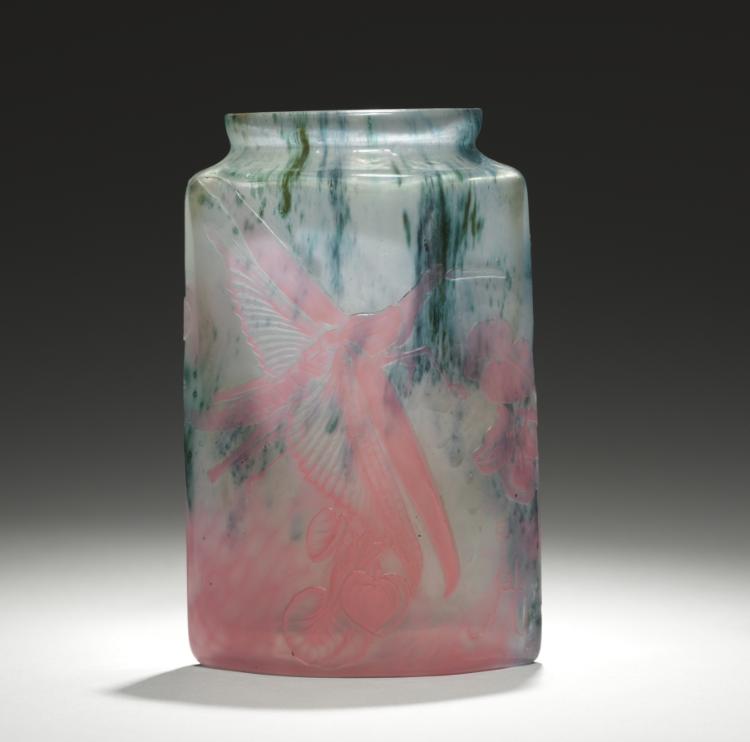
Vase, Emile Gallé, ca. 1900. Photo: The Cleveland Museum of Art, public domain. | ||
A baluster vase with purple clematis on a creamy ground, signed Gallé. The finest glass of art nouveau, and also the most copied. Read only the signature and skip the rest, and you can easily pay hundreds of euros for decorative glass worth fifty. | ||
|
Topic of the week
Emile Gallé (1846-1904) of Nancy was a glass artist, furniture designer and passionate botanist. In 1901 he co-founded the École de Nancy, the collective that shaped French art nouveau. His most famous technique is cameo glass: two to four layers of coloured glass, with the decoration etched out using hydrofluoric acid and, on the best pieces, finished on the wheel. After his death in 1904 the firm continued production into the 1930s. That factory output is fully collectable glass. The trouble lies with what came later: Romanian TIP glass with the mark ground off, and modern reproductions carrying a fake signature. | ||
|
Object of the week
The type you will meet most often: a baluster vase of 25 to 35 centimetres, three layers of glass, clematis or hydrangea decoration in purple and aubergine on a cream to salmon ground, signed Gallé in cameo relief. These were the so-called vases de commerce, the workshop's standard production, made in series even in their own day. Such vases surface weekly on Catawiki, at Flemish auction houses such as Bernaerts and at flea markets. That is exactly why copyists love them: the model is familiar, demand is high, and buyers often look no further than the name. | ||
| ||
|
Did you know
The star before the signature was not a trick but an honest statement: between 1904 and around 1914 the firm used it to show that the master himself no longer took part. A star is therefore not a sign of forgery, it is a dating aid. Collectors treat star Gallé as a category of its own. | ||
|
Deeper dive
The TIP story deserves nuance. In the 1970s and 1980s Romanian workshops made cameo glass after Gallé models and marked it honestly with TIP, short for type. Legitimate decorative glass in itself, often competently made. The fraud only starts when a seller grinds off the TIP mark and offers the piece as an original. On top of that comes a steady stream of modern reproductions, often from Asian workshops, with a fake Gallé signature moulded straight in. You recognise them by the combination: thick, heavy glass, loud colours without transitions, stiff decoration and a signature that sits too large and too prominently on the body. | ||
|
Market & value
Standard vases de commerce fetch roughly 400 to 3,000 euros, depending on size, decoration, colour contrast and condition. Catawiki and Bonhams show results in that band every week. Star Gallé sits in the same range; with good decoration the star barely lowers the price. The top segment is another world: marqueterie de verre and the mould-blown vases with rhododendron or wisteria decoration reach tens of thousands of euros and more at Christie's and Sotheby's. Romanian TIP glass with its mark intact is honest decorative glass and usually stays under 200 euros. | ||
|
Behind the scenes
On Tuesday at 5 pm episode 5 of the Dutch-language Tuesday series Design & Vintage appears, on Louis Poulsen. The blog on antiqbot.com now counts nearly thirty articles in two languages, and this archive grows every week at antiqbot.com/weekly. | ||
|
Question of the week
“My vase is signed Gallé, but there is a small star before the name. Is it a copy?” No. The star means factory production between 1904 and around 1914, after Emile Gallé's own death. It is not a forgery but an honest dating mark, and such vases are fully collectable. The five checks above still apply: star vases get copied too. A question about an object of your own? Write to info@antiqbot.com | ||
| ||
|
Next week
Next week in AntiqBot Weekly #26 we stay at the familiar desk, with a new object and five new checks to test it against. | ||
|
AntiqBot Weekly appears every Sunday. All editions |