| ||
The Eames Lounge Chair: the most copied piece of furniture in the worldVintage Herman Miller, new Vitra, period knockoff or outright replica? Five checks inside. | ||
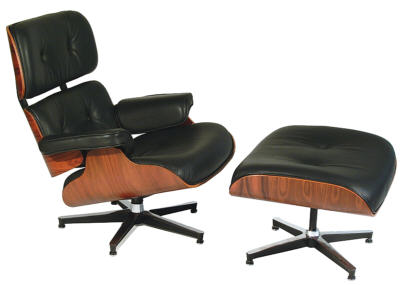
Eames Lounge Chair (670) with Ottoman (671), designed 1956. Photo: Wikimedia Commons. | ||
A low swivelling armchair in moulded rosewood plywood and black leather, designed in 1956 and in continuous production ever since. No piece of design furniture gets copied more often. Recognise only the silhouette and skip the details, and you can easily pay thousands of euros for a replica worth a few hundred. | ||
|
Topic of the week
Charles and Ray Eames designed the Lounge Chair (model 670) and its Ottoman (model 671) in 1956 for Herman Miller. Their aim was a modern take on the English club chair: three shells of moulded plywood with veneer, loose leather cushions and a swivelling aluminium base. Vintage shells are built from five thin layers of wood; current production uses seven. Vitra has built the Eames furniture for Europe since 1957, and since 1984 the split is formal: Herman Miller for the Americas, Vitra for Europe and the Middle East. Anything made outside those two houses is not an original, however close the silhouette gets. And that supply is vast: this chair is among the most imitated design furniture ever made. | ||
|
Object of the week
The pair you will meet most often: a Herman Miller 670 with 671 from the sixties or seventies, rosewood veneer, black leather, swivel base in brushed aluminium. Such sets pass through design auctions and Catawiki every week, and one occasionally surfaces in a house clearance or at a flea market. That is exactly why copyists love this chair: the silhouette is world famous, demand is high and so are the prices. The range runs from honest period knockoffs of the sixties to present-day replicas resold as originals. | ||
| ||
|
Did you know
Until the early 1990s the shells carried a veneer of Brazilian rosewood, Dalbergia nigra. That species has been on CITES Appendix I, the strictest category, since 1992. Production therefore switched to cherry, walnut and santos palisander. Owning a vintage Brazilian rosewood chair and selling it within the EU is allowed, but export outside the EU requires documents, the same nuance as with the ivory in edition #24. | ||
|
Deeper dive
Not every non-original chair is fraud. As early as the sixties the American firm Plycraft built lookalikes to a design by George Mulhauser, and those have become a collecting field of their own: honestly collectable as long as they are sold as Plycraft, at prices far below Herman Miller. The real problem is the present-day replica industry. It copies the silhouette but gives itself away in the details: a back that is too tall and too upright, shiny chrome instead of brushed aluminium, hard stitched leather, missing shock mounts. The most dangerous category adds a counterfeit label underneath. Which is why the label alone is never decisive: the whole has to be right. | ||
|
Market & value
Vintage Herman Miller sets in rosewood from the sixties and seventies fetch roughly 3,500 to 8,000 euros in good condition; design auctions and Catawiki regularly show results in that band. The earliest production of 1956 to 1959, recognisable among other things by down-filled cushions and the so-called boot glides under the feet, sits above that: 8,000 to 15,000 euros and more for documented examples. A new Vitra set lists at around 9,000 euros, which supports the vintage market. Replicas cost 400 to 1,500 euros new and are worth next to nothing second-hand. The price gap is no detail: between an original and a replica there is easily a factor of ten. | ||
|
Behind the scenes
On Tuesday the sixth and final episode of the Dutch-language Tuesday series Design & Vintage appears, on Boch Frères Keramis. The blog on antiqbot.com now counts nearly thirty articles in two languages, and this archive grows every week at antiqbot.com/weekly. | ||
|
Question of the week
“There is no label at all under my chair. Does that make it a certain replica?” No, not certain. Labels regularly come off after sixty years, and reupholstery often removed them. On vintage pieces the whole decides: shock mounts, shell construction, base and cushions. But without a label the burden of proof lies with the seller, and the price should be more cautious. A question about an object of your own? Write to info@antiqbot.com | ||
| ||
|
Next week
Next week in AntiqBot Weekly #27 we stay at the familiar desk, with a new object and five new checks to test it against. | ||
|
AntiqBot Weekly appears every Sunday. All editions |