| ||
The Wishbone Chair: Wegner's Y-chair, endlessly copiedVintage Carl Hansen & Søn, current production or copy? Five checks inside. | ||
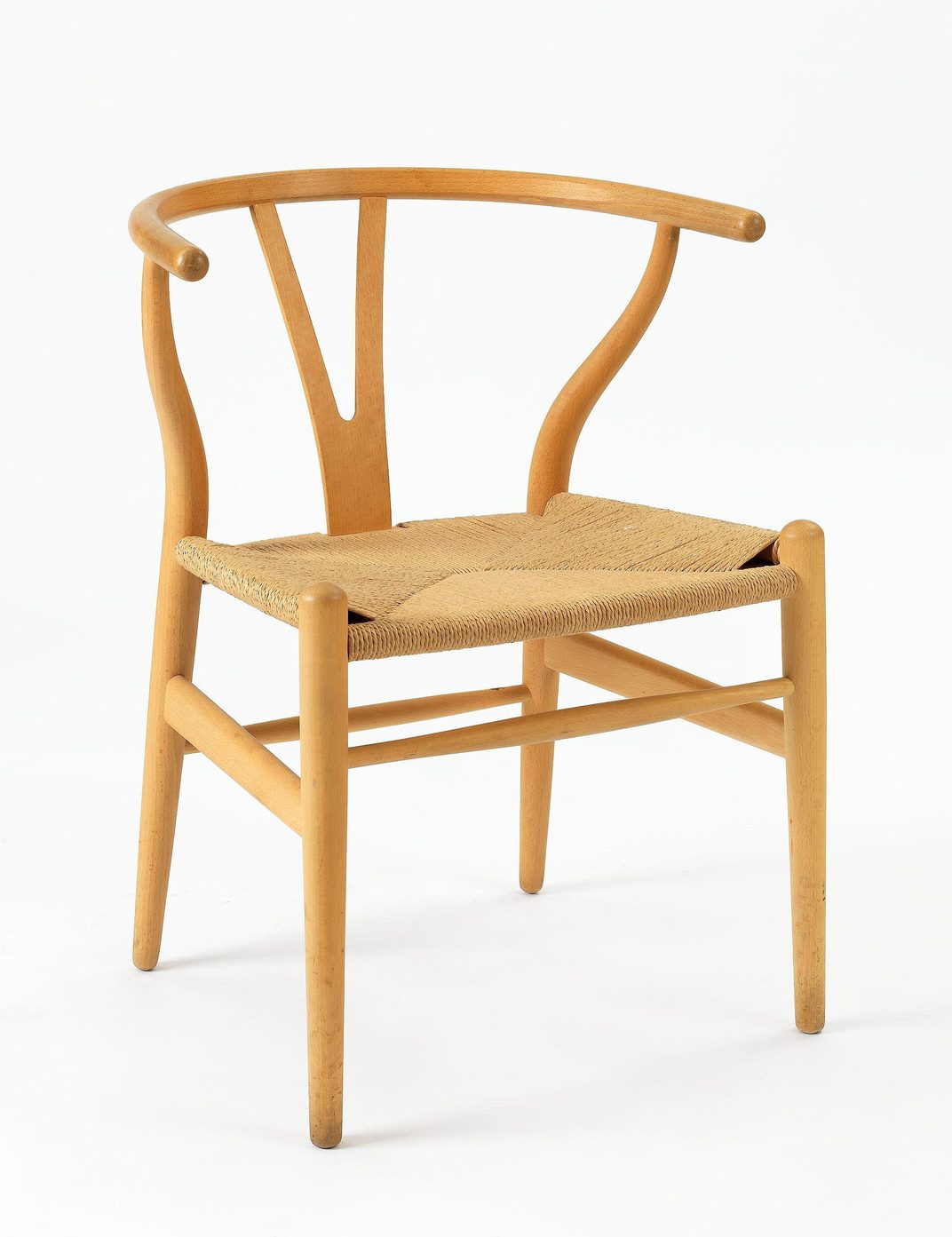
Wishbone Chair (CH24), designed 1949. Photo: Nasjonalmuseet Oslo, CC BY 4.0, via Wikimedia Commons. | ||
A light dining chair with a Y-shaped back support, drawn in 1949 and in continuous production since 1950. After last week's Eames Lounge Chair, this is the second stop in the same reality: the more famous the silhouette, the bigger the flood of copies. The difference is not in that silhouette, but in a handful of details you can check in a few minutes. | ||
|
Topic of the week
Hans J. Wegner drew the Wishbone Chair, model number CH24, in 1949 as one of his first designs for Carl Hansen & Søn. Production started in Denmark in 1950 and has never stopped. The inspiration came from portraits of Danish merchants seated on Chinese chairs of the Ming period; the Y-shaped back support that gave the chair its name carries the curved top rail and keeps the back light and open. In Denmark it is simply called Y-stolen. Wegner designed roughly five hundred chairs in his career, but none became the success the CH24 did. The top rail, which forms backrest and armrests in one movement, is steam-bent from a single piece of solid wood. The seat is hand-woven from some 120 metres of paper cord, about an hour of work per chair. Precisely those two operations make the original recognisable. | ||
|
Object of the week
What you will meet in practice: vintage examples from the fifties to the eighties in oak or beech, usually in sets of four or six, at design auctions, on Catawiki and in house clearances. Alongside them, new chairs by Carl Hansen & Søn, because the model is still made in Denmark today. And above all: an ocean of copies. Search online for wishbone and the wishbone-style offer drowns out the originals. As long as such a chair is honestly sold as a copy, that is a matter of taste. The problem sits in the second-hand market, where copies regularly pass as genuine Wegner, with prices to match. | ||
| ||
|
Did you know
Paper cord is not a cheap stopgap but a Danish wartime product: it was developed during the Second World War as a substitute for jute and seagrass, which could no longer be had. It turned out stronger and more durable than both and became the standard of Danish chair weaving after the war. A well-woven seat lasts for decades and can simply be rewoven afterwards. | ||
|
Deeper dive
Unlike last week's Eames Lounge Chair, the Wishbone has no honest collecting field of period lookalikes. Virtually everything that is not Carl Hansen is a recent factory copy. In most EU countries the design is moreover protected by copyright until seventy years after the designer's death, and Wegner died in 2007; copies are therefore usually offered from outside the EU. For the buyer, this is what counts: buying a copy as a copy is a matter of taste. The deceit begins where a copy is resold as an original, sometimes out of the seller's own ignorance. The top rail and the seat together are rarely faked convincingly, and those two checks cost you two minutes at most. | ||
|
Market & value
A new CH24 in soaped oak costs around 900 euros at official dealers; special woods and finishes sit above that. Vintage examples from the fifties to the seventies fetch roughly 300 to 800 euros apiece, and sets of four to six regularly go for 1,500 to 4,000 euros at design auctions and on Catawiki. Early documented examples and rare versions sit above that. Copies cost 100 to 250 euros new and are worth next to nothing second-hand. The pattern is the same as last week: between original and copy there is quickly a factor that runs up to ten, which is exactly why it pays to look under the chair first and pay afterwards. | ||
|
Behind the scenes
The Dutch-language Tuesday series Design & Vintage was completed last week with its sixth episode, on Boch Frères Keramis. The blog on antiqbot.com now counts some thirty articles in two languages, and this archive grows every week at antiqbot.com/weekly. | ||
|
Question of the week
“The seat of my Wishbone has sagged and is torn at one corner. Does reweaving lower the value?” No, on the contrary. A paper cord seat is a wearing part, and professional reweaving counts as normal maintenance. You only lose value when synthetic cord goes on or the weaving pattern is wrong. So have it done by someone who works with paper cord, and keep the invoice with the chair: well-documented maintenance reassures the next buyer. A question about an object of your own? Write to info@antiqbot.com | ||
| ||
|
Next week
Next week in AntiqBot Weekly #28 we push the design desk aside for an object from a very different workshop, again with five checks to separate genuine from fake. | ||
|
AntiqBot Weekly appears every Sunday. All editions |