| ||
Bronze sculpture: real bronze, recast or spelter?From Barye to parlour bronzes: five checks before you pay. | ||
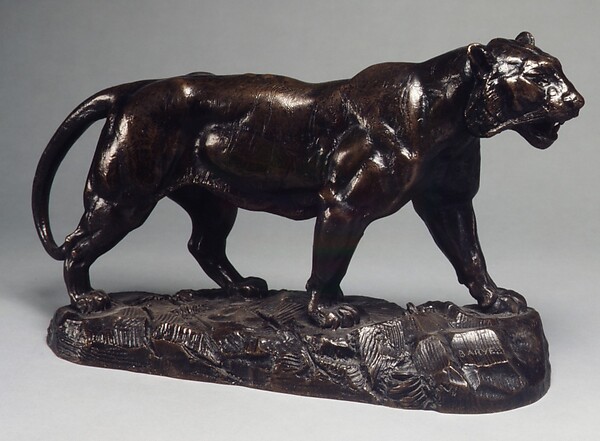
Antoine-Louis Barye, Walking Tiger, bronze (sand cast), modelled 1841. The Metropolitan Museum of Art, New York, public domain. | ||
A bronze sculpture instantly feels old and valuable: heavy, cool, darkly patinated. And it is precisely that feeling that has carried an industry of fakes for well over a century. Pick up a sculpture and you face three questions in practice: is the metal actually bronze, is the cast actually original, and does the signature actually belong to it? All three can be answered with the naked eye and two hands. | ||
|
Topic of the week
The nineteenth century was the golden age of bronze. Sculptors such as Antoine-Louis Barye and Pierre-Jules Mêne turned the animal figure into a genre of its own, and Parisian foundries such as Barbedienne and Susse Frères cast their models in editions for the middle classes. Bronze is an alloy of copper and tin, cast in sand or by the lost-wax technique, and finished by hand after casting: the chasing, in which every hair, claw and fold is sharpened. Against the genuine bronze stand three impostors. Spelter, a zinc alloy also known as zamak or régule, is lighter, more brittle and grey beneath its patina. The recast, or surmoulage, is indeed bronze, but cast from an existing sculpture instead of from the original model: the metal shrinks as it cools, so a recast is slightly smaller and every detail softer and vaguer. And the cold-cast figure, resin mixed with bronze powder, is not a casting at all but plastic with a metal skin. | ||
|
Object of the week
What you will meet in practice: animal bronzes and parlour figures from the nineteenth and early twentieth centuries, Art Deco figures on marble bases, and single bronzes from house clearances, flea markets and Catawiki. Often without paperwork, sometimes with a big name scratched or cast into the base. Alongside them runs a broad stream of doubtful cases: spelter figures offered as bronze, recent recasts of Barye, Mêne or Chiparus with a cast-in signature, and decorative castings from present-day workshops wearing an artificially aged patina. Know the checks and none of this needs to catch you; skip them and you pay bronze money for zinc. | ||
| ||
|
Did you know
Around 1900, spelter was an entirely honest product. Department stores and mail-order catalogues openly sold régule figures as an affordable alternative to bronze, often on a heavy marble base that neatly masked the difference in weight. The deceit is not historical but contemporary: only on today's second-hand market does spelter slide through as bronze, with prices to match. | ||
|
Deeper dive
Not every posthumous cast is wrong. When Barye died in 1875, the Barbedienne foundry bought a large part of his original models and went on casting them under its own stamp: posthumous, but entirely legitimate editions of high quality, collected as a matter of course today. The line runs at the surmoulage, recasting from an existing sculpture instead of from the model: smaller, softer in detail and without the chaser's hand. For modern bronzes, French practice adds a strict rule: an edition of eight numbered casts plus four épreuves d'artiste counts as original work, anything beyond that is reproduction. Nineteenth-century editions sit outside that logic, since they were deliberately cast in series; there, foundry, period and the quality of the chasing decide the value. | ||
|
Market & value
Small animal bronzes after Mêne or Barye fetch roughly 300 to 3,000 euros at auctions such as Catawiki, Drouot or Bernaerts, depending on foundry, size and the sharpness of the chasing. Early casts, lost-wax examples and documented Barbedienne editions sit above that, and top pieces by the great names reach tens of thousands at Christie's and Sotheby's. Spelter remains decoration: 50 to 250 euros for a tidy figure, however grand the name on the base. A recast is worth next to nothing as a work of art. The pattern is familiar by now: between original and fake there is quickly a factor of ten, and the difference sits in details you can check in two minutes before you pay. | ||
|
Behind the scenes
With this edition, AntiqBot Weekly moves back from six weeks of design to the classic art and antiques market. The full archive, from African masks to the Wishbone Chair, lives at antiqbot.com/weekly and grows every Sunday. | ||
|
Question of the week
“My bronze horseman has pale green, powdery spots in the folds. Should I polish them away?” Do not polish. A stable green or brown patina belongs to the sculpture and to its value; polish an old bronze to a shine and you strip away most of that value in a single afternoon. Pale green, powdery spots that keep returning, however, can be active corrosion. Keep the sculpture dry, away from damp, and have a conservator look at it. They can tell harmless patina from corrosion that needs treatment. A question about an object of your own? Write to info@antiqbot.com | ||
| ||
|
Next week
Next week in AntiqBot Weekly #29 we put a new object on the table, again with five checks to separate genuine from fake. | ||
|
AntiqBot Weekly appears every Sunday. All editions |