| ||
Russian icons: period icon, print or souvenir?From Novgorod to Palekh: five checks before you pay. | ||
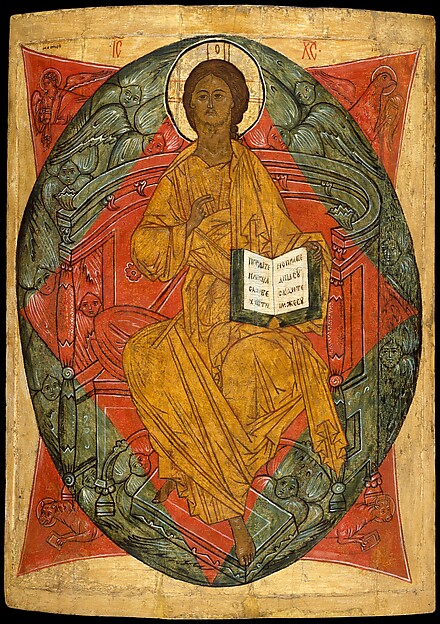
Russian (Novgorod?) painter, Christ in Glory, tempera on wood, 1470-1499. The Metropolitan Museum of Art, New York, public domain. | ||
Few objects carry as much aura as an icon: gold, dark faces, the sheen of candles and centuries. And it is precisely that aura that has been imitated for well over a century. Pick up an icon and you face three questions in practice: is the panel old, is the image painted or printed, and does the metal cover actually belong to the panel? All three can be checked with the naked eye and a loupe. | ||
|
Topic of the week
A Russian icon is not a painting but an object of prayer with a fixed construction. Onto a wooden panel, often lime, a linen cloth is glued (the pavoloka), on top of that a white chalk ground (the levkas), then egg tempera and gold leaf, and over everything a coat of olifa, a linseed-oil varnish. Older panels have a kovcheg, a recessed central field, and inset battens on the back, shponki, which keep the panel flat. Icons were painted all over Russia, but in the nineteenth century the villages of Palekh, Mstyora and Kholuy grew into veritable icon workshops for every household. Against the painted icon stand three impostors. The print: from around 1890, Moscow factories such as Bonaker and Zhako pressed icons in colour onto tin and paper, and today the photo print on old wood joins them. The souvenir: newly painted or printed, artificially aged and offered in bulk to tourists and online since the 1990s. And the assembled piece: a genuine old oklad, the metal cover, on a younger panel, or an old but heavily overpainted panel sold as untouched. | ||
|
Object of the week
What you will meet in practice: nineteenth-century household icons of Christ Pantocrator, the Kazan Mother of God or Saint Nicholas, brass travelling triptychs, and icons with an oklad in brass or silver, from house clearances, flea markets and Catawiki. Often without paperwork, sometimes with an impressive story about a grandmother from Saint Petersburg. Alongside them runs a broad stream of doubtful cases: tin prints offered as painted, souvenir panels with sprayed-on craquelure, and pieces where only the oklad has any age. Know the checks and none of this needs to catch you; skip them and you pay painted-icon money for a print. | ||
| ||
|
Did you know
Olifa, the linseed-oil varnish over every icon, turns nearly black in eighty to a hundred years. For generations such black boards were not restored but simply overpainted with the same image. Beneath an unremarkable nineteenth-century icon an older and better one may therefore be hiding; restorers sometimes uncover those layers one by one. On icons, dark is not a defect but information. | ||
|
Deeper dive
Anyone hunting old icons soon meets the Old Believers, the community that clung to the old rites and the old painting manner after the church reforms of the seventeenth century. Their workshops went on painting the old way into the twentieth century, with the same materials and the same models. An icon in sixteenth-century style can therefore have been painted in perfect honesty in 1890; that is not forgery but tradition, and the price follows the real age. The line runs at intent. Around 1900 the same skilled hands also painted deliberate forgeries of early icons for collectors, complete with false age, and it is happening again today. That is why the construction weighs more than the style: panel, ground, craquelure and wear must tell the same story as the image. If one layer does not fit, the layer wins, not the story. | ||
|
Market & value
Ordinary nineteenth-century household icons, a Nicholas, a Kazan Mother of God, a Pantocrator, fetch roughly 100 to 500 euros at auctions such as Catawiki, depending on size, quality and condition. More finely painted pieces, dated icons and icons with a hallmarked silver oklad sit between 1,000 and 5,000 euros, and early or museum-grade pieces reach tens of thousands at Christie's and Sotheby's. Tin icons and prints remain decoration: 20 to 80 euros, however devout the image. A sprayed souvenir is worth nothing as a work of art. The pattern is familiar: between painted and printed there is quickly a factor of ten, and the difference sits under the loupe, not in the seller's story. | ||
|
Behind the scenes
After last week's bronzes, AntiqBot Weekly puts another classic from the cabinet of art on the table. The full archive, from African masks to Gallé and the Wishbone Chair, lives at antiqbot.com/weekly and grows every Sunday. | ||
|
Question of the week
“My icon has gone almost completely black. Can I clean it with a little oil, the way my mother used to?” Do not. Oil feeds the surface for a moment and then attracts dust and dirt; the board only grows darker. The black is usually the aged olifa varnish, and it can only be removed with solvents and patience, layer by layer, without touching the tempera beneath. That is a restorer's job. A proper cleaning can make an icon shine again, and sometimes an older image emerges from underneath; a household remedy can spoil that chance for good. A question about an object of your own? Write to info@antiqbot.com | ||
| ||
|
Next week
Next week in AntiqBot Weekly #30 we put a new object on the table, again with five checks to separate genuine from fake. | ||
|
AntiqBot Weekly appears every Sunday. All editions |