| ||
Meissen: genuine, Samson or fake mark?From crossed swords to model number: five checks before you pay. | ||
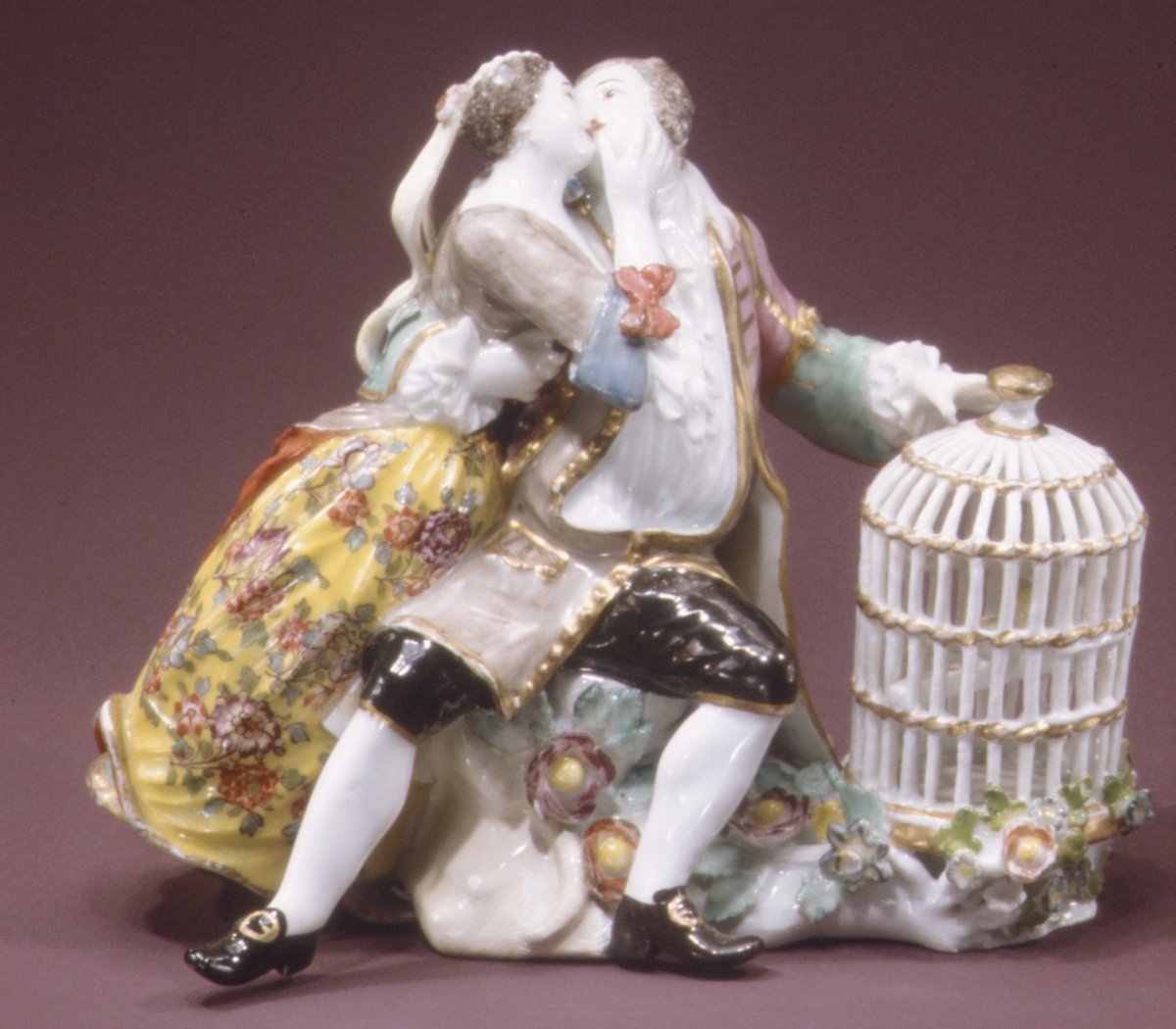
Meissen, Lovers with a Birdcage, model by Johann Joachim Kändler, 1737. The Metropolitan Museum of Art, public domain. | ||
No porcelain mark sits under more bases than the crossed swords of Meissen. A large share of them never came from Meissen. Paris copyists, Dresden decorating studios, Thuringian factories and today Chinese workshops have put the mark on their own porcelain for two hundred years. Whoever turns a figure over and sees two blue swords therefore knows nothing yet. The question is not whether the mark is there, but how it got there, on what body, and whether it fits the model and the period. That difference can be seen, and it sits in five places. | ||
|
Topic of the week
In 1708 Johann Friedrich Böttger and Ehrenfried Walther von Tschirnhaus found the recipe for hard-paste porcelain in Dresden, the first in Europe. Augustus the Strong, Elector of Saxony, founded the manufactory in 1710 in the Albrechtsburg at Meissen, far from curious eyes. From 1731 the sculptor Johann Joachim Kändler made Meissen the house of the porcelain figure: harlequins, lovers, animals, shepherds and court jesters, crisply modelled and finely painted. The swords mark, taken from the Saxon arms, appears in the 1720s and has been the standard mark since 1731. Against the genuine piece stand three impostors. The copy with a false mark: Samson in Paris (founded in 1845) made excellent Meissen copies, and in Dresden studios such as Helena Wolfsohn painted porcelain with the AR monogram of Augustus Rex. The modern fake: cheap figures with a blue mark printed on top of the glaze. And genuine Meissen that looks like more than it is: a 19th-century reissue of a Kändler model, or a second the factory itself rejected, sold as an 18th-century masterpiece. | ||
|
Object of the week
What you will meet in practice: a small shepherd group from an estate, with a broken finger. A pair of vases with flowers in relief from a flea market, with a generous-looking AR mark. A pair of parrots on a classifieds site, so white and perfect they look new. And a Kändler harlequin which, according to the seller, dates from 1740, with a model number on the base. The pattern is always the same: the bigger the story, the more the base matters. Whoever knows the checks turns the piece over before talking price. | ||
| ||
|
Did you know
Böttger was an alchemist who had promised Augustus the Strong gold. He delivered porcelain instead, and was kept under guard for years so that the secret, the arcanum, would not leave Saxony. Even so, the recipe leaked to Vienna as early as 1718. The crossed swords are regarded as one of the oldest trademarks in the world still in use. | ||
|
Deeper dive
The most dangerous copy is not the cheap one but the old one. In the 19th century Samson worked with hard paste, skilled painters and its own variants of the swords mark, and many of those pieces are themselves 150 years old: they show real wear, real restorations and a real provenance from a Belgian or French estate. The difference lies in the details a copyist does not reproduce exactly: the size of the model, the palette of the enamels, the gilding and the way the mark is painted. The second danger is Dresden decoration: genuine porcelain, sometimes even a white Meissen blank, painted afterwards in a Dresden studio. Not fake, but something else, and on the market worth much less than factory painting. | ||
|
Market & value
At auction, on Catawiki, at Nagel or Lempertz, the orders of magnitude run roughly as follows. Twentieth-century and post-war Meissen figures fetch a few hundred euros. Nineteenth-century groups with pommel swords in good condition often sit between 500 and 3,000 euros, depending on model, size and damage. First-generation 18th-century Kändler figures start at a few thousand euros and run into the tens of thousands for important models. A Samson copy sold as Samson brings one hundred to a few hundred euros, as 'Meissen' nothing. A second with grinding lines drops noticeably in price, and damage to fingers, flowers and lace weighs heavily. | ||
|
Kändler and the classic models
Johann Joachim Kändler came to Meissen in 1731 and became master modeller in 1733. In more than forty years he designed, with assistants such as Johann Friedrich Eberlein and Peter Reinicke, hundreds of figures and groups. Whoever buys Meissen is in practice usually buying one of those designs, just not always from the same century. A model was never made only once: the moulds were kept and the manufactory recast popular models in the 19th century, in the 20th century and up to today. A Kändler design therefore says nothing about the age of the example in front of you. The best-known series turn up again and again. The commedia dell'arte figures: Harlequin, Columbine, Pantalone and Scaramouche, often in bright checked costumes. The crinoline groups of court ladies and gentlemen in wide skirts, such as the Lovers with a Birdcage in the photo at the top. The Monkey Band, an orchestra of monkeys in court dress that Kändler and Reinicke worked out around 1753 as a jibe at court music, reissued and copied to this day. The large animals for the Japanese Palace of Augustus the Strong, made by Johann Gottlieb Kirchner and Kändler in the 1730s. And the Swan Service, made from 1737 to 1741 for Count Heinrich von Brühl, with reliefs of swans and reeds, whose single plates are now major pieces. For the buyer this means two things. First: look up the model. Museum collections such as those of The Met, the Rijksmuseum and the Dresden Porcelain Collection show hundreds of Kändler models with sizes and dates. A figure noticeably smaller than the museum example has often been recast from a copy. Second: the model drives demand, the example drives price. A popular 19th-century model in perfect condition can fetch more than a rare 18th-century model with heavy damage. | ||
|
The swords mark by period
The mark is no proof of authenticity, but it is a dating aid, provided it is genuine. This rough scheme helps with a first judgement. Always allow for transitions and exceptions: painters did not work with a ruler, and every period has variants.
| ||
|
Meissen or not? Names you will meet
Samson, Paris. Founded in 1845 by Edmé Samson, specialised in copies of Meissen, Sèvres, Chinese export porcelain and more. Samson used its own marks, sometimes with swords, and these were quite often ground away later to sell the piece as Meissen. A ground-off patch on the base is therefore suspicious. A Samson sold as Samson is an honest collector's piece. Helena Wolfsohn, Dresden. One of the best-known Dresden decorating studios of the 19th century. She painted white porcelain with scenes after Watteau and rich gilding, and used the AR monogram until Meissen took her to court over it. Most AR vases and cups on the market come from this corner. 'Dresden'. The word Dresden under a piece does not mean Meissen. In the 19th century dozens of decorating studios worked in and around Dresden, and in the English-speaking trade 'Dresden china' became a catch-all name. A blue crown with 'Dresden' or the word in script points to such a studio. Carl Thieme, Potschappel. A factory near Dresden, founded in 1872, known for richly decorated vases and figures with abundant flowers and lace in Meissen style. It used its own mark, usually a cross with a T, often with the word Dresden. Thuringia: Volkstedt, Sitzendorf and others. These factories made lace figures and groups in Meissen style in the 19th and early 20th centuries. Their marks, such as crossed hayforks or crossed lines, look like swords at first glance. Attractive and collectable, but not Meissen, and priced far lower. Modern fakes. Recent figures, often from Asian workshops, with a blue mark printed or painted on top of the glaze, a coarse body and flat, harsh colours. They appear at markets and on websites with stories of grandmothers and castles. | ||
|
Recognising damage and restoration
With porcelain figures, condition weighs almost as much as authenticity. Kändler figures have fingers, flowers, lace and attributes that break off at the slightest knock, and after two hundred years a perfect figure is the exception rather than the rule. That is not a problem, as long as the damage is honestly stated. The problem is invisible restoration: a glued arm, a finger remade in resin, an overpainted crack, sold as perfect. To find restoration, use three tools. A UV lamp: porcelain and glaze fluoresce evenly, glue and retouching paint light up differently or stay dark, and in a darkened room you see within a minute where work has been done. A loupe: on a remade part the shine of the glaze stops abruptly, the paint sits slightly more matt and the transition shows a fine seam. And a tooth or fingernail: genuine glaze is hard and cool, resin feels warmer and softer and gives a duller tap. Pay particular attention to the places that always break: fingers and hands, projecting flowers and leaves, hats, small swords and musical instruments, the lace of crinoline skirts and the edges of the base. A figure whose most fragile parts are flawless while the gilding has worn elsewhere deserves extra attention. Small firing flaws, such as a pinpoint in the glaze or a small kiln crack, are not damage; they belong to the material and are weighed differently in the trade from later breakage. For price a simple rule applies: perfect pieces are scarce, and the market pays for that. A professionally restored finger lowers the price moderately, a glued head or a remade arm lowers it sharply. What is disclosed is a selling point; what is concealed is a reason to send it back. | ||
|
How to buy Meissen at markets and online
At a market: always ask to hold the piece yourself and turn it over before you talk price. Look at the mark under the glaze, feel the foot rim, find the incised number and hold it against the light. Then check the fragile places and ask whether anything has been glued. A seller who will not let go of the piece has already given you an answer. Online: ask for a sharp photo of the base straight from below, a close-up of the mark, and photos of all sides and close-ups of the hands and flowers. Ask for the height in centimetres and compare it with the museum example of the same model. Be wary of stock or catalogue photos, of 'from a castle' without a name, and of prices too low for an 18th-century piece to be true. Whoever sees a bargain usually sees a Samson, a Dresden decoration or a reissue. At auctions and on platforms such as Catawiki: read the description for the words that make the difference. 'Meissen' is something other than 'in the style of Meissen', 'Dresden' or 'after Kändler'. An expert description states the period of the mark, the model number, the size and the condition. If one of those four is missing, ask before you bid. | ||
|
Frequently asked questions
How do I recognise genuine Meissen? Look at five things together: a hand-painted mark under the glaze, a white and translucent hard-paste body, crisp modelling, incised model numbers and consistency between mark, model and period. No single point is enough on its own. What does a line through the Meissen mark mean? That the factory itself marked the piece as a second by grinding one or more lines through the mark. The piece is genuine but fetches less. The more lines, the lower the grade. Is Dresden the same as Meissen? No. Meissen is the manufactory in the town of Meissen. 'Dresden' on a piece usually points to a decorating studio or factory in or around Dresden, often from the 19th century. How old is my Meissen figure? The mark gives a first period: dot, star, pommel swords or plain swords. The incised and painted numbers, the style of painting and the model itself refine it. An 18th-century model may have been made again in the 19th or 20th century. What is a Samson copy worth? Sold as Samson, a figure usually fetches one hundred to a few hundred euros, depending on quality and condition. Sold as Meissen, it is deception. | ||
|
Behind the scenes
On porcelain, AntiqBot looks at what a photo can show: the form, style and proportions of the mark, incised and painted numbers, the modelling and the consistency with model and period. How the glaze feels and how the body looks against the light remain work for the hand, and the report says so. Tip: photograph the base straight from below, sharp and in daylight, and the figure from the front as well. | ||
|
Question of the week
“On the base of my Meissen figure there are two lines through the swords. Is it fake?” No, quite the opposite. Those lines are grinding marks, cut through the mark by the factory itself to flag a piece as a second, often for a small firing flaw. So it is genuine Meissen that left the manufactory at a discount. Forgers rarely add them. Do note: a second fetches noticeably less than a first, so do not count it as a masterpiece. A question about an object of your own? Write to info@antiqbot.com | ||
| ||
|
Next week
Next week in AntiqBot Weekly #33 we put a new object on the table, again with five checks to separate genuine from fake. | ||
|
AntiqBot Weekly appears every Sunday. All editions |