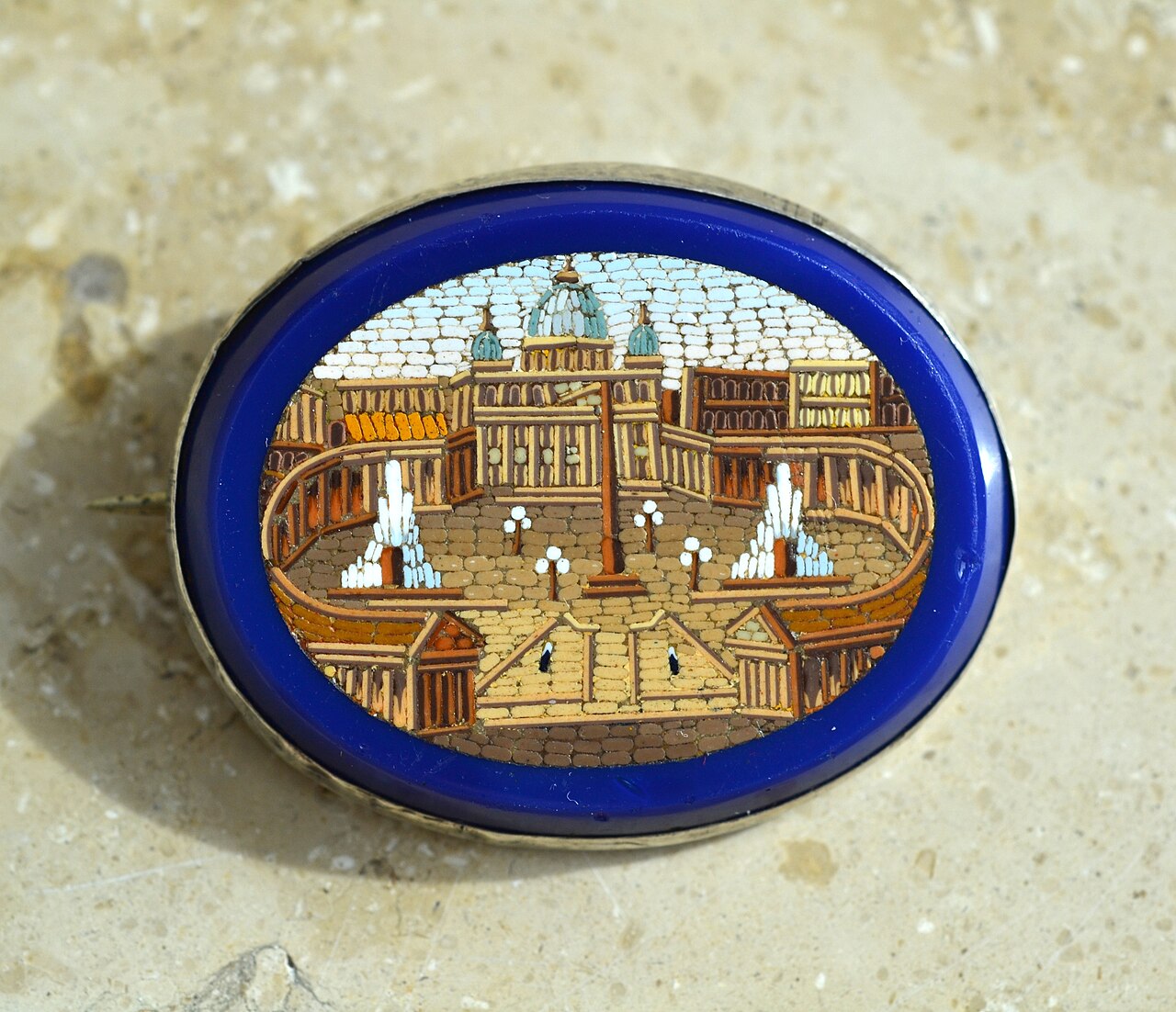
Het onderwerp van de week
Italiaans Micromozaïek — Miniatuurkunst in juwelen
Miljoenen minuscule glasstukjes in Grand Tour-souvenirs
Stel je voor: je bent een welgestelde Europese Grand Tourist in 1790, net teruggekeerd uit Rome. Je hebt de Vaticaan bezocht, de Colosseum beklommen, kunstwerken verzameld. Maar voor je familie en vrienden thuis wil je iets meenemen — niet zomaar een souvenir, maar een kunstwerk in miniatuur dat Rome uitbeeldt op een manier die de inkt van tekeningen ver overstijgt. Je belandt in een werkplaats in Rome waar je getuige bent van een kunstvorm die je versteld doet staan: micromozaïek. Voor je ogen worden miljoenen minuscule stukjes gekleurde glas, elk niet groter dan een korrelzout, voorzichtig één voor één ingelegd in een patroon dat afbeeldingen oplevert van ongeëvenaarde precisie. Het is geen teken van welvaart dat je het huis in neemt — het is een bewijs van verfijning, van inzicht in kostbaarheid, van deelname in een kunsttradditie die duizenden jaren teruggaat naar de Romeinse keizers zelf.
Dit is het begin van de micromozaïek-industrie zoals Europa die in de achttiende en negentiende eeuw zou kennen. Niet geboorte — die lag veel eerder, in de antieke wereld en in Byzantium — maar wel heropstanding. En veel meer dan dat: een gespecialiseerde kunsthandwerk dat Italië tot absolute wereldhoofdstad van het genre maakte. Nog vandaag, meer dan twee eeuwen later, is micromozaïek onderling verbonden met het esthetische erfgoed van Rome, Florence en de Renaissancesteden die het voortbrachten.
Voor verzamelaars vandaag is micromozaïek echter een landmijn. De markt staat vol met reproducties. Niet alleen goedkope namaak uit Aziatische fabrieken, maar ook vakkundig vervaardigde kopieën die gemaakt zijn in de twintigste en eenentwintigste eeuw door ambachtslieden die de technieken authentiek uitvoerden. Hoe onderscheid je een echte Grand Tour-broche van 1830 van een voorzichtig vervaardigde reproductie van 1950? Het antwoord begint bij het begrijpen van wat micromozaïek eigenlijk is — chemisch, kunsthistorisch en praktisch.
Micromozaïek is de kunst van het inleggen van duizenden — soms tienduizenden — minuscule stukjes gekleurde glas, collectief tesserae genoemd, in een onderliggende binder, meestal mastic of een op kalk gebaseerde cement. Deze individuele stukken, meestal snijdingen van gekleurde glasstaafjes genaamd smalto filato (gespannen glas), zijn zo klein dat ze op afstand bijna onzichtbaar zijn. Samen vormen ze echter afbeeldingen van bijna fotografische helderheid: architectonische weergaven van het Colosseum, de Pantheon, Saint Peter's; Romantische natuurscènes; portretten; religieuze scènes; geometrische patronen. De vaardigheden vereist om deze werkstukken te creëren zijn bijna onvoorstelbaar: geduld van religieuze mate, hand-oog-coördinatie van het fijnste niveau, chemische kennis van glascoloratie, en esthetische sensibiliteit van grote verfijning.
De vakkundigheid van echte micromozaïek uit de gouden periode — grofweg van 1780 tot 1880 — kan niet genoeg worden benadrukt. Het is niet alleen ambacht; het is kunst op het hoogste niveau. En vandaag, in een markt waar veel moderne reproductie en vervalsing voorkomen, is het onderscheiden van authentiek werk het verschil tussen het kopen van een schat en het betalen voor glasvezel en kleurstof.
Wat het verhaal nog complexer maakt, is de geografie van het ambacht. Rome was het onbetwiste epicentrum, maar niet de enige producent. In Florence ontstond een parallelle traditie van pietre dure — hardsteenmozaïek — die verwant maar fundamenteel anders was. In Venetië experimenteerden glasmakers met vergelijkbare technieken, hoewel hun productie nooit de schaal van Rome bereikte. En in de negentiende eeuw verspreidde de techniek zich naar andere Europese steden, met name Parijs en Londen, waar Italiaanse emigranten werkplaatsen openden die lokale varianten produceerden. Deze verspreiding maakt authenticatie extra uitdagend: een broche gemaakt door een Italiaanse ambachtsman in Londen rond 1860 is authentiek ambachtelijk werk, maar is het een “Italiaans micromozaïek” in de strikte zin? De grenzen zijn vager dan de meeste verzamelaars vermoeden.
Wat we in deze editie willen bereiken is helder: je de gereedschappen geven om micromozaïek te begrijpen, te herkennen en te evalueren. Niet met de pretentie van een academisch handboek, maar met de praktische focus die je nodig hebt wanneer je op een brocante, veiling of online marktplaats een stuk tegenkomt dat je nieuwsgierigheid wekt. Kennis is je beste verdediging tegen de reproductie-industrie — en micromozaïek verdient die kennis, want het is een van de meest onderschatte en tegelijkertijd meest fascinerende categorieën in de antiekwereld.
Item van de Week
Giacomo Raffaelli (1753–1836) — Vader van het micromozaïek
Om micromozaïek te begrijpen, moet je Giacomo Raffaelli kennen. Raffaelli was geen kunstenaar in de traditionele zin; hij was een experimentator, een onderzoeker, een innovator van het meest praktische soort. Hij werd geboren in Rome in 1753 in een periode waarin de kunsthandwerken van de klassieke oudheid werden herontdekt en opnieuw in ere werden hersteld door antiquairs, verzamelaars en kunstenaars die zich tot Rome aangetrokken voelden. Raffaelli was gefascineerd door Romeins mozaïek — die oude, grootschalige kunstwerken waarbij duizenden kleine steenfragmenten waren samengesteld tot monumentale composities. Maar hij stelde zich een vraag die voorgaande generaties kennelijk niet hadden gesteld: wat als je dezelfde techniek kon toepassen op een veel kleinere schaal, niet met ongepolijste stenen maar met geslepen glas, niet op muren maar op draagbare objecten?
Raffaelli begon te experimenteren met gekleurde glasstaafjes — smalto filato in het Italiaans — dunne roodgloeiglasstaven die in duizenden tinten waren ingekleurd. Door deze staafjes in minuscule stukken te snijden en deze stukken voorzichtig in een lijmbasis in te leggen, kon hij afbeeldingen creëren die onmogelijk leken: composities met meer kleurdetail dan geschilderde werken, maar met de duurzaamheid van mozaïek. Tegen het eind van de achttiende eeuw had Raffaelli een volwaardige atelier en leerlingen opgebouwd. Zijn innovatie maakte hem beroemd in Rome, en groter nog: het maakte Rome tot het epicentrum van micromozaïek voor bijna twee eeuwen.
Raffaelli's atelier bloeide op in de jaren van de Grand Tour. Rijke Europese bezoekers aan Rome wilden authentiek Italiaans kunstwerk meenemen — niet reproducties, niet souvenirs, maar echte micromozaïek-stukken die in Rome waren gemaakt. Raffaelli voldeed aan deze vraag met brochettes, ringen, hangers, medaillons, altijd verfraaid met Rome-scènes: de vier grote basilica's, de Vaticaan, het Colosseum, de fontein van Trevi, de monumntale bouwwerken die Grand Tourists als hoogtepunt van hun reis beschouwden. Raffaelli's werk werd ingesteld — kwaliteit, verfijning, technische precisie — als de gouden standaard.
Maar Raffaelli was niet alleen. Terwijl zijn atelier bloeide, ontstonden ook andere werkplaatsen in Rome. Van gelijk belang was het Vaticaan Mozaïek Studio — een door de Paus gepatroneerde instelling die micromozaïek niet alleen als commercieel ambacht beoefende, maar ook als een kunstvorm van eigenstandig belang. Het Vaticaan Studio beschikte over meer dan 28.000 verschillende tinten smalto — gekleurde glasstaafjes — elk ervan handmatig gesneden en geordend. Voor kunstenaars die het fijnste detail nastreefden, was dit een goudmijn. De studio's kunststof-verzamelaars perfectioneerden minuscule technieken waarmee individuele tesserae van 1 millimeter of kleiner konden worden aangebracht, wat leidde tot pixellijkheid met duizenden stukken per vierkante centimeter.
Raffaelli stierf in 1836, maar zijn erfenis was ingesteld. Gedurende de negentiende eeuw bleven Rome en haar werkplaatsen het epicentrum van micromozaïek. Andere kunstenaars, vooral de werkplaatsen van Castellani in Rome en de successoren van Raffaelli, voerden zijn technieken voort. De Florentijnse juwelier Alessandro Castellani experimenteerde ook met micromozaïek, hoewel hij primair bekend staat voor zijn revivals van Etruskische en antieke sieraadstijlen. Toch is het werk van Raffaelli — zijn oog voor compositie, zijn geduld met detail, zijn technische genialiteit — wat in zekere zin alle volgende generaties van micromozaïek-makers heeft bepaald. Authentieke Raffaelli-stukken zijn zeldzaam en waardevol; ze vormen de piek van de categorie in collectorsringen.
Snelle Check
5 Rode Vlaggen bij Micromozaïek
01
Tesserae zijn te groot en te uniform — Authentieke micromozaïek-tesserae zijn extreem klein, meestal tussen 0,5 en 2 millimeter in doorsnede, vaak veel kleiner. De dichtheid is spectaculair: tot 5.000 stukjes per vierkante centimeter in fijnwerk, 1.000 tot 3.000 in middelmatig werk. Modern namaak gebruikt vaak veel grotere glasstukjes — duidelijk zichtbaar zelfs zonder loupe — om de productie sneller en goedkoper te maken. Ook is het patroon in vervalsingen vaak te uniform, omdat fabrieken machines gebruiken die elk stukje identiek snijden. Authentieke tesserae hebben veel meer variatie in grootte, omdat ambachtslieden ze handmatig tot de juiste afmeting slijpten.
02
Vlak glas in plaats van smalto filato — Authentieke micromozaïek-glasstukjes waren snijdingen van smalto filato: gekleurde glasstaafjes die in hittebehandelde ovens werden getrokken. Deze staafjes hebben een karakteristieke diepte en doorschijnendheid. Als je een stukje oppakt en tegenlight houdde, zie je door het glas. Moderne vervalsingen gebruiken vaak plat gekleurde glas of emaille — massieve kleurstof zonder interne diepte. Kijk naar de randen van de tesserae met een sterke loupe: authentieke stukjes hebben scherpe, onregelmatige randen die door het snijden van glas ontstaan. Vervalsingen hebben vaak gladde, uniform afgewerkte randen die duiden op industrieel verwerking.
03
Geschilderde of bedrukte oppervlakte verborgen als mozaïek — Een misleidende techniek die modern gebruikelijk is: een kunstenaar schildert of drukt een afbeelding op een onderlaag en voegt hier en daar echte tesserae op de oppervlakte toe om het als micromozaïek uit te geven. Of erger: de hele afbeelding is printen op een platte oppervlakte, waarbij de textuur van mozaïek wordt nagebootst. Test dit door voorzichtig onder een hoge loupe naar de oppervlakte te kijken. Authentiek micromozaïek toont duidelijke individuele glas-stukjes, elk met zijn eigen reflectie van licht, elk apart zichtbaar. Geschilderd oppervlak toont vloeiende kleurvergangen en geen individuele stukjes.
04
Moderne lijm of cement zichtbaar — Authentieke micromozaïek wordt ingelegd in mastic — een op terpentijn gebaseerde pasta — of in een op kalk gebaseerde cement die door de tijd heen geel wordt en verhardes tot bijna steen. Met een loupe kijk je onder de tesserae: je ziet donker, vaak enigszins gekorreld bindmateriaal dat geelbruin of zwartachtig is geklurd. Modern synthetisch lijm, epoxy of polyurethaan-lijm lijkt anders: het is helder, uniform, soms glanzend, altijd schoon wit zonder patina. Ook is de wijze waarop modern lijm rondom de tesserae zichtbaar is, verschillende van authentieke mastic, dat rondom stukjes vastzit zonder glans.
05
Generieke toeristische motieven zonder perspectief of schaduw — Authentieke Grand Tour-micromozaïeken waren vaak specifieke afbeeldingen van fameuze Romeinse monumenten: het Colosseum met architectonische nauwkeurigheid weergegeven, de binnenzijde van het Pantheon met realistische perspectief, of religieuze scènes van genuine kunsthistorische subtiliteit. Ze toonden diepte, schaduw, variatie van licht. Moderne vervalsingen gebruiken vaak generieke florales, abstracte geometrie, of vereenvoudigde monumenten zonder echte architectonische kennis. Ze missen de raffinement dat je vindt in authentieke 19e-eeuwse stukken, waarbij kunstenaars schilderkundige technieken — schaduw, perspectief, athmosphere — gebruikten ondanks het medium van mozaïek.
Geen enkele rode vlag is op zichzelf doorslaggevend. Maar als twee of meer samenkomen, dienen waarschuwingen. Authentiek micromozaïek vertelt zijn eigen verhaal — door de irregulariteiten, niet ondanks deze.
Wist je dat
Het Vaticaan Mozaïek Studio had in zijn gouden periode een inventaris van meer dan 28.000 verschillende tinten smalto filato. Dit waren niet alleen rood, blauw en geel — dit waren subtiele nuances: twintig verschillende tinten roze, dertig verschillende blauw-groenen, grijzen met microscopische variaties. Elke tint werd handmatig in kleine batches gemaakt, in gespecialiseerde ovens. Kunstenaars konden hun fijnste werken uitvoeren omdat dit arsenaal beschikbaar was. Wanneer je een fijn stukje micromozaïek van rond 1820 onderzoekt, zie je vaak vier, vijf, zes tinten van “roze” in één bloem — elk tint subtiel anders, elk bijdragend aan de illusie van diepte. Dit detail is bijna onmogelijk in modern werk, omdat producenten geen interesse hebben in het onderhouden van zoveel tinten. Modern micromozaïek telt meestal tussen 500 en 2.000 tinten; authentiek werk gebruikte veel meer.
Dieper kijken
Unterschied tussen Romeins mozaïek, Florentijnse pietre dure en micromozaïek
Verzamelaars verwarren micromozaïek voortdurend met andere kunstverhalen uit dezelfde regio en periode. Dit is begrijpelijk: ze komen uit dezelfde Italiaanse ateliers, ze gebruiken soms dezelfde motieven, ze werden verkocht aan dezelfde Grand Tourists. Maar materiaal en techniek verschillen drastisch, en deze verschillen bepalen zowel hoe je werken authenticeert als hoe je ze waardeert.
Laten we beginnen met Romeins mozaïek. Dit is niet micromozaïek — dit is de aanwezige kunsttradditie waaruit micromozaïek werd gebekt. Romeins mozaïek gebruikt steenfragmenten (tesserae van steen, niet glas), meestal marmer of semi-edelstenen, elk 5 tot 10 millimeter in doorsnede, soms groter. Ze werden in een op zand en kalk gebaseerde matrix gezet. Omdat stenen fragmenten groter zijn en hun kleur minder flexibel is, bereikt Romeins mozaïek niet de verfijning of het kleurenpalet dat glas biedt. Maar het bereikt schaal: de grootste Romeinse mozaïeken bedekken muren van kilometers. Archeologische voorbeelden van Romeins mozaïek uit Pompeii en Herculaneum toont ons wat kunstenaars in de 1e en 2e eeuw bereikten: composities van bijna cinématische verfijning gegeven de technische beperkingen. Maar glas was niet hun medium.
Florentijnse pietre dure — letterlijk “hardstenen” — is een ander beest. Dit is een achttiende- en negentiende-eeuwse kunstvorm primair uit Florence, waarbij stukken edelsteen — lapis lazuli, malachiet, jade, jaspis, agaat — worden uitgeslepen en in patroon ingelegd in een marmeren basislaag. Een pietre dure tafelblad kan gemaakt zijn van honderden kleine stenen, elk uitgeslepen tot vorm, elk ingelegd naast elkaar. Het effect is één van monumentale rijkdom: de glans van geslepen edelstenen, de kleur, de textuur. Pietre dure bereikt verfijning door de kleur van natuurlijke stenen — je kunt geen pietre dure-broche in lichte roze maken omdat lapis lazuli donkerblauw is, omdat malachiet groen is. In contrast: micromozaïek kan elke kleur bereiken omdat glas in elke tint kan worden gemaakt.
Micromozaïek, ten slotte, combineert het miniatuurniveau van Florentijnse pietre dure met het kleurenpalet van het glas. Het gebruikt geen edelsteen — jadeïet te duur, te breekbaar, te lastig om in duizenden stukjes te snijden. Het gebruikt glas: goedkoper, veelzijdiger in kleur, geschikt voor massaproductie in atelier-schaal. Maar het bereikt door combinatie van schaal en kleur en kunst iets wat de twee oudere vormen niet kunnen bereiken: afbeeldingen van bijna fotografische verfijning in miniatuurformaat, draagbaar gemaakt als juweel.
Dit zijn de verschillen in materiaal. En ze betekenen veel voor authenticatie. Wanneer je een “antieke” broche onderzoekt die “micromozaïek” wordt genoemd, kijk je eerst naar de samenstelling. Zijn dit glas-tesserae of steen? Glas — dan kan het micromozaïek zijn. Steen — dan is het eerder pietre dure of een ander ambacht. Deze basischecks helpen je verstaan wat je hebt, en daarvan volgt waardering.
Markt & Waarde
Wat kost Italiaans micromozaïek vandaag?
De markt voor micromozaïek is breed, gedifferentieerd, en regelmatig onderschat. Op de top bevinden zich stukken geattribueerd aan Raffaelli zelf of aan zijn atelier, waarvan veel geverifieerd zijn in archievenstukken of hebben een documenteerde kunsthistorische herkomst. Een echte Raffaelli-broche van rond 1800 kan op gespecialiseerde antiekveiling moeiteloos vijf- tot zesvoudige bedragen opbrengen. Een groot medaillon met Raffaelli-kwaliteit heeft €5.000 tot €15.000 bereikt; uitzonderlijke stukken gaan voor meer dan €30.000.
Onder Raffaelli maar nog steeds van goedeoriginale werkstraatwerk — Rome-ateliers van de negentiende eeuw, Vaticaan Studio-afkomst, of geverifieerd werk door andere meestervormers — bevinden zich brochettes, ringen en kleine hangers meestal in het €300 tot €2.000-bereik. Een prachtige negentiende-eeuwse brooke met fijn Colosseum-detail, geverifieerd echt en in goede staat, kan €800 tot €1.500 halen. Grotere stukken — kisten, spiegel-achtergonden — kunnen veel hoger gaan als hun herkomst correct is.
Dan is er een bruiner segment: twintigste-eeuwse reproduties van goede kwaliteit, modern ambachtelijk vervaardigde kopieën gemaakt door artiesten die authentieken techniekten gebruikten. Deze kunnen zeer moeilijk te onderscheiden zijn van negentiende-eeuws werk zonder deskundige analyse. Ze worden meestal verkocht voor €50 tot €300, soms meer als ze fraai zijn gemaakt. Veel verzamelaars raken gefrustreerd wanneer ze “antieke” micromozaïek kopen voor €150, alleen om later te ontdekken dat het uit 1960 dateert. Het is niet zonder waarde — vakwerk verdient waardering — maar het is niet de drieduizend-jaar-lange artistieke erfenis waarvoor ze dachten te betalen.
Aan de onderkant: twintigste-eeuwse souvenir-micromozaïeks en modern industrieel vervaardigd werk. Deze hebben nauwelijks antieke waarde, €5 tot €30 per stuk. Uitzonderingen: bepaalde jaren zestig en zeventig stukken gemaakt door vakkundige italiense ambachtslieden, die nu als retrodesign collector's items aan waarde winnen. En bepaalde vintage toeristische stukken van goede kwaliteit vinden steeds meer fans.
De grondslag: micromozaïek-waarde wordt bepaald door zeven factoren — periode (17e-eeuws is bijna niet voorkomend; 18e-eeuws extreem zeldzaam; 19e-eeuws het meest verkocht), maker (Raffaelli vs. onbekend = astronomisch verschil), grootte (grotere stukken brengen meer op), motief (architectonische Rome-scènes voor meer waarde dan generieke bloemen), detail (fijner werk beter gewaardeerd), conditie (deugdelijke staat essentieel omdat restauratie zeer zichtbaar is), en herkomst (geverifieerde herkomst kan waarde verdubbelen of meer). Een correct geïdentificeerd stuk met duidelijke datering, goedeconditie en interessant motief is bijna altijd meer waard dan de eigenaar denkt. Een stuk zonder vastgestelde dateering, of uit de tweetigste eeuw aangeboden als achttiende-eeuws, is bijna altijd minder waard dan gehoopt.
Achter de schermen
AntiqBot analyseert micromozaïek langs zeven assen: tesserae-dichtheidsschatting (aantal stukken per vierkante centimeter, bereikt door microscopische meting van representatieve gebieden), materiaal-analyse (glas versus steen, glansanalyse, kleurpigmentatie), motief-datering (historische periode, iconografische elementen, kunsthistorische vergelijking), maakserie-evaluatie (hand- versus machine-snijwerk), bindmateriaal-analyse (mastic versus modern lijm, kleur en samenstelling), metaal-mount-assessment (legering, markeringspatroon, slijtage), en patina-analyse (voor glas en bindmateriaal consistent oud). Voor elke analysefactor communiceren we het vertrouwensniveau — omdat fotografie niet kan voelen of wegen, en omdat sommige analyses microscoop-onderzoek vereisen dat we op afstand niet kunnen uitvoeren. We gebruiken ook digitale beeldanalyse om perspectief en proporties te controleren tegen bekende originele architectonische blauwdrukken: als het Colosseum in het mozaïek proportioneel onjuist is, duidt dat op modern werk, omdat negentiende-eeuwse artiesten archivalische tekeningen gebruikten.
Vraag van de Week
“Hoe herken ik echte zilveren hallmarks en wat vertellen ze me?”
Zilveren hallmarks zijn de “vingerafdrukken” van antieke zilverstukken: officiële stempels aangebracht door gildes en regeringen om zuiverheid aan te duiden, makersnaam of initialen, plaats van fabricage, en precieze jaar. Veel verzamelaars gaan voorbij aan deze stempels omdat ze lastig zijn om te lezen — ze zijn klein, vaak versleten, in archaïsche symbolen. Maar hallmarks zijn precies wat je nodig hebt om een stuk in drie minuten te authenticeren. Een correct gelezen hallmark vertelt je niet alleen wanneer en waar een stuk gemaakt is, maar ook door wie, in welk gehalte, en of het door een officiële keurinstelling is goedgekeurd. Het is de meest objectieve informatiebron die een zilverstuk kan bieden — belangrijker dan stijl, belangrijker dan patina, belangrijker dan de mening van een handelaar. Volgende week leren we hoe je ze leest, wat ze betekenen, en waarom ze zo waardevol zijn voor authenticatie.
Stuur je vraag naar info@antiqbot.com
Volgende week
Zilver Hallmarks — De geheime taal van stempels
Kleine, vaak slijtage-stempels op de achterkant van zilveren stukken. Maar hoe deze stempels te lezen is de sleutel tot authenticatie en datering. Gespecialiseerde gidsen voor Duitse hallmarks, Franse poinçons, Engelse makers-tekens en meer.
Van Engelse lion passant tot Franse kop van Minerva, van Belgische keurmerken tot Duitse Reichsstempel: elk land had zijn eigen systeem, elk systeem vertelt een ander verhaal. Het begrijpen van deze stempels opent een wereld van datering, herkomst en waardebepaling die voor de meeste verzamelaars verborgen blijft.
Volgende week in AntiqBot Weekly #9: Hallmarks van A tot Z, en waarom deze vier-letter-codes honderden euro's verschil kunnen betekenen in juwelen-waarde.
Topic of the Week
Italian Micromosaic — Miniature art in jewelry
Millions of minuscule glass fragments in Grand Tour souvenirs
Imagine yourself as a wealthy European Grand Tourist in 1790, freshly returned from Rome. You have visited the Vatican, climbed the Colosseum, collected artworks. But for family and friends back home, you wish to bring something — not mere souvenir, but an artwork in miniature depicting Rome in a way that transcends pen-and-ink drawings. You step into a workshop in Rome and witness an art form that astounds you: micromosaic. Before your eyes, millions of minuscule pieces of colored glass, each no larger than a grain of salt, are carefully placed one by one into a pattern that yields images of unparalleled precision. It is no mark of mere wealth that you bring home — it is evidence of refinement, of understanding preciousness, of participation in an artistic tradition reaching back thousands of years to Roman emperors themselves.
This is the genesis of the micromosaic industry as Europe would come to know it in the eighteenth and nineteenth centuries. Not birth — that lay much earlier, in antiquity and Byzantium — but resurrection. And far more than that: a specialized craft that made Italy the absolute world capital of the medium. Even today, more than two centuries later, micromosaic remains bound to the aesthetic heritage of Rome, Florence, and the Renaissance cities that produced it.
For collectors today, micromosaic is a minefield. The market is flooded with reproductions. Not only cheap imitations from Asian factories, but skillfully executed copies made in the twentieth and twenty-first centuries by craftsmen who performed the techniques authentically. How do you distinguish a genuine Grand Tour brooch from 1830 from a carefully executed reproduction from 1950? The answer begins with understanding what micromosaic truly is — chemically, art-historically, and practically.
Micromosaic is the art of inlaying thousands — sometimes tens of thousands — of minuscule pieces of colored glass, collectively called tesserae, into an underlying binder, usually mastic or lime-based cement. These individual pieces, typically cuttings of colored glass rods called smalto filato (drawn glass), are so small they are nearly invisible from a distance. Together, however, they form images of near-photographic clarity: architectural renderings of the Colosseum, the Pantheon, Saint Peter's; romantic natural scenes; portraits; religious compositions; geometric patterns. The skills required to create these works are almost unimaginable: patience of religious order, hand-eye coordination of the finest caliber, chemical knowledge of glass coloration, and aesthetic sensitivity of the highest sophistication.
The craftsmanship of genuine micromosaic from the golden period — roughly 1780 to 1880 — cannot be overstated. It is not merely craft; it is art at the highest level. And today, in a market where modern reproduction and forgery abound, distinguishing authentic work is the difference between purchasing treasure and paying for synthetic glass and dye.
What makes the story more complex is the geography of the craft. Rome was the undisputed epicenter, but not the sole producer. In Florence, a parallel tradition of pietre dure — hardstone mosaic — emerged, related but fundamentally different. In Venice, glassmakers experimented with similar techniques, though their output never reached Roman scale. And in the nineteenth century, the technique spread to other European cities, notably Paris and London, where Italian émigrés established workshops producing local variants. This dispersal complicates authentication further: a brooch made by an Italian craftsman in London around 1860 is authentic craftwork, but is it “Italian micromosaic” in the strict sense? The boundaries are more porous than most collectors realize.
The proliferation of fakes has only accelerated in the digital age, where online marketplaces present micromosaic pieces without the benefit of physical inspection, making informed judgment all the more critical. What we aim to achieve in this edition is clear: to give you the tools to understand, recognize, and evaluate micromosaic. Not with the pretension of an academic handbook, but with the practical focus you need when encountering a piece at a flea market, auction, or online marketplace that piques your curiosity. Knowledge is your best defense against the reproduction industry — and micromosaic deserves that knowledge, for it is one of the most underrated and simultaneously most fascinating categories in the antiques world.
Item of the Week
Giacomo Raffaelli (1753–1836) — Father of Micromosaic
To understand micromosaic, you must know Giacomo Raffaelli. Raffaelli was no artist in the traditional sense; he was an experimentalist, a researcher, a practical innovator of the highest order. He was born in Rome in 1753 during a period when the artistic crafts of classical antiquity were being rediscovered and restored to honor by antiquarians, collectors, and artists drawn to Rome. Raffaelli was fascinated by Roman mosaic — those ancient, monumental artworks wherein thousands of stone fragments were assembled into compositions of breathtaking scale. But he posed a question that preceding generations apparently had not asked: what if one could apply the same technique at a vastly smaller scale, not with unpolished stones but with cut glass, not on walls but on portable objects?
Raffaelli began experimenting with colored glass rods — smalto filato in Italian — thin rods of vitreous glass tinted in thousands of hues. By cutting these rods into minuscule fragments and carefully inlaying them into a sticky base, he could create images that seemed impossible: compositions with more color detail than paintings, yet with the permanence of mosaic. By the end of the eighteenth century, Raffaelli had established a full workshop and trained apprentices. His innovation made him famous in Rome, and greater still: it made Rome the epicenter of micromosaic for nearly two centuries.
Raffaelli's workshop flourished during the years of the Grand Tour. Wealthy European visitors to Rome wanted authentic Italian artwork to bring home — not reproductions, not souvenirs, but genuine micromosaic pieces made in Rome. Raffaelli met this demand with brooches, rings, pendants, medallions, always decorated with Rome scenes: the four great basilicas, the Vatican, the Colosseum, the Trevi Fountain, the monumental structures that Grand Tourists regarded as the apex of their journeys. Raffaelli's work became established — for quality, refinement, technical precision — as the gold standard.
But Raffaelli was not alone. As his workshop flourished, other centers emerged in Rome. Equally important was the Vatican Mosaic Studio — a Papal patronage institution that practiced micromosaic not merely as a commercial craft but as an art form of independent significance. The Vatican Studio maintained an inventory of more than 28,000 different tints of smalto — colored glass rods — each individually cut and catalogued. For artists pursuing the finest detail, this was a goldmine. The studio's craftsmen perfected minuscule techniques whereby individual tesserae of 1 millimeter or smaller could be placed, achieving fineness with thousands of pieces per square centimeter.
Raffaelli died in 1836, but his legacy was enshrined. Throughout the nineteenth century, Rome and her workshops remained the epicenter of micromosaic. Other artists, particularly the Castellani workshops in Rome and Raffaelli's successors, continued his techniques. The Florentine jeweler Alessandro Castellani also experimented with micromosaic, though he is primarily known for his revivals of Etruscan and ancient jewelry styles. Yet Raffaelli's work — his eye for composition, his patience with detail, his technical genius — in a sense set the standard for all subsequent generations of micromosaic makers. Authentic Raffaelli pieces are rare and valuable; they represent the pinnacle of the category in collector circles.
Quick Check
5 Red Flags with Micromosaic
01
Tesserae are too large and too uniform — Authentic micromosaic tesserae are extraordinarily small, typically between 0.5 and 2 millimeters in diameter, often much smaller. The density is spectacular: up to 5,000 pieces per square centimeter in fine work, 1,000 to 3,000 in moderate work. Modern imitations frequently employ much larger glass fragments — plainly visible even without magnification — to speed production and lower cost. Additionally, the pattern in counterfeits is often too uniform, because factories use machines that cut each piece identically. Authentic tesserae display far greater variation in size, as craftsmen hand-ground them to precise dimensions.
02
Flat glass instead of smalto filato — Authentic micromosaic glass fragments were cuttings of smalto filato: colored glass rods drawn in heat-controlled furnaces. These rods possess characteristic depth and translucency. Held to light, you see through the glass. Modern counterfeits frequently use flat colored glass or enamel — solid pigment devoid of internal depth. Examine the edges of tesserae under strong magnification: authentic pieces show sharp, irregular edges resulting from glass-cutting. Counterfeits typically display smooth, uniformly finished edges indicating industrial processing.
03
Painted or printed surface disguised as mosaic — A deceptive technique now common in modern forgeries: an artist paints or prints an image onto a base layer and superficially adds real tesserae to present it as micromosaic. Or worse: the entire image is printed onto a flat surface with mosaic texture merely simulated. Test this under high magnification: authentic micromosaic displays plainly visible individual glass pieces, each with its own light reflection, each separately apparent. Painted surface exhibits fluid color gradations and no individual pieces.
04
Modern glue or cement visible — Authentic micromosaic is inlaid in mastic — a turpentine-based paste — or lime-based cement that yellows and hardens nearly to stone over centuries. Under magnification beneath the tesserae: you observe dark, often slightly granular binding material aged to yellowish-brown or blackish tone. Modern synthetic adhesive, epoxy, or polyurethane glue appears otherwise: clear, uniform, sometimes glossy, consistently bright white without patina. Additionally, the manner in which modern glue sits around tesserae differs from authentic mastic, which adheres around pieces without shine.
05
Generic tourist motifs lacking perspective or shadow — Authentic Grand Tour micromosaics were typically specific renderings of famous Roman monuments: the Colosseum depicted with architectural accuracy, the interior of the Pantheon with realistic perspective, or religious compositions of genuine artistic sophistication. They displayed depth, shadow, light variation. Modern counterfeits frequently employ generic florals, abstract geometry, or simplified monuments devoid of true architectural knowledge. They lack the refinement found in authentic nineteenth-century pieces, wherein artists employed pictorial techniques — shadow, perspective, atmosphere — despite their mosaic medium.
No single red flag is conclusive alone. But when two or more coincide, caution is warranted. Real micromosaic tells its own story — through the irregularities, not despite them.
Did You Know
The Vatican Mosaic Studio maintained an inventory of more than 28,000 different tints of smalto filato during its golden period. These were not merely red, blue, and yellow — these were nuanced hues: twenty different shades of pink, thirty different blue-greens, grays with microscopic variation. Each tint was hand-produced in small batches in specialized furnaces. Artists could execute their finest work because this arsenal was available. When examining a fine piece of micromosaic from around 1820, you often see four, five, even six tints of “pink” in a single flower — each tint subtly different, each contributing to the illusion of depth. This detail is nearly impossible in modern work, because manufacturers lack interest in maintaining such extensive color inventories. Modern micromosaic typically numbers between 500 and 2,000 tints; authentic work employed far more.
Looking Deeper
The difference between Roman mosaic, Florentine pietre dure, and micromosaic
Collectors continually confuse micromosaic with other artistic traditions from the same region and period. This is understandable: they emerge from the same Italian workshops, sometimes employ identical motifs, were sold to identical Grand Tourists. But materials and technique differ drastically, and these differences determine both how you authenticate works and how you value them.
Let us begin with Roman mosaic. This is not micromosaic — this is the parent artistic tradition from which micromosaic descended. Roman mosaic employs stone fragments (tesserae of stone, not glass), typically marble or semi-precious stone, each five to ten millimeters in diameter, sometimes larger. They were set in a sand-and-lime matrix. Because stone fragments are larger and their color less flexible, Roman mosaic does not achieve the refinement or color palette that glass offers. But it achieves scale: the largest Roman mosaics covered walls of immense dimension. Archaeological examples from Pompeii and Herculaneum show what artists of the first and second centuries achieved: compositions of nearly cinematic refinement given technical constraints. But glass was not their medium.
Florentine pietre dure — literally “hardstones” — is another beast entirely. This is an eighteenth- and nineteenth-century art form primarily from Florence, wherein pieces of semi-precious stone — lapis lazuli, malachite, jade, jasper, agate — are cut and inlaid in pattern into a marble base layer. A pietre dure tabletop may comprise hundreds of small stones, each cut to shape, each inlaid adjacent to another. The effect is one of monumental richness: the gleam of polished semi-precious stone, the color, the texture. Pietre dure achieves refinement through the color of natural stones — one cannot make a pietre dure brooch in pale pink because lapis lazuli is dark blue, because malachite is green. By contrast: micromosaic can achieve any color because glass can be tinted in any hue.
Micromosaic, finally, combines the miniature scale of Florentine pietre dure with the color palette of glass. It employs no semi-precious stone — jade too expensive, too fragile, too difficult to cut into thousands of fragments. It uses glass: cheaper, more versatile in color, suited to mass-production in workshop scale. Yet through the combination of scale, color, and artistry, it achieves what neither older tradition can: images of near-photographic refinement in miniature format, made portable as jewelry.
These are the differences in material. And they matter greatly for authentication. When examining an “antique” brooch labeled “micromosaic,” you first examine composition. Are these glass tesserae or stone? Glass — then it could be micromosaic. Stone — then it is more likely pietre dure or another craft. These basic checks help you understand what you possess, and from that understanding follows valuation.
Market & Value
What is Italian micromosaic worth today?
The micromosaic market is broad, differentiated, and routinely undervalued. At the apex are pieces attributed to Raffaelli himself or his workshop, many of which are documented in archival records or possess verifiable artistic provenance. A genuine Raffaelli brooch from around 1800 can easily command five- or six-figure sums at specialized auction. A large medallion of Raffaelli quality has reached €5,000 to €15,000; exceptional pieces have exceeded €30,000.
Beneath Raffaelli but still of authentic workshop quality — nineteenth-century Rome ateliers, Vatican Studio attribution, or verified work by other master craftsmen — small brooches, rings, and pendants typically range from €300 to €2,000. A fine nineteenth-century brooch with finely detailed Colosseum rendering, verified genuine and in good condition, might fetch €800 to €1,500. Larger pieces — boxes, mirror-backs — can command significantly higher prices if provenance is solid.
Then there exists a murky segment: twentieth-century reproductions of good quality, modern craftsman-made copies executed with authentic techniques. These can be extraordinarily difficult to distinguish from nineteenth-century work without expert analysis. They typically sell for €50 to €300, sometimes more if finely executed. Many collectors grow frustrated when they purchase “antique” micromosaic for €150, only to discover later it dates from 1960. It is not without value — skilled work deserves appreciation — but it is not the three-thousand-year artistic heritage they believed they were purchasing.
At the bottom: twentieth-century souvenir micromosaics and modern industrial manufacture. These possess minimal antique value, €5 to €30 per piece. Exceptions: certain sixties and seventies pieces made by skilled Italian craftsmen now gaining collector interest as retro design. And particular vintage tourist pieces of quality are finding increasing appreciation.
The fundamentals: micromosaic value is determined by seven factors — period (seventeenth-century almost non-existent; eighteenth-century extremely rare; nineteenth-century most commonly sold), maker (Raffaelli versus unknown = astronomical difference), size (larger pieces command more), motif (architectural Rome scenes valued over generic flowers), detail (finer work more appreciated), condition (sound state essential as restoration is highly visible), and provenance (documented provenance can double value or more). A correctly identified piece with clear dating, good condition, and interesting motif is almost always worth more than the owner believes. A piece without established dating, or dated twentieth-century but offered as eighteenth-century, is almost always worth less than hoped.
Behind the Scenes
AntiqBot analyzes micromosaic across seven axes: tesserae-density estimation (piece count per square centimeter through microscopic measurement of representative areas), material analysis (glass versus stone, gloss analysis, color pigmentation), motif dating (historical period, iconographic elements, art-historical comparison), making-series evaluation (hand-versus machine-cut), binding-material analysis (mastic versus modern adhesive, color and composition), metal-mount assessment (alloy, marking patterns, wear), and patina analysis (for glass and binder consistent with age). For each analytical item we communicate confidence level — because photography cannot feel or weigh, and certain analyses require microscope examination we cannot perform remotely. We also employ digital image analysis to check perspective and proportion against known original architectural blueprints: if the Colosseum in the mosaic is proportionally incorrect, this indicates modern work, as nineteenth-century artists employed archival drawings.
Question of the Week
“How do I read silver hallmarks and what do they tell me?”
Silver hallmarks are the “fingerprints” of antique silver pieces: official stamps applied by guilds and governments indicating purity, maker name or initials, place of manufacture, and precise year. Many collectors pass over these stamps because they are small, often worn, rendered in archaic symbols. But hallmarks are precisely what you need to authenticate a piece in three minutes. A correctly read hallmark tells you not only when and where a piece was made, but also by whom, in what silver content, and whether it was approved by an official assay office. It is the most objective source of information a silver piece can offer — more important than style, more important than patina, more important than a dealer’s opinion. From the English lion passant to the French head of Minerva, from Belgian assay marks to German Reichsstempel: each country had its own system, each system tells a different story. Next week we teach you how to read them, what they signify, and why they are invaluable for authentication.
Send your question to info@antiqbot.com
Next Week
Silver Hallmarks — The secret language of stamps
Small, often worn stamps on the reverse of silver pieces. But reading these stamps is key to authentication and dating. Specialized guides to German hallmarks, French poinçons, English maker’s marks and beyond.
Next week in AntiqBot Weekly #9: Hallmarks from A to Z, and why these four-letter codes can mean hundreds of euros difference in jewelry valuation.