How to Spot Fake Chinese Porcelain: 7 Signs Experts Check
The large majority of Chinese porcelain bearing reign marks on the market does not date from the period the mark claims. Auction specialists repeat it, collectors learn it the hard way: with Chinese porcelain, the copy is the rule and the authentic period piece is the exception.
Anyone who handles Chinese porcelain regularly, at fairs, in auction rooms, during estate clearances, sees the same patterns return. The same mistakes, the same copies, the same hopeful expectations colliding with the facts. A vase that has stood on a mantelpiece for forty years is not automatically forty years old, let alone three hundred.
This article covers the 7 signs experts check first when a piece of Chinese porcelain is presented for assessment. Not as a complete course in ceramic history, but as a practical checklist you can apply today, with your own hands and a decent loupe.
Why Copies Dominate the Market
To read Chinese porcelain correctly, you first need to accept an uncomfortable truth: copying is not a modern crime that crept into the trade. It is part of the tradition itself.
Jingdezhen, the porcelain capital of China, has been producing continuously for many centuries. Potters there copied the marks and styles of earlier reigns as an act of homage, a practice known as apocryphal marking. A Qing-dynasty workshop in the 18th century might place a Ming-period Chenghua mark on its finest work, not to deceive, but to honour a golden age. Two centuries later, workshops of the Guangxu period (1875-1908) produced large quantities of porcelain in the style of Kangxi and Qianlong, and much of that production carries the earlier marks.
On top of that historical layer sits the modern reproduction industry. Jingdezhen still produces today, at every quality level: from honest decorative ware sold as such, to deliberately aged pieces made to pass as antiques. The result is a market in which four different objects can carry the identical six-character mark: a genuine period piece, an 18th-century apocryphal homage, a 19th-century revival piece, and something made last year.
Why this matters for value: these four objects can differ enormously in price, yet three of them are not worthless fakes. A good Guangxu-period revival vase has its own established market. The question is never only "real or fake" but "from which period, and honestly described?" Our guide on Chinese porcelain valuation covers how period determines price.
1. The Reign Mark: the First and Most Misleading Test
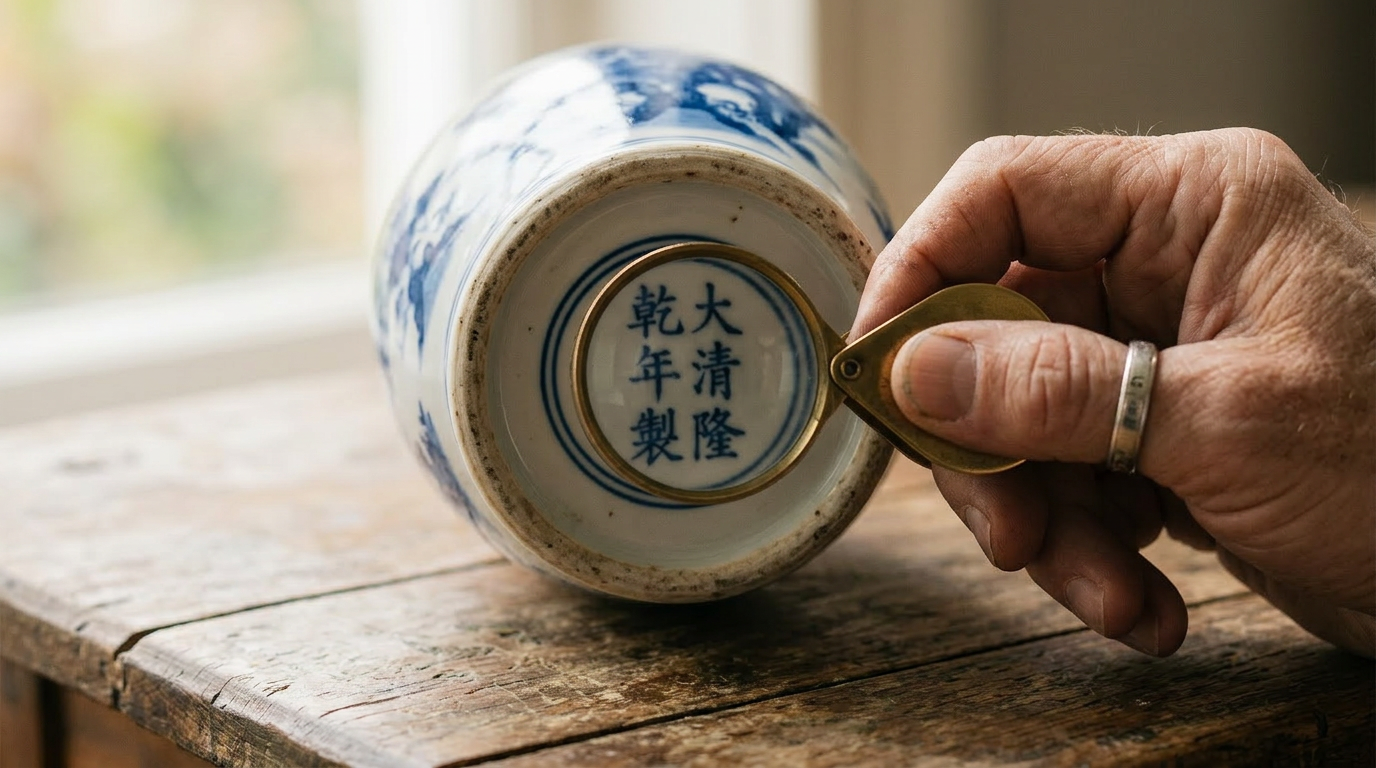
The reign mark on the base is what most people consider proof of authenticity. Ironically, it is the sign that misleads most often, precisely because it is the easiest element to copy and the first thing an amateur checks.
How a Qing reign mark is built
A standard Qing imperial reign mark consists of six characters: 大清康熙年製 for the Kangxi period, read as Da Qing Kangxi Nian Zhi, "made in the Kangxi period of the Great Qing". The formula is always Da Qing, then the emperor's name, then Nian Zhi. The mark appears in two script forms: regular script (kaishu) and the more angular seal script (zhuanshu), and it can be written in underglaze cobalt blue, iron red, or other pigments depending on the period and the type of ware.
The four reign periods you will encounter most often on marked pieces:
| Period | Years | Mark reads |
|---|---|---|
| Kangxi | 1662-1722 | 大清康熙年製 (Da Qing Kangxi Nian Zhi) |
| Yongzheng | 1723-1735 | 大清雍正年製 (Da Qing Yongzheng Nian Zhi) |
| Qianlong | 1736-1795 | 大清乾隆年製 (Da Qing Qianlong Nian Zhi) |
| Guangxu | 1875-1908 | 大清光緒年製 (Da Qing Guangxu Nian Zhi) |
Learning to read these characters is a skill in itself; our article on reading Chinese marks on antiques walks through the characters one by one, and the mark identification guide covers the rarer mark types: hall marks, commendation marks and symbol marks.
What an expert actually looks at
Not the presence of the mark, but its execution. The calligraphy of a period mark came from specialised mark painters who wrote the same six characters thousands of times, fluently and with confidence. Copied marks are often drawn rather than written: hesitant strokes, wrong stroke order visible in the ink flow, characters that are too evenly spaced or subtly malformed. The cobalt of the mark must match the cobalt of the decoration. The mark must sit correctly on the base: centred, under the glaze for underglaze blue marks, with the glaze pooling naturally around it.
And one modern giveaway has become common: transfer-printed marks. Under a loupe, a hand-written mark shows the varying density of a brushstroke; a printed mark shows a flat, even, sometimes dotted structure. This single check with a 10x loupe eliminates a large share of contemporary fakes. More examples of manipulated and forged marks are collected in our article on fake Chinese porcelain marks.
Rule of thumb: a reign mark never proves authenticity. It is only one piece of the puzzle. The writing style, the colour of the cobalt, the placement and the sharpness of the strokes reveal more than the mark itself. A piece without any mark can be authentic and valuable; a piece with a perfect mark can be brand new.
2. The Foot Ring: Where the Truth Hides
The underside of a piece of porcelain is the hardest part to fake convincingly. Turn the piece over, carefully, above a soft surface, and examine the foot ring: the unglazed rim on which the piece stood in the kiln.
What genuine age looks like
On genuinely old porcelain the exposed body at the foot ring shows a soft, slightly uneven texture. Where iron in the clay met the kiln atmosphere, a mild orange-brown oxidation often developed, sometimes called the iron-red foot rim. Centuries of standing, moving and handling leave fine, irregular wear on the resting surface: tiny scratches in random directions, with a smooth, almost polished feel where the piece touched tables and shelves. The transition between glaze and exposed body is crisp on well-made imperial ware, and the trimming of the foot itself follows period conventions: the shape of a Kangxi foot differs from a Qianlong foot.
How fakers imitate it, and where they fail
Artificial ageing is a craft of its own, but it tends to overshoot. Sandpaper wear runs in parallel lines instead of random directions. Tea or coffee staining lodges in places where dirt would never naturally accumulate. Deliberately applied "kiln grit" sits on top of the surface instead of being fused into it. A foot ring that is uniformly dirty is as suspicious as one that is uniformly clean: real dirt is selective. And modern porcelain bodies are often whiter, denser and more glassy than the slightly warm-toned bodies of older wares. When the foot ring and the mark tell different stories, believe the foot ring.
3. Weight and Sound: Lighter Than You Expect
Fine imperial porcelain of the great periods, Kangxi, Yongzheng, Qianlong, was thrown thin from highly refined clay and fired at high temperature. The result is a body that feels surprisingly light for its size, with walls of even thickness and a clear, resonant ring when tapped gently with a fingernail.
Modern copies are often noticeably heavier and thicker-walled, because the economics of reproduction do not reward the risk of throwing thin. The clay composition differs, the firing differs, and the balance in the hand differs. Potting quality also shows at the neck and rim: period pieces of quality have finely finished rims, while copies often feel blunt or rolled.
This is the least measurable of the seven signs and the one that grows most with experience. Handle documented pieces whenever you can, at viewing days of auction houses such as Christie's, Sotheby's or Bernaerts, and the difference starts to register in your hands. The visual differences between old and new bodies are illustrated side by side in our modern versus antique Chinese porcelain visual guide.
4. The Glaze: Look With a Loupe, Then With UV
Authentic old glaze almost always contains life: microscopic air bubbles of varying size, small irregularities, pinholes, and sometimes a soft surface sheen that centuries of handling produce and that polishing cannot quite imitate. Under a 10x loupe, old underglaze blue sits visibly beneath a layer of glass, slightly diffused at the edges. Modern glazes tend to be more uniform, with bubbles that are small and evenly distributed, and decoration that sits flat and sharp.
Crazing, the fine network of cracks in some glazes, develops naturally over long periods, with dirt gradually accumulating in the older cracks. Artificially induced crazing is common on fakes and often looks too regular, too fresh, or stained too evenly.
Under UV light (a simple blacklight suffices) modern materials frequently fluoresce differently from old glaze, and restorations, overpainting and later additions can light up against the original surface. Treat UV as a useful first indicator, not as a verdict: some old materials fluoresce too, and some modern glazes do not. What UV mainly reveals is inconsistency, and inconsistency is always a question that needs answering.
5. Decorative Style: Anachronisms Give It Away
Every period had specific decorative conventions, and this is where forgers most often betray themselves, because painting convincingly in a period style is far harder than copying a six-character mark.
A dragon with five claws was reserved for imperial use; export and provincial wares show four or three claws. Certain floral scrolls, border patterns and figure types belong to specific periods. The way faces are painted, the way rocks and clouds are constructed, the density of the composition: all of it changes through the centuries, and specialists read it the way a philologist reads handwriting.
A piece that claims to be Ming but carries decorative elements that only became common under the Qing has a problem, regardless of how convincing the mark looks. The same holds for technique: famille rose enamels, for example, belong to the 18th century and later, so a "Ming" piece decorated in famille rose refutes itself. Checking decoration against period is one of the classic mistakes buyers skip when buying Chinese porcelain, usually in the excitement of a supposed bargain.
6. Cobalt Blue: Not All Blue Is Equal
The famous blue-and-white porcelain owes its colour to cobalt oxide, but the source and processing of that cobalt changed over time, and with it the character of the blue.
Early Ming cobalt, imported from Persia, produces a deep, somewhat uneven blue with characteristic dark spots where the pigment concentrated, the effect known as heaped and piled. Later domestic Chinese cobalt reads more even and can lean silvery or greyish. Kangxi-period blue at its best shows graded washes in multiple tones, sometimes called the five colours of blue. Modern chemically purified cobalt is bright, flat and perfectly even, a blue that did not exist before industrial refinement.
Forgers know about heaped and piled, and imitate it by dabbing darker spots into the wash. Under the loupe the imitation often reveals itself: the genuine effect sits within the stroke, where pigment physically accumulated, while the imitation sits on top of it, as added dots. Read the blue together with the decoration style of sign 5: colour and drawing must agree about their period.
7. Provenance: Where Does It Come From?
A piece with documented provenance, an old collection label, an auction catalogue entry from the 1960s, a dated invoice, a family photograph with the piece visible, is not automatically authentic, but it is a significant additional data point. Porcelain that demonstrably entered a European collection before the modern reproduction wave carries a different starting probability than a piece that surfaced last month.
Be wary of stories without paper. "It was always at grandmother's" is an anecdote, not provenance. "Brought back by a great-uncle who sailed to the East" is a family legend attached to thousands of objects. An invoice from a reputable auction house dated 1978 is provenance. Collection labels can themselves be faked or transferred, so treat them as claims to verify: does the collection exist, does the numbering match a catalogue?
Weigh provenance last, not first. The physical evidence of signs 1 to 6 tells you what the object is; provenance tells you what people have said about it. When the two conflict, the object wins.
Uncertain About Your Piece?
Have your Chinese porcelain analysed by AntiqBot CeramCheck: AI analysis of the mark, glaze, decoration and style, checked against reference marks and auction data. Sign up and get 1 free credit for your first analysis. After that, buy credit packs starting from €0.60 per analysis.
Analyse Your PorcelainThe Four Fakes You Will Actually Meet
Theory becomes practical when you know what typically turns up at flea markets, general auctions and estate clearances in Europe. Four categories cover most cases.
1. Modern decorative reproductions
Mass-produced blue-and-white ware, often with a four-character or six-character mark, heavy in the hand, flat printed or quickly painted decoration, snow-white body. Made as decoration, not deception, but frequently resold with an "antique" label once it has aged a few decades in a living room. This is the most common category by far.
2. Deliberately aged fakes
Reproductions given artificial wear: abraded foot rings, tea-stained crazing, applied dirt. Quality varies from laughable to genuinely dangerous. The foot ring and glaze checks (signs 2 and 4) catch most of them, because artificial ageing tends to be too uniform.
3. Later period pieces with earlier marks
The historically legitimate category: Guangxu-period revivals of Kangxi styles, 18th-century apocryphal Ming marks. These are genuinely old, honestly collectable, and have their own market value. The error is not owning them; it is buying or selling them as the earlier period. Correct attribution is exactly where careful mark and style analysis pays for itself.
4. People's Republic porcelain sold as imperial
Porcelain made after 1949 is called People's Republic porcelain. Much of it is skilfully made, some of it is collectable in its own right, and a good deal of it carries Qianlong or Guangxu marks. It surfaces constantly in estate sales, often with a firm family conviction that it is "the old Chinese vase". Body colour, glaze uniformity and decoration style give it away to a trained eye.
A Practical Order of Operations at Home
When a piece of Chinese porcelain is in front of you and you want a first assessment before spending money on it, or before selling it too cheaply, work in this order:
- Step 1: pick it up. Register weight, wall thickness, balance, the feel of the rim.
- Step 2: turn it over. Read the foot ring: texture, oxidation, wear direction, body colour.
- Step 3: only now look at the mark. Hand-written or printed? Fluent or drawn? Does its cobalt match the decoration?
- Step 4: loupe on the glaze and the blue: bubbles, edge diffusion, crazing, added "age".
- Step 5: check the decoration against the claimed period: claws, palettes, motifs, painting quality.
- Step 6: ask for provenance, in writing where possible, and weigh it last.
Two further habits keep this checklist honest. First, examine damage and restoration separately from age: a hairline, a re-stuck rim or an overpainted repair says something about condition and value, but nothing about authenticity, and sellers sometimes use visible old damage as implicit proof of age. It is not; copies get chipped too. Second, decide your maximum price before you start handling the piece, based on the least favourable plausible attribution. If the object turns out better than that, the surprise is pleasant; if you price it as imperial Qianlong and it proves to be a later revival, the surprise is expensive.
For a structured second opinion, photograph the piece the way an analyst needs it: the whole object straight on, the base with the mark filling the frame in sharp focus, a detail of the decoration, and any damage or restoration. Natural daylight, no flash directly on the glaze. Good photographs are half the analysis, whether the piece goes to CeramCheck or to an auction house specialist.
Frequently Asked Questions
How do I spot fake Chinese porcelain?
Check the reign mark, but never trust it alone. Examine the foot ring for natural wear and oxidation, test weight and ring, inspect the glaze with a loupe and under UV, and confirm the decoration matches the claimed period. It is the combination of signs that decides, never one test.
Is my Ming vase real?
Statistically, the odds are low: most Ming-marked vases on the market are later, often 19th or 20th century, or modern. But "later" is not the same as worthless. A correct attribution, even to a more modest period, gives you an honest value instead of a fantasy.
What does a genuine Qing reign mark look like?
Six characters, Da Qing (emperor) Nian Zhi, fluently written in period-consistent script and pigment, correctly placed on the base. The table earlier in this article lists the four periods you will meet most often, with their characters and years.
What does authentication cost?
With AntiqBot CeramCheck your first analysis is free on registration; after that, credit packs start from €0.60 per analysis. A physical expertise at an auction house typically runs €50 to €150 per object, which remains the right route for pieces where a major value is plausibly at stake.
Summary: the 7 Checks at a Glance
- Reign mark: analyse writing style, colour and sharpness; a mark never proves authenticity
- Foot ring: texture, colour, oxidation and wear direction of the unglazed area
- Weight and sound: fine imperial porcelain is often lighter than expected, with a clear ring
- Glaze: microscopic structure under the loupe, inconsistencies under UV
- Decorative style: check for anachronisms in motifs, palette and painting quality
- Cobalt blue: the character of the blue must match the claimed period
- Provenance: documented history as supporting evidence, weighed last
Final Thought
No single test gives certainty. It is the combination of all these signs, each one a small probability shifted, that makes a reliable judgement possible. That is precisely why AntiqBot uses multiple analysis vectors simultaneously: not one check, but an interplay of visual analysis, mark recognition and stylistic comparison.
And remember: doubt is not weakness. Doubt is the beginning of knowledge. The collector who assumes every mark is honest pays the tuition; the collector who checks seven signs collects the pieces.