The Most Dangerous Mistakes When Buying Chinese Porcelain
The most expensive mistakes in the porcelain trade are not made by people who know nothing, but by people who know just enough to convince themselves. Six mistakes return again and again, at flea markets, in auction rooms and online. Know them, and you buy differently.
Chinese porcelain is one of the most collected and, at the same time, most faked categories in the entire antiques world. The price differences are extreme: two vases that look identical to a layperson can differ in value by a factor of a thousand. Precisely that combination, huge price gaps and subtle differences in features, makes the terrain so dangerous for buyers.
This article covers the six mistakes that cost the most money in practice. Not as theory, but as they actually happen: at the flea market at eight in the morning, in the saleroom at lot 214, and late at night in front of a marketplace listing with a ticking countdown.
Mistake 1: Trusting the Reign Mark Alone
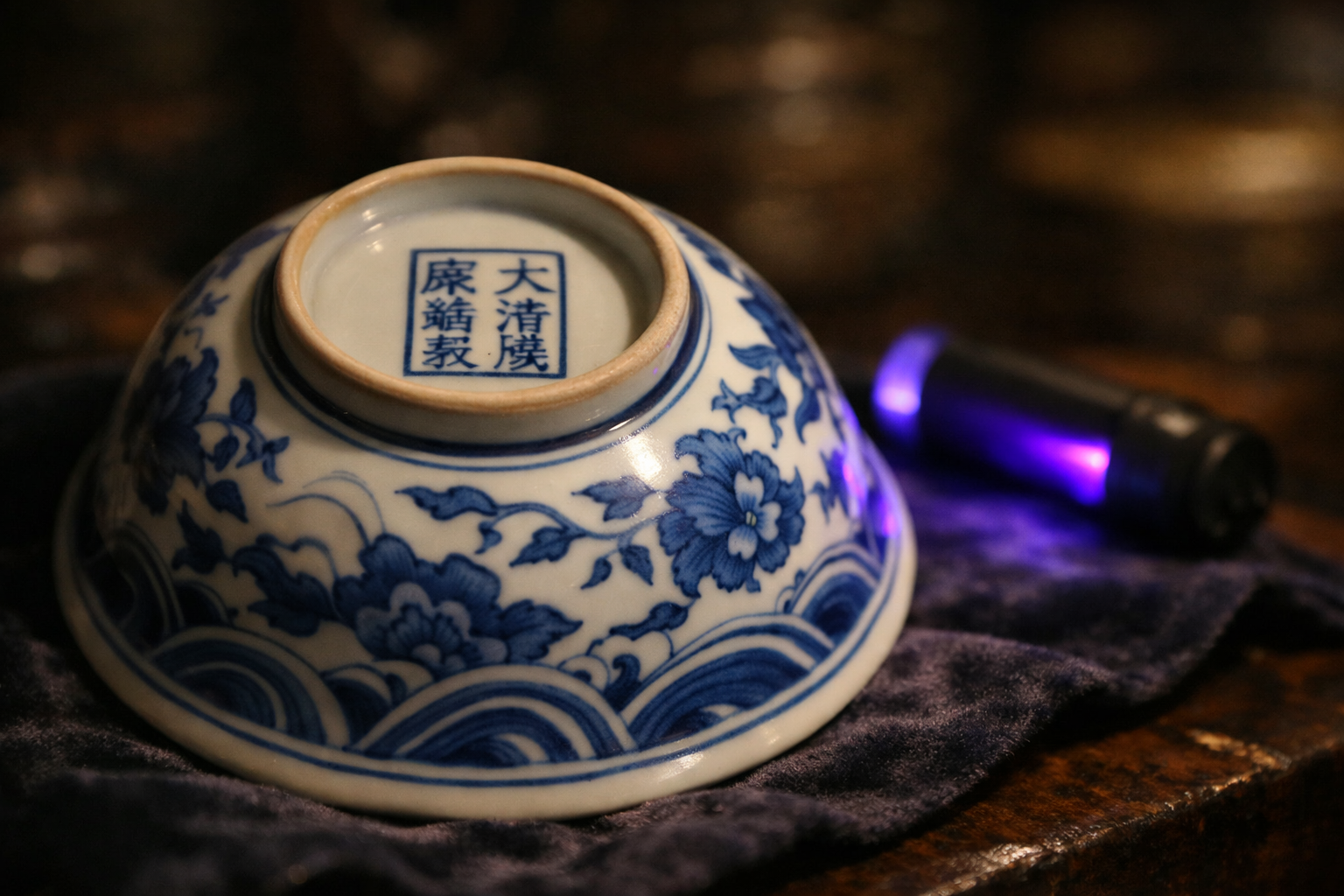
The classic, and still number one. A buyer turns a vase over, sees six Chinese characters, looks them up, finds "Qianlong, 1736-1795", and starts counting imaginary money. What that buyer does not know: reign marks were copied for centuries, within China itself, both as homage to earlier periods and as a commercial trick. The large majority of reign-marked porcelain on the market is younger than its mark claims.
That does not make the mark worthless as information, far from it. But it is a claim, not proof. The execution of the calligraphy, the colour of the cobalt, the placement on the base: all of it must be consistent with the claimed period, and even then it remains one puzzle piece next to foot ring, glaze, weight and decoration. The full inspection routine is laid out step by step in our guide on how to spot fake Chinese porcelain, and if you want to learn to read the characters themselves, start with reading Chinese marks on antiques.
Rule of thumb: treat every mark as a question, never as an answer. "Why is this mark on this piece?" is the right opening attitude. Sometimes the answer is "because it belongs there". Usually it is not.
Mistake 2: Relying on the Shade of Blue
Somewhat advanced buyers know the cobalt story: early Ming blue from Persian cobalt is deep and blotchy ("heaped and piled"), Kangxi blue shows layered tones, modern chemical cobalt is flat and even. That story is correct. The mistake lies in the application: whoever knows one feature starts seeing that one feature everywhere.
Forgers read the same literature as collectors. Dark spots in the blue are deliberately imitated by dabbing pigment points into the wash. The difference is visible under a loupe, the genuine effect sits within the brushstroke while the imitation lies on top of it, but a buyer who judges colour without a loupe walks straight into it. The reverse error happens too: genuinely old porcelain gets rejected because its blue looks "too even" to a layperson expecting the Kangxi ideal on a piece that simply comes from another period or kiln.
The shade of blue is a supporting feature, never a deciding one. Always read it together with the decorative style and the technical execution. The visual differences between periods are shown side by side in our modern versus antique Chinese porcelain visual guide.
Mistake 3: Overpaying for 'Famille Verte' or 'Famille Rose' Without Documentation
The terms famille verte and famille rose open wallets. They sound like connoisseurship, like Paris auction catalogues, like eighteenth-century refinement. And so they get attached, on marketplaces and at fairs, to practically anything bearing green or pink enamels.
The facts: famille verte, with its brilliant green enamels, flourished in the Kangxi period (1662-1722). Famille rose, recognisable by its opaque pink tones, appeared only in the early eighteenth century and dominated from Yongzheng and Qianlong onwards. Both were then produced and imitated for two more centuries: nineteenth-century revival pieces, twentieth-century export work, contemporary decoration. A plate "in famille rose style" from 1960 is not an eighteenth-century plate, however correct the terminology.
The mistake, then, is not believing the terminology but assuming the period without evidence. Always ask: from which period does this piece date, and what shows it? A seller who says "famille rose" but will not commit to a period has already answered your question. And a piece claiming to be Ming while wearing famille rose enamels refutes itself: the technique did not yet exist.
Mistake 4: Failing to Detect Restoration
This is the most expensive mistake relative to how easy it is to avoid. A professionally restored hairline, a re-attached neck or a retouched rim is often invisible to the naked eye, especially under fair-stand lighting or in the glow of product photos. The value gap between intact and restored runs to tens of percent on better porcelain, and far beyond that at the top of the market.
Three simple checks catch most of it. One: UV light. Overpainting, filler and modern adhesives almost always fluoresce differently from original glaze; an evenly purple surface with one deviating zone deserves a conversation. Two: the tap test. Tap gently around the rim with a fingernail; intact porcelain sings, a restored zone sounds dull or dead. Three: the touch test. Restoration material feels warmer and softer than cold, hard porcelain; run a fingertip slowly along the rim and across the surface.
Restoration, by the way, is not a death sentence, and that makes the mistake a double one: whoever misses it overpays, but whoever finds it holds a negotiating argument. A skilfully restored piece from a good period can be an excellent purchase at the right, reduced price, certainly for someone who collects to learn and to display rather than to invest. The mistake never lies in the restored piece itself; it lies in hanging an intact piece's price tag on a treated object.
When buying online, always ask explicitly about restoration, in writing. "Are there any restorations, hairlines or chips?" is a question an honest seller answers in two sentences and a dishonest seller audibly shuffles around. Keep that answer: it is your ground for recourse if the piece turns out to have been treated.
Mistake 5: Confusing Export Porcelain with Imperial Porcelain
From the seventeenth century onwards, China shipped enormous volumes of porcelain to Europe through the trading companies. That export porcelain, from Kraak dishes to Canton vases, is genuinely old, often charming, and thoroughly collectable. But it was made in large series for the trade, not in limited numbers for the imperial court, and those two markets sit far apart in price.
The confusion arises because both categories are old and Chinese, and because export pieces have been in European families for generations, complete with the story "this is a genuine old Chinese vase". That story is true. Only the conclusion attached to it, imperial quality and imperial value, is not. Features pointing towards export: decoration adapted to European taste, coats of arms or monograms, serial execution, and the absence of the refinement in painting and material that characterises court porcelain.
By all means buy export porcelain; it is a beautiful collecting field with centuries of history. But buy it at export prices. What a realistic price looks like per category and period is covered in our guide on Chinese porcelain valuation.
Mistake 6: Misinterpreting Auction Results
"A similar vase fetched €40,000 at auction." Few sentences have caused more bad purchases than this one. The mistake has three layers.
Layer one: "similar" is a dangerous word in porcelain. The record result concerned a piece with imperial provenance, documented history and intact condition; the piece in front of you shares only the shape and the colour scheme. Layer two: auction results are outliers and failures at the same time. For every record lot there are unsold and withdrawn lots that never make a headline; whoever sees only the records structurally overestimates the market. Layer three: the difference between hammer price and total price. On top of the hammer price, auction houses add a buyer's premium of typically twenty to thirty percent; treating hammer prices as market value makes you rich on paper when selling and poor in practice when buying.
Use auction results as a bandwidth, not a promise, and compare only with lots whose period, condition and provenance genuinely match. Results from established houses such as Christie's, Sotheby's and Bonhams are publicly searchable; Catawiki results also give a more sober picture of the middle market than the records that reach the press.
Where the Mistakes Happen: Flea Market, Auction Room, Online
The same six mistakes feel different depending on the setting, because each environment puts its own pressure on your judgement. Understand the environment and you recognise the moment the mistake presents itself.
At the flea market
Here the pressure is speed. The light is poor, someone is looking over your shoulder, and the thought "if I don't grab it now, someone else will" pushes you straight past your own checklist. On top of that, you rarely have a loupe or UV torch to hand, while stallholders know their stock and seldom price a piece low by accident. The discipline here: carry a pocket loupe on your keyring, turn every piece over before you discuss the price, and accept that you will miss some bargains. The real flea-market bargain is usually not the piece everyone grabs at, but the piece whose foot ring only you have read. More fieldcraft lives in our guide on buying antiques at flea markets.
In the auction room
Here the pressure is competition. Bidding itself activates something ancient in a person: losing to another bidder feels like loss, even when stopping is the right decision. Auction houses know that mechanism; the catalogue description, moreover, is a legally weighed text in which "Qianlong mark" means something fundamentally different from "Qianlong period". Read those formulations literally. The discipline here: attend the viewing day, examine the lot in hand, write down your maximum including premium before the session starts, and let the lot go the moment that number passes. A bidder who raises his maximum during the bidding has no maximum.
Online
Here the pressure is incompleteness. You are buying from photos the seller chose, under a countdown that manufactures urgency. The discipline here: never buy on less than sharp photos of the front, the base with the mark, the rim and any damage; request missing images and treat a refusal as an answer. Put your restoration questions in writing and keep the reply. And calculate the total price, fees and shipping included, before you bid, not after.
Five Questions Every Seller Should Be Able to Answer
An honest seller answers these five questions readily; an evasive seller answers them too, just differently than he thinks.
- "From which period does this piece date, exactly?" Daring to name a period is the baseline. "Old" or "antique" without a period is not an answer.
- "What do you base that dating on?" The answer shows whether the seller has looked at mark, body and decoration himself or is merely passing the story along.
- "Are there any restorations, hairlines or chips?" Ask in writing, keep the answer.
- "Where does the piece come from?" Provenance need not be impressive, but the story must stay consistent when you probe.
- "May I photograph or receive detailed images of the base and the mark?" A refusal ends the conversation.
Notice what these questions have in common: none of them requires expertise from you. They merely move the burden of proof to where it belongs, with the person selling the piece.
In Doubt Before You Buy?
Have the piece analysed first by AntiqBot CeramCheck: AI analysis of the mark, glaze, decoration and style, checked against reference marks and auction data. Sign up and get 1 free credit for your first analysis. After that, buy credit packs starting from €0.60 per analysis.
Analyse Before You BuyThe Reverse Mistake: Leaving Opportunities Behind
Honesty demands showing the mirror side too. Whoever finishes this article seeing fakes everywhere makes a seventh mistake: paralysis. The market genuinely contains good pieces circulating below their value, and they follow a fixed pattern: they are being sold by someone who, at that moment, knows less about them than you do.
The estate sale where "auntie's old vase" stands among the glassware, priced as decoration. The auction lot with a vague catalogue description and poor photographs, which specialists scroll past. The export piece labelled "Japanese", or the other way around. This is exactly where knowledge pays out: the same checklist that protects you from overpaying also tells you when a piece is better than its price. The difference between the buyer who misses opportunities and the buyer who makes mistakes is not courage but method: both see the same piece, only one reads it while the other gambles.
If you want to learn systematically to see what a piece really is, rather than what it appears to be, the fastest way is to document every borderline purchase: photographs, your assessment beforehand, and what the piece eventually turned out to be. After twenty pieces you own a personal archive of your own blind spots, and that is worth more than any handbook.
The Common Thread: Why These Mistakes Persist
Six different mistakes, one shared mechanism: they all happen at the moment desire works faster than verification. The buyer wants the mark to be right, wants the blue to be Kangxi, wants the auction comparison to hold. Forgers and hurried sellers are not selling porcelain; they are selling that desire.
The antidote is not more knowledge alone, but a fixed working order that you follow even when the piece is beautiful and the price is tempting. Especially then. Discipline at the moment of buying is cheaper than expertise afterwards.
The Checklist Before Every Purchase
- Set your maximum price in advance, based on the least favourable plausible attribution, and stick to it.
- Turn the piece over: foot ring, body and mark together tell you more than the decoration on the front.
- Use a loupe on mark, blue and glaze: hand-painted or printed, layered or dabbed, lived-in or sterile.
- Run the UV, tap and touch tests for restoration, or ask about it in writing when buying online.
- Check the decoration against the claimed period: techniques and motifs that do not belong to the period refute the story.
- Compare against real references: sold lots of comparable period and condition, premium included, not headlines.
What Photographs Tell You in Advance
When buying online, photographs are your only sense, so it pays to read them the way an appraiser does. The order of importance is the reverse of what sellers usually show: the base with foot ring and mark says more than the most beautiful overall shot. Watch the sharpness of precisely that image; sellers photograph sharply what they want to show and vaguely what they would rather not explain. One blurry base photo among ten crisp mood shots is rarely a coincidence.
Look further at the transition between glaze and body at the foot ring, at the evenness of the blue in detail shots, and at rims and handles, the places where restoration hides most often. And use the same photos for an independent second opinion: an analysis based on good photographs for antiques authentication costs a fraction of what one wrong purchase costs.
Frequently Asked Questions
What is the biggest mistake when buying Chinese porcelain?
Trusting the reign mark alone. Reign marks were copied for centuries, so a correct-looking mark proves nothing by itself. Judge the whole: mark, foot ring, glaze, weight, decorative style and provenance in combination.
How do I detect restoration?
UV light reveals zones that fluoresce differently, the tap test exposes dull-sounding restored areas, and restoration material feels warmer than porcelain. When buying online, always ask in writing about restorations and hairlines.
Is export porcelain worth less than imperial porcelain?
Usually yes: it was made in large volumes for the trade. But it is a fully-fledged collecting field with its own market. The mistake is not buying it, but paying imperial prices for it.
What does an analysis cost beforehand?
With AntiqBot CeramCheck your first analysis is free on registration; after that, credit packs start from €0.60 per analysis. Compare that with the price of one mistakenly bought "Qianlong" vase and the arithmetic is quickly done.
Budget and Building: Buy Less, Buy Better
Most beginning collectors buy too many pieces too quickly. Ten mediocre or doubtful objects together cost more than two good ones, teach you less, and are harder to sell later. The porcelain market structurally rewards patience: the supply is endless, with a new flea market, a new auction, a new estate every single week. Scarcity does not live in the supply, but in the good pieces within that supply, and you only find those by looking often and buying rarely.
A workable rule for anyone serious about their collection: set a fixed amount per period, say per quarter, and allow yourself within that budget at most one purchase whose attribution you are not fully certain of, explicitly labelled as tuition. Every other purchase runs the full checklist. That way the joy of the hunt survives, while the mistakes stay bounded to an amount you consciously set aside to learn from. And sell something now and then: nothing sharpens the buying eye like standing on the other side of the table and receiving the questions you ought to be asking.
Final Thought
Avoiding mistakes in this field is not a matter of distrust but of sequence. Whoever verifies first and falls in love afterwards buys better pieces for less money over the years. And whoever has once felt the discipline of walking away from a piece that looked too good for its price understands why the best collectors rarely regret what they did not buy.