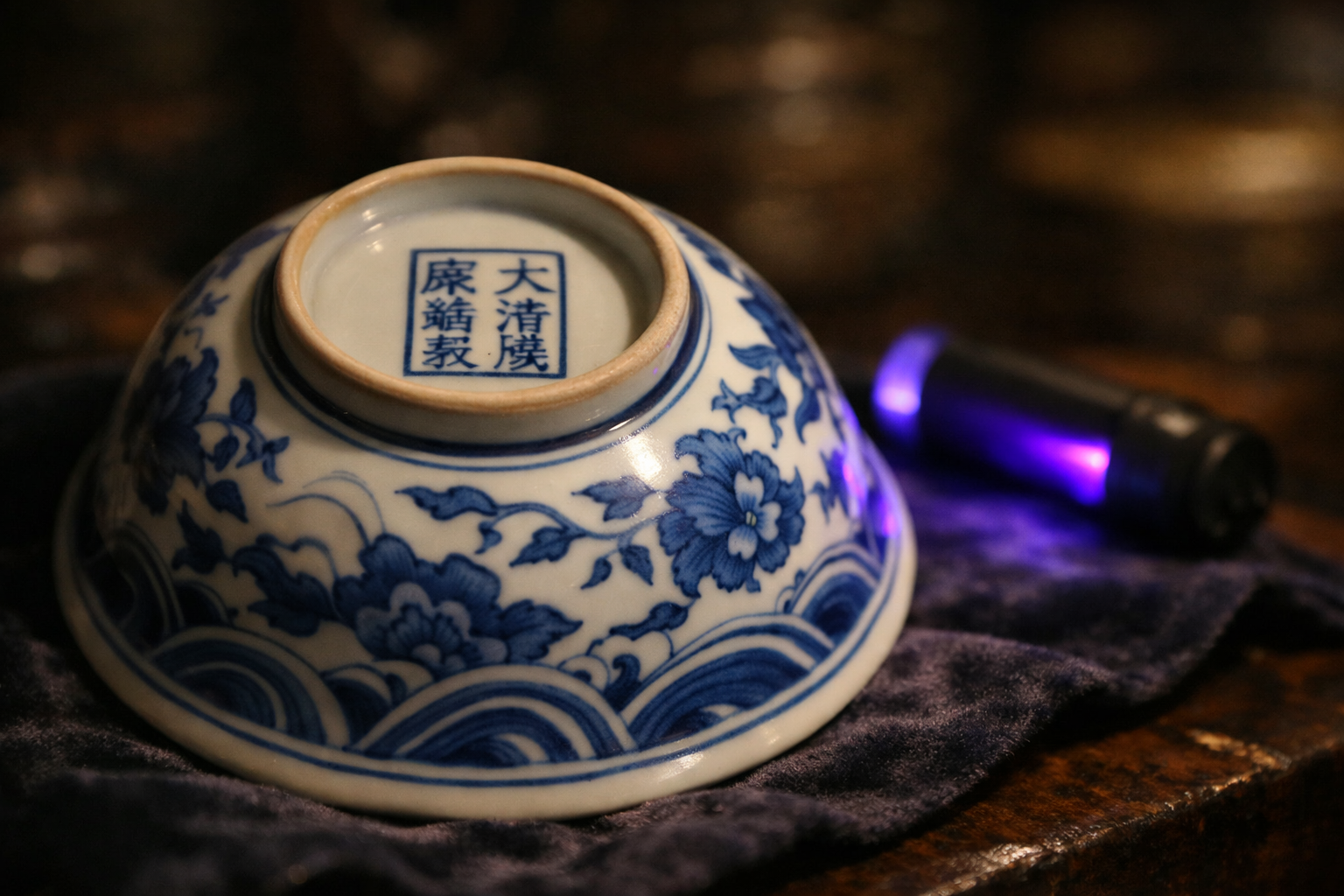
Modern vs Antique Chinese Porcelain: A Visual Guide
Most pieces sold today as "antique Chinese porcelain" on flea markets, in online listings and at estate clearances are modern. Not because sellers are dishonest, but because the visual cues that separate the two have become harder to read as decals, transfers and machine-aged finishes improved. This guide walks you through what to look at, in what order, and what each clue means.
If you also want to read marks themselves, start with our complete guide to reading Chinese porcelain marks. For the specific question of forged reign marks, our forensic guide to fake Chinese porcelain marks is the companion to this article. The present text is about the piece as a whole, not about the mark alone.
A note on terminology before we begin. In this article, "antique" means pre-1912 (before the fall of the Qing). "Republic period" covers 1912 to 1949. "People's Republic porcelain" covers 1949 to roughly 1990. "Modern" covers everything from the 1990s onward, the era of mass-produced antique-style export ware that fills most online listings today.
1. Why the Visual Cues Have Become Harder to Read
Twenty years ago, a competent collector could tell a modern Chinese vase from a 19th-century one in three seconds at five metres. Today the same collector needs to pick the piece up, turn it over, look at the foot rim under raking light, and check the weight. Three things have changed.
First, decoration technology improved. Inkjet decals and high-resolution photo transfers on ceramics now produce decoration that mimics hand-painted brushwork at a distance. The lines look convincing in a phone photograph. They fall apart only under direct magnification.
Second, the Chinese ceramics industry around Jingdezhen now deliberately produces "antique-style" ware for the global decoration market. These pieces are not forgeries in the legal sense. They are decorative reproductions, openly produced, but they enter the secondary market through countless intermediaries, and by the third hand they are sold simply as "old Chinese vase from an estate".
Third, applied patinas have matured. A skilled finisher in Jingdezhen can apply tea staining, dust accumulation, kiln grit imitation, foot wear and even calcium deposits in a way that survives casual handling. The patina looks period-correct at first glance. It only fails the test of close, systematic visual analysis.
Faced with these three changes, you cannot rely on one signal. You need to read four or five signals together. If three or more agree, you have a defensible reading.
2. The Foot Rim: The Single Most Diagnostic Spot
If you can only look at one part of the piece, look at the foot rim. The foot rim is the unglazed circle where the piece stood in the kiln. It reveals the porcelain body, the firing process, and centuries of wear, all in one place.
On a genuine 18th-century Chinese piece, the foot rim shows a few consistent features. The body is a creamy off-white, sometimes faintly grey, never bright modern white. The edge is irregular, hand-finished by a foot-cutter, with tiny variations in thickness and angle around the circle. Kiln grit, the tiny sand or rice husk fragments that prevented the piece from sticking to the kiln support, has fused into the unglazed clay and cannot be wiped off. Wear shows as fine surface scratches, accumulated dust dark in the porous body, and a softening of the sharp edges along the rim from centuries of being set down.
On a modern piece, the foot rim is clean. The body colour is bright white because modern Chinese porcelain often uses purified kaolin and additives that produce a whiter result than the historic Jingdezhen mix. The edge is mechanically uniform, often slightly bevelled at the same angle around the entire foot, betraying machine finishing. Applied kiln grit, if present, wipes off with a damp cloth because it was glued on rather than fused during firing. Applied "wear" patterns are too symmetrical, present where wear would not naturally occur, and absent at the sharp corners that real wear attacks first.
3. The Clay Body: Look at the Break, Look at the Light
If the piece is chipped (and many old pieces are chipped somewhere), the break reveals the body. Hold the chip up to a strong light. An old Chinese porcelain body, particularly Jingdezhen, has a slight warm translucency. The body itself glows faintly through thin sections. The colour is creamy or faintly pale yellow against a strong torch.
A modern industrial Chinese body is whiter, denser, and either fully translucent (premium reproductions) or completely opaque (cheap reproductions). The translucency feels different too: it is a clean, even glow rather than the slightly cloudy warmth of historic body.
If there is no chip, look at the unglazed rim of the foot itself in raking light. Run your thumb over it. Old body has a faint mineral feel, slightly sandy at very high magnification. Modern body feels glass-smooth or chalky depending on the additives used.
4. The Glaze Surface: Pinholes, Pooling, Crackle, Wear
A Qing-period glaze, applied by dipping or pouring, almost always shows three or four signature features. Look for pinholes, the tiny punctures left when gas bubbles escaped during firing. They occur in a slightly random pattern across the surface, never in a perfect grid. Look for glaze pooling at the base of decorative ridges or where the glaze ran during the firing, producing a slightly thicker, slightly bluer or greener zone. Look for crackle if the piece is high-fired Qing, where the cooling rate cracked the glaze in a way that ink rubbed into the cracks now shows as a fine network. And look for wear: the glaze on the rim and on raised decoration shows fine scratches, dulled high points, and occasional missing micro-flakes.
A modern glaze is too perfect. Industrial glaze spraying produces an even, uniform surface with no pooling, few or no pinholes, and no natural wear. If crackle is present on a modern piece, it is induced crackle, deliberately created at the time of firing as a decorative effect rather than a side product of cooling. Induced crackle is regular, runs across the entire piece in a consistent pattern, and the cracks are filled at the time of manufacture rather than rubbed full of dirt over decades.
One test you can do in any antique shop: rub a fingernail across the rim. On an old piece you will feel micro-roughness from accumulated wear. On a modern piece the rim is glass-smooth.
5. The Decoration: Brushwork vs Decal vs Transfer
A hand-painted Chinese decoration, executed in the 18th or 19th century, has consistent characteristics that cheap modern decals and inkjet decals cannot reproduce convincingly. Look at the cobalt blue lines under a 10x loupe. Real cobalt, applied with a brush, soaked slightly into the unfired body before the glaze was applied. The line edges feather softly into the surrounding ground, and the cobalt is not uniformly dense along a single stroke: a brush starts heavy, runs out, and is reloaded. You see variation in line thickness and ink density along the stroke.
A decal or transfer decoration shows the opposite. The edges are sharp and uniform, with no feathering. The colour density is mechanically consistent across the entire piece. If you look very closely, you may even see dot patterns from the printing process, particularly on shaded areas. Some recent decals also have a faint shine difference where the decal sits on top of the glaze rather than under it. A fingernail test along a decoration line: on a hand-painted underglaze piece, you feel only glaze. On a decal applied over glaze, you feel a tiny ridge where the decal edge sits.
Iron-red overglaze decoration is harder to fake convincingly. The traditional iron-red pigment has a slightly grainy texture under magnification and a particular dull orange-red colour that modern enamels match only approximately. Famille rose pinks made with colloidal gold show a particular cool pink that synthetic pinks do not reproduce.
6. Cobalt Tone: A Period Signature
Cobalt blue is the most studied pigment in Chinese porcelain because it changed in character several times over the centuries. Yuan dynasty cobalt (1271 to 1368) came largely from Persia and produced a deep, almost violet blue with slight black speckling where the iron in the cobalt fluxed during firing. Early Ming cobalt from the same source has similar character. Late Ming cobalt was often domestic and produced a more grey-blue, less vivid result. Early Kangxi (1662-1722) cobalt is deep, ink-blue, occasionally with violet undertones. Late Kangxi shifts toward a brighter sapphire blue. Yongzheng (1723-1735) is typically a refined, even blue. Qianlong (1736-1795) covers a wider palette but the underglaze cobalt of the period is consistently controlled.
Modern cobalt, applied in an industrial setting, is uniform across the entire piece. There is no fluxing speckle, no edge feathering into the body, and no variation in tone across the decoration. A modern "Ming-style" vase often gives itself away by having a perfectly even cobalt that no Ming kiln ever produced.
This signature is invisible from a distance and obvious under a loupe. Always loupe the cobalt before forming an opinion.
Rule of thumb. If the cobalt looks too clean and too even, you are looking at modern work. Period cobalt has character. Modern cobalt has consistency.
7. The Reign Mark: One Signal Among Many
A reign mark on the base, in six characters of the form 大清[emperor]年製, was used throughout the Qing dynasty and continues to appear on modern pieces. The presence of a Qing reign mark tells you only that someone, at some point, decided to put a Qing reign mark on this piece. It does not tell you when, by whom, or in what kiln.
The four most commonly forged or apocryphal reigns are Kangxi (1662-1722), Yongzheng (1723-1735), Qianlong (1736-1795) and Guangxu (1875-1908). Other Qing reigns, such as Jiaqing (1796-1820), Daoguang (1821-1850), Xianfeng (1851-1861), Tongzhi (1862-1874) and Xuantong (1909-1911), exist as legitimate reign marks but are rarely faked because their market recognition is lower.
For the forensics of the mark itself (brushwork, cobalt of the mark, character proportions, framing), our forgery guide is the deep dive. For this article, the practical point is: never let the mark be your primary signal. The mark is read last, after the body, the foot, the glaze and the decoration have all spoken.
8. The Weight: Tactile Diagnosis
Pick the piece up. Close your eyes. Weigh it in your hand.
A genuine 19th-century or earlier Chinese vase has a specific tactile signature: dense but not heavy, with the weight distributed in a way that feels balanced when held by the neck. The thickness of the body varies gently around the piece, betraying hand-throwing. A potter who threw the piece on a wheel produced subtle variations that even four generations of finishing cannot fully erase. The base is typically slightly heavier than the upper body because the potter pulled the clay up rather than starting with a uniform-thickness block.
A modern slip-cast piece feels different. Slip-casting produces a uniform wall thickness, which means the weight is distributed too evenly. The piece can feel either too light (thin walls) or too heavy in proportion to its size (thick walls), but it rarely feels right. A slip-cast piece also has a faint mould seam, visible if you run a finger along the inside of the neck or along a curved exterior surface. The seam is sometimes filed down but rarely completely removed.
9. The Sound: A Diagnostic Most Buyers Ignore
Flick the rim of the piece lightly with a fingernail. A well-fired old porcelain rings with a clear, pure tone that sustains for a second or more. The pitch depends on size and shape, but the clarity is unmistakable.
A cracked piece thuds rather than rings. A repaired piece thuds across the repair. A poorly-fired modern reproduction also thuds, because incomplete sintering means the body does not vibrate cleanly. A well-made modern reproduction rings, but the tone is often slightly higher and shorter than an old piece of comparable size.
This test is not conclusive on its own, but combined with the visual signals it adds confidence. A bright clear ring plus a hand-thrown body plus an irregular foot rim plus period cobalt is a strong case.
10. Side-by-Side: A 10-Point Comparison Checklist
Use the following checklist when comparing a candidate piece to known-period references, either at a museum, a serious auction preview, or in the high-quality reference catalogues from Christie's, Sotheby's, Bonhams or specialist dealers.
- Foot rim colour. Creamy off-white with kiln grit fused in (old) versus bright white and clean (modern).
- Foot rim finish. Irregular, hand-cut, softened by wear (old) versus mechanically uniform, sharp edges (modern).
- Body translucency. Slight warm glow against a torch (old) versus clean white glow or full opacity (modern).
- Glaze pinholes. Random scatter, present (old) versus absent or in a regular pattern (modern).
- Glaze pooling. Visible at decoration ridges and corners (old) versus uniform across the surface (modern).
- Cobalt tone. Period-specific, with edge feathering and density variation (old) versus uniform, mechanically consistent (modern).
- Decoration edges. Brush-stroke variation, soft transitions (old) versus sharp printed edges, possible dot patterns (decal).
- Weight balance. Heavier base, varying wall thickness (hand-thrown) versus uniform thickness, possible mould seam (slip-cast).
- Wear patterns. Natural, asymmetric, present where contact occurs (old) versus too uniform or absent in expected zones (modern).
- Sound. Clear sustained ring (old, intact) versus thud or short bright tone (modern or cracked).
Score the piece against this list. Seven or more "old" signals is a strong case. Five or six is a homage piece, possibly Republic period or late 19th-century apocryphal. Three or fewer is modern.
11. Republic Period (1912 to 1949): The Hardest Category
The hardest category to place visually is good Republic-period work. The Republic period (1912 to 1949) saw a deliberate revival of Qing imperial styles, executed by craftsmen trained in the late Qing tradition with access to traditional materials and kilns. The best Republic pieces are technically excellent, carry Kangxi, Yongzheng, Qianlong or Guangxu marks, and require material analysis to date with full confidence.
Republic visual signatures include slightly more controlled cobalt than late Qing, a slightly more refined foot finishing, and decoration that often has a stiffer or more deliberate quality than the more relaxed work of the 18th century. The pieces can still be valuable: Republic famille rose, Republic blue and white, and signed Republic enamel works from artists in the Jingdezhen revival schools have their own collector market and sell at four-figure prices for good examples.
If your piece scores seven or more "old" signals from the checklist but feels just slightly too refined, Republic is the likely period.
12. People's Republic Porcelain (1949 to ~1990): Often Mistaken for Antique
Between 1949 and the late 1970s, the People's Republic produced enormous quantities of porcelain. Some pieces carried propaganda marks, some carried factory marks such as 中國景德鎮製 (Made in Jingdezhen, China), and some carried apocryphal Qing reign marks for the domestic and export market.
Post-1949 People's Republic porcelain is sometimes high-quality and uses traditional materials, which is why it confuses casual collectors. Visual signatures: glazes are often thinner and more uniform than late Qing, bases are often unusually clean (the wear consistent with 150 years of use is simply not there), and the cobalt is more controlled and chemically standardised than 19th-century work. Cultural Revolution era pieces (1966 to 1976) often show propaganda imagery, red star motifs, or quotations from Mao alongside more traditional motifs.
This category is not worthless. Good People's Republic porcelain has its own collector market and is rising in value. But it is not antique, and the difference matters for both price and legal description.
13. Mistakes Buyers Make in the Comparison
Mistake 1: Looking at the mark first. The mark is the most copied feature on the piece. Treat it as one signal, read last, never as the primary diagnosis.
Mistake 2: Trusting tea staining as proof of age. Tea staining is one of the easiest patinations to apply artificially. A piece can be tea-stained in a week. Real age shows in wear patterns, not in surface darkening.
Mistake 3: Trusting the foot grit if it brushes off. Real kiln grit is fused into the unglazed clay during firing. It does not move. Applied grit, glued or pressed onto the foot after firing, wipes off with a damp cloth or even a hard brush. Test this before forming an opinion.
Mistake 4: Trusting "estate provenance" without paperwork. "From an estate" is the most common provenance claim in the secondary market. It is also the easiest to fabricate. Real provenance is documentary: auction lot numbers, dated photographs, original receipts, customs documents for older import. Without paperwork, "estate" is the same as "no provenance".
Mistake 5: Trusting auction asking prices as evidence of value. Online platforms allow sellers to ask anything they like. The realised price at major houses such as Christie's, Sotheby's, Bonhams or a serious continental house like Bernaerts is the only useful price benchmark. Always check sold lots, never asking prices.
14. When to Stop and Call an Expert
If the piece scores six or more "old" signals and is likely worth more than 1.000 euros at a serious auction, stop your own assessment and bring in a specialist. The combination of high apparent value and reasonable age signals is exactly the scenario in which a few hundred euros of physical examination cost is justified before purchase.
For pieces in the 100 to 500 euro range, a structured AI screening through AntiqBot's CeramCheck module is a defensible first step. For pieces above 1.000 euros, AI screening is one input among several, never the final verdict. Always confirm with physical examination by someone who can see, weigh and handle the piece.
For very high-value pieces, thermoluminescence (TL) testing on a small ceramic body sample provides a date range with reasonable confidence. TL is destructive (it requires removing a small sample), expensive (around 200 to 400 euros per test), and is normally only worth doing on pieces in the four-figure or higher range.
Want a Structured Reading of Your Piece?
Sign up and get 1 free credit for your first analysis. After that, buy credit packs starting from €0.60 per analysis. AntiqBot's CeramCheck module evaluates body, glaze, foot rim, decoration, cobalt tone and mark in one structured report, gives you a five-tier authenticity verdict, and flags the categories you should escalate to a physical specialist.
Analyse Your Porcelain15. Frequently Asked Questions
How accurate is a visual-only assessment of Chinese porcelain?
A trained visual assessment, executed under good lighting with magnification and physical handling, can place a piece into one of four broad categories: antique imperial, antique non-imperial, Republic or modern. The accuracy of that placement is high (above 90 percent in studies of dealer assessments compared against TL testing) when all signals are read together. Single-signal assessments (mark only, decoration only) are much less accurate.
Can a modern piece have all the right "old" signals?
A small number of premium modern reproductions, produced by skilled craftsmen using traditional methods, can satisfy seven or more of the checklist signals. These pieces typically sell at four-figure prices in the contemporary studio market and are not intended to deceive. The deception happens at the third or fourth hand, when the piece enters the secondary market as "old". For such pieces, only material analysis or expert physical examination is conclusive.
Is the foot rim test reliable on a piece that has been cleaned?
Partially. Cleaning removes dust accumulation and surface dirt but does not change the body colour, the foot rim geometry, the kiln grit fusion or the wear softening of sharp edges. A cleaned old piece still reads as old on the foot rim, just less obviously than a piece with intact dust accumulation.
What does it cost to escalate to physical examination?
Costs vary by region and expert. A serious examination by a specialist dealer or auction house consultant typically costs in the range of 80 to 200 euros and includes weight, sound, foot rim, glaze and decoration assessment. Thermoluminescence testing in a laboratory costs 200 to 400 euros and provides a date range with documented confidence. For pieces below 1.000 euros, physical examination is rarely cost-effective. Above that, it is normal practice.
Where can I see a verified period reference for comparison?
Major museums with online catalogues (the Met, the British Museum, the Rijksmuseum, the Palace Museum Beijing, the Victoria and Albert) all publish high-resolution photographs of marked, dated pieces. The Christie's and Sotheby's archives of sold lots are searchable and free, and they show realised prices alongside detailed condition reports. For Belgian and Dutch market context, the archives of Bernaerts and Veilinghuis AAG are useful reference points.