| ||
Reading bronze: what the stamp, number and patina revealFrom F. Barbedienne to Georges Rudier: five checks before you pay. | ||
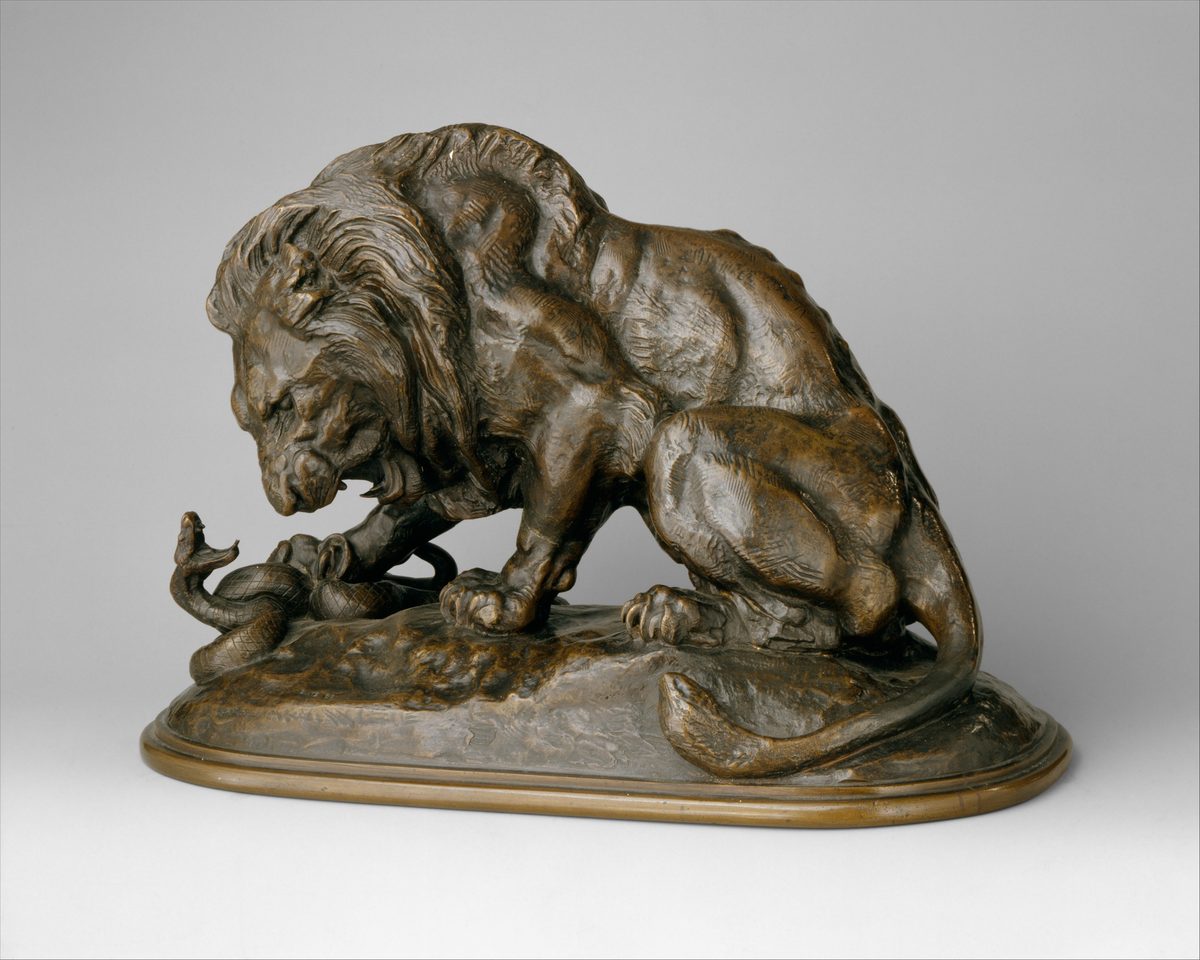
Antoine-Louis Barye, Lion and Serpent, model 1838, sand cast of about 1850, signed BARYE, without a foundry mark. The Metropolitan Museum of Art, public domain. | ||
In edition 28 we learned to tell bronze from spelter (zamak): the metal, the weight, the ring. Whoever has taken that step faces the harder question. A genuine bronze is not yet an original cast, and an original cast is not yet a lifetime cast. Between a bronze that Barye had cast himself, an edition by Barbedienne after his death and a recast from a present-day workshop sit the same metal and often the same signature, but a difference in price of a factor of ten to a hundred. The proof lies in small signs: the foundry's stamp, the numbers and letters under the base, and the way the patina sits on the metal. Reading those signs is a craft of its own. This edition teaches its first five rules. | ||
|
Topic of the week
A bronze is almost never cast just once. The artist's original model, in wax, clay or plaster, serves as the starting point for a mould, and out of that mould come casts: during the artist's lifetime and under his supervision, and afterwards often for decades under the supervision of heirs, publishers or foundries. On top of that comes the surmoulage: a new cast made from an existing bronze rather than from the model, outside any control. From the outside all those casts look alike. Up close they do not. Three questions decide the value. Who cast it: a foundry that worked with the artist, or an anonymous workshop? When: during the artist's lifetime, shortly after his death with the original models, or generations later? And in what edition: a numbered series, a commercial 19th-century edition, or an uncontrolled recast? The answer, if all is well, stands on the sculpture itself. The foundry struck or cast its name into the piece, sometimes with a number, a letter or a seal, and the patina and the inside tell the rest. Whoever can read those signs knows the history of the cast before talking price. | ||
|
Object of the week
The lion in the photo is Antoine-Louis Barye's Lion and Serpent, a model of 1838, sand cast, probably around 1850 and therefore during his lifetime. The piece carries the signature BARYE and nothing else: no foundry mark, because in those years Barye published his bronzes himself. That very model comes onto the market today in four guises. The lifetime cast, like this one, crisply chased and sometimes with a cold-struck number. The posthumous edition by Barbedienne, who after Barye's death in 1875 bought a large part of his models at the estate sale of 1876 and cast them under its own stamp, with the small gilt FB seal that specialists date to the years 1876 to 1889. The 20th-century recast, taken from an existing bronze, slightly smaller and softer, sometimes with a cast-in stamp that never came from Paris. And the recent decorative bronze from an Asian workshop, with BARYE in the rock and a chocolate-brown patina fresh from the acid bath. The same lion four times over, in four price brackets. | ||
| ||
|
Did you know
The biggest bronze forgery of the 20th century ran not on false stamps but on real ones. In the 1980s and 1990s the French dealer Guy Hain persuaded the Rudier foundry to recast Rodins from the original moulds and plasters, and had the Georges Rudier stamp replaced by that of Alexis Rudier, so that the casts passed for pieces from Rodin's lifetime. When he was arrested in 1992, twenty tonnes of bronze were seized; an estimated six thousand pieces, also after Barye, Carpeaux, Claudel, Frémiet, Mêne and Maillol, had already been sold by then. Hain was sentenced to four years in prison in 1997, confirmed on appeal in 2002. Many of those bronzes still stand in collections, with a stamp that is, in itself, perfectly genuine. | ||
|
Deeper dive
When is a cast an original? For modern bronzes French law gives the answer, and the whole market follows it. A tax decree of 1967, in force since 1968, counts only casts in an edition of eight, controlled by the artist or the rights holders, as original works of art; on top of that, practice tolerates four artist's proofs, numbered I/IV to IV/IV. Twelve per model, then, and the Musée Rodin keeps to exactly that limit for the posthumous Rodins it still has cast today. The Marcus decree of 1981 adds the mirror rule: a surmoulage, copy or other recast must carry the word Reproduction visibly and indelibly. What is sold as an original without that word is either genuine, or it is fraud. Nineteenth-century editions fall outside that logic. Barye, Mêne, Frémiet and their publishers deliberately cast in series and without numbering; a Barbedienne cast of 1885 is not a reproduction but a legitimate posthumous edition. There, the ranking sets the price: first the cast made in the artist's lifetime and under his supervision, then the early posthumous edition from the original models, then the later commercial issues, and at the bottom the surmoulage, which may have been made at any moment and is not a work of art. The stamp places the sculpture in that ranking. That is why 'signed Barye' is no argument in itself: the name sits in the model and travels into every cast, including the worst. | ||
|
Market & value
The market pays for the ranking. Take one and the same model of an animal bronze by Barye or Mêne, thirty centimetres high. A lifetime cast with crisp chasing usually fetches a multiple of a later edition at Drouot, Bonhams or Sotheby's, and the best examples run into the tens of thousands of euros. A posthumous Barbedienne or Susse edition in good condition often sits between a few hundred and a few thousand euros, according to model and size. A 20th-century recast without provenance stays in the hundreds, and a recent decorative bronze fetches on Catawiki or at a flea market what it is worth as decoration: a few tens to a couple of hundred euros. With modern artists the gap is wider still: a numbered cast by a known name with foundry mark and certificate is a work of art with a market price, an unnumbered cast without papers is a problem no auction house wants to take on. Rule of thumb: the bigger the name, the heavier the burden of proof, and the more a missing or wrong stamp costs. | ||
|
The great foundries and their marks
Whoever buys bronze keeps meeting the same names. Each stamp has its own period, its own artists and its own form. This list is not a reference work, but it is a first compass. F. Barbedienne, Paris. Founded in 1838 as a partnership between Achille Collas, inventor of the mechanical reducing machine, and Ferdinand Barbedienne. After Barbedienne's death in 1892 it was carried on by his nephew Gustave Leblanc-Barbedienne, until 1952. Stamp: F. BARBEDIENNE FONDEUR, later also with PARIS added. Reduced editions carry the round Collas seal as well. It cast the models of Barye from 1876; those early posthumous editions often bear the small gilt FB seal. Susse Frères, Paris. A house with roots in 1758, which published bronzes from about 1839 and remained one of the great foundries far into the 20th century. Stamps reading Susse Frères Éditeurs Paris in varying abbreviations, later also Susse Fondeur Paris. After the deaths of Mêne and of Cain it took over their models and went on casting them; in the 20th century it also cast for the Musée Rodin. Thiébaut Frères, Paris. A major 19th-century foundry, stamp Thiébaut Frères Fondeurs Paris, later continued as Fumière et Gavignot. It cast for Frémiet, among others, and for many salon sculptors of the Third Republic. A.A. Hébrard, Paris. The lost-wax foundry of the early 20th century, stamp cire perdue A.A. Hébrard, usually with a number. It cast the animals of Rembrandt Bugatti in numbered editions and, from 1919, all the bronzes of Degas, in sets identified by a letter. A Degas bronze from his lifetime does not exist: he never had anything cast. Rudier, Paris. The stamp Alexis Rudier Fondeur Paris stands on the Rodins of his lifetime and on the casts for the Musée Rodin up to 1952; the foundry had been run by his son Eugène since 1897, under his father's name. From 1952 nephew Georges Rudier took over the casting for the museum, with his own stamp. Today the Musée Rodin has its casting done by the Fonderie de Coubertin. The stamp C. Valsuani cire perdue belongs to another Paris foundry that worked for many modern artists. Belgian foundries. On Belgian bronze you meet the Compagnie des Bronzes de Bruxelles, active from 1854 to 1979, the Fonderie Nationale des Bronzes of J. Petermann in Saint-Gilles and the Verbeyst foundry in Brussels. Their stamps stand on the work of most Belgian sculptors of the late 19th and the first half of the 20th century. Vienna. The cold-painted Vienna bronzes of the Bergman workshop carry a B in an amphora and often the word Geschützt, meaning 'protected design'. Here too: the sign is well known, so it is copied, and its form and crispness count for more than its presence. | ||
|
Numbers, letters and seals: a short glossary
| ||
|
Lifetime, posthumous or later: the timeline by name
The stamp only gains meaning next to the sculptor's biography. Four examples you meet at every auction. Antoine-Louis Barye (1795-1875). Published his bronzes himself for years: signature BARYE, no foundry mark, often a cold-struck number. After his death Barbedienne bought a large part of the models at the sale of 1876 and cast them into the 20th century, with F. BARBEDIENNE FONDEUR and, in the first years, the gilt FB seal. Both are genuine Baryes; the price differs. Pierre-Jules Mêne (1810-1879). Set up his own foundry in 1838 and cast and sold his animals himself; his son-in-law Auguste Cain worked in the same workshop. Lifetime casts carry P.J. MÊNE and no foundry mark. After the deaths of Mêne and later of Cain, Susse took over the models and went on casting them for decades, with the Susse stamp. A Mêne without a stamp is therefore often the older, better one. Auguste Rodin (1840-1917). Lifetime casts and the first posthumous casts for the Musée Rodin carry Alexis Rudier Fondeur Paris. From 1952 Georges Rudier, later also Susse, today the Fonderie de Coubertin, with numbering up to twelve per model and a copyright sign with the year. A Rodin without one of those stamps, or with a stamp that does not match the year of casting, is the Guy Hain case from the Did you know above. Rembrandt Bugatti (1884-1916). His animals were cast in lost wax at Hébrard and signed, stamped and numbered in the wax; Hébrard also cast editions after his death, such as the royal tiger cast between 1922 and 1927 in a series of seventeen. Number, stamp and casting period are recorded for the important models in the catalogue raisonné. What is not in there is suspect. | ||
|
Patina up close: types and pitfalls
Patina is not dirt and not chance. The foundry applied it deliberately, with heat and chemicals, and so determined the look of the sculpture. The French 19th century loved brown and olive, sometimes black; art deco loved green, silver and gold; Vienna painted cold in every colour. Each of those layers is thin, sits in the metal and lets the chasing show. What comes afterwards is time: dust in the hollows, wax from generations of polishing, wear on the high points and at the spot where the piece is lifted. Three pitfalls. First the fresh patina: even, thick, glossy, without wear, or with wear 'applied' with a cloth and therefore equally strong everywhere. Second the green: a thin, even green can be an intended patina, but powdery, grainy light green in the hollows is active corrosion, and bright green that seems sprayed over a brown patina is last month's decoration. Third the restored patina: a bronze that was once scoured down to the yellow with metal polish and then repatinated looks flat and new, and the fine traces of the chaser have gone. Museum photos of the same model show how the surface ought to look. Care is therefore simple: do not polish. Dust with a soft brush, at most a thin layer of microcrystalline wax, buffed with a soft cloth. No silver polish, no lemon, no steel wool. To the connoisseur, a polished bronze is a damaged bronze. | ||
|
How to buy a bronze at the market and online
At the market: take the sculpture in your hands, turn it over and look into the base before you talk price. Find the signature, the stamp and the numbers, and look at them with a loupe: cast in or struck, crisp or clogged. Look at the wear on the high points and at the dust in the hollows. Ask about the provenance, and be wary when the answer is bigger than the sculpture. Online: ask for close-up photos of the signature and the stamp in raking light, of the underside and the inside of the base, and of every side of the piece. Ask for the measurements in centimetres and the weight, and lay the measurements next to a documented example of the same model. Read the description for the words that make the difference: 'Barye' is something other than 'after Barye', 'd'après' or 'in the style of', and 'signed' only means that the name sits in the model. For modern bronzes: ask for the foundry certificate or the confirmation of the heirs, because without those papers no auction house will accept the piece. At auction and on platforms such as Catawiki: a good expert description names the foundry, the probable casting period, the edition or the number, the measurements and the condition of the patina. If one of those five is missing, ask before you bid. And remember the ranking: lifetime, early posthumous, later edition, surmoulage. The stamp says where the sculpture stands in that row, and the price ought to match. | ||
|
Frequently asked questions
What does F. Barbedienne Fondeur on my bronze mean? That the cast, if the stamp is genuine, comes from the Paris foundry of Barbedienne, active from 1838 to 1952. It says nothing about the date of the model: Barbedienne cast the models of Barye, for instance, only after his death, from 1876 onwards. Compare the form of the stamp with documented examples, because in a recast the stamp is cast along with the rest and loses its crispness. Is a bronze without a foundry mark a fake? No. Barye and Mêne published their own bronzes and put only their name in the model; many 19th-century casts carry no foundry mark at all. Without a stamp, the chasing, the patina, the inside of the cast and the measurements compared with documented examples decide. What is a surmoulage? A new cast taken from an existing bronze instead of from the artist's original model. The metal shrinks by about one and a half per cent with every casting generation and the details grow softer. In France such a recast has had to carry the word Reproduction visibly since 1981. How many original casts of a bronze may exist? For modern bronzes the French rule allows an edition of eight numbered casts, controlled by the artist or the rights holders, plus four artist's proofs: twelve per model. Nineteenth-century editions by Barye, Mêne or Frémiet fall outside that logic; they were deliberately cast in series and without numbering. May I polish my bronze? No. The patina is part of the work and helps determine the value. Dust it with a soft brush and use at most a thin layer of microcrystalline wax. A bronze polished down to the metal, or chemically stripped and repatinated, loses a large part of its value. | ||
|
Behind the scenes
On bronze, AntiqBot reads what a photo shows: the signature and the stamp, their form and position, the numbers, the quality of the chasing and the build-up of the patina, and sets that against documented examples and auction results for the same model. What a photo cannot show, weight, ring and the inside of the base, remains work for the hand, and the report says so. Tip: photograph the stamp and the signature close up in raking light, the underside of the base, and the sculpture from the front. | ||
|
Question of the week
“My small bronze horse by Mêne has no foundry mark, only P.J. MÊNE in the rock. Is that a bad sign?” No. Mêne was his own foundry: from 1838 he cast and sold his work himself, so a lifetime cast carries his name and no foundry mark. Only the posthumous editions carry the name of Susse Frères. An unstamped Mêne can therefore be precisely the best example, provided the rest is right: crisp chasing, a thin and well-worn patina, a dark old interior and measurements that match documented examples. The absence of a stamp is not proof, it is an invitation to do the other four checks. A question about an object of your own? Write to info@antiqbot.com | ||
| ||
|
Next week
Next week in AntiqBot Weekly #34 we put a new object on the table, again with five checks to separate genuine from fake. | ||
|
AntiqBot Weekly appears every Sunday. All editions · Also read edition 28: bronze, recast or spelter |