| ||
Original painting or print? Five checks before you buyFrom printer's dots under the varnish to the stretcher on the back: how to read a canvas. | ||
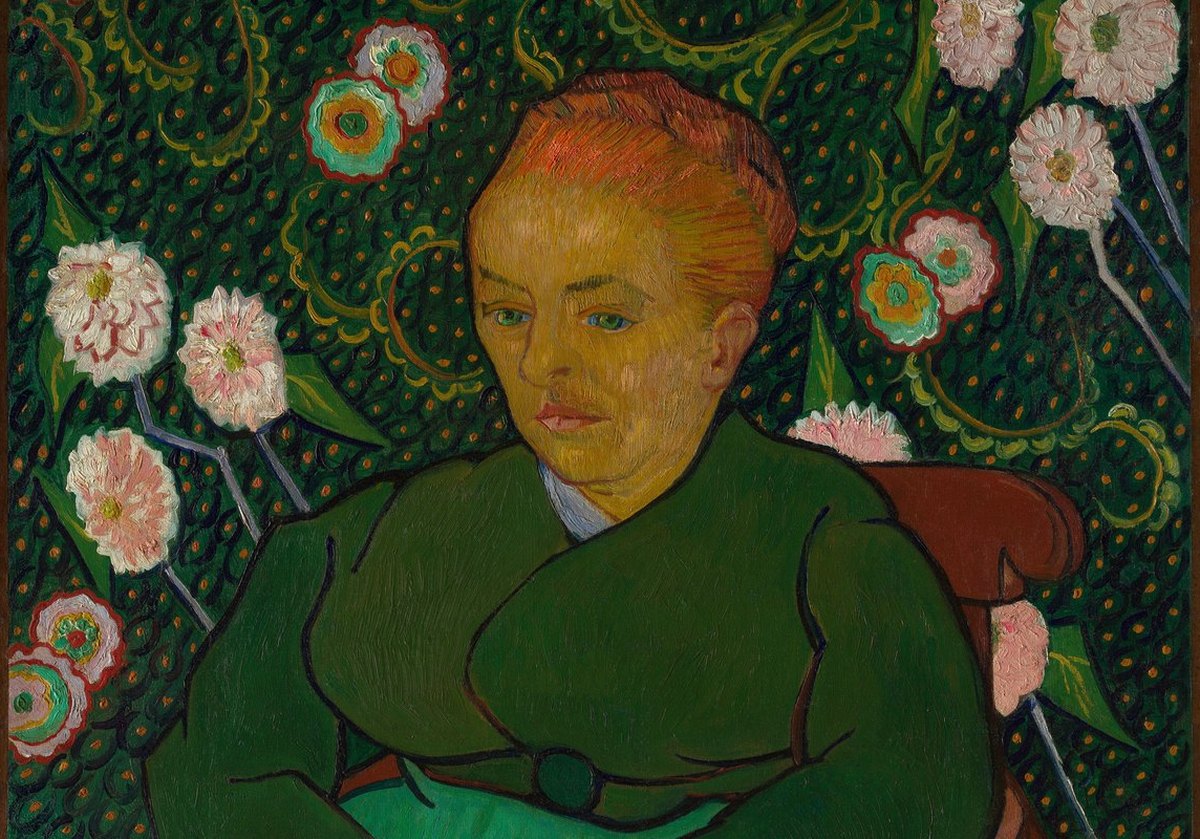
Vincent van Gogh, La Berceuse (Augustine Roulin), 1889, oil on canvas, 92.7 x 73.7 cm, detail. The Metropolitan Museum of Art, The Walter H. and Leonore Annenberg Collection, public domain. | ||
They hang at every flea market and in every charity shop: landscapes in gilded frames, flower pieces with thick paint, a portrait with a signature in the corner. Some are genuinely painted, by hand, layer by layer. A large share is printed, sometimes so well finished that the seller does not know it either. The difference is money: an original, even by an unknown hand, has a market; a reproduction is decoration. You do not need a laboratory to see it. Raking light, a loupe that costs a few euros and a look at the back settle most cases. This edition teaches you those five checks. | ||
|
Topic of the week
A painting is paint on a support: canvas, panel or board. A reproduction is an image of a painting, printed on paper or on canvas. So far it is simple. It gets difficult because reproductions have been made to look like paintings for a century and a half. In the 19th century printers produced oleographs: colour lithographs finished with varnish and pressed with a canvas texture, so that in a frame they passed for oil paint. The 20th century brought offset prints on canvas, and today there are giclées: high-quality inkjet prints on canvas, stretched on a frame, sometimes touched up by hand. As a result you meet four kinds on the market. Genuine paintings, from masters to amateurs. Reproductions on paper or canvas without any finishing. Enhanced reproductions: a print to which varnish, clear gel or a few brushstrokes were added afterwards to suggest relief. And mixed pieces, where a printed base has been partly painted over. The first group has real value, even an anonymous canvas from a good period. The other three are decoration, however convincing the frame. | ||
|
Object of the week
The painting in the photo is La Berceuse by Vincent van Gogh, painted in Arles in 1889, now in the Metropolitan Museum in New York. Look at the flowers on the wallpaper: the paint literally stands on top, in thick daubs that cast shadows in raking light. That is called impasto. Look at the green dress: broad, visible strokes that change direction where the form changes. And look at the outlines: drawn with a brush, thick and thin, not by a machine. Precisely because Van Gogh is reproduced so often, he makes the best teaching material. A print of this canvas, however sharp, has a flat surface. An enhanced print has relief, but that relief does not follow the forms, and under the loupe you see the printer's pattern beneath it. | ||
| ||
|
Did you know
Van Gogh did not paint La Berceuse once but five times. Between December 1888 and March 1889 he made five versions in Arles of the same portrait of Augustine Roulin, the wife of his friend the postman. Today they hang in different museums, including the Metropolitan Museum in New York, the Kröller-Müller Museum in Otterlo and the Art Institute of Chicago. A master repeating his own work is normal in art history: workshops made copies and variants, and later painters also copied famous works as practice or to order. Such a hand-painted copy is not a print: it is a real painting, with paint and brush, but not by the master. On the market that is a category of its own, with its own price. | ||
|
Deeper dive
How were they printed? Four techniques determine what you see under the loupe. Chromolithography, from the 19th century, was printed from a series of stones, one per colour. Under the loupe you see a grainy or stippled structure, not a tight grid. When such a colour lithograph was varnished and pressed with a canvas texture, it was called an oleograph, and it hung in thousands of living rooms as a cheap alternative to an oil painting. Offset printing, from the 20th century, shows the familiar screen of round dots in cyan, magenta, yellow and black, which form rosettes under magnification. Screen printing lays down even areas of ink with sharp edges, without dots, but also without brushstrokes. And the giclée, since the 1990s, is a high-quality inkjet print: under the loupe fine, randomly scattered droplets, often printed on canvas and stretched on a frame. On top come the enhancements: varnish, gel with imitation brushstrokes, sometimes a few real touches of paint in the lightest passages. Those enhancements change the surface, but not what lies underneath. That is why the loupe decides, on a spot where no touch has been added. | ||
|
Market & value
The market draws a sharp line. Ordinary reproductions on paper or canvas, even in a fine frame, usually sell at markets and online for a few to a few tens of euros, and often the frame is worth more than the image. 19th-century oleographs in their original gilt frame have a small market of their own, usually in the same order of magnitude, with the frame as the largest part of the price. Hand-painted decorative canvases from the 20th century, often anonymous and made in series for the home market, are mostly in the tens of euros. A genuine painting by a skilled hand from a good period can fetch hundreds of euros even without a known name, and a documented work by a recognised painter much more. The difference between the first and the last group is exactly what the five checks reveal. What almost never adds up: a price justified by a famous name on a canvas that turns out to be a print. | ||
|
Kinds of reproduction: a small guide
| ||
|
Varnish and relief: the enhanced-print trap
The enhanced print is today the biggest source of mistakes. A manufacturer prints a painting on canvas and then, by hand or by machine, applies a layer of clear acrylic or gel with strokes and ridges that resemble brushwork. The result shines like oil paint, has relief in raking light and feels painted under the fingertip. Anyone who only does check 1 gets caught. The giveaway lies in two things. The relief has roughly the same height and the same direction everywhere, and it does not follow the forms: a stroke runs from the sky straight into the treetop, or sits in an area the painter would have left smooth. And beneath the relief lies the printed image. Put your loupe on a flat area, a patch of sky, a background, a shadow, and look through the glossy layer. Dots or droplets in a pattern mean: print, whatever lies on top. The opposite mistake happens too. A genuine painting can be painted so thinly and smoothly, or varnished so heavily, that there is hardly any relief. Then check 1 tells you little, and the loupe, the edges and the back decide. No single check is enough on its own; together they rarely leave doubt. | ||
|
Reading the back
The back is the most honest part of a painting, because hardly anyone thinks about it. A 19th-century canvas is linen, with an irregular weave, darkened at the back by oxidation and dust. The stretcher is solid wood with bevelled edges and slots for wedges, the tacks or nails are sometimes rusted, and there may be chalk numbers, a colourman's stamp or a framer's label. A modern print on canvas has machine-woven cotton or polyester, even and light at the back, stapled onto a light frame of softwood, often with a sticker or a paper sleeve. A panel or board can also be a painting: then look at the edge of the support and at the paint layer on the side. Be careful with conclusions. An old canvas may have been relined or restretched during a restoration, and an old frame can surround a new print. Treat the back as a witness, not a judge: it has to tell the same story as the front. | ||
|
Original painting or original print?
Not every print is a reproduction. An etching, a woodcut or a lithograph made by the artist personally, printed by hand in a limited edition, numbered and signed in pencil, is an original work of art on paper, with a market of its own. That is something different from a photomechanical reproduction of a painting, even if it carries a number and a signature. The distinction again lies under the loupe: an original lithograph or etching shows the lines and grain of the stone or plate, not an offset screen. A reproduction with a printed signature, or a pencil signature beside a printed image, remains a reproduction. This edition is about paintings and their printed copies; original prints will be covered in a later edition. | ||
|
How to buy a painting at the market and online
At the market: bring a small loupe and your phone light. Hold the light at an angle across the canvas, look with the loupe into a flat area, turn the piece around and inspect stretcher, canvas and labels. Look along the side at the edge of the paint layer. That takes two minutes and almost always decides. Online: ask for a photo of the front, of the back, of one side and of a detail in raking light, ideally with a close-up of a flat area. A seller who will not show the back often has a reason. Read the description for the words that make the difference: oil on canvas is something else than print on canvas, giclée, reproduction, after or in the style of. At auctions and on platforms such as Catawiki: a good description names the technique, the support, the dimensions, the condition and what is known about provenance. If the technique is missing, ask before you bid. | ||
|
Frequently asked questions
How can I tell if a painting is really painted? Use raking light and a loupe. A painted canvas shows relief that follows the forms, mixed colour and brush marks. A print shows a pattern of dots or ink droplets under the loupe, especially in the flat areas. Also look at the edges and the back: an old stretcher and paint running irregularly over the edge point to a painting. Can a print have relief? Yes. Enhanced prints are given varnish, clear gel or imitation brushstrokes afterwards. They shine and feel painted. Look with the loupe through the varnish in a flat area: if you see dots in a pattern, it is a print, however thick the layer. What is an oleograph? An oleograph is a 19th-century colour lithograph that was varnished and pressed with a canvas texture to look like an oil painting. It hung in many living rooms. Under the loupe you see a grainy printed structure instead of brushwork. Is a hand-painted copy a print? No. A hand-painted copy is a real painting, with paint and brush, but after the work of another painter. It is a category of its own with its own price, and not a work by the master. What is my painting worth? That depends first on whether it is painted or printed. Reproductions usually sell for a few to a few tens of euros, decorative hand-painted canvases mostly for tens, a skilled painting from a good period for hundreds and more. Technique, condition, period and provenance decide the rest. | ||
|
Behind the scenes
On paintings, AntiqBot looks at what a photo shows: the technique, the surface and the paint layer, the edges, the support and the stretcher at the back, the signature and the condition, and searches for comparable sales. What a photo cannot show well, such as very fine relief or the pattern under a thick varnish, needs a detail photo. Tip: photograph the front straight on, the whole back, one side, and a close-up of a flat area in raking light. | ||
|
Question of the week
“My painting shines, you can feel the brushstrokes and it hangs in a heavy gilt frame. Still, a friend has doubts. Who is right?” Shine, relief and a heavy frame prove nothing: those three are exactly what make enhanced prints convincing. Take a loupe and find a flat area, a patch of sky or background with no stroke on it. Look through the glossy layer. If you see a regular pattern of dots or fine droplets, it is a print with varnish or gel on top. If you see mixed paint, grains and fine cracks, it is painted. Then turn it around: stretcher, canvas and labels must tell the same story. A question about an object of your own? Write to info@antiqbot.com | ||
| ||
|
Next week
Next week in AntiqBot Weekly #36 we put a new object on the table, again with five checks to tell genuine from fake. | ||
|
AntiqBot Weekly appears every Sunday. All editions · Also read edition 34: real Baccarat or just heavy glass |