| ||
Executioner's sword, shame mask, thumbscrew: genuine or fairground attraction? Five checksA Halloween special on the darkest corner of the antiques market, and why so much of it was made up. | ||
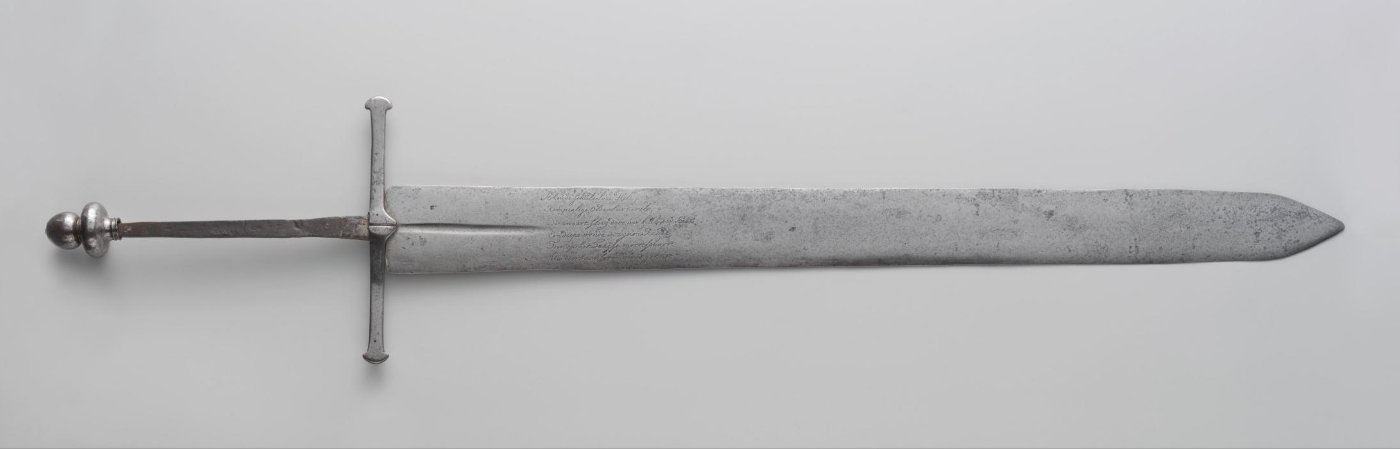
Executioner's sword, associated with the beheading of Johan van Oldenbarnevelt in 1619, the Netherlands, 1600-1625. Rijksmuseum, Amsterdam (NG-NM-4245), public domain. | ||
Halloween is the moment when the darkest objects of the antiques world briefly step into the light. Executioner's swords, shame masks, thumbscrews, shackles. They really are for sale, at auctions in Munich, Vienna and London, on Catawiki and at the flea market. But nowhere in the antiques trade has so much been made up as here. In the 19th century torture chambers became a crowd-puller, and anyone who wanted visitors needed gruesome objects. Genuine, supplemented and entirely invented pieces stood side by side, and they circulate to this day. This special teaches you to see the difference, and tells you what the genuine pieces are worth. | ||
|
Subject of this special
For centuries, punishment was public. Anyone who received a sentence was exhibited in the market square, branded, put in the pillory or executed. The instruments that went with it belonged to towns and lordships, and were often kept in town halls, prisons and castles. When corporal punishment disappeared in the course of the 18th and 19th centuries, those objects remained. Some ended up in museums, some in private collections, and some disappeared. Then something happened that is decisive for the antiques market. In the 19th century a public fascination with the dark Middle Ages grew. Castles and towns set up torture chambers for visitors, and travelling exhibitions toured Europe and America with gruesome pieces. Demand for spectacular objects was greater than the supply of genuine pieces. So missing instruments were copied, parts were combined and stories were invented. What you find on the market today comes from those two sources: the genuine archives of criminal justice, and the 19th-century fairground. | ||
|
Object of this special
The sword in the photo is in the Rijksmuseum in Amsterdam, and it carries a famous story: this is said to be the sword with which Johan van Oldenbarnevelt was beheaded on the Binnenhof in The Hague on 13 May 1619. The sword itself is genuinely old, made in the Low Countries between 1600 and 1625. An engraved verse runs along the blade. And yet the museum itself calls it highly doubtful that this weapon was used at the execution. The reason is the provenance. The sword's trail only begins in the 18th century, more than a hundred years after the beheading, and according to the museum the verse on the blade was probably engraved around 1745 for the poet Frans Greenwood. Look at the shape too: this sword ends in a point, while most executioner's swords end blunt or square, because an executioner chops and does not thrust. A genuinely old piece, then, with a story attached to it later. That is exactly the pattern you meet again and again in this corner of the market. | ||
| ||
|
Did you know
The iron maiden, the cabinet with spikes on the inside, is the most famous torture instrument in the world and was probably never used as one. Not a single reliable record of it is known from the Middle Ages. The story of a first execution in Nuremberg on 14 August 1515 is attributed to the Nuremberg scholar Johann Philipp Siebenkees, who lived from 1759 to 1796. The Nuremberg example was exhibited in the 19th century and was lost in a bombing raid in 1945. A copy was sold in 1890 to the English Earl of Shrewsbury, travelled to the World's Fair in Chicago in 1893 and today stands in the Kriminalmuseum in Rothenburg ob der Tauber. Closer to home for Belgian readers: the Science Museum in London holds an iron shame mask with horns and large ears from the Brussels area. It is said to have been found when the prison of Vilvoorde was rebuilt in the 1770s, and is dated between 1550 and the end of the 18th century. And the famous executioner's mask shown in the Tower of London in the 19th century was, according to the Royal Armouries, most likely part of a scold's bridle. An iron mask for an executioner they call improbable. | ||
|
In depth: the 19th-century torture chamber
The Kriminalmuseum in Rothenburg, today one of the largest legal history museums in Europe with some 50,000 objects, grew out of a 19th-century attraction: a torture chamber for tourists, modelled on a similar exhibition in Nuremberg. The museum tells that history itself today. The best known of those early collections, that of the Royal Castle of Nuremberg, was sold in 1890 to the Earl of Shrewsbury. It toured Britain, was shown in Chicago in 1893 and then disappeared into storage for years. In 2009 some 252 pieces from it were auctioned in New York. Such collections mixed genuine legal history objects with additions and complete reconstructions. The German legal historian Wolfgang Schild described how the well-known iron maidens were pieced together from museum artefacts for exhibitions. For a buyer this means: a piece with a 19th-century exhibition provenance may be genuinely old, partly old, or made entirely for the public. Provenance tells you where a piece has been, not what it is. | ||
|
Market & value
The deepest and most reliable market is that for executioner's swords, Richtschwert in German. At Bonhams in London, German executioner's swords from the 17th and 18th centuries made between £3,120 and £6,600 between 2006 and 2018, premium included. The highest prices went to swords with a date, a verse and a fully original hilt. Swords with a 17th-century blade on an 18th-century hilt sat at the bottom, around £3,100 to £3,600. At Dorotheum in Vienna in 2017, a 17th-century Bohemian sword with wheel, gallows and the name of the executioner of Lauban and Reichenberg sold for €9,426 against an estimate of €4,000 to €5,000. A modern replica sold online this year for €150. Shame masks are rarer at auction. At Hermann Historica in Munich, the reference house for this kind of object, a 17th-century mask forged in one piece with ears, beard and tongue sold in 2024 for €1,400. At Dorotheum in 2015, a 16th or 17th-century mask with horns and a bell was catalogued with a starting price of €3,200. Shackles fetch high prices above all with strong provenance: in Australia, documented leg irons from the 19th-century penal colonies sold for between 725 and 4,000 Australian dollars. For thumbscrews, neck violins and pillories we found no reliable recent auction results, so we do not give a figure. Telling, though: in 2012 the Paris auction house Cornette de Saint Cyr planned to sell a large collection of torture instruments, including a so-called inquisition chair estimated at €600 to €800. After protests by human rights organisations the sale was cancelled. Pieces from that collection still turn up with dealers. | ||
|
Reading an executioner's sword
An executioner's sword is made to chop, not to fight. That is why it has a long two-handed grip, a short straight crossguard, a heavy pommel and a broad, straight blade without a sharp point, sometimes with two to four small holes near the end. Most surviving examples date from the 16th to the middle of the 18th century. They remained in use for a long time: the last executions by the sword in Europe took place in Switzerland, in 1867 and 1868. The blades often carry engravings and inscriptions that justify the executioner's work. A wheel and a gallows, the symbols of justice, sometimes a crucifix or a prayer, and verses such as "Die Herren steuern dem Unheil, ich exequiere ihr Endurteil", the lords ward off evil, I carry out their final judgement. Sometimes the executioner's name is on it, or a year. Such an inscription raises the value, but it is also the first thing a forger adds. So read it critically: does the spelling fit the period, does the style of the lettering fit that of the rest of the decoration, and does the engraving lie under or over the rust? | ||
|
Shame masks and shaming punishments
The shame mask, Schandmaske in German, was not an instrument of torture but a shaming punishment. Anyone who gossiped, cursed or misbehaved had to wear the mask and was put on show in the square. The shapes often refer to the offence: long ears for those who eavesdropped, a long tongue for those who gossiped, a pig's snout for those who behaved like a swine. Often a small bell hung from it, so that everyone would hear. England had a variant with a metal plate in the mouth, the scold's bridle. Precisely because they are so graphic, shame masks are popular with makers of reproductions. Openly 20th-century examples circulate, sold as decoration and sometimes later losing their label. A genuine mask is forged by hand, often riveted together from several plates, with wear on the fastening and on the inside. A mask that looks new on the inside was never worn. | ||
|
What does the law say?
Since 2019 the European Union has had a regulation against trade in goods used for capital punishment and torture, Regulation 2019/125. It was made against modern instruments of torture, but the list does not look at age. The list of goods with no practical use other than torture includes thumbscrews and finger-screws, bar fetters and gang chains, restraint chairs with shackles, spiked batons and whips with multiple lashes or barbs. For those goods there is a ban on export to and import from outside the EU, irrespective of their origin. There is no general exemption for antiques. The only exception is a licence for goods intended exclusively for public display in a museum in view of their historic significance. Trade within the EU is not covered by the regulation: a Belgian who buys an antique thumbscrew at a German auction house does nothing wrong. Anyone who sells such a piece to a buyer in the United Kingdom, Switzerland or the United States is exporting, however. Executioner's swords, shame masks and branding irons are not listed as such. This is not legal advice: if in doubt, ask customs for advice before you sell or buy outside the EU. | ||
|
How to buy at the market and online
At the market: bring a torch and a loupe. Look at the rivets and seams, the thread of any screws and the distribution of the rust. Turn the piece over: the inside and the underside lie less than the front. Ask about the provenance, and write down what the seller says. A story about a castle or a famous execution is not proof, it is a reason to look more closely. Online: ask for photos of the whole piece, of the inscription close up, of the joints and of the inside. Read the description for the words that make the difference: executioner's sword or in the style of, 17th century or 17th-century style, original or restored. An auction house that recognises an old blade on a later hilt says so. If that information is missing on an expensive piece, ask for it before you bid. And think of the buyer after you: anyone who wants to resell outside the EU needs to know which pieces fall under the anti-torture regulation. Finally, a word about the subject itself. These objects document real human suffering. Collectors, museums and legal historians keep them to understand what justice and punishment looked like, not to make a spectacle of them. Whoever buys such a piece buys a piece of legal history. That deserves the same seriousness as any other historical object. | ||
|
Frequently asked questions
Are antique torture instruments genuine? Some are. Executioner's swords, shame masks, shackles and branding irons exist as genuine historical objects. But many pieces sold as medieval torture equipment are 19th-century creations for torture chambers and exhibitions, or were assembled from separate parts. The iron maiden is the best-known example. Did the iron maiden really exist? There is no reliable record of an iron maiden as a torture instrument from the Middle Ages. The story only appears at the end of the 18th century, and the known examples are 19th-century constructions for exhibitions. The Nuremberg example was lost in 1945. What is an executioner's sword worth? At Bonhams, genuine German executioner's swords from the 17th and 18th centuries made roughly £3,100 to £6,600 between 2006 and 2018, premium included. At Dorotheum in Vienna a documented sword bearing the executioner's name sold for €9,426 in 2017. A modern replica sells for around €150. How do I recognise a genuine shame mask? By hand-forged iron, riveted or forged in one piece, with wear where the mask closed and was worn, and corrosion logically distributed over the whole piece. Welded seams, modern screws and uniformly milled steel point to a reproduction. Openly 20th-century copies also circulate. Am I allowed to sell an antique torture instrument? Within the European Union, the EU anti-torture regulation (2019/125) imposes no restriction. Selling to a buyer outside the EU, or buying from there, is different: thumbscrews, bar fetters and restraint chairs are subject to an export and import ban, with only a licensed exception for display in a museum. If in doubt, ask customs for advice before you sell. | ||
|
Behind the scenes
With old weapons and ironwork, AntiqBot looks at what a photo can show: the form and proportions, the construction, the joints, the patina and any inscriptions, and compares them with known pieces and auction results. What a photo shows poorly, such as the depth of the rust or the way a hilt is attached, calls for detail photos. Tip: photograph the whole piece straight from above, the inscription as close as it stays sharp, and the joints from all sides. | ||
|
Question of the week
“At a brocante I bought an iron mask with long ears and a tongue. The seller said it is a medieval shame mask. How do I know whether that is right?” Start with the construction. An old shame mask is forged by hand: look at the rivets holding the plates together, which are irregular and hand-hammered. If you see welded seams, modern bolts or perfectly uniform steel, it is a later piece. Then look at the wear: around the fastening and the edges the metal should be worn smooth, and the rust should be deep and uneven. Medieval is rarely right, by the way: most genuine shame masks on the market date from the 16th to the 18th century. A photo of the whole piece, of the fastening and of the inside already tells a lot. A question about an object of your own? Write to info@antiqbot.com | ||
| ||
|
Sunday
On Sunday AntiqBot Weekly #37 appears as usual, with a new object on the table and again five checks to tell genuine from fake. | ||
|
AntiqBot Weekly appears every Sunday, this special is an extra edition for Halloween. All editions · Read also edition 28: bronze sculptures, genuine or recast |