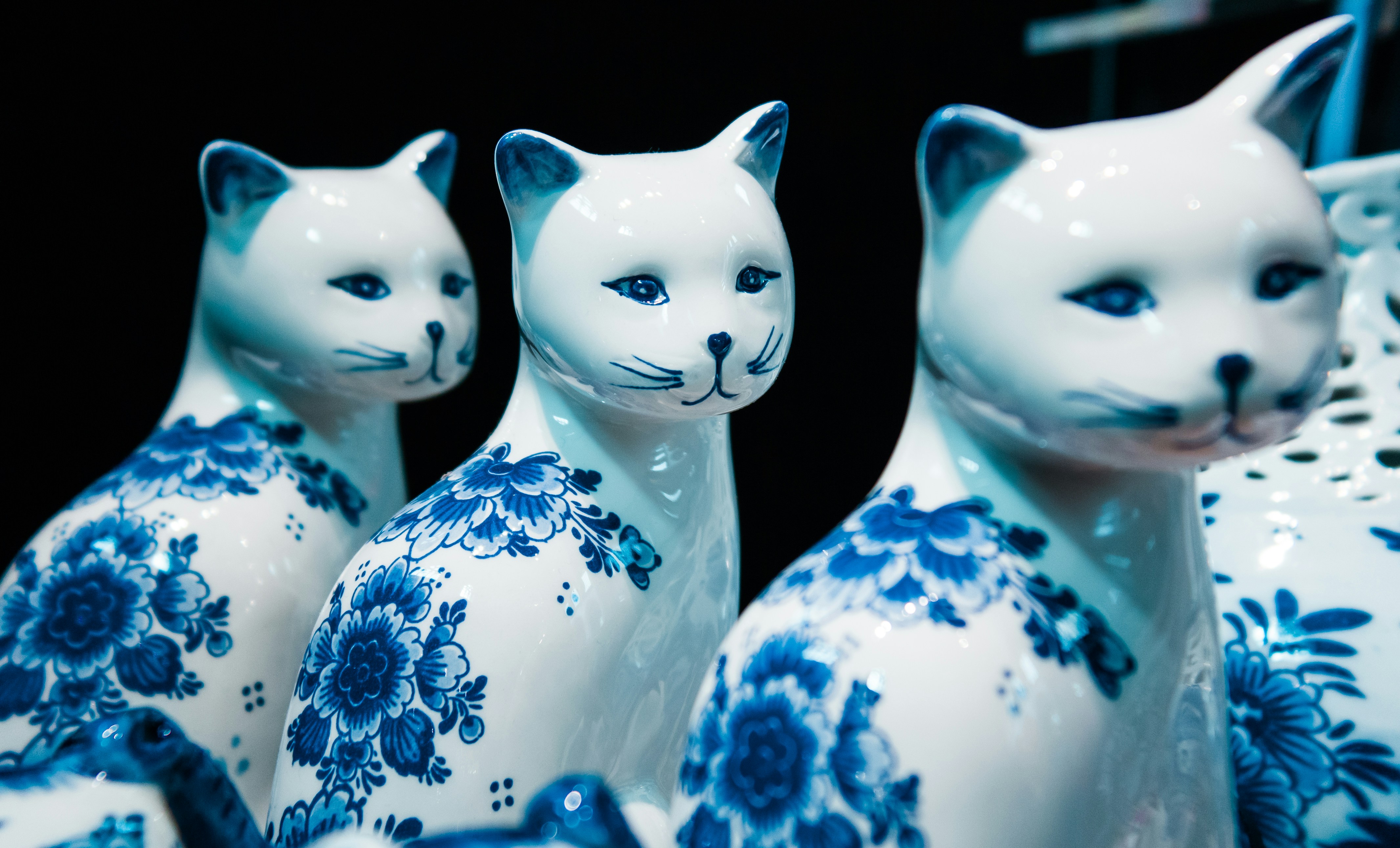
How to Identify Porcelain Marks: The European Manufacturer Guide
You find a beautiful porcelain cup at an estate sale. The glaze is immaculate, the gilding gossamer-thin, and on the base there is a mark in cobalt blue that you cannot quite read. It could be Meissen. It could be a 19th-century imitation. It could be worth four hundred euros or four thousand. This guide is for that moment: a practical, expert-level reference to European porcelain marks identification, covering the major German, French, British, Scandinavian, and Low Countries factories from their founding marks to their later period variants. Note that this guide covers European porcelain exclusively. Chinese reign marks and porcelain from the Qing and Republic periods are addressed in our separate guide to Chinese porcelain marks identification.
Why Porcelain Marks Matter
A porcelain mark does more than name the factory. It compresses several layers of information into a few square centimetres of fired clay: the manufacturer, the approximate period of production, sometimes the individual painter or gilder, occasionally the pattern name, and in the case of British wares, a formal registration number tied to a legal date. Each of these layers feeds directly into the valuation calculation that any serious buyer, seller, or insurer needs to make.
The commercial stakes are substantial. A Meissen plate from the Marcolini period (1774 to 1814) might sell at Bonhams for 600 to 900 euros in good condition. The visually similar plate bearing a spurious crossed-swords mark applied decades later might sell for 60 to 90 euros, or less if the deception is obvious. The difference between those two outcomes is almost entirely a question of mark authentication. For collectors operating in the mid-range market where fakes are proportionally most common, reading marks correctly is a core skill, not an optional refinement.
Named factories also carry what specialists call a "provenance premium." Pieces with well-documented marks from Sèvres, KPM Berlin, or Vienna consistently achieve multiples of two to five times the price of comparable but unattributed Continental porcelain. At the top of the market, for exceptional documented Sèvres jewel pieces or early Meissen figures, that multiplier climbs far higher. Christie's and Sotheby's both run dedicated European porcelain sales precisely because the market for correctly attributed pieces is deep and sustained.
Scope of this guide: We cover European hard-paste and soft-paste porcelain marks from approximately 1710 to the mid-20th century. Tin-glazed earthenware (faience, majolica, Delftware) is included where it appears alongside true porcelain in the same collecting context. Chinese export porcelain and Asian marks are outside this guide's scope.
How to Read a Porcelain Mark
Before cataloguing individual factories, it is worth establishing the systematic approach that experts use when examining an unfamiliar mark. Rushing to identification without first gathering the basic physical data leads to avoidable errors.
Location and application method
Most factory marks appear on the base (foot rim area) of a piece. Marks on the interior or on the outer wall are exceptional and worth noting as potentially anomalous. The application method is one of the most useful authentication signals available without laboratory equipment.
Underglaze marks are applied before the final glaze firing, typically in cobalt blue oxide (which withstands high temperatures) or occasionally in manganese black. They sit beneath the glaze surface. Run your fingertip across the mark: if the glaze layer covers it smoothly without any texture change, the mark is underglaze. This matters because underglaze marks are significantly harder and more expensive to fake than overglaze marks. A forger applying a false mark to a blank piece must either fire the piece again (destroying the glaze uniformity) or apply the mark on top of the glaze.
Overglaze marks are applied in enamel colours after the glaze has been fired, then low-fired again to bond the enamel. They sit slightly proud of the glaze surface and can feel very slightly textured or raised. Many factories used overglaze marks legitimately (including Sèvres for some of its gold marks and pattern numbers), but an overglaze mark on a piece that should have an underglaze mark is a significant red flag.
Impressed marks are pressed into the clay body before firing. They are common on Wedgwood, Spode, and some Continental stoneware. They cannot be faked onto a finished piece and are therefore highly reliable. Look at the mark from a raking-light angle to see impressed marks clearly.
Incised marks are scratched into the clay with a sharp tool before firing. Common on modeller's marks, pattern numbers, and some early Continental wares. Like impressed marks, they are pre-firing and cannot be added to a finished piece.
Colour of the mark
Cobalt blue is by far the most common colour for underglaze factory marks, partly because cobalt oxide survives high-temperature porcelain firing without burning away. Red and other enamel marks are almost always overglaze. Black iron oxide marks can be either. When a mark colour is described as "blue," always clarify whether the blue reads as a clean, slightly purplish tone (cobalt) or as a greyer, slightly inky tone (sometimes a sign of later-period production or a different colorant mix).
What to record before identifying
A useful discipline before reaching for a reference book is to write down or photograph: (1) the mark's approximate shape (crossed elements, a letter, a crown, a shield, an animal, a cipher); (2) the application method; (3) the mark colour; (4) any accompanying letters, numbers, or symbols; (5) the paste colour visible at the foot rim (pure white, slightly warm, distinctly grey, or ivory). These five data points eliminate the majority of mis-identifications that occur when collectors jump directly to visual comparison.
The Big Four: Meissen, Sèvres, KPM, and Vienna
Four factories sit at the apex of the European porcelain hierarchy in both historical importance and current market value. Understanding their mark evolution in detail is the single most effective investment a collector can make.
Meissen
The Meissen factory near Dresden, Saxony, was established in 1710 following the experiments of Johann Friedrich Böttger, who produced the first true European hard-paste porcelain. For the first decade or so, marks were inconsistent. The factory used "KPM" (Königliche Porzellan-Manufaktur) in various forms alongside "MPM" (Meissner Porzellan-Manufaktur) and even the monogram "AR" for Augustus Rex, designating pieces made for the personal collection of Elector Augustus the Strong.
The crossed-swords mark, derived from the electoral arms of Saxony, was introduced around 1720 to 1724 and quickly became the factory's dominant mark. It remains in use today, making period identification by sword style absolutely essential for dating Meissen pieces.
Early period (c. 1724 to 1763): The swords are painted in underglaze cobalt blue with a slightly awkward, hand-drawn quality. The hilts are often depicted with a small horizontal crossguard and the blades cross at roughly the midpoint. From around 1730 to 1740, the swords become somewhat more confident in execution. In the Höroldt period, which saw the development of the famous chinoiserie and harbour scene painting styles, the swords are typically painted with moderate care but without the mechanical precision of later periods.
Marcolini period (1774 to 1814): Count Camillo Marcolini directed the factory during this period. The mark is identifiable by a small star added between the hilts of the crossed swords (visible with a loupe). This star mark is highly specific and reliable as a period indicator.
19th-century production: From around 1815, the swords become more standardised and mechanically painted. The hilts simplify. Many pieces from this period are now described as "second period" Meissen in auction catalogues.
Post-1924 mark: From 1924, dots were added to the mark in various positions to indicate seconds (slightly defective pieces sold at a discount). A piece with a dot between the sword points is a factory second. A single incised line through the swords indicates a definite factory second sold without decoration guarantee.
The crossed-swords mark is the most imitated mark in porcelain history. Dresden factories from the late 19th century (Wolfsohn, Thieme, Klemm) routinely applied swords marks to pieces intended to be sold as "Dresden porcelain" (a legitimate regional term) but which were often passed off as Meissen by later sellers. The Dresden factory marks tend to show swords that are slightly longer in proportion, or with different hilt geometry. Comparison with authenticated examples remains the most reliable detection method short of technical analysis.
Sèvres
The Sèvres factory has one of the most complex mark sequences in European ceramics, reflecting its turbulent history through the French monarchy, Revolution, Empire, Restoration, and subsequent republican periods. Understanding Sèvres marks requires distinguishing between two fundamentally different paste types: soft-paste (pâte tendre) and hard-paste (pâte dure).
Soft-paste period (to approximately 1772): Sèvres began as the Vincennes factory in 1740, transferring to Sèvres in 1756. Soft-paste porcelain is more translucent, warmer in tone, and physically softer than hard-paste. The factory's famous ground colours (bleu de roi, rose Pompadour, vert pomme) were originally developed for soft-paste. The mark for this period is the interlaced double-L cipher in underglaze blue, with a date letter between the two Ls. The date letter system begins with A for 1753 and runs through single letters to Z for 1777, then double letters AA, BB, and so on to PP for 1800. A piece marked with the double-L cipher containing the letter H, for example, was made in 1760. Painter's marks were also added alongside the factory mark, allowing attribution to specific decorators whose salaries and work records survive in the factory archives held at the Musée National de Céramique, Sèvres.
Hard-paste period (from approximately 1770): Sèvres began transitioning to hard-paste after kaolin deposits were found at Saint-Yrieix. For a transitional period, both pastes were in use simultaneously, and the marks for this period carry a crown above the double-L to indicate hard-paste production.
Revolutionary and post-Revolutionary period (1793 to 1804): Royal marks were abandoned. The factory used "RF Sèvres" (République Française) in overglaze red or blue, often stencilled rather than hand-painted. Pieces from this period are historically interesting but generally command lower prices than the Royal period.
Empire period (1804 to 1814): Under Brongniart's direction (which transformed Sèvres technically and artistically), the mark becomes "M. Imple de Sèvres" in red overglaze for manufactured goods, or various impressed marks for paste quality. Brongniart also discontinued soft-paste production entirely in 1800, a decision that later generations would lament.
Later 19th-century marks: A system of date marks using letters and numerals continues through the 19th and into the 20th century. Pieces also often carry painter's marks, gilder's marks, kiln marks (for firing date), and decoration marks, making a fully documented Sèvres piece a palimpsest of information. The Sèvres factory archives are unusually complete and can, in principle, trace individual pieces back to their painter and firing date.
The Sèvres mark was copied almost immediately by 18th-century English and Continental factories, and extensively faked in the 19th century. The most common deception involves adding Sèvres marks to blank Limoges porcelain, or adding painted decoration to genuine but undecorated Sèvres blanks (known as "later-decorated" pieces, which carry a significant value discount). The quality of the ground colour application is often the most accessible indicator: genuine 18th-century Sèvres ground colours have a depth and consistency that is technically very difficult to replicate.
KPM Berlin
The Königliche Porzellan-Manufaktur in Berlin has used several marks across its history, but two are most commonly encountered: the orb and scepter mark and the eagle mark.
The orb (Reichsapfel) mark: A globe surmounted by a cross, used from the factory's establishment under Frederick the Great in 1763. This mark in underglaze blue is the primary factory mark of the 18th century. It appears alongside a scepter on many pieces (hence the common shorthand "orb and scepter"). The scepter resembles a simplified letter K or a curved wand and can be confused with Meissen swords on cursory examination.
The eagle mark: The Prussian eagle appears on pieces from around 1830 onward, often in combination with the orb. It is particularly associated with the technically superb painted plaques that KPM produced throughout the 19th century, including the famous portrait plaques after Old Masters. These plaques have been extensively copied and the market for fake KPM plaques is significant. Legitimate KPM plaques carry the orb mark on the reverse, sometimes with an impressed "KPM" and a signature or monogram of the painter.
KPM also used an impressed "KPM" mark separately from the painted marks, and pieces may carry both. Period identification within KPM requires reading the combination of marks rather than any single element. The factory is still in operation and produces pieces today, so a current mark is not a guarantee of historical production. Auction houses including Christie's and Bonhams have specialist appraisers for KPM, and the factory's own archive in Berlin has been used for authentication in disputed cases.
Vienna
The Imperial Porcelain Manufactory in Vienna (Kaiserliche Porzellanmanufaktur) operated from 1718 to 1864, making it the second oldest European porcelain factory after Meissen. Its primary mark is the Bindenschild: a blue shield bearing a horizontal stripe, derived from the Austrian imperial arms. The mark appears in underglaze blue and is sometimes described simply as "the shield mark."
Period identification within Vienna uses both the style of the shield and accompanying marks. In the earliest period (1718 to approximately 1744), under Du Paquier's management, the factory used no consistent mark at all, which means unmarked Continental porcelain of early 18th-century date that matches the characteristic Du Paquier glaze and paste quality is often attributed to Vienna by elimination and comparative analysis.
From approximately 1744, when the factory passed to imperial control, the Bindenschild mark becomes consistent. Date coding using impressed two-digit year numbers (the last two digits of the year) was introduced in 1783 and continued to the factory's closure in 1864. A Vienna piece with "27" impressed alongside the shield mark was made in 1827. This date-coding system is one of the clearest and most reliable in European ceramics.
After the Vienna factory closed in 1864, its moulds and designs were acquired by various firms, and "Vienna-style" pieces with spurious shield marks flooded the late-19th-century market. These are sometimes called "fake Vienna" or "Helena Wolfsohn Vienna" (after one prominent Dresden decorator who applied Vienna-style marks). The paste quality, foot rim profile, and glaze characteristics of genuine Vienna differ clearly from the later copies when examined carefully.
British Porcelain Marks
British factories developed their own distinct mark traditions, often including impressed or printed pattern numbers alongside factory marks, and from 1842 using the government's registration mark system. Understanding the British system requires familiarity with the Registration Mark (Kite Mark) and the "Rd. No." system that succeeded it.
Royal Doulton
The Doulton factory at Lambeth, London, began producing art pottery in the 1860s and stoneware before that. The Burslem factory in Staffordshire, which became the focus of fine porcelain production, was established in 1882. "Royal Doulton" as a title was granted in 1901 when King Edward VII granted the Royal Warrant.
Marks before 1901 read simply "Doulton" with "Burslem" or "Lambeth" indicating the factory. Post-1901 pieces carry the lion-and-crown mark with "Royal Doulton" printed in a circle or oval, often in green for tablewares and backstamp colours varying by period and range. A date code system using letters was introduced in 1928 and ran through the 20th century, with single letters (A through O) indicating the year within a cycle.
Pattern numbers on Royal Doulton pieces are recorded in pattern books that have been partly transferred to the Royal Doulton archive (now managed through Waterford Wedgwood Royal Doulton). Resources including Replacements.com maintain extensive pattern identification databases for Royal Doulton tableware that are useful for pattern dating even when the factory mark is partially worn or damaged.
Wedgwood
Josiah Wedgwood founded his factory in 1759 at Burslem, later moving to Etruria in 1769. The key mark rule for Wedgwood is that genuine pieces produced by the original Josiah Wedgwood factories are marked "WEDGWOOD" (impressed into the clay body) without any additional words. The mark "Wedgwood & Co." indicates a completely different and unrelated Staffordshire company (Ralph Wedgwood and successors) and should never be confused with Josiah Wedgwood's factory. This distinction is consistently made in every major auction catalogue.
Bone china (as opposed to Wedgwood's better-known jasperware, basalt, and creamware) was produced by Wedgwood from 1812, with a brief interruption, and the bone china mark carries "WEDGWOOD" with "ENGLAND" added from 1891 (per the McKinley Tariff Act requiring country of origin on exports to the US). "Made in England" appears on 20th-century pieces. Dating Wedgwood requires reading these geographical additions alongside the three-letter date code introduced in 1860: the third letter indicates the potter, the second the month (from O for January through to Z for December, omitting certain letters), and the first the year within a 25-year cycle. Reliable period identification uses published reference tables for this code system.
Wedgwood's jasperware (the distinctive blue or sage green unglazed stoneware with white relief decoration) is not porcelain in the strict sense but is highly collectable and subject to the same mark authentication considerations. Extensive 20th-century production in Wedgwood jasperware means that differentiating early 18th and 19th-century pieces from later production matters considerably for value.
Royal Worcester
The Worcester Porcelain Company was founded in 1751 and has maintained continuous operation longer than almost any other British factory. It received the Royal Warrant in 1789 from King George III, and the "Royal Worcester" name became formalised in the 19th century.
The earliest Worcester mark is the open crescent in underglaze blue, sometimes with a script "W" or a version of the Meissen crossed-swords (a deliberate market imitation). From 1769, the crescent is more consistent. The factory's marks evolved through multiple phases, but the most practically useful for dating is the date code system introduced in 1867, using a series of dots arranged around the factory mark: one dot in 1867, adding one dot per year up to 1890 when the system reset. From 1892, a more complex system of letters and numbers within the printed mark provides year identification that can be tracked through published Worcester mark references.
Royal Worcester's 19th-century painted pieces (particularly the fruit and flower paintings associated with painters such as Harry Davis and the Stinton family) command strong prices at auction. These pieces typically carry both the factory mark and the painter's mark (usually initials), and provenance through a known painter significantly affects value.
Spode and Copeland
Josiah Spode established his Stoke-on-Trent factory around 1770 and is credited with perfecting the bone china formula that became the British porcelain standard. Spode marks are typically impressed or printed, reading "SPODE" sometimes with pattern numbers. The factory passed to William Taylor Copeland in 1833 and the name "Copeland" (or "Copeland & Garrett" in the partnership period 1833 to 1847) replaced Spode on marks for several decades. "COPELAND SPODE" appears on later pieces from the late 19th century, and the brand was eventually revived as "Spode" in the 20th century.
The distinction between Spode, Copeland & Garrett, and later Copeland pieces is important for collectors of British porcelain services: Spode-period wares generally command higher prices, and the mark sequence allows accurate attribution in most cases. Pattern numbers on Spode and Copeland are extensively documented, including in the online databases maintained by Replacements.com which cross-references pattern numbers to factory period.
French Regional Factories: Limoges, Paris, and Strasbourg
France outside Sèvres produced substantial quantities of porcelain, and the Limoges region in particular became the dominant source of French hard-paste porcelain from the late 18th century onward.
The critical point for buyers is that "Limoges" is a geographic designation, not a single factory mark. Over forty manufacturers operated in and around Limoges between the 1770s and the 20th century. The presence of the word "Limoges" on a piece base tells you only the region of manufacture. The specific factory mark (sometimes a separate overprinted backstamp from a decorating firm) tells you who made and/or decorated the piece.
Among the Limoges factories with the most active collector markets: Haviland and Co. (founded 1842, with extensive US export connections and well-documented pattern series); Charles Field Haviland; Bernardaud (founded 1863, still active); J. Pouyat (active through the 19th century); and Guerin-Pouyat-Elite, whose marks are frequently encountered on late-19th-century tablewares. The Haviland firm in particular maintained meticulous records and pattern identification for Haviland is well supported by specialist databases.
Paris "Porcelaine de Paris" or "Paris porcelain" refers to the hard-paste porcelain produced by numerous small factories in and around Paris from roughly 1770 to 1850. These factories served the luxury market that Sèvres could not supply fast enough, producing gilded and painted table services, vases, and cabinet pieces. Marks are factory-specific and often hard to identify without specialist references: common marks include "Darte Frères" (rue de Charonne), "Nast" (rue de Popincourt), "Dihl et Guerhard" (a major factory patronised by the Duc d'Angoulême), and many others. Paris porcelain in good condition with documented factory attribution achieves competitive prices at Drouot and in specialist Continental sales at Christie's.
Strasbourg faience (tin-glazed earthenware, not porcelain) is included here because it regularly appears in European ceramic auctions alongside porcelain. The Hannong factory at Strasbourg used "PH" monograms and various number marks. Strasbourg faience is distinguished by its high-temperature (grand feu) polychrome decoration, particularly its naturalistic flower painting in the style known as "Deutsche Blumen," which the factory developed independently and which influenced Meissen's own flower painting.
Scandinavian and Low Countries Marks
Royal Copenhagen
The Royal Copenhagen Porcelain Factory was established in 1775 under patronage from the Danish royal family and has used its three-wavy-lines mark (representing the three Danish waterways, the Sound, the Great Belt, and the Little Belt) since the earliest years of production. The mark appears in underglaze blue beneath a crown, and the combination of crown and three wavy lines is one of the most recognisable and consistently used marks in European ceramics.
The factory's most famous series, the Flora Danica service (begun 1790 for Catherine the Great of Russia, though never delivered to her), is among the most valuable European porcelain services ever produced, with individual pieces routinely achieving five-figure sums at major auctions. Flora Danica pieces carry the three-wavy-lines mark alongside the individual botanist's notation identifying the specific plant species depicted.
For dating purposes, a crown above the three lines indicates production from 1775 to approximately 1820. From 1820, the crown is accompanied by specific monarch's marks that allow further narrowing. A cross through one of the wavy lines indicates a factory second. Current Royal Copenhagen production uses the same basic mark but with "Denmark" added and often with "Royal Copenhagen" printed in full, making period identification by mark text straightforward.
Delft and the Dutch Faience Factories
Genuine "Delft" refers to tin-glazed earthenware produced in the city of Delft, primarily in the 17th and 18th centuries. The city had over thirty factories by 1700, and the marks of individual factories are necessary to distinguish fine De Porceleyne Fles (The Porcelain Bottle) or De Grieksche A (The Greek A) pieces from the output of lesser manufacturers and from the extensive tourist-trade imitations produced from the late 19th century onward.
Factory marks for Delft are typically monograms, animal figures, or letter combinations specific to each manufactory. The mark "De Porceleyne Fles" or its abbreviation "PF" indicates the only Delft factory still in operation today (founded 1653), which produces both high-quality collector pieces and tourist souvenirs. The tourist-trade "Delft" pieces (many actually produced in China or elsewhere) often carry generic blue-and-white windmill or canal imagery without any proper factory mark, or with suspiciously neat printed marks that lack the hand-applied quality of genuine 17th and 18th-century factory stamps.
For collectors, distinguishing genuine antique Delft from tourist Delft is primarily a matter of paste quality (genuine Delft has a warm buff earthenware body visible at chip points), glaze character (tin glaze has a softer, slightly matte quality at the edges), and the confidence of the painted decoration (17th-century Delft painting has a characteristic assured speed visible in the brushstrokes).
Rörstrand and other Swedish factories
Sweden's Rörstrand factory, founded in 1726, is one of the oldest continuously operating ceramic factories in Europe. Its marks vary considerably by period but typically include the factory name "Rörstrand" or "R" monograms alongside date codes and quality marks. Rörstrand is best known in the collector market for its Art Nouveau and early 20th-century pieces, which carry full "Rörstrand Sweden" marks. The factory also produced extensive faience through the 18th century, and early pieces are distinguished by paste and glaze quality comparable to continental faience factories.
Registration Marks, Pattern Numbers, and the British System
The British government's system of design registration provides one of the most useful dating tools available for 19th and early 20th-century British ceramics. Understanding this system allows precise date attribution for a large proportion of British porcelain encountered in the market.
The Kite Mark (1842 to 1883): The diamond-shaped registration mark was used from 1842 to 1883 and contains four pieces of information at its corners and centre: the class of goods (IV for ceramics), the year letter, the month letter, and the day of registration. A ceramic piece bearing this kite mark can be dated precisely to its registration day using published decoding tables. The year codes run through two separate sequences (1842 to 1867, and 1868 to 1883) with different letter assignments, and published guides are freely available for both. Christie's and Bonhams regularly reference kite mark decoding in their British ceramic lot descriptions.
Rd. No. (1884 onward): From 1884, a simple "Rd. No." followed by a sequential registration number replaced the kite mark. Published number ranges allow year identification: Rd. No. 1 was registered in January 1884, Rd. No. 19754 in 1885, and the numbers increase predictably through to Rd. No. 673750 in 1900. Extensive online databases now allow instant date lookup for any registered design number.
Pattern numbers (distinct from registration numbers) are typically sequential production numbers that individual factories used to track their pattern ranges. Spode, Copeland, Royal Worcester, and others all used pattern number sequences, and these have been catalogued in specialist reference works. When a factory pattern number appears on a piece alongside a registration mark, the two together provide both a date of design registration and confirmation of the factory's pattern series.
Practical note: A British piece marked with a kite mark or Rd. No. gives you a date of registration, not necessarily production. A popular pattern registered in 1865 might have been produced continuously until 1890 or beyond. The registration mark sets the earliest possible production date, not the actual one.
Common Fakes, Reproductions, and Misrepresentations
Porcelain marks have been copied, faked, and misrepresented since the 18th century. The major categories of deception worth knowing:
Spurious Meissen swords
The Dresden factory tradition produced large quantities of pieces marked with crossed-swords variants that resembled Meissen sufficiently to mislead casual buyers. The major Dresden decorating firms (Wolfsohn, Thieme, Klemm, Hamann) used marks designed to evoke Meissen without technically reproducing it exactly. Wolfsohn, for example, used an "AR" monogram (mimicking the Meissen Augustus Rex mark) until a lawsuit in 1881 forced him to cease. Thieme used a "Crown Dresden" mark. These are not forgeries in the strict sense (no criminal intent was necessarily involved in the original sale), but pieces described as "Meissen" in later transactions are frequently one of these Dresden firms.
The paste quality is usually the most accessible indicator: genuine Meissen hard-paste has a very specific chalky white quality at the foot rim that is difficult to replicate. Dresden porcelain of the same period often has a warmer or slightly greyer paste tone. Under UV light, genuine Meissen paste of the 18th and early 19th centuries typically shows a distinctive fluorescence different from later copies, though this test requires reference examples for calibration.
Fake Sèvres marks
The Sèvres factory's most prestigious mark (the soft-paste period double-L cipher with date letters) was applied to countless pieces that have nothing to do with the factory. The most common category is "decorated Limoges with added Sèvres marks," typically done in the late 19th century when Sèvres-style painted plaques and vases were fashionable. The paste quality of Limoges hard-paste is quite different from genuine Sèvres soft-paste: Limoges is bright white and hard, while genuine Sèvres soft-paste is warmer, softer (will scratch with a metal point), and has a characteristic slight translucency under strong light. The glaze quality also differs: genuine Sèvres soft-paste glaze has a depth and slight "swimming" quality to the colours that the hard-paste Limoges copies cannot replicate.
Tourist and souvenir Delft
The tourist market for blue-and-white "Delft" has been served by non-Dutch manufacturers for over a century. Many pieces sold as "Delft" in European gift shops and online marketplaces are produced in Asia with no connection to Dutch ceramic traditions. The distinguishing features of genuine antique Delft (pre-1800) are: buff earthenware body, hand-painted decoration with the characteristic speed and assurance of trained Dutch decorators, and factory marks that correspond to documented Delft manufactories. Late-19th and early-20th-century genuine Delft (from De Porceleyne Fles and a few other surviving factories) is clearly marked with the factory name. Anything without a proper factory attribution should be treated as tourist ware until proven otherwise.
Later-decorated pieces
A category that often confuses buyers is "later-decorated" porcelain: pieces with genuine factory marks from prestigious manufacturers (typically Meissen, Sèvres, or Vienna) that were decorated outside the factory, sometimes much later. Meissen sold undecorated white blanks ("white ware") at various points in its history, and these blanks were purchased by independent decorators (Hausmaler) who applied their own painted decoration. High-quality Hausmaler decoration on genuine Meissen paste can itself be valuable, but the piece should be described and valued as Hausmaler work, not as factory-decorated Meissen. The distinction is made by looking for the consistency of the decoration with period factory styles, and by checking for the presence of factory decoration kiln marks (separate from the paste mark) that would be expected on pieces decorated in-house.
How AntiqBot's CeramCheck Identifies Porcelain Marks from Photos
The practical challenge with porcelain mark identification is that a large proportion of the reference knowledge is distributed across specialist books (Godden's Encyclopedia of British Pottery and Porcelain Marks, Cushion and Honey's Handbook of Pottery and Porcelain Marks, the Röntgen German porcelain marks reference), online databases, and institutional archives, none of which is easily accessible to someone standing in front of a piece at an auction preview or an estate sale.
AntiqBot's CeramCheck module is built to address exactly this situation. The module analyses porcelain and ceramic marks from uploaded photographs, cross-referencing manufacturer databases including the Online Encyclopedia of Ceramic Marks, Kovels factory marks references, and MarcaPedia, alongside auction records from Christie's, Bonhams, Catawiki, and Invaluable. The analysis process identifies:
- Factory attribution: Which manufacturer produced the piece, with confidence level
- Period identification: Approximate date range based on mark style and accompanying marks
- Mark type: Underglaze, overglaze, impressed, or incised
- Pattern identification: Where pattern numbers or names are legible and documented
- Valuation range: Based on comparable auction results for the identified factory, period, and condition
- Red flags: Indicators suggesting the mark may be spurious, a later copy, or inconsistent with the piece's physical characteristics
The valuation output includes market context drawn from recent auction data, so the range given reflects current market conditions rather than historical reference prices. For a piece that might be Meissen or might be a Dresden copy, this distinction in the valuation range can span an order of magnitude, making the identification step the critical gating question for any purchase decision.
To get the most useful output from CeramCheck, photograph the base mark directly (perpendicular to the surface, with good light and minimal shadow), photograph the foot rim to show paste colour and glaze quality, and photograph the overall piece for context. Three photos covering these angles typically provide sufficient information for confident factory and period identification.
For broader antique identification and valuation from photos, including pieces outside the ceramic category, see our guide to free antique valuation from a photo.
Identify your porcelain mark now
Upload a photo of the base mark and let CeramCheck cross-reference it against manufacturer databases, registration records, and recent auction data.
Sign up and get 1 free credit for your first analysis. After that, buy credit packs starting from €0.60 per analysis.
Analyse your pieceFrequently Asked Questions
What is the oldest European porcelain manufacturer?
Meissen, founded in 1710 near Dresden in Saxony, is widely recognised as the first European hard-paste porcelain factory. Its crossed-swords mark, introduced around 1720 to 1724, remains one of the most imitated marks in ceramic history. The Vienna factory followed in 1718, making it the second oldest.
How do I tell if a porcelain mark is painted under or over the glaze?
Run your fingertip across the mark. An underglaze mark sits beneath the glaze surface and feels perfectly smooth because the glaze covers it entirely. An overglaze (enamel) mark sits on top of the glaze and has a very slight raised or textured feel. Underglaze marks are generally older and harder to fake convincingly, since applying a new underglaze mark to a finished piece requires refiring and disrupts the glaze surface in detectable ways.
What does the Sèvres double-L mark mean?
The intertwined double-L cipher stands for Louis, representing the monarchs Louis XV and Louis XVI who patronised the Sèvres factory. Between the two Ls, a date letter was added from 1753 onward: A for 1753, B for 1754, and so on through to PP for 1800. The letter immediately identifies the year of manufacture for soft-paste pieces from the Royal period.
Is all Limoges porcelain valuable?
Not automatically. Limoges refers to the region in France, not a single factory. Over forty factories operated in and around Limoges between 1770 and the 20th century. Pieces by Haviland, Bernardaud, or Pouyat from the 19th century carry real collector interest, while 20th-century Limoges souvenir ware with generic marks has modest value. The specific factory mark, the pattern, and the date all matter significantly.
How can I identify a porcelain mark from a photo?
AntiqBot's CeramCheck module analyses porcelain and ceramic marks from uploaded photos, cross-referencing manufacturer databases including the Online Encyclopedia of Ceramic Marks, Kovels factory marks, and MarcaPedia, alongside auction records from Christie's, Bonhams, and Catawiki. Upload a clear photo of the base mark and the module returns factory identification, period, pattern name where possible, and a valuation range. The first analysis is free with registration.