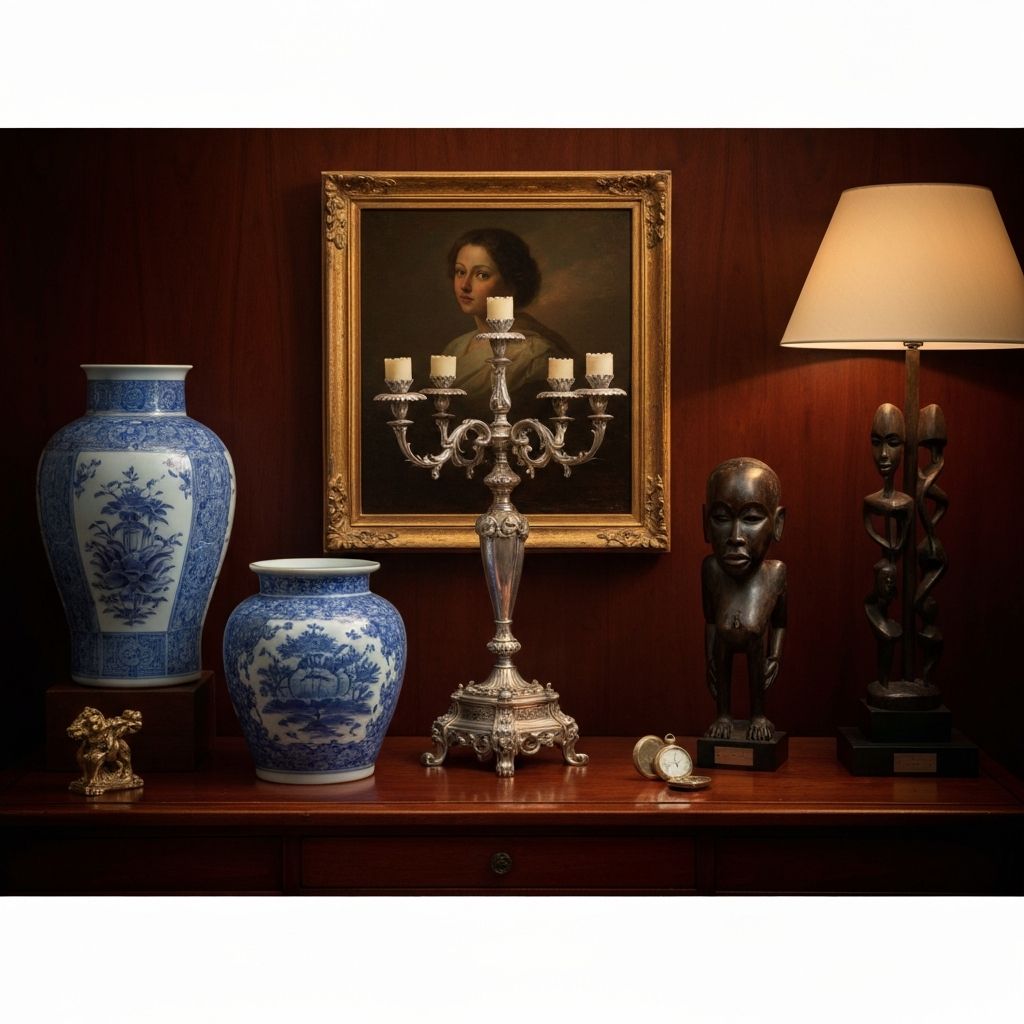
Free Antique Valuation From a Photo: How It Works and What to Expect
You are at an estate sale on a Saturday morning. You pick up a ceramic bowl with a blue underglaze mark on the base, a ring of characters you cannot read, and a quality of glaze that feels genuinely old. The asking price is €35. The question that runs through every collector's mind in that moment is simple and urgent: is this worth it? Ten years ago, answering that question meant finding a specialist, booking an appointment, and waiting two weeks. Today, you can photograph the base, upload the image, and have a well-reasoned valuation in under sixty seconds. This guide explains exactly how photo-based antique valuation works, what the technology can and cannot do, how to take the right kind of photograph, and how to interpret what you get back.
What a Photo-Based Antique Valuation Actually Does
People often arrive at photo valuation tools with two very different expectations. Some expect a magic number, as precise as a supermarket barcode scan. Others are sceptical and expect nothing useful at all. The reality sits between those positions, and understanding it makes the result far more actionable.
A photo-based valuation does three things simultaneously. First, it attempts to identify the object: what it is, who made it, when it was made, and in what stylistic or manufacturing tradition it belongs. Second, it assesses the visible evidence for or against authenticity, drawing on marker systems, stylistic conventions, and period-specific manufacturing details. Third, it anchors an estimated value range to real auction records for comparable objects.
What it does not do is physically inspect the object. Weight, resonance when tapped, the feel of a glaze, the smell of old wood, the precise depth of tool marks under a loupe: these are things a photo cannot convey. A good AI valuation is therefore not a substitute for hands-on expertise; it is a fast, low-cost first filter that tells you whether further investigation is warranted, and at what level of the market you should be thinking.
The right mental model: a photo valuation gives you the same quality of rapid assessment a knowledgeable dealer does when they pick up an object at a fair. It is informed, structured, and market-anchored. It is not a certificate. That distinction matters, and every reputable tool will make it explicit.
Another thing photo-based valuation does that most people do not anticipate: it forces you to look at your object properly. The act of photographing the base, the back, the marks, the seams, and the surface under raking light teaches you more about what you are holding than ten minutes of casual handling. Many users report that the process of preparing images for submission is itself educationally valuable.
The Difference Between an AI Valuation and a Professional Appraisal
This distinction deserves its own section because it prevents genuine confusion and occasional disappointment.
A professional appraisal is a formal document, signed by a certified appraiser, based on physical examination, and designed to stand up in legal and financial contexts. Insurers require them. Probate courts accept them. Customs authorities recognise them. An appraiser may also carry personal liability for significant errors of judgement. The appraisal process typically costs between €80 and €300 for a single object and takes one to three weeks from submission to report.
An AI valuation from a photo is none of those things. It is fast, cheap, and market-oriented. It draws on pattern recognition across thousands of comparable auction results and maker's mark databases, and it delivers structured output within a minute. It has no legal standing. If your ceramic bowl turns out to be a Qianlong-period imperial piece worth €40,000 and you want to insure it, you will still need an appraiser's report.
Where AI valuation excels is in the large middle ground: objects that may or may not be significant, where the cost of a professional appraisal would exceed the likely value of the piece, or where you simply need to decide quickly whether to buy or walk away. For objects under roughly €500 in likely value, an AI assessment often represents the most economically rational first step. For objects above €2,000, treat the AI result as a research starting point and commission an in-person assessment before any major transaction.
The two approaches also serve different emotional needs. A professional appraisal delivers finality and formal authority. A photo valuation delivers orientation and momentum. Both are legitimate. Neither is a replacement for the other.
What Makes a Good Photo for Antique Identification
The quality of your photo is the single largest variable in the accuracy of a photo-based valuation. A blurry snapshot of a teapot sitting on a patterned tablecloth under a ceiling bulb will produce a vague result. A set of clean, well-lit images covering the key angles will produce a result that is genuinely useful. Here is what matters.
Lighting
Natural daylight from a north-facing window is ideal. It is diffuse, consistent, and does not create the harsh reflections that obscure marks on silver or glaze surfaces on ceramics. If you are shooting indoors without access to good window light, a pair of daylight-balanced LED panels (5500K) placed at 45-degree angles to the object will replicate the same effect. Avoid camera flash: it creates specular highlights on glazed or polished surfaces that wash out exactly the details the analysis engine needs to see.
For marks and signatures that are engraved, incised, or in low relief, raking light at a very low angle (almost parallel to the surface) causes the marks to cast shadows and become dramatically more legible. Take a dedicated mark shot under raking light in addition to your standard views.
Angles and Coverage
A minimum submission should include four images: a straight-on front view showing the overall form, a back or base view showing any marks, signatures, labels, or stamps, a close-up of any identified marks filling the entire frame, and a scale reference shot showing the object next to a known object (a coin, a ruler, a euro note).
For furniture, add a shot of the underside or back of a drawer showing construction details: the type of saw marks, the joint method, the hardware fixing. For silver, a close shot of every individual hallmark in the cluster is more useful than one photo showing all the marks small. For paintings, photograph the back of the canvas or panel, showing any labels, stretcher construction, and canvas type, as well as a close shot of the signature under raking light.
Background and Focus
Plain white, pale grey, or pale cream backgrounds remove visual noise and allow the analysis to focus on the object. A cluttered background does not cause the AI to fail; it does reduce the proportion of the image devoted to useful information. Sharp focus throughout is essential, particularly for marks. Use a tripod or brace your phone against a surface if your hands are not steady.
What Not to Do
Do not edit photos beyond basic exposure correction. Do not apply filters, artificial sharpening, or saturation boosts. These distort colour and surface texture in ways that can mislead pattern recognition. Do not crop out the edges of the object. Do not submit a screenshot of an image rather than the original photograph. Resolution matters: most phones shot in standard mode produce more than enough detail; do not downsize before uploading.
How AntiqBot's 20+ Specialist Modules Work
Generic image recognition trained across all categories simultaneously tends to perform adequately on common objects and poorly on the specialist knowledge that actually matters to collectors. A painting attribution requires different expertise from a silver hallmark identification, which requires different expertise from a Chinese porcelain mark reading. AntiqBot addresses this by routing each submission through a specialist module configured for that specific category of object.
The current module roster covers African art (AfroCheck), silver and hallmarks (SilverCheck), paintings and signatures (ArtCheck), ceramics and porcelain including Chinese marks (CeramCheck), Picasso attributions (PicassoCheck), antique furniture (FurnitureCheck), jewellery (JewelryCheck), antique clocks (ClockCheck), vintage toys (ToyCheck), mechanical watches (WatchCheck), bronzes, tapestries, tribal art, Art Deco objects, and several further specialist categories. When you upload a photo, you select the module that corresponds to your object type, and the analysis draws on that module's specific knowledge base.
Authentication Phase
Before any value can be estimated, the object must be placed. The authentication phase works through a structured checklist of observable indicators.
For ceramics, this includes glaze consistency and surface texture, the type and depth of the foot rim, the character of any painted decoration (brushwork fluency, pigment layering, tonal variation), the form and reading of any reign mark, and any secondary marks including collector's stamps or import marks. For silver, it includes the presence, legibility, and internal consistency of the hallmark cluster: purity mark, assay office mark, date letter, maker's mark, and any duty or import marks. Each national hallmarking system has its own conventions, and SilverCheck cross-references against databases including 925-1000.com, ASCAS, the Online Encyclopedia of Silver Marks, and the Goldsmiths Hall register. For paintings, ArtCheck assesses signature style and placement, canvas or panel construction visible from the reverse, pigment layer structure where visible, and cross-references against the RKD (Rijksbureau voor Kunsthistorische Documentatie) for Dutch, Flemish, and Belgian artists, artsignaturedictionary.com for signature verification, and auction databases for attribution evidence. For further detail on how silver hallmarks are read from photos, see our guide to silver hallmark identification from a photo.
The output of the authentication phase is a verdict on one of five tiers: Authentic, Probably Authentic, Uncertain, Probably Not Authentic, or Not Authentic. Each verdict comes with a confidence score and a written explanation of the specific indicators that drove the conclusion. Red flags are reported as red flags, without softening language. A high confidence score and a positive verdict warrant different next steps than an Uncertain verdict with several noted anomalies.
Valuation Phase
The valuation phase runs in parallel with authentication and draws on a different layer of knowledge: current and historical auction results for comparable objects. AntiqBot cross-references auction records from Christie's, Sotheby's, Bonhams, Catawiki, and Bernaerts to construct a value range anchored in real transactions.
The system identifies comparables by matching object type, maker or attribution, period, condition indicators visible from the photo, and size (where scale information is available). It then applies a market condition adjustment to account for the direction and tempo of the relevant collecting category. A Qing dynasty Famille Rose bowl attributed to the Qianlong period trades in a different market environment than a signed Art Deco ceramic vase from the same decade; the valuation logic treats these as distinct market segments with their own comparable sets.
The result is a price range rather than a single figure. A range of €400 to €700 communicates something meaningfully different from €10,000 to €25,000. The width of the range reflects genuine market variation for that category and condition bracket, not analytical imprecision. High-provenance objects with well-documented exhibition or collection histories will show tighter ranges; anonymous objects of uncertain attribution will show wider ones.
Which Types of Antiques Can Be Valued From a Photo (and Which Cannot)
Photo-based valuation performs well across a large range of object categories. It performs less well, or not at all, on a defined subset where physical examination is genuinely irreplaceable.
Objects that are well-suited to photo analysis include paintings and works on paper (where signature, style, composition, and back-of-canvas construction are the primary authenticating evidence), silver and metalwork (where hallmarks are the primary evidence and a close photograph is sufficient to read them), ceramics and porcelain including both European and Chinese marks, antique furniture (where construction methods, joinery, hardware, and secondary surfaces provide the authentication record), clocks and watches with visible makers' signatures and movement characteristics, African and tribal art (where formal and stylistic analysis is the primary tool), bronzes (where cast quality, patina characteristics, and foundry marks are visually assessable), and jewellery with visible maker's cartouches or hallmarks.
Objects that present genuine limits for photo-based analysis include loose gemstones, where identification requires a refractometer, hardness test, or spectroscope and a photograph provides insufficient data for reliable species identification. Furniture condition assessments that depend on structural soundness, hidden repairs, or woodworm activity in inaccessible areas are also better handled in person. Extremely rare objects where the authentication decision hinges on physical testing (pigment analysis, carbon dating, dendrochronology) similarly require laboratory methods that no photograph can substitute.
A practical rule: if the key question about your object is one that a knowledgeable person could answer by looking at it carefully under good light, a photograph can substitute for that examination. If the key question requires touching, tapping, weighing, or chemically testing the object, a photograph cannot.
Step by Step: How to Get a Free Antique Valuation on AntiqBot
The process is short and designed to take less than five minutes from photo to result.
Step 1: Register. Create a free account at antiqbot.com. Registration takes under two minutes and gives you 1 free credit immediately. No payment details are required to claim it.
Step 2: Photograph your object. Follow the guidance above: front view, back or base view, close-up of any marks, scale reference. Clean the surface lightly if it is dusty. Use natural light or daylight-balanced LEDs. Take the mark shot under raking light.
Step 3: Select the correct module. On the analysis page, choose the module that matches your object type. If you are unsure, the module descriptions on the selection screen guide you. A piece of silver goes to SilverCheck. A ceramic with an unclear mark goes to CeramCheck. A painting with a signature goes to ArtCheck. When in doubt between two categories, choose the one that matches the primary material.
Step 4: Upload your photos and submit. You can upload multiple images in a single submission. Add any contextual notes you have: provenance, where you acquired the object, any labels or documentation that came with it. Provenance information is weighted in the valuation phase and can shift the result significantly for high-quality objects.
Step 5: Receive your analysis. Within sixty seconds you will have the five-tier authentication verdict, confidence score, written explanation of the indicators reviewed, and the estimated value range with comparable auction lots cited. The result is saved to your account history for future reference.
Get Your First Analysis Free
Sign up and get 1 free credit for your first analysis. After that, buy credit packs starting from €0.60 per analysis.
Start Your Free AnalysisWhat the Results Tell You
Understanding the output structure prevents misreading the result in either direction: dismissing a serious finding or over-relying on a provisional one.
The verdict. One of five tiers, from Authentic to Not Authentic. Read this in conjunction with the confidence score, not in isolation. An Authentic verdict at 55% confidence means something different from the same verdict at 92% confidence. The confidence score reflects how much unambiguous authenticating evidence was visible in the submitted photographs.
The written analysis. This section explains which specific indicators were evaluated and what they showed. For ceramics, it might note that the reign mark uses the correct six-character format (大清乾隆年製 for a Qianlong piece, for example) with appropriate character spacing and brushwork consistency, that the foot rim trimming method matches the claimed period, and that the glaze pooling in the foot rim is consistent with high-fired period wares rather than later reproductions. For silver, it will identify each hallmark in the cluster and note any inconsistencies. This narrative is where the expert knowledge lives and where you will find the most actionable information.
Red flags. If the analysis identified anomalies, they appear explicitly in this section. They are not softened by the surrounding positive observations. A piece with three strong authentication indicators and one serious inconsistency will have that inconsistency reported prominently, because in authentication, a single red flag often outweighs several positives.
The value range. Expressed as a minimum and maximum figure in euros, anchored to specific comparable auction lots. Each comparable is cited with its sale house, approximate sale date, and hammer price. You can use these comparable citations to do your own research on the named auction platforms if you want to verify the data or find additional comparables.
Recommended next steps. The analysis closes with a recommendation calibrated to the verdict and value range. A low-confidence result on a potentially high-value piece will recommend professional in-person assessment. A high-confidence positive result on a piece in the €100 to €300 range will typically note that no further assessment is necessary for buying or selling decisions at that level, while suggesting that formal appraisal would be required for insurance purposes. For guidance on interpreting painting signatures specifically, the guide to identifying painting signatures online covers the additional evidence layers that support or undermine attribution claims.
Understanding Valuation Ranges: Why Antique Prices Vary
A frequent point of confusion for people new to the antiques market is the breadth of value ranges. If two apparently identical blue-and-white porcelain plates sold at Christie's and Catawiki respectively, why might one have achieved €800 and the other €4,500? The answer reveals how antique markets actually work and why a range is a more honest output than a single figure.
Condition is the largest single variable within a category. A pair of George III silver candlesticks in unrestored condition with a well-developed original patina will sell for significantly more than an identical pair that has been heavily polished, has one repaired socket, and is missing one nozzle. The difference in hammer price can exceed 60%. A photograph can reveal some condition issues (chips, cracks, obvious repairs, overpainted areas) but not all of them. The value range therefore brackets the condition uncertainty.
Provenance drives significant premiums for well-documented objects. A painting that passed through a named collection, has an old exhibition label on the back, and appears in a published catalogue raisonne will consistently outperform a formally identical work with no provenance trail. The premium can be multiples of the base price at the high end of the market. When you submit provenance information with your analysis, the valuation phase weights this accordingly.
Market timing matters more than most people expect. Collecting categories move in cycles. African Kuba sculpture was fetching three to five times its 2010 prices at the peak of the 2018 to 2022 institutional collecting boom; it has since moderated. Art Deco Clarice Cliff ceramics peaked in the late 1990s and early 2000s and have not fully recovered those levels in the broader market, though exceptional pieces continue to perform. The AntiqBot valuation draws on recent auction data to reflect current conditions rather than historical peaks.
Sale venue and buyer pool affect realised prices in ways that a valuation cannot fully predict. A well-catalogued lot at a Christie's Important Works of Art sale in London commands a different buyer pool than the same object on Catawiki. A prestigious sale context adds credibility and competition; a local auction adds accessibility. Neither is inherently superior for the seller, because the cost structure and commission rates differ substantially. For a comprehensive discussion of this distinction, the guide on appraisal value versus market value in antiques is worth reading before any major sale decision.
When to Act on an AI Valuation vs. When to Get a Second Opinion
Knowing when the AI result is sufficient and when you need more is the practical skill that separates good collectors from expensive lessons.
Act directly on the AI result when the estimated value is below approximately €500 and the confidence score is above 75%. At this value level, the cost of a professional appraisal (typically €80 to €150) is disproportionate, and the AI result gives you enough orientation to make a sensible buying or selling decision. A positive verdict with a strong confidence score at this level means you can proceed with reasonable confidence. A negative or uncertain verdict at any confidence level means walk away or negotiate aggressively on price.
Seek a second opinion when the estimated value exceeds €2,000. The asymmetry of consequences changes at this level: the cost of being wrong is significant, and a professional appraisal fee is a small percentage of the object's value. Commission an in-person assessment, and use the AI result as a brief for the appraiser, pointing them to the specific indicators the analysis flagged.
Seek a second opinion when the confidence score is below 60% regardless of the verdict. A low-confidence result means the visible evidence is genuinely ambiguous, and the analysis is telling you so honestly. This is not a failure of the tool; it is an accurate reflection of the available information. Treat it as a prompt to look harder at the object, seek additional documentation, or have it examined in person.
Seek a second opinion when specific red flags are reported that have significant value implications: a reign mark that is correct in format but inconsistent in brushwork, a signature that matches the artist's style but uses a support material not available in that period, silver hallmarks that are individually correct but form a cluster that should not coexist on a piece of that claimed date. These are the cases where an experienced human eye at close range adds genuine value beyond what a photograph can communicate.
Always seek a professional appraisal for insurance, probate, customs clearance, or legal disputes. No AI-generated result will be accepted by any of these institutions as formal documentation. The correct workflow is: AI analysis first to establish approximate market value and identify key authentication points, professional appraisal second to produce the legally valid documentation you need.
Frequently Asked Questions
Can I get a free antique valuation from a photo?
Yes. When you register on AntiqBot, you receive 1 free credit immediately. That credit gives you one complete analysis: authentication assessment, confidence score, written explanation, and estimated value range with cited auction comparables. No payment details are required to register. If you want additional analyses, credit packs start from €0.60 per analysis for the 50-credit pack.
How accurate is a photo-based antique valuation?
Accuracy varies with photo quality, object type, and the visibility of key authentication markers. On well-photographed objects with clear maker's marks, the results are consistently well-calibrated against professional assessments in the mid-market range (€100 to €5,000). For very rare objects at the top of the market, AI valuation is a useful first filter but should always be supplemented by professional examination. The value ranges are anchored in real auction data from Christie's, Sotheby's, Bonhams, Catawiki, and Bernaerts, not in algorithmic estimates.
What types of antiques work best for photo valuation?
Ceramics, porcelain, silver, paintings, furniture, clocks, watches, jewellery with visible hallmarks, African art, bronzes, and vintage toys are all well-served by the specialist modules. Objects requiring physical testing for identification (loose gemstones, objects where condition depends on structural integrity not visible in photos) are less suited to the format.
Is the result legally binding?
No. An AI valuation is a market-oriented estimate, not a certified appraisal. For insurance, probate, legal disputes, or export licensing, you need a signed report from a certified appraiser who has examined the object in person.
What if I disagree with the result?
Start by reviewing the quality of your submitted photographs against the guidance in this article. A second submission with better photos of the key marks often produces a more precise result. If you have documentation (provenance papers, old auction catalogues, prior appraisals) that supports a different assessment, submit it with the analysis notes: documented provenance is a weighted input in the valuation phase. If you still disagree, the rational next step is an in-person assessment by a specialist in the relevant category.