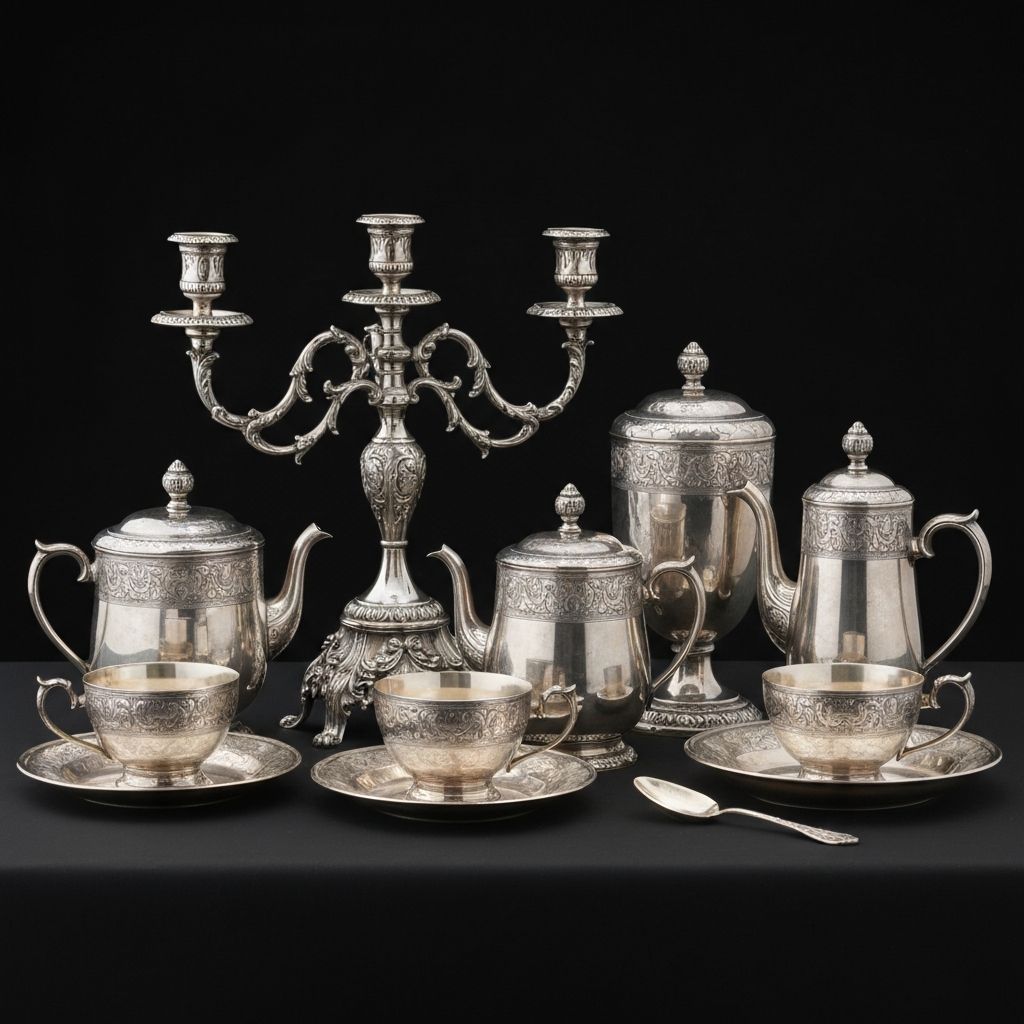
Silver Hallmark Identification From a Photo: The Complete Guide
You pick up a silver teapot at a flea market, turn it over, and find a cluster of tiny stamped symbols on the base. A lion. A crown. Two letters in an ornate shield. A set of initials. These marks could tell you exactly who made the piece, where it was tested for purity, in what year, and whether any duty was paid on it. Or they could tell you that the pot is silver-plated nickel and worth a fraction of what solid silver would fetch. The difference between reading those marks correctly and guessing can run into hundreds of euros. This guide explains how silver hallmark identification works, what each type of mark means, how national systems differ, and how to identify silver hallmarks from a photo using modern AI tools.
What Are Silver Hallmarks?
A hallmark is an official stamp applied to precious metal objects after the metal has been tested (assayed) by an independent authority. The word comes from Goldsmiths' Hall in London, where British silver and gold has been tested since the fourteenth century. Hallmarks are not decorative: they are legal guarantees. In most European countries, selling silver above a certain weight without a hallmark was illegal for centuries, and the penalties for fraudulent marking were severe.
The purpose of hallmarking is consumer protection. Before spectroscopic testing existed, the only way a buyer could trust that a piece of silver was actually silver (and not pewter, tin, or base metal with a thin silver wash) was to see the stamp of an authorised assay office. The assay office tested a scraping of the metal, confirmed its purity, and applied its own mark alongside the maker's mark. Neither party could easily fake the other's stamp, creating a rudimentary but effective chain of custody.
Today, hallmarks are the primary tool for dating and attributing antique silver. A complete British hallmark set from the Georgian period can tell you the exact year of assay (within a twelve-month period), the city where it was assayed, the maker, the purity, and sometimes whether duty had been paid to the Crown. No other category of antique offers this level of built-in documentation.
Not all silver carries a full hallmark set. Some small or lightweight items (spoons under a certain weight, vinaigrettes, thimbles) were historically exempt from full marking in certain countries. American colonial silver was often marked only with the maker's mark. When a piece has fewer marks than expected, that absence is data, not necessarily evidence of forgery.
The Five Main Types of Silver Marks
British silver, which forms the backbone of the global auction market for antique silver, uses a system of up to five distinct marks. Understanding each type separately is the foundation of silver hallmark identification.
1. The Purity (Fineness) Mark
This mark confirms the silver content of the alloy. In Britain, the standard since 1238 has been sterling silver: 925 parts per thousand pure silver (92.5%), with the remaining 7.5% typically copper for hardness. From 1697 to 1720, a higher standard called Britannia silver (958.4 parts per thousand) was briefly made compulsory, partly to discourage silversmiths from melting down coinage. Britannia silver is marked with a seated figure of Britannia rather than the lion passant used for sterling.
On Continental European silver, purity is often expressed as a number: 925 (sterling), 800 (80% silver, common in Germany, Belgium, the Netherlands, and Scandinavia), 84 (zolotnik system used in Imperial Russia, equivalent to approximately 875 parts per thousand), or 950 (French first standard). These numeric marks are among the clearest to read in photographs because they are often stamped in plain numerals inside a cartouche.
2. The Assay Office Mark (Town Mark)
This is the stamp of the office that tested the silver. British assay offices each had a distinctive symbol:
- London: a leopard's head (crowned until 1821, uncrowned thereafter)
- Birmingham: an anchor (introduced 1773)
- Sheffield: a crown (1773 to 1974), then a York rose (from 1975)
- Edinburgh: a castle
- Dublin: a crowned harp (Hibernia)
- Chester: three sheaves of wheat and a sword (closed 1962)
- Newcastle: three castles (closed 1884)
- Exeter: a castle (closed 1883)
- York: five lions on a cross (closed 1857)
The town mark is one of the most reliable elements for geographic attribution. A Birmingham anchor on a piece of Victorian silver immediately narrows the assay location to the Midlands, and combined with the maker's mark, often to a specific manufacturer's district within that city.
3. The Date Letter
British assay offices used an alphabetical cycle of letters, each in a specific typeface and shield shape, to indicate the year of assay. The letter changed annually on a fixed date (in London, 29 May until 1975, then 1 January). Because each office used different letter styles and shield shapes, the same letter could mean different years depending on which town mark accompanies it. A Gothic capital A in a plain rectangular shield means a different year in London than a plain italic a in an ornate shield in Birmingham.
Date letter tables are published in reference works and are available through the Online Encyclopedia of Silver Marks and 925-1000.com. Reading a date letter from a photograph requires clarity on both the letter form and the shield outline, which is why macro photography and good lighting are essential for accurate silver hallmark identification from a photo.
4. The Maker's Mark
Silversmiths were required to register a mark at their local assay office before submitting work for testing. Early maker's marks used pictorial symbols (a pot, a swan, a fleece) because literacy was not universal. From the early eighteenth century onward, initials in a cartouche became standard in Britain. The cartouche shape (oval, rectangular, pointed, lozenge) was part of the registered mark, so two silversmiths with the same initials could be distinguished by their different shield shapes.
Identifying a maker's mark from a photograph is often the hardest part of silver hallmark identification, because the marks are small, the surfaces are curved, and decades of polishing can flatten the relief. The Association of Small Collectors of Antique Silver (ASCAS) maintains one of the most extensive online databases of registered maker's marks, cross-referenced with biographical data on silversmiths.
5. The Duty Mark
From 1784 to 1890, a tax was levied on silver in Britain. To prove the duty had been paid, assay offices stamped a profile portrait of the reigning monarch's head on hallmarked silver. The duty mark is therefore a useful dating tool: its presence confirms a piece was assayed between 1784 and 1890, and the monarch's portrait can narrow the date further (George III, George IV, William IV, or Victoria).
The duty mark was abolished in 1890. Its absence on a piece that otherwise reads as Georgian or early Victorian is a red flag worth investigating.
How to Read British Silver Hallmarks
Reading a complete British hallmark requires identifying all present marks and cross-referencing them systematically. The standard approach, taught at the Goldsmiths Hall register and replicated in every major reference work, proceeds in this order: purity mark first, then assay office, then date letter, then maker.
The Lion Passant
The lion passant (a lion walking to the left, right paw raised) has been the British sterling silver mark since 1544. It is one of the most recognisable marks in the silver world and appears on virtually every piece of British sterling silver made in the past five centuries. On Britannia silver (1697 to 1720, and on any piece voluntarily assayed to that standard thereafter), the lion passant is replaced by the seated Britannia figure.
In photographs, the lion passant often appears worn on heavily polished pieces. The shield shape changed over time: the lion appears in a plain rectangular shield on most Georgian pieces, and the shield shape was standardised across all British offices from 1975 onward as part of the Hallmarking Act reforms.
Reading the Date Letter in Context
The date letter system is where most amateur researchers go wrong. Because each assay office used its own alphabet cycle with its own typefaces and shield shapes, there is no universal date letter table. You must first identify the assay office from the town mark, then consult that office's specific date letter tables.
A practical example: the letter H in a plain shield on a piece with a London leopard's head corresponds to 1762 to 1763 in one cycle, 1802 to 1803 in another cycle, and 1842 to 1843 in a third cycle, depending on which London alphabet cycle you are consulting. The typeface (Roman, italic, Old English, script) is the differentiating factor.
Photography helps here. A clear, well-lit photograph of the date letter shield, taken from directly above with a macro lens or close-up phone camera, will often show typeface details that are invisible to the naked eye under poor light.
Provincial British Marks
Silver assayed outside London carries the same purity requirements but different town marks and sometimes different date letter cycles. Birmingham silver, which was produced in enormous quantities from the mid-eighteenth century onward (the city became the centre of mass-produced silverware), uses the anchor as its town mark. The anchor appears upright on Birmingham silver, which distinguishes it from Sheffield's crown (or post-1974 rose).
Scottish silver from Edinburgh and Glasgow follows its own hallmarking conventions. Edinburgh uses a castle with three towers. The date letter system in Edinburgh is separate from London's and runs on its own cycle. Glasgow (which had its own assay office from 1819 to 1964) used a tree, fish, bell, and bird mark derived from the city arms, making Glasgow silver among the most visually distinctive in the British Isles.
Continental European Silver Marks
Outside Britain, silver hallmarking systems developed independently in each country, often reflecting the political structures of the era. Understanding the major Continental systems is essential for collectors who encounter Belgian, Dutch, French, or German silver at auction or on the market.
Belgian Silver Marks
Belgium has had a consistent system of silver marking since the country was established in 1830, though the marking traditions in what is now Belgium predate independence and were part of the broader Austrian Netherlands and French Imperial systems. Belgian silver from the nineteenth and twentieth centuries typically shows a lion's head in profile as the purity guarantee for 800-grade silver, and a different lion configuration for 925. The maker's mark (poinçon de maître) appears alongside the guarantee mark.
Antwerp silver from before Belgian independence is among the most sought-after in Northern European auctions, including Bernaerts in Antwerp. The hand of Antwerp (a red hand on a silver field, derived from the city arms) appears on some Antwerp guild silver as a town mark, making identification of pre-1830 Antwerp silver relatively straightforward once you know what to look for.
Dutch Silver Marks
The Netherlands developed one of the most rigorous hallmarking systems in Europe. Dutch silver from the seventeenth and eighteenth centuries is marked with a combination of city marks (each Dutch city with a significant silversmithing tradition had its own mark), a date letter or year number, and a maker's mark. Amsterdam silver is particularly well documented, with the city's three-cross mark (the St Andrew's crosses from the city arms) serving as the town mark.
From 1814 onward, Dutch silver was marked with a national system using a lion with a sword and bundle of arrows (the Dutch state symbol) for 934-grade silver, and different marks for lower grades. The assay system was reformed several times in the nineteenth and twentieth centuries, and Dutch reference works (particularly Citroen's standard catalogue, consulted by ASCAS and 925-1000.com) provide detailed tables for each period.
French Silver Marks
French silver hallmarking is among the most complex in Europe because it was repeatedly reformed following political upheavals. The Ancien Régime had a system of guild marks, fermiers généraux (tax farmer) marks, and city marks that operated in parallel. The Revolution abolished the guild system in 1791 and introduced a new national system. Napoleon further reformed the system in 1797 (Year 5 of the Revolutionary calendar), introducing the rooster head as the guarantee mark for 950-grade silver and the owl for imported silver.
The Restoration, the July Monarchy, the Second Empire, and the Third Republic each brought modifications. For practical identification purposes, the most useful French marks are the rooster head (first standard, 950, nineteenth century), the owl (import guarantee, also used for some lower-grade domestic silver), and the Minerva head (introduced 1838 as the first standard mark, replacing the rooster in some contexts). Christie's and Drouot catalogues routinely publish detailed mark attributions for French silver lots, making them a useful secondary reference.
German Silver Marks
Germany had no unified national hallmarking system before 1884, when the German Empire standardised silver marking across the formerly separate states. Before unification, each state and free city had its own system. Augsburg silver (historically one of the most important German silversmithing centres) used a pine cone as its town mark. Nuremberg used an N. Hamburg used a castle. These town marks are the primary identification tool for pre-unification German silver.
After 1884, German silver was marked with a crescent moon and crown (Halbmond und Krone) as the official purity guarantee for 800-grade silver. This mark became one of the most widely recognised on Continental silver and appears on enormous quantities of German domestic silver made from the Imperial period through to the Weimar Republic.
Russian Silver Marks
Imperial Russian silver uses the zolotnik system for purity, expressed as a number followed by a Cyrillic character or as a pure numeral. The most common grades are 84 (875 parts per thousand), 88 (917 parts per thousand), and 91 (948 parts per thousand). Russian silver also bears an assay office mark (the city where it was tested), a date (usually the last two digits of the year), and a maker's mark, which was registered with the local assay master.
Moscow and St Petersburg silver is extensively documented in the Online Encyclopedia of Silver Marks and in specialist auction catalogues from Sotheby's and Christie's, both of which have handled major collections of Imperial Russian silver. The kokoshnik mark (a woman's head in profile wearing a traditional headdress) was introduced in 1896 as a state quality guarantee and is one of the clearest Russian silver marks to identify from a photograph.
Silver marked "EPNS", "EP", "A1", "silver on copper", or "Sheffield plate" is not solid silver. EPNS stands for electroplated nickel silver. These items have no silver purity assay marks because they are not solid silver. They can still be collectible and valuable, but they are in a different market category from hallmarked solid silver.
How to Identify a Silversmith's Maker Mark
The maker's mark is the most personal element of a hallmark set. It connects a specific object to a specific craftsperson or firm, and when the maker is well documented, it can add significantly to the object's auction value and historical interest.
Cartouche Shapes and What They Signal
In British silver, the shape of the cartouche surrounding the maker's initials is as important as the initials themselves. Common cartouche shapes include the plain rectangle, the pointed oval (vesica), the round-cornered rectangle, the cut-corner rectangle, and the lozenge (diamond). When two silversmiths shared the same initials, which happened regularly in cities with large silversmithing communities, the different cartouche shapes were what distinguished their registered marks.
Large firms sometimes used more elaborate cartouches incorporating additional elements such as a small animal, a tool, or a fleur-de-lis. These additional elements are often partially legible in photographs even when the main initials are worn.
Cross-referencing Maker's Marks
The primary research tools for British maker's marks are Jackson's Silver and Gold Marks (the standard reference work, now in multiple editions), the Goldsmiths Hall register (partially available online), and the ASCAS database. For Continental marks, 925-1000.com provides one of the most comprehensive freely accessible databases, organised by country and period.
When researching a maker's mark from a photograph, record the following details before consulting any reference: the initials (letter by letter, including any ampersand or punctuation), the cartouche shape, any additional elements visible within or outside the cartouche, and the approximate size of the mark relative to other marks present. Maker's marks are typically smaller than assay marks, and their size relative to the piece can also provide clues about the period.
Partnership Marks and Firm Succession
Many maker's marks represent partnerships rather than individual silversmiths. In Britain, partnership marks typically show two sets of initials (for example, WE&S for William Eley and William Fearn, or HB for Hester Bateman). When a senior partner died or retired, the mark was often re-registered with changed initials. Tracking a silversmithing firm through its successive marks is a legitimate form of silver research and can date a piece more precisely than the date letter alone.
Major British silversmithing firms such as Paul Storr, Hester Bateman, Matthew Boulton, and Paul de Lamerie are extensively documented in auction literature. A piece bearing the mark of Paul Storr, for instance, will be noted in Sotheby's and Christie's past auction results, providing both authentication benchmarks and market value data.
Common Forgeries and What to Watch For
Silver hallmark forgery has existed nearly as long as hallmarking itself. The penalties for counterfeiting hallmarks in Britain were historically severe (transportation or death in the eighteenth century), but the financial incentive was considerable. Modern collectors need to be aware of the main categories of fraudulent marking.
Transposed Hallmarks
The most common form of hallmark fraud is the removal of genuine hallmarks from a small, damaged, or low-value piece and their insertion into a larger, more valuable piece that was never hallmarked. This is called "let-in" or "transposed" hallmarking. The telltale sign is a hallmark that sits in a slightly different surface texture than the surrounding metal, or hallmark marks that are at an unusual depth or show solder lines around them under magnification.
A correctly struck hallmark should sit flush with or fractionally below the surface, with the metal compressed around it in a characteristic way. A let-in hallmark patch often shows a slight ridge where the patch meets the parent metal, and the marks themselves may be oriented inconsistently with how a maker would naturally have struck them.
Spurious Marks
Some pieces carry marks designed to look like hallmarks but that were never registered with any assay office. These are called spurious marks. They were particularly common on silver imported into Britain from Continental Europe in the late nineteenth and early twentieth centuries, where importers sometimes applied marks to satisfy buyers who expected to see stamps without the items actually having been assayed in Britain.
The Imported Goods Act of 1904 and subsequent British regulations required all imported silver to be assayed and marked in Britain before sale. Items that avoided this requirement sometimes carry marks that superficially resemble British hallmarks but fail on close inspection: the lion passant faces the wrong direction, the assay office symbol does not match any real office, or the cartouche shape has no British precedent.
Later Additions and Overmarking
Some pieces have had later marks added to earlier, authentic pieces. A common example is a plain Georgian silver teapot to which a later chased decoration was added (raising questions about whether the original marks still apply to the current weight and composition), or a piece where a worn or illegible date letter has been re-struck with a different letter to make the piece appear older or younger than it is.
Checking for mark consistency is the primary defence against these practices. A genuine hallmark set should show consistent depth, wear, and patination across all marks. Marks that look noticeably fresher or deeper than their surroundings merit closer examination.
The Goldsmiths' Company in London maintains a permanent archive of registered maker's marks going back to the seventeenth century. Their research service can confirm whether a specific mark combination was ever legitimately registered, which is one of the most reliable defences against spurious mark fraud.
How to Identify Silver Hallmarks From a Photo
Practical silver hallmark identification from a photograph depends on image quality, lighting, and a systematic approach to what you see. This section covers the physical technique of photographing hallmarks well, then explains how AI-assisted tools such as AntiqBot's SilverCheck module can take over the cross-referencing work.
Getting a Usable Photograph
The single most common obstacle to silver hallmark identification from a photo is poor light. Hallmarks are struck into metal, meaning they are formed by impressed relief. They are visible primarily through the shadows cast in that relief, not through surface colour. A photograph taken with direct flash or flat overhead light will wash out the shadows and make the marks invisible. The correct approach is raking light: a single light source held at a low angle to the surface, creating strong directional shadows that reveal every detail of the struck marks.
In practice, you can achieve this with a desk lamp or even a phone torch held at roughly 15 to 30 degrees to the surface. Take the photograph with your phone camera perpendicular to the marks (directly above), with the light source off to one side. The resulting image should show clear shadow detail in each impressed mark.
For very small marks, use your phone's native zoom only up to 2x before switching to a dedicated macro lens attachment. Digital zoom beyond 2x degrades pixel quality in ways that make fine details like date letter typefaces difficult to read. If the marks are on a curved surface (the base of a teapot, the inside of a ring, the neck of a jug), photograph from the angle that keeps the greatest number of marks in focus simultaneously.
What to Photograph
A complete identification requires photographs of all marks present. On a British teapot, this typically means the base (where the full hallmark set is usually struck), any marks on the lid (often repeated or partial marks), any marks on the handle (sometimes a maker's mark only), and any marks on the spout mount. On flatware, marks appear on the back of the handle, and sets of six or twelve pieces will show consistent marks across all pieces if they were made as a matched set.
Photograph each cluster of marks separately at maximum usable resolution. Include a reference scale if possible (a coin, a ruler) so the mark sizes can be assessed. Mark size is a useful authentication signal: a lion passant that is disproportionately large relative to the piece, or a date letter that is smaller than the town mark, suggests something unusual.
AntiqBot SilverCheck: AI-Assisted Hallmark Identification
AntiqBot's SilverCheck module was built specifically for silver hallmark identification from uploaded photographs. It processes the image, isolates individual mark elements, and cross-references them against four primary databases: 925-1000.com, the Association of Small Collectors of Antique Silver (ASCAS), the Online Encyclopedia of Silver Marks, and the Goldsmiths Hall register.
The module identifies purity marks and outputs the corresponding silver grade (sterling 925, Britannia 958, 800-grade Continental, and others). It reads assay office marks and returns the city and, where relevant, the approximate period when that specific mark configuration was in use. For date letters, it cross-references the letter form, typeface, and shield shape against the specific date letter table for the identified assay office, returning the most probable assay year or year range. For maker's marks, it searches registered mark databases by initial combination and cartouche shape, returning the most probable maker with biographical context where available.
The valuation component draws on current auction data from Catawiki, Christie's, and Bonhams to provide a market context for the identified piece, accounting for maker, period, form, and condition as far as these can be assessed from the photographs provided.
The output follows AntiqBot's standard five-tier authenticity verdict: Authentic, Probably Authentic, Uncertain, Probably Not Authentic, or Not Authentic, with a coherent analysis text that explains which marks support or undermine the attribution. Red flags identified during mark analysis (inconsistent wear, suspicious cartouche shapes, mark combinations that do not correspond to any known assay period) are reported directly without softening.
Identify Your Silver Hallmarks Now
Upload a photo of your silver piece and let AntiqBot SilverCheck cross-reference 925-1000.com, ASCAS, the Online Encyclopedia of Silver Marks, and the Goldsmiths Hall register in seconds.
Sign up and get 1 free credit for your first analysis. After that, buy credit packs starting from €0.60 per analysis.
Analyse My SilverLimitations and When to Seek Expert Assessment
Photo-based hallmark identification has genuine limitations that any responsible tool acknowledges. Worn marks on heavily polished pieces may not photograph with enough detail for confident identification. Transposed hallmarks may not be detectable from a photograph alone (they require physical examination of the solder lines). Some unusual or regional marks fall outside standard databases.
For pieces with significant potential value (above approximately €500 in estimated silver weight alone, or where maker attribution would place the piece in a major auction house context), a physical examination by a specialist silversmith or an assay office is advisable before purchase or sale. The Goldsmiths' Company in London offers a hallmark identification and research service. Specialist auction houses including Bonhams, Christie's, and Sotheby's all offer appraisal services for significant pieces.
AntiqBot SilverCheck is best used as a first-stage triage tool: it will identify the majority of common British and Continental European marks accurately, flag anomalies that warrant further investigation, and provide a market context that helps you decide whether a specialist assessment is worthwhile.
Building a Systematic Approach to Silver Research
Whether you are a collector building a focused collection, a dealer sourcing stock at flea markets and estate sales, or an heir trying to understand what is in a family's silver cabinet, a systematic approach to silver hallmark identification will save time and prevent costly mistakes.
Start With the Purity Mark
Before anything else, establish whether the piece is solid silver at all. Look for the lion passant (British sterling), a numeric purity mark (Continental), or the Britannia figure. If the only marks present are EPNS, EP, or similar plate marks, the research process for solid silver does not apply. Silver plate can still be worth researching from a decorative arts perspective, but it is a different object category.
Identify the National System
The lion passant places a piece in the British system. Numeric purity marks (800, 925, 950) point to Continental origin. A rooster head points to France. A crescent moon and crown points to Germany. A kokoshnik points to Imperial Russia. Once you have identified the national system, you can consult the appropriate national reference database rather than searching all systems simultaneously.
Work From Known to Unknown
In most hallmark sets, at least one mark will be clearer than the others. Start with what is readable. If the assay office mark is clear and the date letter is worn, the office mark alone narrows the date range considerably. If the maker's mark is clear but the date letter is illegible, the maker's active dates (available in most reference works) provide a cross-check. Build the identification from what is certain toward what is uncertain, rather than committing to a date or maker before all available marks have been read.
Document Everything
For any piece of potential value, maintain a research file that includes the original photographs, your mark-by-mark readings, the reference sources consulted, and the final attribution with its confidence level. This documentation becomes part of the object's provenance record and can be presented to a potential buyer, an insurer, or an auction house. An object with documented, verified hallmark research is easier to sell and typically commands a better price than an identical piece without that paper trail.
Silver Hallmarks and Valuation
Understanding silver hallmarks is inseparable from understanding silver valuation. The marks provide the three data points that drive most valuation decisions: the silver grade (which determines melt value), the maker (which determines maker premium), and the date (which situates the piece in a stylistic and historical context).
Melt Value as a Floor
Every piece of hallmarked solid silver has a calculable melt value: the spot price of silver multiplied by the weight in troy ounces multiplied by the purity fraction. For sterling silver (92.5%), a 200-gram teapot at a spot price of €30 per troy ounce has a melt value of roughly €175. This is the floor below which a piece should not trade unless it is heavily damaged or has significant restoration work needed.
Most antique silver trades well above melt value, and the hallmarks are the primary driver of that premium. A piece by Paul Storr or Hester Bateman will trade at ten to fifty times melt value at a major auction house. A piece by an anonymous provincial maker from the same period might trade at two to four times melt value. The difference is entirely in what the maker's mark tells you about the object's place in silver history.
Stylistic Periods and Market Preferences
Market preferences for silver periods shift over time. Georgian silver (roughly 1714 to 1830) has been the consistent favourite in the British and international auction markets for decades, with particularly strong demand for pieces from the Rococo period (1740 to 1770) and the Neoclassical period (1770 to 1800). Early Victorian silver is somewhat less fashionable but represents excellent value for collectors. Edwardian and Arts and Crafts silver has a specialist following. The hallmarks date a piece to a specific stylistic period, which is one reason accurate date letter reading matters beyond mere curiosity.
On the Continental side, French Empire silver (1800 to 1815) and Dutch seventeenth-century silver command the highest premiums. Belgian silver from the period before industrialisation (pre-1850) is an area of growing collector interest, partly because it is less well documented than British silver and therefore undervalued relative to quality.
For deeper context on how auction value relates to insurance appraisal and replacement value, read our companion article on appraisal value vs. market value in antiques. If your silver research leads you to investigate other marked objects, our guide to Chinese porcelain marks identification covers the analogous process for reign marks and studio marks on ceramics.
Frequently Asked Questions
Can I identify silver hallmarks from a photo?
Yes. AntiqBot's SilverCheck module analyses uploaded photographs and cross-references hallmark databases including 925-1000.com, ASCAS, and the Goldsmiths Hall register to identify purity marks, assay office marks, date letters, and maker's marks. Image quality matters: use raking light (a torch or lamp held at a low angle) to bring out the relief of the stamped marks before photographing.
What does the lion passant on silver mean?
The lion passant (a walking lion facing left, right paw raised) is the British sterling silver purity mark, confirming the item is at least 92.5% pure silver. It has appeared on British silver since 1544 and is one of the most widely recognised marks in the antiques world. It does not indicate the maker, the date, or the assay office; those are conveyed by separate marks.
How do I find out who made a piece of antique silver?
The maker's mark, usually the silversmith's initials in a cartouche (a small shaped border), is stamped on every hallmarked piece. Cross-reference the initials and cartouche shape against ASCAS, 925-1000.com, or the Online Encyclopedia of Silver Marks. For British silver, Jackson's Silver and Gold Marks (available in most major libraries) remains the definitive printed reference. AntiqBot SilverCheck automates this cross-referencing from a photograph.
Is unmarked silver worth anything?
Unmarked silver can still have value, but provenance and authenticity are harder to establish. Some early American colonial silver and certain Continental European pieces were not consistently hallmarked. Objects can be tested for silver content by an assay office or a reputable jeweller using X-ray fluorescence (XRF) spectroscopy, which gives a precise purity reading without damaging the piece. Unmarked silver of good quality and interesting form does sell at auction, but typically at a discount to comparable hallmarked pieces.
What is the difference between silver plate and sterling silver hallmarks?
Sterling silver carries a full set of hallmarks including a purity mark (the lion passant in Britain, or a numeric mark on Continental pieces) struck by an independent assay office. Silver plate carries manufacturing marks rather than assay marks. Common silver plate marks include EPNS (electroplated nickel silver), EP, A1, EPBM (electroplated Britannia metal), and the word "plated." These marks indicate a base metal (often nickel, copper, or Britannia metal) with a thin silver layer deposited by electroplating. Silver plate carries no purity assay mark because there is no solid silver purity to certify.