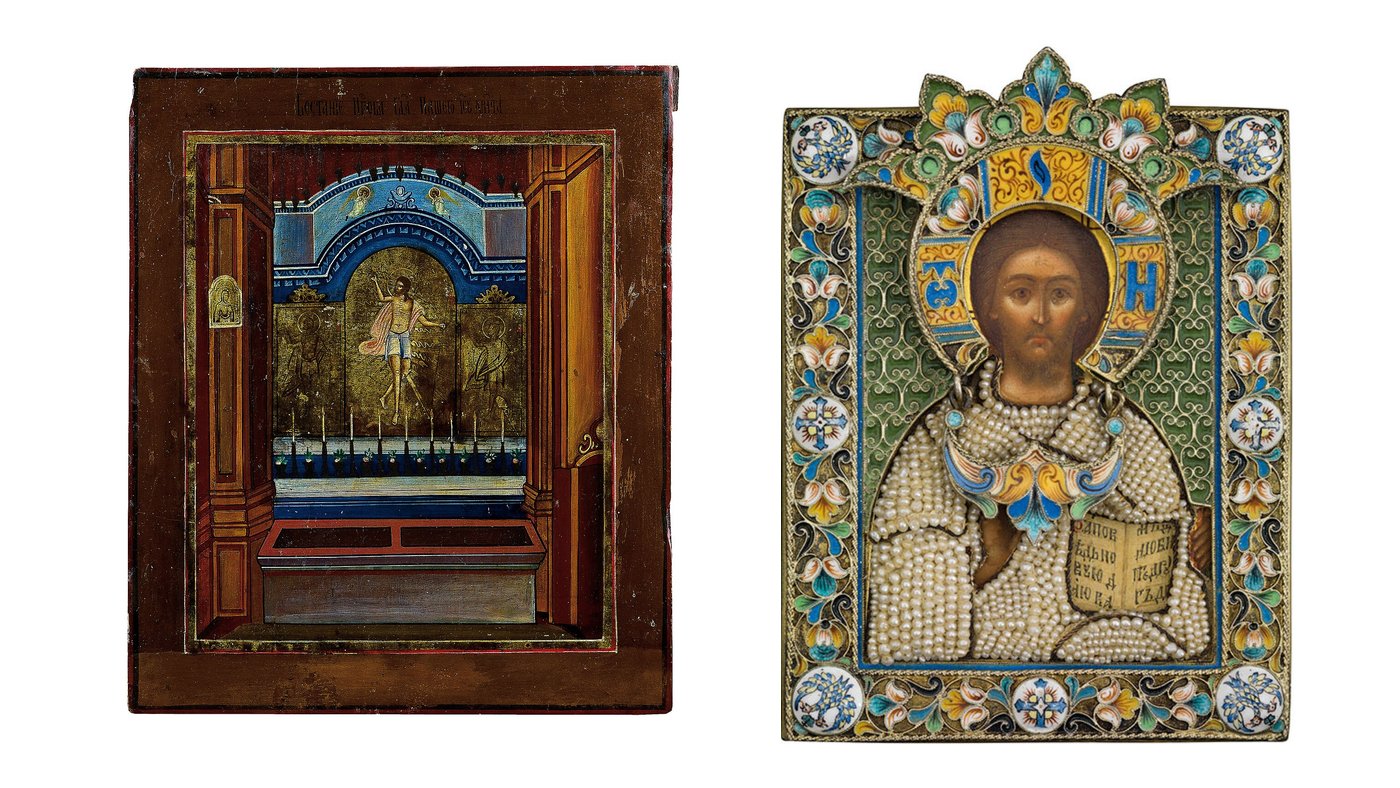
Russian and Greek Icons: Genuine, Old Copy or Modern Reproduction?
Few objects inspire as much awe, and as much confusion, as an icon. The gold gleams, the face looks at you gravely, the wood feels ancient. And yet there is hardly a category of antiques where the copy market is as large, as old and as treacherous. There are fifteen-euro reproductions that, in a photograph, are almost indistinguishable from a fifteen-thousand-euro panel. This article explains how to read the layers: the wood, the ground, the paint, the metal and the story around them.
Icons now arrive on the European market from every direction at once. They surface in the estates of grandparents who once bought them on a trip. They hang by the dozen at flea markets and in thrift shops. They appear on online auctions, from Catawiki to the specialist houses, in every price bracket side by side. And because virtually every icon looks old to an untrained eye, the same thing happens at both ends of the market: buyers pay antique prices for souvenirs, and heirs give away genuine eighteenth-century panels because they assume they are the tourist-shop kind.
Both mistakes are avoidable. Not because icons are easy to judge, they are not, but because most copies and reproductions give themselves away on a handful of checkable points. Once you know where to look, you can filter ninety percent of what is on offer within minutes. For the remaining ten percent there is analysis and expertise. Let us start at the beginning: what is an icon, technically speaking?
What an icon technically is: wood, cloth, chalk, egg and gold
A traditional icon is not a painting in the Western sense. It is a layered object, built according to a procedure that has hardly changed since Byzantine times. The base is a wooden panel, in Russia usually lime, pine or cypress, in Greece often cypress or another local wood. A piece of linen cloth, the pavoloka, was traditionally glued onto that panel, and over it came many thin layers of ground made of chalk or gypsum bound with hide glue. That brilliant white, polished ground layer is called the levkas, or gesso.
On the gesso the icon painter worked in egg tempera: pigments bound with egg yolk. Backgrounds and halos were frequently laid with gold leaf. Once everything had dried, the whole received a protective coat of olifa, a boiled linseed-oil varnish. And that olifa is one of the keys to dating: over the course of fifty to a hundred years it darkens, sometimes so much that the image becomes almost unreadable. This is why old icons were often overpainted rather than cleaned, layer upon layer, sometimes three or four images deep.
Anyone who understands this procedure immediately sees why an icon reveals so much to a careful observer. Each layer ages in its own way. Wood shrinks and warps. Gesso cracks in a characteristic network. Tempera wears differently from oil paint. Olifa yellows and darkens. A reproduction can copy the image, but copying the interplay of five ageing materials is far harder. That is where the difference becomes visible.
Russian or Greek: the two great families
Most icons on the Western European market are Russian or Greek, with smaller groups from the Balkans, Romania, Ukraine and the Middle East. The families are related, they share the same Byzantine roots, but they are easy enough to tell apart.
Russian icons carry inscriptions in Church Slavonic, written in Cyrillic letters. The famous abbreviations are a good starting point: IC XC for Jesus Christ, MP ΘΥ for the Mother of God. The great early centres were Novgorod, Pskov and Moscow, joined from the late sixteenth century by the refined Stroganov school. From the seventeenth and above all the nineteenth century, mass production came from specialised icon-painting villages such as Palekh, Mstera and Kholuy, which supplied tens of thousands of icons a year for households across Russia. The vast majority of Russian icons you will encounter today are nineteenth-century and come from that tradition.
Greek icons carry Greek inscriptions. After the fall of Constantinople in 1453 the centre of gravity shifted to Crete, where the so-called Cretan school produced work of exceptional quality in the fifteenth to seventeenth centuries, and later to the Ionian islands and the workshops around Mount Athos. Nineteenth-century Greek icons are often somewhat more popular and direct in style than their Russian contemporaries, frequently with chased and punched decoration worked into the gold itself rather than a separate metal cover.
Origin matters for the assessment. The Russian market is larger, more deeply documented and reaches higher peaks, but it also holds by far the most forgeries and reproductions. The Greek market is more modest, with its own very large segment of souvenir icons made for tourists and pilgrims. If you can place the inscription, you know at once which of the two copy markets you need to watch for.
The older pieces: why the age lives in the panel
With icons there is a reversal that surprises many collectors at first: the back is often more informative than the front. The image can be copied; the panel is much harder to fake. So always turn an icon over, and at an online auction always ask for photographs of the reverse and the sides.
Older Russian panels, roughly up to the seventeenth century and later in conservative workshops, often have a kovcheg: a recessed central field, leaving the border standing slightly proud like a frame. That recessed field was cut from the solid wood, and the transition, the luzga, was carved by hand. On the reverse there are usually one or two transverse battens, shponki, slid into dovetailed grooves to restrain warping. On an old panel those battens have often loosened or partly slid out as the wood shrank, and the bare wood of the back has darkened deeply and unevenly through centuries of oxidation, with wear where hands held the panel.
Nineteenth-century panels are generally flat, without a kovcheg, with simpler battens or none at all. That is no disqualification; it is simply how panels were made in that period. What you do watch for are saw marks. A panel cut cleanly by machine, with sharp corners and an evenly pale back, is not an eighteenth-century object, whatever the front claims. And a back that has been stained or scorched an even dark brown, without nuance, without wear, is suspect: real age colours unevenly, artificial ageing colours uniformly.
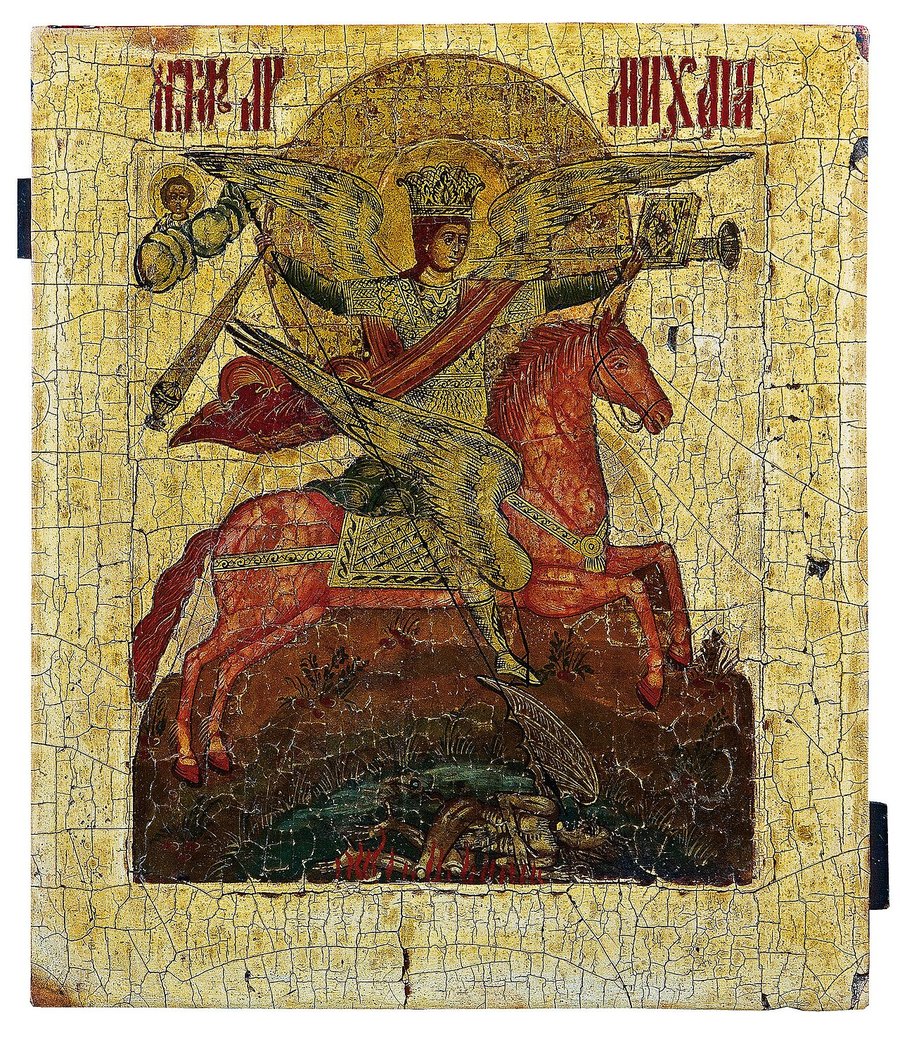
The craquelure tells the same story on the front. Over generations, gesso cracks into a fine, irregular network that follows the movement of the wood: denser near the edges, wilder around knots, with a lifted flake or an old retouch here and there. Printed or artificially induced craquelure is too regular, too shallow, and bears no relation to the wood beneath. Under a loupe the difference is almost always visible.
The copy market, part one: old copies that are themselves antiques
Here it gets interesting, because with icons the word copy does not automatically mean worthless. Copying is not a side phenomenon in icon painting; it is the heart of the tradition. An icon painter was not supposed to be original: he followed centuries-old pattern books, the podlinniki, which prescribed how each saint should look. A nineteenth-century icon of the Mother of God of Kazan is therefore by definition a copy of a much older prototype, and at the same time a fully legitimate antique object with a market value of its own.
On top of that, Russia had a flourishing market for deliberately archaic icons. The Old Believers, a conservative religious movement that split away after the church reforms of the seventeenth century, wanted icons in the old style from before those reforms. Workshops in Mstera and elsewhere served that demand with icons that look older than they are, sometimes on old panels, sometimes with deliberately darkened olifa. In the late nineteenth century, when wealthy collectors also began to collect early icons, part of that production slid into outright forgery of sixteenth-century pieces. Some of those forgeries are now themselves a hundred and fifty years old, carry genuine craquelure and genuine olifa, and are difficult even for specialists.
For practical purposes this means: the question is rarely whether an icon is a copy, because almost every icon is. The question is when the copy was made, how well it is painted, and whether it is being sold honestly for what it is. A finely painted Mstera icon in the old style from 1880 is a sought-after collector's piece. The same icon offered as sixteenth-century Novgorod is a problem worth thousands of euros.
The copy market, part two: modern reproductions and souvenirs
The second copy market is younger, far larger in numbers, and fortunately far easier to recognise. Since the 1970s and 1980s icons have been reproduced on an industrial scale, and that stream has never stopped.
The largest category is the printed icon on wood. A reproduction of a famous icon is printed on paper or foil, glued onto a wooden board, sometimes given a coat of varnish with an artificial craquelure effect, and the souvenir is ready. The Greek tourist and pilgrim market supplies them by the million: screen prints with shiny gold-coloured foil, often with a certificate sticker on the back, sold in monastery shops and souvenir stores from Athens to Thessaloniki. In Russia, church workshops, of which Sofrino near Moscow is the best known, have produced printed and mounted icons for church use for decades. All of these objects are entirely legitimate as devotional items. They are simply not antiques, and their market value is that of a souvenir.
Recognising them is loupe work. A print consists of a raster: under magnification you see dots or lines instead of brushstrokes. Real tempera has relief, however minimal, and under raking light you can see the direction of the brush and the build-up in layers. Printed gold is even and mirror-smooth; real gold leaf shows overlapping leaves, tiny tears and wear on the high points. A printed icon is, moreover, perfect: no pigment loss, no retouches, none of the small accidents that two centuries of use inevitably leave behind.
There is also a middle category that demands more attention: the hand-painted modern icon. In Greece, Romania, Bulgaria and Russia, excellent icons are painted today using the traditional technique, with real egg, real gesso and real gold leaf. Newly painted is, again, perfectly legitimate; there is a lively market for contemporary icon painting. The risk lies with examples that have been artificially aged: browned, damaged in strategic places, fitted with imitation wormholes. Watch the logic of the wear. Real wormholes run erratically and vary in diameter; drilled holes are round and uniform. Real wear sits where hands and lips touched the object, on the edges and on the painted hands and feet of the saint. False wear is scattered at random, or suspiciously tidy all around.
The riza: when the silver says more than the paint
Many Russian icons carry a metal cover, the riza or oklad, which conceals the whole image except the faces and hands. That cover is an object of assessment in its own right, and often the fastest route to a date.
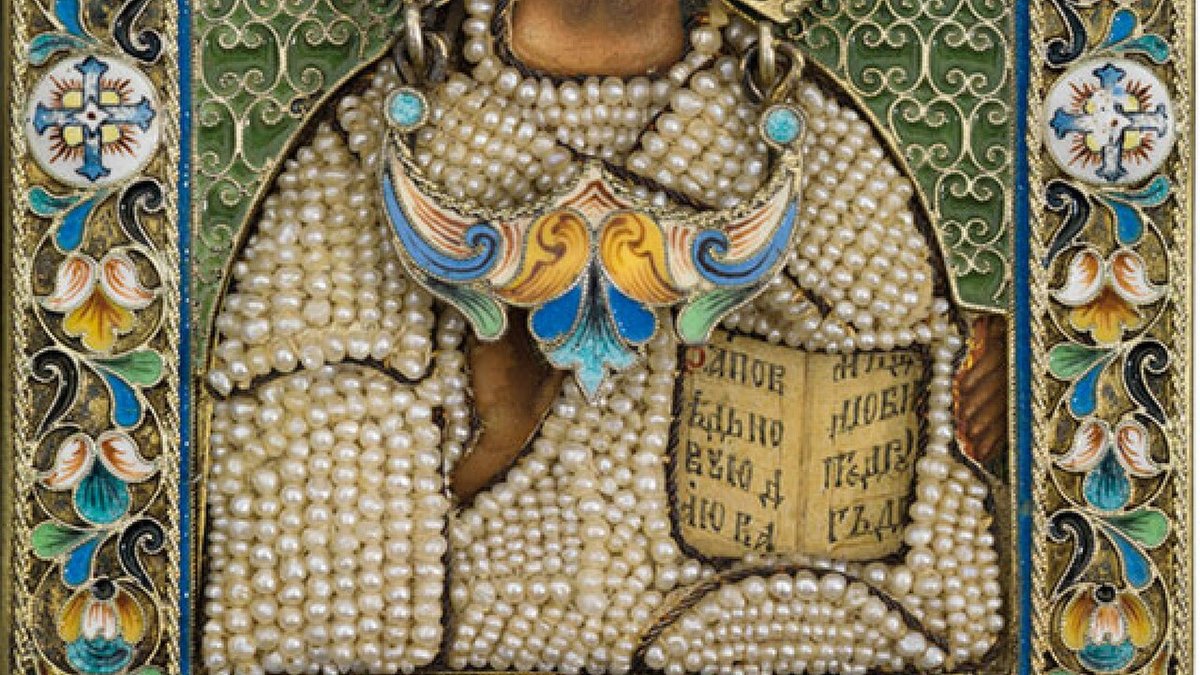
If the riza is silver, it will as a rule carry Russian hallmarks: a city mark, a date or kokoshnik mark, a maker's mark and a standard mark, usually 84 zolotniks, which corresponds to a fineness of 875/1000. A legible Moscow or St Petersburg mark with a date year dates the riza to the year, and with it, indirectly, often the icon as well. How to decipher such marks systematically is covered in our guide to identifying silver maker's marks online. If the cover is silver-plated copper, brass or stamped tin, you are almost certainly in the popular or later segment, or looking at a modern reproduction wearing a shiny plastic or foil dress.
Two warnings. First: a genuine old riza does not prove that the paint beneath it is right. There are marriages of old rizas with young or heavily overpainted panels, precisely because the silver inspires confidence. So always ask, or check, what the icon looks like under the riza; on old ensembles the painting beneath the cover is often fully worked up only where it shows, and that is normal. Second: a riza whose hallmarks are too sharp, too complete and too neatly arranged deserves extra suspicion, because hallmarks are faked as well. The whole must make sense, not just one component.
What are icons worth? The market in 2026
The icon market has changed profoundly over recent decades. The major London auction houses dropped their specialised Russian art sales after 2022, shifting the centre of the trade to specialist European houses, dealers and online platforms such as Catawiki. At the same time, part of the Russian buying power left the market. The consequence is predictable: the top segment remained scarce and sought after, while the broad middle segment of nineteenth-century icons became more accessible than it has been in years.
In broad strokes, and with all the caveats that belong to any valuation from photographs, the structure looks like this. Printed reproductions and souvenir icons have decorative value, generally a few tens of euros. Straightforward nineteenth-century Russian household icons without a cover routinely change hands between roughly one hundred and five hundred euros, depending on condition, size and painting quality. More finely painted pieces, icons with a hallmarked silver riza, dated or signed examples and sought-after subjects climb into four-figure sums. Early panels from the sixteenth and seventeenth centuries, work from the great schools and museum-grade pieces with watertight provenance occupy a league of their own, where five- and six-figure prices occur. The difference between those categories rarely lies in the first impression and almost always in the details this article describes.
Condition weighs more heavily with icons than beginners expect. Overpainting depresses value, unless it is itself old and interesting. Aggressive cleaning, where the olifa and the top layer of paint have been polished away, is often fatal to the fine linear work in faces and garments. Loss of gesso, active woodworm and warped panels can be restored, but with modest icons the costs quickly outweigh the gain. Anyone familiar with the reasoning in how to tell if a painting is valuable will recognise the pattern: quality of the hand, age, condition and provenance set the price together, and none of the four alone.
Provenance and legal diligence
Icons come with one extra chapter that does not apply to a teapot: provenance is also a legal matter. Russia has long had strict export restrictions on cultural goods more than a hundred years old, and icons rank high on that list. Greece protects its religious heritage just as firmly, and the European Union applies rules to the import of cultural goods from third countries. An icon that entered a Western European collection legally decades ago is therefore not only safer, but also worth more than a piece with no documented past.
In practice this means: keep and ask for everything that demonstrates provenance. Old purchase invoices, auction catalogues, customs documents, even a dated family photograph with the icon on the wall. Be cautious with pieces that appear on the market recently and without any documentation, especially at the higher end. And if you inherit an icon and do not know what it is, take inventory first and decide afterwards, as we describe at greater length in our guide to the first steps when inheriting antiques.
A short checklist for the market stall or the screen
Taken together, the first assessment of an icon comes down to ten looks, in this order.
- Back first: irregularly aged wood, loosened shponki and old wear are good signs; evenly stained, machine-sawn or brand-new wood is not.
- Loupe on the image: brushstrokes and relief are good; a printing raster of dots means reproduction.
- Craquelure: irregular, wood-related and with depth is old; regular, shallow and uniform everywhere is applied.
- Gold: overlapping leaves with wear point to gold leaf; mirror-smooth and even to foil or print.
- Olifa: an old, locally darkened and yellowed varnish layer belongs; a uniform honey-brown film over a perfect image is make-up.
- Wear logic: damage in logical places, retouches and pigment loss belong to two centuries of use; perfection does not.
- Inscriptions: Church Slavonic or Greek, correctly spelled and organic to the composition; missing or clumsy lettering is a red flag.
- Riza: genuine hallmarks date the silver, but always check what lies beneath.
- Wormholes and ageing: erratic and varied is real; round and uniform is drilled.
- The story: does the price match what the object claims to be, and is there provenance?
Run through these ten points and you will pick out the souvenirs and the crude fakes yourself. What remains is the difficult middle group: old copies, shifted datings, married rizas and artificially aged new panels. That is where the real work begins.
How AntiqBot looks at an icon
An AntiqBot analysis walks the same road as the connoisseur, but systematically. The analysis weighs the panel construction, the craquelure, the painting technique, the inscriptions and any metal cover against one another, compares the image with the known types and schools, and tests the whole against the current market. The result is a verdict with an indicative value and, just as important, the reasons behind it. Red flags are named, not massaged away: a printing raster under the loupe is not compensated by a fine story about the back.
The quality of such an analysis stands or falls with the photographs. For icons that means, at a minimum: the full front taken straight on, the full back, the sides, a detail of the face, a detail of any inscriptions and hallmarks, and preferably a shot in raking light in which relief and craquelure are visible. How best to take such photographs is set out step by step in our guide to photographing antiques for authentication. Twenty minutes of careful photography pays off more with icons than with almost any other type of object.
And sometimes the answer is: go to a human. A presumably early panel, large sums of money, or legal questions about provenance call for a physical examination by a specialist, with inspection under UV and possibly dendrochronology. An analysis beforehand mainly ensures that you take that step only for the pieces that deserve it, and that you begin the conversation with the expert or the auction house well informed.
An icon in the attic, inherited, or one you have your eye on?
Sign up and get 1 free credit for your first analysis. After that, buy credit packs starting from €0.60 per analysis.
Start your free analysisFrequently asked questions
My icon has a certificate on the back. Does that make it genuine? A sticker or stamp reading certificate means little by itself. Greek souvenir icons carry such a label almost as standard, and it merely confirms that the piece is a reproduction of a well-known original. What carries weight are documents from recognised experts, auction houses or customs, with a description that demonstrably matches your example.
Is a nineteenth-century icon a copy? Almost always, and that is not a defect. Icon painting is a copying tradition: every icon follows an older prototype. A nineteenth-century icon is an authentic antique object with a market of its own. It only becomes a problem when a younger icon is sold as an older one, or a print as painting.
May I clean an icon myself? Better not. The darkened olifa can only be removed with the right materials and experience, and household remedies are guaranteed to take the fine top layer of the painting with them. Dusting with a soft dry brush is the maximum; everything else is work for a conservator.
What is the riza worth on its own? A silver riza has a metal value and, with good hallmarks and chasing, a collector's value. Even so, it almost never pays to separate the ensemble from its cover: a complete, matching whole is worth more than the sum of its parts, and splitting old ensembles diminishes their historical value irreversibly.
Can AntiqBot date an icon from photographs? The analysis gives a reasoned estimate of period, region of origin and type, with an indicative value and an explicit degree of confidence. With good photographs of front and back, that is enough for the great majority of icons to know what you are holding and whether further expertise is worthwhile. For the definitive dating of early or very valuable panels, physical examination remains the norm.