How to Identify a Silver Maker's Mark Online: The Definitive Method
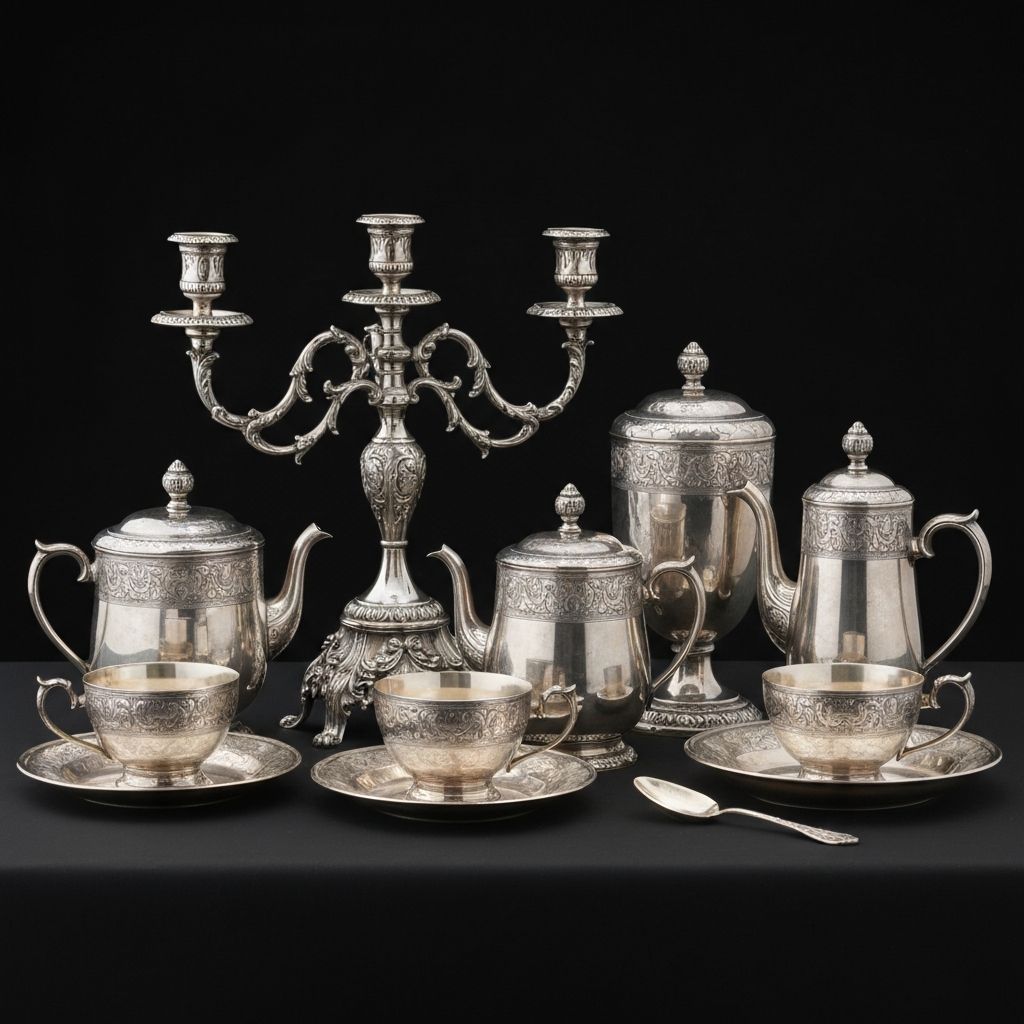
You are holding a beautiful silver cream jug. The base carries a cluster of tiny stamped symbols, and somewhere in that cluster is a small cartouche you have never seen before: two initials inside a shield outline, perhaps with a tiny pictogram beneath them. That stamp is a maker's mark, and it is a fundamentally different thing from the hallmarks beside it. The hallmarks confirm the silver is genuine and tell you its fineness. The maker's mark tells you who sat down at a bench and made this object by hand. Identifying that silversmith can transform your piece from a pleasant antique into a documented work by a named craftsman, with everything that implies for provenance, academic interest, and market value. This guide explains the complete method for silver maker's mark identification, from reading the cartouche shape to using online reference databases and AI tools.
Maker's Mark vs. Hallmark: Understanding the Difference
The confusion between maker's marks and hallmarks is one of the most common errors in amateur silver research, and it costs collectors real money. The two types of stamp serve entirely different purposes, are applied by different parties, and require different reference resources to interpret.
A hallmark is applied by an independent assay office after testing the metal for purity. In Britain, the assay office stamps a purity mark (the lion passant for sterling silver at 92.5%), a town mark identifying which assay office tested the piece, a date letter showing the year of assay, and sometimes additional marks such as the sovereign's head duty mark or the Britannia mark for higher-grade silver. The hallmark answers the question: what is this object made of, and when was it officially verified?
A maker's mark is applied by the silversmith or workshop before the piece goes to the assay office. It is the craftsman's personal registration stamp, typically comprising initials and sometimes a small pictorial device inside a shaped cartouche. The maker's mark answers the question: who made this?
The core distinction: Hallmarks tell you WHAT the silver is. Maker's marks tell you WHO made it. The research processes, reference books, and databases for each are almost entirely separate. Searching a purity mark database will not help you find a silversmith, and vice versa.
On a well-preserved British piece you will typically find both sets of marks side by side. On Continental European silver the arrangement differs by country, but the same principle holds: the assay or guarantee mark (confirming fineness) is distinct from the silversmith's personal cartouche. On some early American silver, particularly coin silver from before 1868, there may be no official hallmarks at all, and the maker's mark is the only documentary stamp present.
A further complication is that the hallmark-plus-maker's-mark system was not universal, consistent, or continuous. Wars, revolutions, changes in guild regulations, and varying local enforcement meant that pieces from certain places and periods carry only a maker's mark, only a fineness mark, or neither. Understanding this background is essential before you begin looking anything up. For a full treatment of purity marks, date letters, and assay office stamps, see our companion article on silver hallmark identification from a photo. This article focuses exclusively on the maker's mark.
How to Read a Maker's Mark Cartouche
Every maker's mark has three readable components: the cartouche shape (the outline frame), the initials inside, and sometimes an accompanying device (a small pictogram, symbol, or tool). Each component contributes information.
The Cartouche Shape
The outline of the cartouche frame is the first clue about origin and period. British silversmiths registered their marks at one of the assay offices, and the shape of the cartouche they chose was regulated or at least conventionally standardised in certain periods. A shaped shield (the heraldic escutcheon) is the most common British form. An elongated oval or ellipse is typical of French and Belgian work from the 17th through 19th centuries. A rectangle with cut corners, known as a clipped rectangle, was widely used in the Germanic states and Scandinavia. A lozenge (diamond) shape often indicates a female silversmith, following a convention in several countries where women registered marks in this shape to distinguish their work. A round or circular cartouche appears on Dutch and some Scandinavian pieces.
The internal border of the cartouche also matters. A plain line is the simplest; a serrated or beaded border is common on later British and American work; a double line was used in some Belgian and Dutch registers.
The Initials
Maker's marks used initials rather than full names for the same reason that medieval stonemasons used mason's marks: brevity on a small stamp. The number of initials gives information about the workshop structure.
- A single letter usually indicates a sole practitioner using only their surname initial, or a workshop name abbreviated to one character. More common in early periods before guild regulations became stricter.
- Two initials, the most common format, typically represent either first-name and surname initials of a sole silversmith (e.g., "P L" for Paul de Lamerie) or the combined initials of a partnership (e.g., "B & C" for a firm with two partners).
- Three initials were used for both three-person partnerships and for sole silversmiths who registered all three of their names, sometimes to avoid confusion with another smith with the same two initials.
- Four initials or more indicate a company mark, particularly common in the 19th century as silversmithing became industrialised. Firms like Elkington & Co. or George Jenkinson registered multi-initial marks.
The typeface of the initials also varies deliberately. Roman capitals, italic script, Gothic or blackletter, and even decorative typefaces were all used. Changes in typeface were sometimes used by the same silversmith when re-registering a mark after a workshop move or a change in partnership.
The Device or Pictogram
Many maker's marks include a small pictorial device in addition to the initials. This device served as an additional identifier for illiterate customers or for rapid recognition in the assay office register. Common devices include anchors, stars, crescents, hands, hearts, crowns, tools of the trade (a hammer, a tongs, a set of scales), animals, and heraldic symbols. The device is often the most distinctive and searchable part of the mark once the initials have proved too common to narrow the field.
British Maker's Marks: The London Goldsmiths' Hall Register and Beyond
Britain has the most thoroughly documented silversmithing tradition of any country, largely because the Goldsmiths' Company in London required silversmiths to register their marks at Goldsmiths' Hall from 1363 onward, with increasingly systematic record-keeping from the late 17th century. The register is not freely available online in its complete form, but substantial portions have been published, and the Goldsmiths' Hall in London offers research services for serious enquiries.
The landmark reference work for British silver is Sir Charles James Jackson's "English Goldsmiths and Their Marks," first published in 1905 and revised in later editions. Jackson catalogued thousands of London makers' marks with their cartouche shapes, initials, and, crucially, the dates of registration. A piece whose maker's mark matches a Jackson entry can often be dated to within a decade or two on the basis of the mark alone, before even consulting the date letter.
London vs. Provincial Marks
London silver is the best documented, but provincial British centres had their own assay offices and their own maker registers. Birmingham, Chester, Edinburgh, Newcastle, Norwich, Exeter, and Dublin all operated active silversmithing trades with locally registered makers. Sheffield operated a separate assay office from 1773, becoming particularly important for cutlery and flatware. The marks from these provincial centres are documented in specialist publications and in the databases listed later in this article.
One point that trips up many researchers: a London assay mark does not mean a London silversmith. Silversmiths in provincial towns and even in Scotland sometimes sent their work to London for assay if their local office was inconvenient or if they were producing work for a London retailer. The maker's mark reveals who made it; the assay office mark reveals where it was tested.
Partnership Marks and Succession Marks
When a silversmith took on a partner or sold the workshop, the registration changed and a new mark was struck. This creates a documentary trail that can be followed. A piece bearing "I W" in an oval might be the work of the sole practitioner John Wakelin; a piece bearing "W & T" might be the partnership of Wakelin and Taylor that succeeded him. The sequences of registrations at Goldsmiths' Hall allow researchers to place pieces in specific windows of time even when the date letter is worn or ambiguous.
Women silversmiths are particularly interesting in this context. Hester Bateman registered her own mark at Goldsmiths' Hall in 1761 and became one of the most prolific silversmiths of the Georgian period. Her mark "H B" in an oval cartouche is now one of the most recognised in British silver and, correspondingly, one of the most frequently forged. When a piece purports to be by Bateman, extra scrutiny of the cartouche proportions, the style of the initials, and the coherence of the surrounding hallmarks is essential.
Belgian and Dutch Maker's Marks
The Low Countries have a silversmithing tradition that predates the major British regulatory framework. Antwerp was already producing documented plate in the 15th century, and the Antwerp guild (the St. Eligius guild, patron saint of metalworkers) maintained register books that survive in the Felixarchief in Antwerp. These records cover silversmiths active from the late medieval period through the guild's dissolution under French revolutionary rule in the 1790s.
Antwerpse Zilversmeden
Antwerp maker's marks from the guild period typically appear in an oval or shaped cartouche and contain the silversmith's initials alongside a personal device. The Antwerp city mark (a hand, the "handken") appears as a separate stamp, confirming the piece was tested and registered in Antwerp. A piece carrying both an Antwerp city mark and a clearly legible maker's mark cartouche can often be identified to a specific silversmith and date window using the Felixarchief records or the published studies by Micheline Soenen and other Flemish silver historians.
After the French annexation and through the Dutch United Kingdom period (1815-1830), Belgian silversmiths operated under a modified French guarantee system. Maker's marks from this transitional period show a mixture of older guild-style cartouches and the new French-influenced crowned oval format.
Dutch Maker's Marks and VOC-Era Silver
Dutch silver from the 17th and 18th centuries represents some of the most collectable European plate. The major centres were Amsterdam, Haarlem, Utrecht, and Delft, each with its own assay office and maker register. Dutch maker's marks appear in a variety of cartouche shapes, but the elongated oval and the circle are particularly common.
VOC-era silver (pieces made for or associated with the Dutch East India Company, 1602-1799) is a specialist collecting field. Not all silver from this period is strictly VOC silver, but pieces bearing Dutch maker's marks alongside colonial provenance or stylistic elements suggesting East Indies use attract serious attention from specialist collectors and auction houses including Sotheby's Amsterdam.
The published reference for Dutch maker's marks is "Nederlandse Zilvermerken 1814-1953" by G.W. Frederiks, covering the period of national standardisation. For earlier periods, the relevant municipal archives and the Rijksmuseum's documentation department are the primary resources.
French Maker's Marks: Poincon de Maitre, Lettre de Charge, and the Revolution
The French system of silversmithing marks is among the most complex and best documented in Europe, and it changed dramatically as a result of the Revolution of 1789. Understanding whether a French piece predates or postdates the Revolution is the essential first step in French maker's mark research.
Pre-Revolutionary French Marks
Under the Ancien Regime, French silversmiths were organised into guilds (the corporation des orfevres) regulated by royal decree. A silversmith registered a poincon de maitre (master's mark) with the local guild on qualifying as a master craftsman. This mark consisted of a crowned cartouche containing two letters (usually initials) and a small device, such as a fleur-de-lis, a cross, a bird, or a tool. The crown above the cartouche is the definitive visual signature of a pre-Revolutionary French maker's mark.
Alongside the maker's mark, pre-Revolutionary French silver carries a lettre de charge (a charge mark applied by the fermier general, the tax farmer who collected the duty on new silver) and a decharge mark applied on release from the assay inspection. These tax administration marks are often the most visually prominent on the piece but carry no information about who made it. The maker's mark is the smaller, crowned cartouche nearby.
The standard reference for pre-Revolutionary French marks is Henri Nocq's "Le Poincon de Paris" in five volumes, covering Parisian makers from the late medieval period through 1789. This remains the authoritative source for identifying a poincon de maitre from the Ancien Regime.
Revolutionary Obliteration and Post-Revolutionary Marks
In 1797, the new French republic abolished the guild system and with it the old mark structure. Old maker's marks were officially cancelled by being struck with an obliteration punch, producing the characteristic hatched oval or lozenge overprint that appears on many French pieces from this period. This obliteration mark is not a defacement in the negative sense; it is itself a historical document recording the moment of legal change, and it does not reduce the piece's interest for researchers.
From 1797, a new national system of guarantee marks replaced the guild structure. Silversmiths now registered with a central authority and used marks whose format was standardised nationally. The poincon de maitre survived as a concept but changed in appearance: the crown disappeared, the cartouche shape became more regular, and the initials were accompanied by a lozenge or other standardised border. Post-1797 French maker's marks are covered by Tardy's "Les Poincons de Garantie Internationaux pour l'Argent," a comprehensive reference that also covers other Continental systems.
German and Austro-Hungarian Maker's Marks
German-speaking Europe produced some of the most technically accomplished silversmithing of the Renaissance and Baroque periods, centred above all on Augsburg and Nuremberg. Both cities maintained guild registers that have been extensively studied and published.
Augsburg Workshop Marks
Augsburg silversmiths used a maker's mark system that ran in parallel with the city's pineapple mark (the Pyr, confirming assay) and a date letter. The maker's mark was registered with the city's goldsmiths' guild and typically appeared in a shaped cartouche with initials and sometimes a small device. Augsburg silver from the 17th and 18th centuries is catalogued in Helmut Seling's "Die Kunst der Augsburger Goldschmiede 1529-1868," a three-volume reference work that is the standard tool for Augsburg maker identification.
The Augsburg system is notable because the city's silver was exported widely across Europe, and Augsburg pieces appear regularly in British, French, and Scandinavian collections. When a piece carries the Augsburg pineapple alongside an unidentified cartouche, Seling is the first stop.
Nuremberg, Vienna, and the Habsburg Lands
Nuremberg maintained its own guild register distinct from Augsburg, and the characteristic N mark appears on Nuremberg silver alongside the maker's cartouche. Vienna became increasingly important from the 18th century onward, and under the Habsburg empire a centralised mark system was introduced covering all the imperial lands. The Viennese system used a date letter alongside maker's marks registered with the Vienna guild, and from 1866 a national guarantee mark (the Austrian guarantee punch) standardised the purity certification across the empire.
Austrian and Bohemian maker's marks from the 19th century, including those from Prague, Budapest, and Bratislava workshops, are covered in the reference "Prager Goldschmiedezeichen" by Emanuel Poche and the broader Austro-Hungarian coverage in the Rosenberg "Der Goldschmiede Merkzeichen" series, which remains the most comprehensive catalogue of Germanic maker's marks despite being published in the early 20th century.
American Maker's Marks: Coin Silver, the Sterling Transition, and the Great Firms
American silver presents a markedly different research challenge from European plate. The United States had no national assay system in the European sense. Before the adoption of the sterling standard (formally established by federal law in 1868, though used by some manufacturers earlier), American silversmiths worked in coin silver, melting down currency to use as their raw material. The resulting pieces typically carry only the maker's mark and sometimes a quality designation such as "COIN," "C," "PURE COIN," or "STANDARD."
Coin Silver Marks
Coin silver is approximately 89 to 90% pure silver, slightly below the British sterling standard of 92.5%. A piece marked only with initials and "COIN" is not defective silver; it is American silver made in the pre-standardisation tradition. Identifying the maker requires searching regional directories and silversmithing histories, since there was no centralised national register. Dorothy Rainwater's "Encyclopedia of American Silver Manufacturers" and the companion "American Silver" by Kathryn Buhler (published by the Museum of Fine Arts Boston) are the standard printed references.
Gorham, Reed and Barton, Tiffany, and the Major Firms
After 1868 and the adoption of the sterling standard, American silver enters a better-documented period. The major manufacturing firms each developed distinctive maker's marks that became well known. Gorham Manufacturing Company of Providence, Rhode Island, used a lion passant, an anchor, and a Gothic G as its house mark from 1868, directly echoing the British hallmarking vocabulary to signal quality to buyers accustomed to British silver. Reed and Barton of Taunton, Massachusetts, used "R & B" or the Britannia figure mark depending on the period. Tiffany and Company of New York used "T & Co." alongside the sterling mark.
Pieces by these firms are not difficult to identify once you know the marks. The challenge with American silver is usually the opposite: identifying a smaller regional maker whose work carried only plain initials stamped in a simple rectangle, with no additional quality or town mark to anchor the research.
The Silver Collector Society and various American regional silver studies have produced maker directories covering the southern states, New England, the mid-Atlantic, and later the Midwest. Bonhams' specialist silver catalogues also regularly provide maker documentation on American pieces sold at auction, providing useful comparative material.
Key Reference Databases for Maker's Mark Research Online
Online resources have transformed silver maker's mark identification over the past two decades. The following databases are reliable, actively maintained, and cover the major collecting areas.
ASCAS (Association of Small Collectors of Antique Silver)
ASCAS maintains a freely searchable database of silver marks organised by country, period, and mark type. The site is particularly strong on British marks and has solid coverage of Continental European national systems. The search interface allows filtering by cartouche shape and initial, which is useful when you have a partial reading of the mark. ASCAS also hosts a community forum where members with specialist knowledge discuss difficult identifications.
925-1000.com
The website 925-1000.com covers global silver marks with particular strength in the post-1800 period. It is organised by country and includes both purity marks and maker's marks, with visual examples of cartouche shapes. The Continental European coverage, including Scandinavian, Russian, and Eastern European marks, is broader here than on ASCAS.
Online Encyclopedia of Silver Marks
The Online Encyclopedia of Silver Marks focuses on providing visual reference images alongside textual descriptions. For maker's marks where the cartouche shape is distinctive but the initials are worn, the visual matching function is particularly useful. Coverage is strongest for British and American material.
Goldsmiths' Hall, London
The Goldsmiths' Company maintains a research service at Goldsmiths' Hall in the City of London. While their full register is not publicly searchable online, they respond to enquiries about specific marks and can provide authoritative attribution for British maker's marks. For pieces of significant value, a formal enquiry to Goldsmiths' Hall is worth the effort.
Catawiki and Auction House Catalogues
Online auction platforms including Catawiki provide a searchable archive of sold lots, each catalogued with mark descriptions. Searching a description of your cartouche shape and initials in Catawiki's search bar will often surface comparable pieces that have been professionally catalogued, providing both identification and a market value reference point. Major auction house online archives (Christie's, Sotheby's, Bonhams) similarly function as working reference libraries for silver researchers.
Felixarchief Antwerp and Municipal Archives
For Belgian silver, the Felixarchief in Antwerp is the primary archive. Researchers can submit queries and access digitised pages from the guild registers. Dutch municipal archives (particularly the Amsterdam Stadsarchief and the Utrecht Archief) hold comparable records for their respective silversmithing traditions.
How to Photograph a Maker's Mark for Online Identification
No database query and no AI tool can work accurately from a poor photograph. The quality of your image is the single most important factor in successful online identification, and it is entirely within your control.
Raking Light: The Essential Technique
Silver marks are shallow impressed stamps. The character of the impression, the cartouche outline, the letter forms, and the device are all defined by the relief of the stamp, not by any colour difference with the surrounding metal. To make the relief visible in a photograph, you need raking light: a single light source positioned at a very low angle to the metal surface, almost grazing it. This creates long shadows across even minute ridges and depressions, making the stamp legible.
The practical setup: place your piece on a dark (ideally black or very dark grey) non-reflective surface. Use a single lamp, a window with directional light, or your phone's torch function. Position the light source so it comes from one side at roughly ten to twenty degrees above the horizontal. The marks will emerge dramatically. Experiment with the angle: rotate the light through ninety degrees to find the position that gives the clearest read of the cartouche.
Scale Reference and Focus
Silver maker's marks are typically two to eight millimetres across. At this scale, a photograph without a scale reference is almost useless for remote identification, because the proportions of the cartouche and the letter sizes are diagnostic. Place a ruler, a coin of known size, or a matchstick head alongside the marks before photographing. Focus carefully: the mark needs to be sharp edge to edge, not just in the centre. On a smartphone, tap the screen over the mark to lock focus before shooting.
Multiple Angles and Context Shots
Take at least three photographs of the mark area: one straight on at maximum detail, one at a slight angle to show cartouche depth, and one showing the full base or underside of the piece with all marks visible in context. The arrangement of multiple marks relative to each other is itself informative, since different national systems placed maker's marks and assay marks in consistent relative positions.
What to Look for Before You Photograph
Silver marks are often obscured by tarnish, dirt in the recesses, and polishing residue. A very gentle clean of just the mark area with a soft toothbrush and warm water (no silver polish on the marks themselves, as repeated polishing can destroy them) before photographing will improve legibility significantly. Do not use chemical dip cleaners on marks, as these can dissolve the fine edges of the impression.
Using AntiqBot's SilverCheck to Identify Maker's Marks from Photos
AntiqBot's SilverCheck module is built specifically around the challenge of identifying silver marks from uploaded photographs. The module cross-references the known reference databases for maker's marks, including the ASCAS register, 925-1000.com data, the Online Encyclopedia of Silver Marks, and the Goldsmiths' Hall reference corpus, and applies AI pattern recognition to cartouche shape and initial matching.
The process is straightforward. Upload a photograph taken using the raking-light technique described above. SilverCheck analyses the image for mark locations, identifies cartouche shapes, reads or estimates the initials, and matches the combination against known patterns. The output includes a list of candidate makers ranked by confidence, the country and period of origin implied by the cartouche format, and a link to the relevant reference database entry where one exists.
Crucially, SilverCheck distinguishes between maker's marks and hallmarks in its output. If your piece carries both, the module reports them separately, so you are not left trying to figure out whether the initials you see belong to the silversmith or to the assay office. This is the distinction that manual research databases frequently obscure: they often present all marks together, leaving the researcher to sort out which is which.
The module also handles worn or partially legible marks better than a text search in a conventional database. When only part of the cartouche is visible, a visual pattern match against thousands of catalogued examples is more effective than trying to search by incomplete initials.
Identify Your Silver Maker's Mark with SilverCheck
Upload a photo and get a ranked list of candidate silversmiths, the cartouche type, country of origin, and reference database links, all in one result. Sign up and get 1 free credit for your first analysis. After that, buy credit packs starting from €0.60 per analysis.
Analyse Your Silver NowWhy a Maker's Mark Matters for Valuation
The difference in value between an anonymous piece and a documented piece by a named silversmith can be extreme. Understanding this gap is important both for buying intelligently and for knowing when to invest in thorough research.
The Premium for Named Silversmiths
Consider a Georgian silver sauce boat in good condition. Bearing only a clear sterling hallmark with no legible maker's mark, it sells at a provincial auction for perhaps 200 to 400 euros, valued essentially on its silver weight plus a modest premium for age and quality. The same sauce boat, with a clearly identified maker's mark attributing it to a documented London silversmith of note, might sell at Christie's or Sotheby's for ten to twenty times that amount. The object has not changed; the documentation has.
The premium is not arbitrary. A named maker's mark provides three things that anonymous silver cannot: art-historical context (the piece can be placed in a specific workshop tradition and compared with other known works), provenance that satisfies serious collectors and institutions, and a known quantity for future scholarship. Major silver collectors at the level of TEFAF or the major auction houses are buying documented objects, not just metal.
Specific Makers and Their Market Impact
Certain names command consistent premiums that are well established in the market:
- Paul de Lamerie (1688-1751): The greatest British silversmith of the Rococo period. Any authenticated piece bearing his mark will attract intense competition at auction. His work is in the collections of the Victoria and Albert Museum, the Ashmolean, and major American museums.
- Hester Bateman (1708-1794): The pre-eminent female silversmith of the 18th century. Her mark "H B" in an oval is one of the most recognised in British silver and commands a significant premium over comparable anonymous work. As noted, it is also one of the most forged, making authentication critical.
- Paul Storr (1771-1844): The leading British Regency silversmith, whose work for Rundell, Bridge and Rundell placed his output in royal commissions and the grandest aristocratic dining rooms. Storr pieces appear regularly at Christie's and Sotheby's with six-figure estimates.
- Niclaes Loockemans and other Antwerp Masters: For Belgian silver, documented Antwerp guild masters whose names appear in the Felixarchief register attract specialist collector interest at Belgian auction houses including Bernaerts.
- Johannes Schiotling and other Amsterdam masters: Dutch 17th-century silver from documented makers in the Frederiks reference attracts serious attention in specialist Dutch and international sales.
The Research Decision
Knowing whether your piece has a legible maker's mark is therefore not an academic exercise. If the mark can be read and attributed, professional valuation, specialist auction placement, and potentially significant returns become realistic options. If the mark is too worn to read, a professional conservator or silver specialist may be able to improve legibility using techniques not available to the amateur researcher. The question "who made this?" is often also the question "what is this worth?" For more on how attribution affects pricing, see our article on appraisal value vs. market value for antiques.
Fakes, Transpositions, and Spurious Marks
The premium commanded by certain maker's marks also drives forgery. There are broadly three types of fraudulent marks to be aware of.
Entirely fake marks are stamps cut to imitate a prestigious maker's cartouche and struck on a piece that the silversmith in question never touched. These are caught by examining the quality of the strike (depth, sharpness, surrounding metal distortion), the consistency of style between the mark and the object, and by cross-referencing with known authenticated examples.
Transposed marks are genuine marks that have been removed from one piece, usually a small or damaged one, and let into a larger piece of greater value. This practice was common enough in the 19th century that the Goldsmiths' Company eventually took active steps to prevent it. The tell is a let-in cartouche: a small rectangular or shaped panel of metal, visually distinct from the surrounding surface, containing the marks. Legitimate assay marks are struck directly into the base metal without any such let-in panel.
Re-struck or enhanced marks occur when a worn mark has been re-struck with a similar punch to improve legibility, either innocently by a restorer or fraudulently to make a lesser mark resemble a prestigious one. Comparing the depth of the maker's mark against the depth of the surrounding hallmarks (which were all struck at the same time and should show comparable wear) is a basic check.
Frequently Asked Questions
What is the difference between a maker's mark and a hallmark on silver?
A hallmark confirms the metal's purity and the assay office that tested it. A maker's mark identifies the specific silversmith or workshop that produced the piece. They are different stamps, often appearing side by side. Hallmarks answer WHAT the silver is; maker's marks answer WHO made it. The research processes and reference resources for each are almost entirely separate.
How do I identify a silversmith's maker's mark from a photo?
Photograph the mark under raking light on a dark background, include a scale reference, and then search the cartouche shape and initials in reference databases such as ASCAS, 925-1000.com, or the Online Encyclopedia of Silver Marks. AntiqBot's SilverCheck module can also analyse the photo directly and cross-reference known silversmith registers, providing ranked candidate matches from a single uploaded image.
What does a cartouche shape tell me about a maker's mark?
The outline frame of a maker's mark carries real information. A shield or heraldic escutcheon is typical of British work. An oval is common in French and Belgian silver. A rectangle with clipped corners appears on Germanic and Scandinavian pieces. A lozenge or diamond shape often indicates a female silversmith. Combined with the initials inside, the cartouche shape is usually enough to narrow the national origin and broad period before beginning database research.
Where can I look up antique silver maker's marks online for free?
The main free resources are ASCAS, 925-1000.com, and the Online Encyclopedia of Silver Marks. For British marks, the Goldsmiths' Hall in London offers research services. For Belgian material, the Felixarchief in Antwerp holds the guild registers. AntiqBot's SilverCheck provides AI-assisted analysis cross-referencing these sources from a single uploaded photo, with 1 free credit on signup.
Does a named silversmith's maker's mark increase the value of a piece?
Significantly, yes. A piece by a documented London silversmith such as Paul de Lamerie or Paul Storr commands multiples of what the same object would fetch anonymously. The same is true for named Belgian Antwerp guild masters or documented Dutch 17th-century silversmiths. A maker's mark that can be attributed transforms the piece from metal and craftsmanship into an art-historical document with full auction house appeal.
What is a poincon de maitre on French silver?
A poincon de maitre is the French maker's mark registered by a silversmith with the local guild on achieving master status. It appears in a cartouche containing two initials and a personal device, and is identified by the crown above the cartouche, which is the definitive visual signature of a pre-Revolutionary French maker's mark. After 1797, the crown disappeared and a standardised national format replaced the guild system. The standard reference is Henri Nocq's "Le Poincon de Paris."