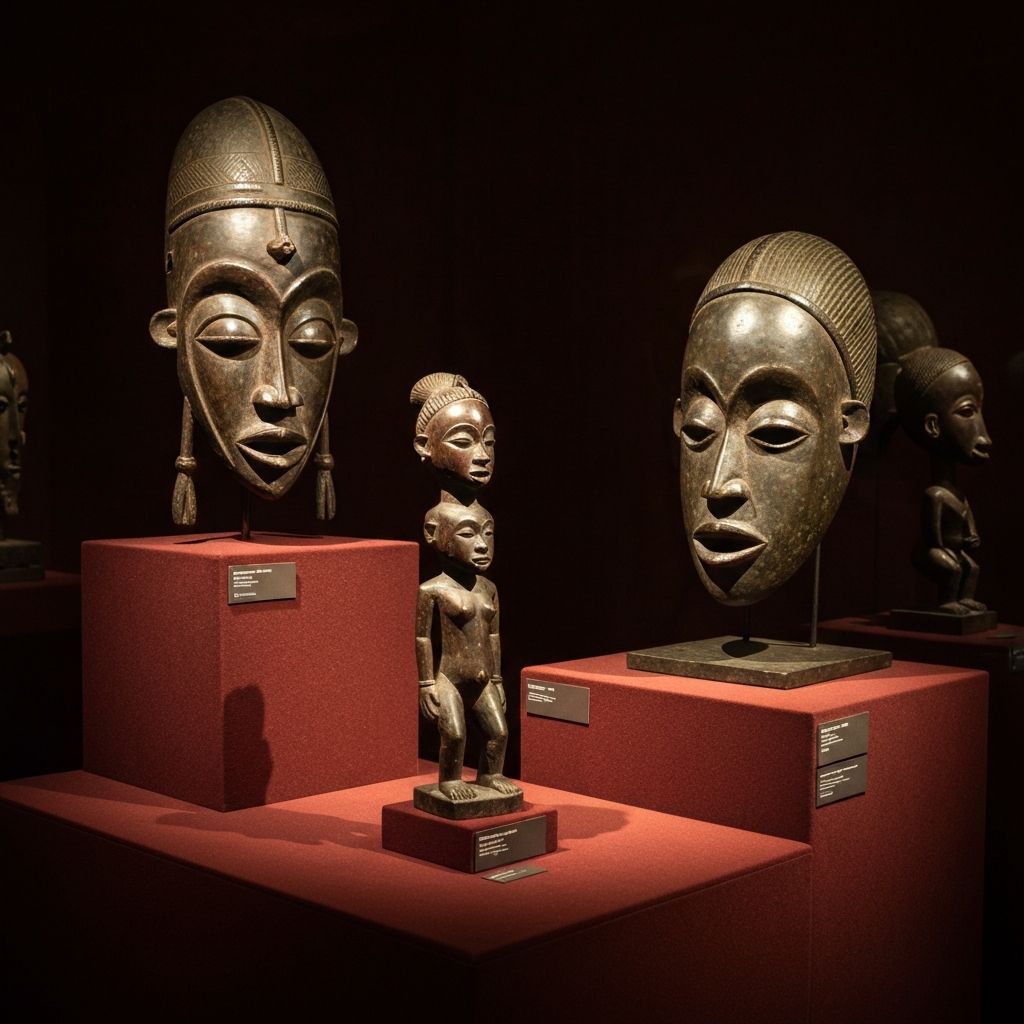
African Art Authentication Guide: How to Identify Genuine Tribal Objects
When a single Fang reliquary head sold at Christie's Paris for more than EUR 5 million, it confirmed what specialist dealers have known for decades: authentic African art is among the most consequential collecting categories in the world. The problem is that for every object of that calibre, tens of thousands of tourist-grade pieces and deliberate fakes circulate through flea markets, online platforms, and well-meaning estate sales. This guide gives you the analytical framework used by professional authenticators and by AntiqBot's AfroCheck module to distinguish genuine ritual objects from skilled reproductions.
The Spectrum: From Airport Art to Ceremonial Object
Not every piece of African carving is a forgery. The market operates along a spectrum with four broadly distinguishable tiers, and understanding where an object sits is the first step in any serious assessment.
Airport art and tourist production occupies the bottom of the spectrum. These are objects made for sale to visitors, typically in the 1960s through the present. They are carved with metal tools, often power tools, from non-traditional wood species. Surfaces are finished with sandpaper, commercial stains, or shoe polish. They are designed to look "African" rather than to function within a specific cultural context. They have monetary value as craft objects, but none as ethnographic artefacts.
Workshop production pieces are more dangerous because they are harder to dismiss at a glance. These are objects made by skilled carvers who know the iconographic vocabulary of the tradition they are imitating. Many are produced in West and Central African cities specifically for the export market. The carving quality can be excellent. What they lack is context: no ceremonial use, no accumulated patina from handling, no residue from ritual application of substances. A sharp-eyed specialist will notice that the wear pattern does not correspond to how the object would have been used.
Old production pieces (sometimes called "old tourist art" or "early commercial production") occupy a genuinely ambiguous middle zone. These are objects made for sale, often as early as the colonial era, that have since accumulated decades of patina from storage conditions, handling, and exposure. A Baule figure made for a Belgian colonial official in 1935 is not a ceremonial object, but it is genuinely old. Its patina is real. Its wood is properly aged. Auction houses including Bonhams and Catawiki regularly sell such pieces with honest attributions that acknowledge their commercial origin while noting their age.
Genuine ritual objects with use patina are what serious collectors seek. These are pieces that functioned within their original cultural context: masks worn at initiation ceremonies, ancestor figures that received regular offerings of palm oil and kaolin, power objects (nkisi) charged with medicines. Their authentication rests on reading the accumulated evidence of actual use, which cannot be fully replicated by artificial aging techniques.
The Belgian market has particular depth in this category. Decades of colonial connection between Belgium and the Congo (today the Democratic Republic of Congo) means that many of the finest Kongo, Luba, and Kuba objects that left Central Africa in the late 19th and early 20th centuries passed through Belgian hands and remain in Belgian collections. The RMCA (Royal Museum for Central Africa, Tervuren) holds one of the world's largest and best-documented collections of Central African material culture, and its publications are essential reference tools for any serious authenticator.
Reading Patina: The Most Important Authentication Signal
Patina is the accumulated physical and chemical evidence of an object's history. On African art, it is the single most informative authentication signal, and it is also the most frequently faked. Learning to distinguish natural use patina from artificially induced aging is a skill that takes years to develop with physical objects in hand, but the underlying logic can be understood analytically.
Natural Use Patina
Genuine use patina on African objects is the product of specific human interactions and specific tropical storage environments. It accumulates unevenly, following the logic of use rather than the logic of aesthetics.
Encrustation and substance accumulation. Ritual objects were regularly treated with substances: palm oil, kaolin (white clay), ochre, camwood (red powder), blood, millet porridge, and various resins. These accumulate in recessed areas, in carved interstices, around the base where the object sat on a surface, and along the lower portions of vertical objects. Genuine encrustation is stratified: multiple layers applied over years, bonded into the wood grain, sometimes with insect frass incorporated into the matrix. It cannot be scraped off cleanly. Under magnification, it shows distinct layers and irregular distribution.
Handling wear patterns. A mask worn at ceremonies will show specific wear: the inside surface polished smooth from contact with the wearer's face and hair; the exterior worn along the ridges that protrude furthest; the attachment holes for raffia or fibre frayed and enlarged from use. A carrying figure will be worn on the sides and base from being held, with protected areas in deep relief retaining original surface texture. The wear pattern must be consistent with the object's function. A figure that shows uniform wear across all surfaces was either sanded or tumbled.
Insect damage consistent with tropical storage. Wood-boring beetles are a constant presence in tropical environments. Their exit holes (small, circular, 1 to 3 mm diameter) and subsurface galleries are characteristic of objects stored in African conditions. The galleries run with the grain. On old objects, insect damage is typically old: exit holes are darkened and the wood around them is stable. Recent insect damage (light-coloured wood visible at the edges) on an object claimed to be 60 years old is a red flag. Conversely, the absence of any insect activity on a very old claimed object from a tropical region is also suspicious.
Wood shrinkage and cracking. Tropical hardwoods, particularly those used traditionally in West and Central Africa, move significantly as they age and as moisture content changes. Old objects show cracks that run with the grain, that are stable (no fresh wood visible at the edges), and that have darkened interiors. The cracking pattern follows the internal structure of the wood. Random cracking that does not follow grain direction suggests forced aging.
Artificial Aging: How to Spot Each Technique
Artificial aging of African art is a well-developed craft. The most common techniques each leave distinctive traces.
Soot and smoke coating is the oldest and most widespread technique. An object is exposed to smoke or cooking fire to create a dark surface. Genuine smoke patina from years of proximity to a hearth penetrates the wood surface; it is absorbed rather than sitting on top. Fake smoke coating sits in the surface layer, can be rubbed off on a cloth, and often shows an unnaturally uniform distribution. It also tends to obscure fine carving detail rather than accumulate preferentially in recesses. The smell of fresh smoke or carbon on a piece claimed to be decades old is a clear warning.
Shoe polish and wax products create a surface sheen that mimics handled patina. The giveaway is in the texture: genuine handling patina is absorbed into the wood grain and creates a micro-smooth surface under magnification. Wax sits on top, fills pores uniformly, and can be detected by rubbing with a white cloth. It also tends to collect in recesses in a way that genuine patina does not: genuine patina thins out in recesses because hands cannot reach them, while wax accumulates wherever it was applied.
Forced cracking through rapid drying, soaking cycles, or heat produces cracks that cross grain lines and show fresh, light-coloured wood interiors. Genuine aging cracks run with the grain and have darkened interior surfaces from years of oxidation.
Chemical treatments including potassium permanganate, dilute acids, and commercial wood-darkening agents create surface oxidation that can closely resemble natural aging. The tell is distribution: chemical treatments are applied by brush or immersion and tend to be more uniform than natural patina. Under raking light, chemical treatments often show brush marks or tide lines. On objects with complex relief carving, chemical agents will reach all surfaces; genuine use patina will not.
Sandblasting and wire brushing are used to create apparent wood erosion similar to what occurs in dry storage or open air exposure. The resulting surface texture is mechanically regular in a way that natural weathering is not. Genuine weathering emphasizes the differential hardness between annual rings; mechanical abrasion treats all wood uniformly.
Major African Art Traditions and Their Characteristic Markers
Broad authentication principles apply across all African art, but each major tradition has specific markers that specialists use to assess authenticity and regional origin. The following covers the five traditions most frequently encountered at Belgian auction houses and in European collections.
Kongo and DRC Region: Nkisi Figures and Power Objects
The Kongo-speaking peoples of the lower Congo River basin produced some of the most powerful objects in the African art canon. The nkisi (plural minkisi) are ritual power objects animated by a specialist (nganga) through the incorporation of medicines (bilongo) within or attached to the figure.
The most famous form is the nkisi nkondi (nail fetish), a standing figure into which iron blades, nails, and metal objects are driven to activate the object's power. Authentic examples show iron objects of diverse types and ages, with genuine oxidation that varies between pieces, suggesting incremental accumulation over time. The wood shows compression and splitting around the metal insertions from the force of driving. Machine-cut nails applied to a reproduction will show uniform rust and will sit cleanly in pre-drilled holes without the surrounding wood distortion that comes from being hammered in.
The bilongo cavity is a critical authentication marker. In genuine examples, the abdominal cavity or the horn affixed to the head will show residue from its contents: resins, clays, organic matter, sometimes feathers or cloth remnants. The material inside will have bonded with the wood over years. A reproduction bilongo cavity is typically empty, lined with clean wood, or packed with obviously recent material.
Kaolin (white clay) residue is characteristic of Kongo ritual use. It appears as white deposits in recessed areas, around the face (particularly the eyes), and on the base. Genuine kaolin residue is integrated into the surface and may show multiple application layers. Applied chalk or white paint sits differently on the surface and lacks the clay-mineral structure of genuine kaolin.
Raffia traces on attachment points and around the waist or neck of nkisi figures indicate genuine use. Old raffia is fragile, darkened, and often partially missing. New raffia, or the obvious absence of any fibre attachment despite clear attachment points, requires explanation.
Yoruba and Nigeria: Gelede Masks and Ibeji Figures
Yoruba art from southwestern Nigeria and Benin Republic is among the most extensively documented and collected of all African art traditions. Two categories are most frequently encountered: the Gelede masquerade headdress and the ere ibeji (twin figures).
Gelede headdresses are worn horizontally on top of the head during masquerade performances. Genuine examples show abrasion and wear on the flat underside from contact with the performer's head. The surface superstructure (which varies enormously, from figural groups to animals to scenes of daily life) will show wear commensurate with age on the highest relief areas. Indigo dye traces in cloth attachments or painted areas are a Yoruba-specific marker: the deep blue-black of genuine aged indigo differs from commercial paint in texture and in how it sits in carved interstices.
Ere ibeji figures are carved when one of a pair of twins dies, to house the deceased twin's soul. They are intensely personal objects that accumulate a very specific patina from regular handling: anointing with camwood paste (producing a deep red-brown stain), palm oil, and other substances applied by the surviving twin or the mother. Genuine ibeji figures show heavy, stratified encrustation concentrated on the head and upper body (where anointing is concentrated), with the face often rendered indistinct by accumulated pigment. The carving vocabulary is highly regional: different Yoruba towns and carving lineages have identifiable stylistic signatures that specialists can use to pinpoint origin.
The Yoruba carving tradition also shows a characteristic tool vocabulary. Adze marks on the back and underside of heads are diagnostic: genuine Yoruba carving shows specific adze stroke patterns that differ from both European carving tools and from the machine-finishing of reproductions.
Bamana and Mali: Chi Wara and Komo Masks
The Bamana people of Mali produced two of the most iconic forms in West African art: the Chi Wara antelope headdress and the Komo power helmet mask.
Chi Wara headdresses are worn in pairs (male and female) during agricultural ceremonies celebrating the mythical antelope that taught humans to farm. Genuine examples show specific wear from being attached to a woven basketry cap for wearing: the base will show compression, fibre residue, and wear from the attachment method. The iron hardware used for attachment in older pieces is hand-forged, with hammer marks on the surfaces, irregular cross-sections, and genuine age oxidation. Cast or machine-produced iron elements indicate modern manufacture.
Wood species is a meaningful regional marker for Bamana objects. Traditional carvers in the Mali interior worked predominantly with local hardwoods including dimb (Cordyla africana), Pterocarpus species, and similar dense hardwoods. These species have specific grain patterns and oxidation colours. Objects carved from obviously non-African wood species (pine, European oak, tropical species from outside the region) warrant skepticism regardless of patina.
Komo masks are helmet masks used by the Komo power association, among the most significant political and ritual institutions in Bamana society. They accumulate extraordinary encrustation from decades of applied substances: blood, earth, resins, feathers, porcupine quills, animal horns, and organic matter. A genuine Komo mask in use condition is a remarkable object: the original carved form may be entirely obscured by accumulated material. The encrustation on a genuine Komo has a physical density and cohesion that is very difficult to replicate artificially, and the materials embedded in it can be partially identified visually and through analysis.
Kuba Kingdom and DRC: Geometric Vocabulary and Royal Art
The Kuba Kingdom in the Kasai region of what is now the Democratic Republic of Congo produced some of the most technically sophisticated art in Sub-Saharan Africa. The Kuba are particularly known for their royal portrait figures (ndop), their ceremonial cups, their velvet-textured raphia cloth, and their extraordinarily complex geometric decorative vocabulary.
The Kuba geometric pattern system is one of the most reliable authentication markers in African art. The patterns are highly systematic, based on interlocking geometric motifs governed by strict compositional rules. Genuine Kuba objects show patterns that follow these internal rules with precision; reproductions frequently deviate from the system in ways that are immediately apparent to anyone who has studied Kuba art seriously. The RMCA in Tervuren holds extensive comparative collections that allow pattern-by-pattern analysis.
Beadwork is a key element of Kuba royal art. Genuine royal cups and containers decorated with glass trade beads show specific bead types consistent with the period of manufacture: Venetian millefiori beads, faceted Bohemian glass, and locally produced beads have characteristic appearances. The threading and attachment technique follows identifiable Kuba conventions. Mass-produced reproduction beadwork from modern plastic or acrylic beads is identifiable at a glance.
Raphia (raffia palm fibre) cloth is both a material and a cultural marker. Genuine Kuba raphia cloth has a distinctive velvety texture from cut pile techniques and shows patterns woven or embroidered according to the Kuba geometric system. The ageing of genuine raphia produces a warm golden-brown patina quite different from new fibre or artificially stained modern cloth.
Dogon and Mali: Ancestor Figures and Masks
Dogon art from the Bandiagara Escarpment in Mali is among the most extensively published in African art scholarship, which is both an advantage and a complication for authentication. High scholarly visibility has created a large market for forgeries that are informed by published examples.
The telltale markers of genuine Dogon figures include erosion patterns specific to their storage conditions: figures kept in toguna (men's meeting house) rafters or in granary niches show specific weathering from smoke exposure, temperature cycling, and occasional rain exposure. The erosion on genuine Dogon figures follows natural grain and surface variation; mechanical sanding or wire brushing creates a different surface character.
Pigment analysis is particularly useful for Dogon objects. Traditional Dogon pigments include mineral ochres, kaolin, charcoal, and organic dyes. These age in characteristic ways and can be partially assessed visually: genuine mineral ochre has a distinctive opacity and clay-mineral texture that differs from commercial paint. Iron-based pigments age to specific oxidation colours over decades.
The Dogon carving vocabulary is also highly regional and stylistically coherent. Published scholarship, particularly the work produced in connection with the Metropolitan Museum of Art's Dogon exhibitions, provides detailed comparative material. Objects that claim Dogon attribution but deviate significantly from documented regional styles require careful explanation.
Wood Identification and Scientific Dating
Scientific analysis cannot replace connoisseurship, but it provides independent data that can confirm or challenge visual assessment. Three techniques are relevant to African art authentication.
Wood species identification by a botanist or dendrochronologist is one of the most practically useful scientific tests. Each major African carving tradition used specific local wood species, and identifying the wood can confirm or challenge regional attribution. The test is non-destructive if a small core sample is taken from a non-visible area, and the results are objective. A Kongo nkisi claimed to come from the lower Congo carved in a wood species native to West Africa (1,500 km away) requires explanation. Wood species identification is available from several European botanical laboratories at reasonable cost.
Carbon-14 (radiocarbon) dating is the most widely known scientific dating method and is sometimes applied to African wood objects, but its limitations are significant. Carbon-14 dates when the tree died, not when the carving was made. An African hardwood tree may have been felled 40 years before the carving was made, lived for 200 years before felling, or been recycled from an earlier object. The calibration curve for recent wood (the past 300 years) also produces relatively large error margins. Carbon-14 is more useful for eliminating obviously modern objects than for confirming old ones, and it should always be combined with other evidence.
Thermoluminescence (TL) dating is the most reliable scientific dating method for terracotta objects (Nok, Djenne, Akan goldweights made in clay). TL measures the accumulated radiation dose in crystalline minerals since they were last heated, which for fired clay correlates directly with the date of firing. TL dating of terracotta is reliable to within 10 to 20 percent of the object's age and is widely used in authentication of West African terracotta figures, which are heavily forged. Major auction houses require TL certificates for significant terracotta pieces. The test requires a small sample (typically 100 to 200 mg) from the interior of the object.
Scientific dating is not a shortcut around connoisseurship. Forgers have learned to combine genuinely old wood with recent carving, or to use genuine old terracotta fragments embedded in reproduction pieces to pass TL testing. Scientific evidence must always be evaluated alongside the totality of physical evidence, stylistic analysis, and provenance documentation.
Provenance and the Pre-1970 Rule
Provenance documentation has become the central legal and commercial issue in the African art market. The 1970 UNESCO Convention on the Means of Prohibiting and Preventing the Illicit Import, Export and Transfer of Ownership of Cultural Property established the legal framework that governs the international trade in cultural objects. Under this convention, most African nations can claim objects that left their territory illegally after 1970.
In practice, the major international auction houses (Christie's, Sotheby's, Bonhams) apply the 1970 rule as a minimum standard: objects must have documented provenance showing they were outside their country of origin before 1 January 1970 to be accepted for sale without legal risk. Objects with clear pre-1970 provenance command significant price premiums at auction; objects with no provenance sell at a discount that reflects the legal and reputational risk.
For Belgian collectors and the Belgian market, the colonial period (1885 to 1960) created a specific provenance layer that is both historically documented and legally complex. Objects acquired by Belgian colonial administrators, missionaries, and traders between roughly 1880 and 1960 have the oldest and in some respects the most clearly documented provenance available for African art. The RMCA in Tervuren is the central institutional reference for this material: its collection records, acquired over more than a century, document the provenance and acquisition circumstances of thousands of objects that passed through Belgian hands during the colonial period.
However, colonial-era provenance is not ethically simple. The circumstances under which objects were acquired during the colonial period ranged from legitimate commercial exchange to confiscation, and the legal and ethical status of colonial-era acquisitions is an active area of policy debate in Belgium and across Europe. Several Belgian institutions have voluntarily repatriated objects following negotiations with the DRC and other countries. Buyers and sellers of objects with colonial-era provenance should be aware of this context and should follow the ongoing policy developments.
At a practical level, the most valuable provenance documentation for African art includes: photographs showing the object in a datable collection context; bills of sale, auction records, or estate inventories with dates; exhibition or publication records; and collector correspondence. Belgian colonial administrative records, when accessible, can also document acquisition dates and circumstances. The Musee Royal de l'Afrique Centrale in Tervuren has archival resources that can be consulted for research purposes.
CITES and ivory. Any African art object that contains ivory (whether elephant, hippopotamus, or other protected species) is subject to the Convention on International Trade in Endangered Species (CITES) regulations. In Belgium and across the EU, the trade in antique ivory requires documentation of pre-1947 date of acquisition and, for items within the EU, registration with competent national authorities. Buyers of objects containing ivory should obtain proper documentation and legal advice before purchase or resale. This is a hard legal requirement, not a matter of discretion.
Metal Attachments and Applied Elements
Metal elements on African art objects provide some of the most reliable authentication data because metal ages predictably and the manufacturing techniques of earlier periods leave distinctive traces.
Hand-forged versus cast or machine-produced iron. Traditional African ironworking produced objects with hammer-texture surfaces, variable cross-sections, and forge-weld joints that are visible under magnification. Hand-forged iron nails, blades, and hooks show these characteristics. Cast iron (post-industrial) or machine-cut iron has a completely different surface character: smooth, uniform cross-section, precise dimensions. On a nkisi figure claiming to date from the early 20th century, machine-cut steel nails from a hardware store are an immediate disqualifier.
Iron oxidation patterns. Genuine old iron in tropical conditions oxidizes in specific ways depending on its exposure environment. Surface rust on iron driven into wood should show penetration into the surrounding wood grain (tannins in the wood react with iron to create characteristic dark staining). The rust itself should be stable and dark, not active and orange. Fresh rust applied with chemicals tends to be uniformly orange, friable, and superficial.
Brass tacks, trade beads, and mirror insets. Many African art objects incorporate imported trade materials: brass tacks from European trade, glass beads, mirror fragments. These materials have specific historical ranges: certain bead types were imported during certain periods, and their characteristics can be dated. Venetian glass trade beads from the 19th century look distinctly different from modern reproductions of the same types. Mirror fragments incorporated into ritual objects (particularly Kongo figures) should show genuine silvering oxidation and glass ageing consistent with the claimed date.
How AntiqBot's AfroCheck Module Authenticates African Art from Photos
AntiqBot's AfroCheck module applies a structured analytical framework to photographs of African art objects. The module is built around the same authentication principles described in this guide, translated into a systematic visual analysis protocol.
When you submit photographs of an African art object, AfroCheck analyses multiple layers of evidence simultaneously. Surface analysis examines patina distribution, wear patterns, and the visual characteristics of encrustation and substance residue. Structural analysis looks at wood grain orientation, crack patterns, tool marks, and the physical relationship between different elements of the object. Iconographic analysis compares the object's formal elements against documented examples from the relevant tradition, looking for consistency with authentic regional styles.
The module's scoring system follows AntiqBot's universal five-tier verdict framework, from AUTHENTIC through to NOT AUTHENTIC. The verdict is accompanied by a detailed analysis that identifies which authentication indicators are present, which are absent, and which are ambiguous. Red flags are never softened or compensated by positive indicators: a single significant red flag will hold the score down regardless of how many positive indicators are present, because this reflects how professional authentication actually works.
For African art specifically, AfroCheck is configured to flag the following automatically: absence of expected use patina, patina distribution inconsistent with the claimed function, iron hardware inconsistent with claimed age, wood species inconsistency where detectable from grain photographs, iconographic departures from documented regional styles, and claims that combine elements from incompatible traditions. The module also generates provenance guidance: for objects where visual evidence is consistent with genuine age, it recommends what documentation to seek and which reference sources to consult.
Photograph quality matters significantly for African art analysis. Close-up photographs under raking light (light source at a low angle to the surface) reveal surface texture, patina character, and tool marks that are invisible in flat overhead lighting. For guidance on photographing objects for authentication analysis, see our guide on how to photograph antiques for authentication. For an overview of what a photo-based analysis can and cannot determine, the article on free antique valuation from photo gives useful context on what AI-assisted analysis delivers in practice.
Run an AfroCheck Analysis on Your Object
Upload photographs of your African art object and receive a structured authentication report covering patina, iconography, provenance indicators, and valuation guidance. Sign up and get 1 free credit for your first analysis. After that, buy credit packs starting from €0.60 per analysis.
Start Your AnalysisRed Flags: The Most Common African Art Fakes and How Each Fails
Experienced authenticators develop pattern recognition for specific fake types. The following are the categories most frequently encountered in the European market, with the diagnostic failure point for each.
The "fresh smoke" mask. A carved mask with a dark, slightly glossy surface that smells of smoke or carbon when placed close to the nose. The surface is uniformly dark, with no lighter areas in the deepest recesses where smoke could not reach. The interior (worn surface) shows no differential wear from facial contact. Failure point: smoke distribution is inconsistent with genuine use, and the smell indicates recent treatment.
The wax-polished figure. A standing figure with an attractive warm patina that comes off on a white cloth when rubbed. Under magnification, the surface pores are uniformly filled. The wear pattern is uniform rather than concentrated at handling points. Failure point: wax sits on surfaces rather than being absorbed into wood grain, and genuine handling wear is absent.
The "tourist nkisi". A standing figure with metal objects driven into it, presented as a Kongo nail fetish. The nails are machine-cut and uniformly rusted. The abdominal cavity is empty with clean wood visible. The figure's carving vocabulary does not correspond to documented Kongo figural traditions. Failure point: hardware, cavity contents, and iconography all fail simultaneously.
The Dogon figure with artificial erosion. A figure presented as a Dogon ancestor carving with a uniformly eroded surface produced by sandblasting or wire brushing. The erosion treats all wood uniformly rather than emphasizing hard grain over soft. Deep carved recesses show the same surface character as raised areas. Failure point: genuine Dogon erosion is differentially distributed according to wood density and exposure conditions.
The provenance-fabricated piece. An object of uncertain authenticity accompanied by a typewritten label claiming acquisition by a named colonial official in a specific year, often in the range of 1920 to 1945. The label is aged by artificial means. The object itself does not correspond to collections documented at the named location. Failure point: the object's physical characteristics do not support the claimed age, and the provenance documentation cannot be verified through independent records.
The style-mixed composite. A piece that combines iconographic elements from different regional traditions that were never in contact: Dogon formal vocabulary on a figure with Kongo-style abdominal cavity, or Kuba geometric patterns on a mask form from the Yoruba region. Failure point: genuine African art traditions have internal consistency; cross-traditional composites indicate manufacture by someone who knew African art visually but not culturally.
The over-restored auction piece. A genuine old object that has been extensively restored, with significant areas of new wood, fills, and repainting that may exceed 50% of the visible surface. This is not exactly a fake, but it raises serious questions about what is being sold. Failure point: the patina and surface characteristics are inconsistent across the object, with clearly new areas adjacent to genuinely old areas. Full restoration history should be disclosed in any responsible sale.
What Authentic African Art Is Worth: Price Ranges and the Belgian Market
African art valuation is among the most variable in the antiques market. The difference between a EUR 200 piece and a EUR 200,000 piece may be invisible to an untrained eye: both may be similarly sized carved figures with dark patinas. What drives value is a combination of aesthetic quality, cultural significance, condition, provenance documentation, and the specific demand for the tradition in question.
At the lower end, routine pieces with limited documentation and modest aesthetic quality sell in the EUR 50 to 500 range at general auction houses including Catawiki and regional Belgian auction rooms. These include old tourist-art pieces, commercial-era Yoruba carvings, and routine examples from high-production traditions.
Mid-range documented pieces from identifiable Belgian collections, with clear aesthetic merit and attribution to specific traditions, typically achieve EUR 1,000 to 15,000 at specialized sales. Bernaerts in Antwerp and similar Belgian auction houses with active tribal art departments handle significant volume in this range. Objects with written provenance documentation from colonial-era Belgian collections, even without prestigious names attached, carry a premium in this market because the documentation itself has value for subsequent resale.
The upper market begins at roughly EUR 15,000 and extends without a firm ceiling for exceptional pieces. A well-documented Kongo nkisi figure of significant aesthetic quality with a traceable Belgian colonial collection history might sell in the EUR 30,000 to 100,000 range at a Belgian specialist auction. The same piece with a published exhibition history or a connection to a named collector could reach significantly higher. At BRAFA (Brussels Art Fair) and at the specialist tribal art dealers on the Belgian market, six-figure prices for museum-quality Central African material are not unusual.
The international market provides the ceiling. Christie's Paris tribal art sales have established price records for Fang reliquary figures, Kuba royal statuary, and significant Kongo power objects in the EUR 500,000 to multi-million range. These are exceptional pieces with impeccable provenance, published histories, and decades of institutional endorsement. But the top-tier Belgian market feeds into this international market: pieces that start at Bernaerts or with a Brussels dealer can, after establishing a sale record, appear at the major international houses at significantly higher prices.
Understanding the Belgian market's specific dynamics is important. Belgium's colonial history created a concentration of Central African material (DRC, Rwanda, Burundi) that is not matched elsewhere in Europe except in specific museum collections. The market for Kongo, Luba, Kuba, and Lega material is particularly active in Belgium, and Belgian buyers at Bernaerts or BRAFA are often competing with international buyers who recognize the quality of Belgian collections. For collectors, this means that genuinely good pieces from Central Africa can be acquired in Belgium at prices that are competitive internationally, while mediocre pieces from the same traditions often achieve prices in Belgium that exceed what they would fetch elsewhere.
For context on how photo-based valuation works and what it can realistically determine, see our dedicated guide on antique valuation from photo.
Frequently Asked Questions
Look for natural use patina: accumulated grease along grip zones, insect exit holes consistent with tropical storage, wood shrinkage cracks that run with the grain, and residues of kaolin, ochre, or organic matter in recessed areas. A genuine old mask will show wear precisely where hands touched it repeatedly, not uniformly across the surface.
The 1970 UNESCO Convention is the international benchmark for determining whether an object left its country of origin legally. Major auction houses including Christie's and Sotheby's require documented provenance showing an object was outside its country of origin before 1 January 1970. Objects with verifiable pre-1970 provenance command significant price premiums and face far fewer legal obstacles.
Carbon-14 dating is useful but has significant limitations for wooden objects. It dates when the tree died, not when the carving was made. A sculptor can carve fresh wood decades after felling, or use old recycled timber. For terracotta figures (Nok, Djenne), thermoluminescence dating is far more reliable. Wood species identification by a botanist adds a second, independent authentication layer.
Genuine nkisi power figures carry a bilongo medicine pack, usually in the abdomen or a horn attached to the head. The bilongo cavity will show residue from ritual use: resins, organic materials, kaolin traces, sometimes feathers or cloth remnants. The iron nails or blades driven into the surface of a nkisi nkondi (nail fetish) should show genuine oxidation consistent with the wood's age, not uniform rust applied with chemicals. Reproduction nails are typically machine-cut and uniformly corroded.
Belgian auction results vary enormously by quality and provenance. Routine workshop-grade pieces with thin provenance sell for EUR 50 to 500. Mid-range documented objects from established Belgian collections achieve EUR 1,000 to 15,000. Museum-quality pieces with colonial-era provenance traceable to the 1920s through 1960s regularly break EUR 50,000 at Belgian specialist sessions. The Brussels art fair circuit, including BRAFA, is one of the most important secondary markets in Europe for tribal art.