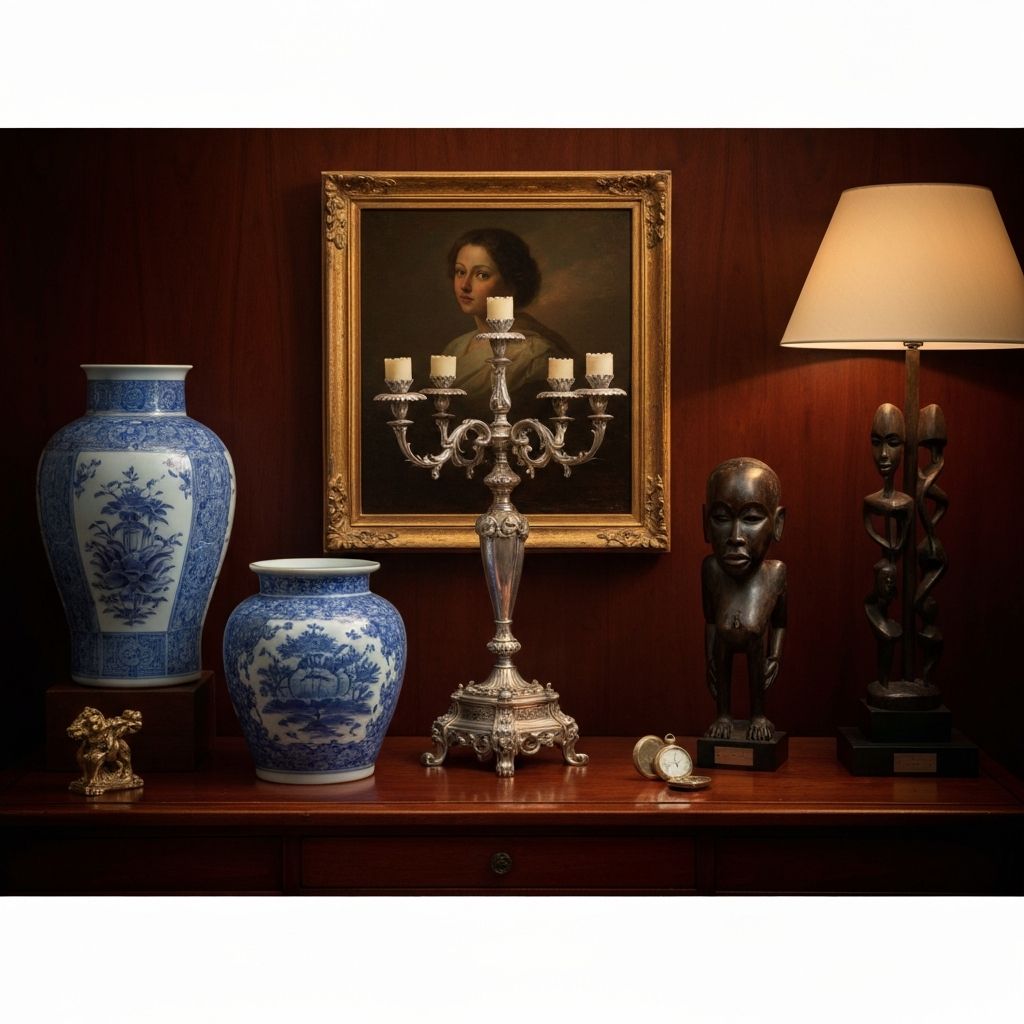
How to Sell Antiques Online: Platform Guide and Expert Tips
Selling antiques online is not complicated, but it is unforgiving if you skip one step: knowing what you actually have. This guide walks through every stage, from authentication to dispatch, so you reach the right buyer on the right platform at the right price.
The Costly Mistake Nobody Warns You About
Here is a scenario that plays out every week across eBay, Etsy, and dozens of smaller second-hand marketplaces. Someone clears out an estate, photographs a decorative vase, writes "old porcelain, unknown maker, lovely blue and white" in the listing, and accepts the first offer of €40. The buyer, who did their homework, knows they are looking at a Qing-period piece with a 大清光緒年製 reign mark. Three months later it sells through a specialist at Bonhams for €3,800.
The original seller did not do anything wrong in a moral sense. They simply skipped step zero: finding out what they had before they listed it.
This is not an isolated case. Christie's specialists, Catawiki curators, and Belgian auction houses like Bernaerts all report that a significant portion of items they receive for consignment were previously sold, sometimes multiple times, at a fraction of their value because sellers treated "unknown" as a permanent state rather than a temporary one worth resolving.
The internet has made it genuinely possible to sell antiques to the right collector anywhere in the world. But that same internet also makes it trivially easy to sell too fast, to the wrong buyer, on the wrong platform, for the wrong price. The fix is not complicated. It just requires a sequence.
Step Zero: Know What You Have Before You List
Before you choose a platform, write a description, or think about shipping, you need a working answer to three questions:
- What is this object, and when was it made?
- Who made it, and is there any documentation?
- What does the current market pay for comparable pieces?
These questions are not always answerable to the level of a full expert appraisal. But they are almost always answerable to the level of "this is probably 19th-century Belgian silver with Antwerp guild marks, worth somewhere between €200 and €600 at auction." That is enough to choose the right platform and set a sensible reserve.
Historically, getting those answers meant a physical visit to an auction house, paying for a valuation, or knowing the right dealer. That barrier kept a lot of genuine pieces from reaching their market. AI-assisted analysis has changed that. Tools like AntiqBot allow you to upload photographs of an object, including close-ups of any marks, signatures, or hallmarks, and receive a detailed authentication and valuation analysis in minutes, drawing on the same reference databases that auction house specialists consult: Christie's and Sotheby's sold results, RKD (Rijksbureau voor Kunsthistorische Documentatie) for Dutch and Flemish art, silver mark databases like the Online Encyclopedia of Silver Marks and ASCAS, ceramic mark references via Kovels and MarcaPedia, and comparable sales from Mutualart and ArtPrice.
AntiqBot is not a replacement for a specialist opinion on a genuinely important piece. It is the preparation step that tells you whether you need a specialist opinion at all, and on which platform your object belongs.
Read more about what good documentation photography looks like before you start: How to Photograph Antiques for Authentication. And if you want to understand what a free valuation from a photo can and cannot tell you: Free Antique Valuation from a Photo.
Find Out What You Have First
Upload a photo and get an authentication and valuation analysis before you list. Sign up and get 1 free credit for your first analysis. After that, buy credit packs starting from €0.60 per analysis.
Start Your Free AnalysisMatching Your Object to the Right Platform
The biggest lever you can pull when selling antiques online is platform choice. The same object can sell for three times as much on the right platform versus the wrong one. The decision comes down to four variables: estimated value, object category, buyer geography, and how much friction you are willing to accept in the selling process.
Here is a practical decision matrix before we go into each platform in detail:
| Platform | Best Value Range | Best For | Main Risk |
|---|---|---|---|
| Catawiki | €50 – €5,000 | Most antique categories, European audience | Expert review delay |
| Christie's / Sotheby's / Bonhams online | €1,000+ | Verified high-value pieces | Buyer's premium, consignment minimums |
| Bernaerts | €100 – €10,000 | Belgian/Dutch art, silver, furniture | Regional reach only |
| eBay | €10 – €500 | Collectibles, decorative items, parts | Underpricing, returns |
| Etsy / specialist dealers | €20 – €800 | Jewelry, small decoratives, affordable antiques | Low discoverability for rare items |
| Local auction houses | €50 – €3,000 | Furniture, large objects, regional art | Lower price ceiling, limited online reach |
Catawiki
Catawiki is the best starting point for the majority of people selling antiques online in Europe. Its model is well-suited to sellers who are not professional dealers: you submit an object, a specialist curator reviews it and writes the catalogue copy, and if accepted it goes into a dedicated specialist auction that typically runs for seven days. The buyer base is international, with strong demand from collectors in Germany, France, the Netherlands, Belgium, and increasingly further afield.
The platform charges no listing fee and takes a seller commission of around 12.5%. Buyer's premium is paid by the buyer, not you. For objects in the €50 to €5,000 range, this structure is very favourable.
Catawiki's specialist review process is both its greatest strength and its main point of friction. Your object will be assessed before it goes live. If the specialist disagrees with your description or estimated value, they will correct it. That can feel frustrating, but it is actually a service: their curators see tens of thousands of objects and are well-calibrated to current market demand. Objects that have been authenticated and documented before submission move through the review process faster and tend to achieve stronger results, because the listing is credible from the start.
Catawiki is particularly strong for Continental silver, Art Deco ceramics, African art, mid-century decorative objects, Belgian and Dutch paintings, and quality porcelain. If your piece has a clear attribution or hallmarks, document them thoroughly before submitting.
Christie's, Sotheby's, and Bonhams Online
All three major international auction houses operate online auction divisions that accept consignments at significantly lower estimates than their marquee evening sales. Christie's Online (formerly Christie's LIVE and now integrated into their main site), Sotheby's Marketplace, and Bonhams Online all run specialist sales with global collector bases.
The buyer's premium at these houses runs between 25% and 30%, paid by the buyer. Seller commission varies by negotiation and consignment value, but typically falls in the 10% to 15% range for private consignors. Minimum estimates are generally in the €1,000 to €2,000 range depending on category.
The principal advantage of consigning with a major house is authentication credibility. A lot catalogued and sold by Christie's carries provenance that follows the object permanently. For genuinely important pieces, that provenance premium compounds over time and makes subsequent resales more valuable. If your authentication analysis suggests you have something genuinely significant, a specialist opinion from one of these houses is worth seeking before you list anywhere.
For mid-range objects, the consignment minimums and the length of the process (typically 8 to 16 weeks from submission to settlement) make the major houses less practical than Catawiki or a regional specialist. But for the right object, the ceiling is much higher.
Bernaerts
Bernaerts, based in Antwerp, is the leading auction house for Belgian and Flemish art, Continental silver, and antique furniture in the Benelux region. It operates both live and online auctions and has a strong regional collector base combined with a growing international online following.
For sellers based in Belgium or the Netherlands, Bernaerts offers the practical advantage of local consignment without the complexity of international shipping for large or fragile pieces. Their specialist knowledge of Belgian silverwork (Antwerp and Brussels guild silver in particular), Flemish paintings, and period furniture is genuine and deep. Objects that have a specifically Belgian or Dutch provenance often achieve better results at Bernaerts than they would on an international generalist platform, because the relevant collectors know to look there.
Their online catalogue is accessible internationally, and their estimates tend to be realistic and well-researched. For sellers with Belgian or Flemish pieces, Bernaerts should be the first specialist call, not the last resort.
eBay
eBay reaches more potential buyers than any other platform in the world. For the right category of object, that breadth is genuinely valuable. Collectibles with active niche communities (specific pottery marks, particular clock manufacturers, regional silverware, militaria, scientific instruments) often find their best buyers on eBay precisely because those buyers are actively searching, have price alerts set, and know exactly what they are looking at.
The risk on eBay is underpricing. The platform's default dynamic drives prices toward the median, not the ceiling. Buyers on eBay expect to find things cheap. An object that a specialist would immediately recognize as exceptional can sit at a low price because the right collector never saw it framed correctly, or the description gave them no reason to look closely.
eBay is appropriate for decorative items with moderate collector demand, parts and accessories (clock movements, furniture hardware, ceramic fragments), objects with clear factory marks that eBay's search algorithm surfaces well, and items in the under-€200 range where the friction of specialist auction is not justified. For genuinely rare or high-value pieces, eBay should be a last resort, not a first choice.
If you do list on eBay, write the most precise description you can, include every mark photographed clearly, and set a reserve price based on your research rather than hope. The buy-it-now option with a best-offer setting often outperforms a pure auction for antiques on eBay.
Etsy and Specialist Dealers
Etsy has a large and active antiques and vintage section. Its buyer base skews toward decorative, wearable, and lifestyle objects: jewelry, small porcelain figures, vintage textiles, decorative ceramics, and affordable collectibles. The platform works well for objects with strong visual appeal in the under-€500 range, where the buyer is making a semi-emotional purchase rather than a pure investment.
Etsy's search is driven by tags and listing quality, which rewards sellers who invest time in descriptions and photography. It does not work well for objects whose value is primarily in their rarity or provenance rather than their visual presence, because Etsy buyers typically cannot evaluate those factors.
Selling directly to specialist dealers is another route worth considering for certain categories. Dealers buy at wholesale, typically 30% to 50% of retail or auction estimate. You will receive less than at auction, but the transaction is immediate, certain, and requires no photography, listing, or shipping management. For sellers who need to liquidate quickly, or who have objects in categories where finding the right individual buyer takes months, a dealer sale can be the rational choice.
Local Auction Houses
Every region has generalist local auction houses that handle antiques, estate sales, and household contents. Their reach is primarily regional, but for certain object categories that creates an advantage rather than a limitation. Large furniture, heavy bronzes, significant paintings with a local provenance, and decorative items with strong regional appeal (local pottery, regional silver, national school paintings) often achieve better results at a regional house than on an international generalist platform, because the relevant buyers attend those sales in person.
Local houses generally charge seller commissions of 10% to 20% and have no minimum estimates. The settlement process is faster than major international houses. For furniture and large decorative items where shipping is a practical obstacle to online sale, a local house is often the most practical route.
Photographing Antiques for Online Sale
Photography is the single largest variable in online antique sale outcomes. A well-photographed piece communicates authenticity, condition, and quality before a word is read. A poorly photographed piece, regardless of its genuine merit, is immediately discounted by experienced buyers who have learned that bad photography often signals an uneducated seller.
The basic equipment requirement is modest: a smartphone with a good camera, a neutral background (white or light grey for most objects, dark for silver and metalwork), and natural indirect light. Avoid flash photography entirely. Flash creates reflections on glazed surfaces and eliminates the subtle texture variations that tell a knowledgeable eye whether they are looking at a hand-painted piece or a transfer print.
The required shots for most antiques are:
- Full object front view, squared to the camera, on a clean neutral background
- Full object from the back or reverse
- Both sides at 45 degrees if the object is three-dimensional
- Base or underside, always (this is where marks live)
- Close-up of every mark, signature, stamp, or hallmark, sharp and well-lit
- Detail shot of any damage, repair, or condition issue
- Scale reference (a ruler, or a common object for context in at least one shot)
For silver, lay the piece on a dark surface and use a single light source from one side to bring out hallmarks and surface texture. For paintings, photograph in front of a window in diffuse daylight rather than under ceiling lights. Canvas texture and paint application both read better in indirect natural light than under artificial sources.
Mark photography deserves particular attention because it is the primary authentication signal for buyers and platform specialists. A blurred photo of a hallmark tells a specialist nothing. A sharp macro shot of the same mark can confirm origin, date, and maker within seconds. Most modern smartphones can achieve adequate macro focus if you hold them steady and give the camera time to lock focus before pressing the shutter.
Writing the Listing Description
A strong listing description for an antique follows a consistent structure. It answers the questions a knowledgeable buyer will ask, in the order they ask them, without requiring them to request more information.
The elements every listing should include:
- Object type and period: be as specific as you can. "19th-century French faience plate" is more useful than "antique plate." "Flemish oil on panel, attributed to the circle of Jan Brueghel, circa 1620" is more useful than "old painting."
- Maker or attribution: if known, state it with the source. "Signed lower right: Carel Fabritius" is a claim. "Signed lower right with an initial and the date 1847, attributed to the Delft school" is a description. Be precise about what you know and what you infer.
- Dimensions: always in centimetres, height first, then width, then depth for three-dimensional objects. Include weight for silver and metalwork.
- Marks and inscriptions: describe and photograph all marks. Do not skip marks you cannot identify. "Unidentified mark to base, photographed in image 6" is the correct approach.
- Condition: honest and specific. Every significant chip, crack, restoration, or staining must be described and photographed. Condition issues discovered after purchase by a buyer who feels they were not disclosed are the primary cause of disputes and returns.
- Provenance: if you know the ownership history, include it. Even partial provenance ("purchased at Bernaerts, Antwerp, auction March 2018, lot 247") adds credibility and value.
Write in plain, direct English. Avoid flowery language about beauty or rarity unless it is substantiated. Platform specialists and experienced collectors respond to factual precision, not enthusiasm.
Pricing Strategy
Pricing antiques for online sale is an exercise in research, not instinct. The most reliable method is comparable sales analysis: finding objects of the same type, period, maker, and approximate condition that have sold at auction within the past 12 to 24 months, and using the hammer prices as anchors.
The best sources for comparable sales data are Mutualart, ArtPrice, Invaluable, and the sold results sections of Catawiki, Christie's, Sotheby's, and Bonhams. Search by object type, mark, or maker name and filter to sold results only. Unsold estimates tell you what the market hoped; sold prices tell you what it actually paid.
For auction listings, setting an opening bid is different from setting a reserve price. The opening bid is what starts the auction and determines whether anyone bids at all. Set it too high and the auction starts without bids, which psychologically signals lack of interest to subsequent viewers. Set it too low and you risk selling far below market if only one or two bidders participate.
A practical rule for opening bids: set at 30% to 40% below your realistic market estimate for the object. Set your reserve (the confidential minimum price below which the piece will not sell) at approximately 70% to 80% of your target price. This creates competitive momentum while protecting against a bad outcome.
For buy-it-now or fixed-price listings, price at fair market value, meaning the mid-point of the comparable sales range you researched. Pricing above the range means the object sits until you reduce it; pricing at the top of the range requires a very well-presented listing to justify it to buyers who know the market.
On reserve prices: Many sellers set a reserve equal to what they paid, rather than what the market will bear. These are different numbers. What you paid is your cost. What the market will bear is the current going rate. If you paid above market at a retail dealer, your reserve based on cost will prevent the piece from selling. Use comparables, not cost, as your anchor.
Condition Reporting Honestly
Accurate condition reporting is both an ethical obligation and a commercial necessity. A buyer who feels a condition issue was concealed will return the piece, leave negative feedback, or dispute the transaction. All three outcomes are worse for the seller than disclosing the issue upfront and pricing accordingly.
The standard condition grades used across the antique trade are:
- Mint / As new: no wear, damage, or restoration. Rare for genuinely old pieces.
- Excellent: minimal wear consistent with age, no damage, no restoration.
- Very good: light wear, no significant damage, minor age-related marks.
- Good antique condition: the standard phrase for honest wear consistent with age and use. This is not a euphemism for damage; it means the piece looks its age without being damaged.
- Fair: significant wear or minor damage that affects appearance but not structural integrity.
- Poor / As found: damage, losses, or significant condition issues. Requires specific description.
Restoration requires explicit disclosure. If a piece has been repaired, describe what was repaired, approximately when, and by what method if known. A professional restoration by a conservator can actually be a positive in the listing ("professionally restored hairline crack to base, invisible under normal light, documented in image 8"). An amateur repair concealed beneath paint should be described accurately, because experienced buyers will detect it and withdraw trust in the entire listing if they find something undisclosed.
For ceramics and glass, check under UV light before listing. Repairs and restorations that are invisible under normal lighting fluoresce clearly under UV. Many specialist buyers do this as a matter of routine, and discovering an undisclosed restoration this way ends the relationship.
Packing and Shipping Antiques
Shipping is where antique sales go wrong after everything else has gone right. Ceramics, glass, and delicate metalwork are routinely damaged in transit by sellers who underestimate the forces involved in courier handling. A piece that survives 200 years does not automatically survive a parcel sorting facility.
The standard for fragile antiques is double-boxing with a minimum of 5 cm of cushioning material on all six sides of the inner box. The inner box contains the wrapped object; the outer box contains the inner box surrounded by additional cushioning. The inner box should not be able to move inside the outer box when shaken.
Wrapping sequence for ceramics: wrap each piece individually in acid-free tissue, then a layer of foam sheeting, then bubble wrap. Do not use newspaper directly against the object, as the ink transfers. Do not allow pieces to touch each other inside the box. If shipping multiple pieces in one box, wrap and box each piece separately, then place the individual boxes inside a larger outer box.
For paintings on canvas or panel: use a rigid board slightly larger than the painting on both sides, taped at the edges, before boxing. Never roll a canvas that was not designed to be rolled. For large paintings, specialized art logistics services (Cadogan Tate, Hasenkamp, Crown Fine Art) are worth the cost.
Insurance is not optional for objects above €100. Most standard courier insurance is capped at very low limits and excludes fragile items unless declared and covered explicitly. Purchase declared-value insurance at replacement cost, not at purchase price. Keep the receipt from your authentication analysis as part of the claims documentation if needed.
Carriers to consider: DHL Express and UPS for international shipments offer better handling protocols than budget domestic couriers for fragile items. For very high-value pieces, dedicated art courier services offer white-glove handling and appropriate insurance levels as standard.
Taxes and Legal Obligations for Private Sellers
The tax treatment of antique sales differs significantly between private individuals and professional dealers, and between Belgium and the Netherlands, the two jurisdictions most relevant to many AntiqBot users. This section is a general orientation, not tax advice. For your specific situation, consult a qualified tax advisor.
Belgium: Private Individuals
Belgian private individuals selling personal possessions are generally not subject to VAT on those sales, and the proceeds are typically not taxable as income, provided the sales are genuinely incidental rather than a business activity. The line between incidental sales and a business activity is not defined by a specific number of transactions but by the regularity and intent of the activity. Selling inherited items or personal collection pieces occasionally falls clearly on the private side. Operating a consistent buying and reselling business without registering falls clearly on the wrong side of that line.
For Belgian antique dealers registered for VAT, the margeregeling (margin scheme) is the standard treatment. Under the margin scheme, VAT is calculated only on the profit margin (selling price minus purchase price), not on the full selling price. This is a significant benefit for dealers selling second-hand goods. The scheme requires that the original purchase was from a private individual or another margin-scheme seller, and that proper documentation is maintained for each transaction.
The Netherlands: Private Individuals
In the Netherlands, private sales of personal possessions are similarly not subject to income tax or VAT for genuinely private sellers. The belastingdienst distinguishes between hobby/incidental activity and a source of income (bron van inkomen). If you sell regularly with the intention of making a profit, the activity may be considered a source of income subject to income tax in Box 1.
Dutch registered dealers can apply the margeregeling under the same principles as in Belgium. The Dutch scheme (BTW-margeregeling) is well-established and widely used in the antique and second-hand goods sector.
CITES and Cultural Property Considerations
Two legal constraints apply regardless of tax status. Objects containing ivory (even antique ivory predating the CITES Convention) require export documentation for international sale under CITES regulations. The rules are complex and jurisdiction-specific; Belgian and Dutch customs authorities both enforce them actively. If you have any object that may contain ivory, research the specific documentation requirements before listing for international sale.
Objects potentially subject to cultural property rules (significant archaeological objects, works of art of national importance) have additional regulatory constraints on export and sale. Most objects in normal private collections do not trigger these rules, but large-scale holdings from estates or demolition projects occasionally require due diligence.
Frequently Asked Questions
What is the best platform to sell antiques online?
It depends on the value and category of your piece. Catawiki is the best starting point for most antiques in the €50 to €5,000 range. Christie's, Sotheby's, and Bonhams online are better for verified high-value pieces. eBay reaches the widest audience but carries the highest risk of underpricing. For Belgian and Dutch art and silver, Bernaerts is the specialist choice.
Do I need to authenticate an antique before selling it online?
You are not legally required to authenticate before listing, but you should. Knowing what you have determines which platform is appropriate, what reserve price is realistic, and how to write an accurate description. Selling without knowing what you have is the single biggest cause of underpricing. A basic analysis costs a fraction of what an underpriced sale loses.
How do I price antiques for online auction?
Research comparable sold listings on Catawiki, Invaluable, and Mutualart for the past 12 to 24 months. Set your opening bid at 30% to 40% below your target price to attract early bidders. Set your reserve at 70% to 80% of your target. For buy-it-now listings, price at fair market value based on comparables, not based on what you paid.
Do I have to pay VAT when I sell antiques privately in Belgium or the Netherlands?
Private individuals selling personal possessions are generally not subject to VAT on those sales. Professional dealers in Belgium and the Netherlands can apply the margin scheme (margeregeling), which means VAT is charged only on the profit margin rather than the full selling price. Always consult a tax advisor for your specific situation, particularly if your sales are regular or volume-based.
How should I pack antiques for shipping?
Double-box fragile items with a minimum of 5 cm of cushioning on all sides. Wrap ceramics and glass individually in foam or bubble wrap before placing in the inner box. Declare full replacement value when purchasing shipping insurance. Do not allow pieces to touch each other inside the packaging. For high-value items, use specialist art logistics services rather than standard courier services.
Where to Start
The sequence matters. Authentication first, platform selection second, listing third. Sellers who reverse that order, listing first and hoping the right buyer finds them, leave money on the table or invite disputes they cannot resolve.
Your first step is a photograph and an analysis. Know the period, the maker if identifiable, the condition accurately described, and a realistic market range. With that in hand, every subsequent decision becomes simpler: you know whether you are calling Bernaerts or submitting to Catawiki, whether to set a reserve or let the market decide, whether a piece warrants professional packing and specialist insurance or can go in a well-padded box via DHL.
The antique market rewards preparation. The knowledge that auction house specialists and experienced dealers carry was hard-won over years. The tools available in 2026 make a meaningful portion of that knowledge accessible before you list your first piece, at a cost that is trivial compared to the difference between selling correctly and selling blind.
Ready to Find Out What You Have?
Upload your photos and get a detailed authentication and valuation analysis. Sign up and get 1 free credit for your first analysis. After that, buy credit packs starting from €0.60 per analysis.
Analyse Your Piece