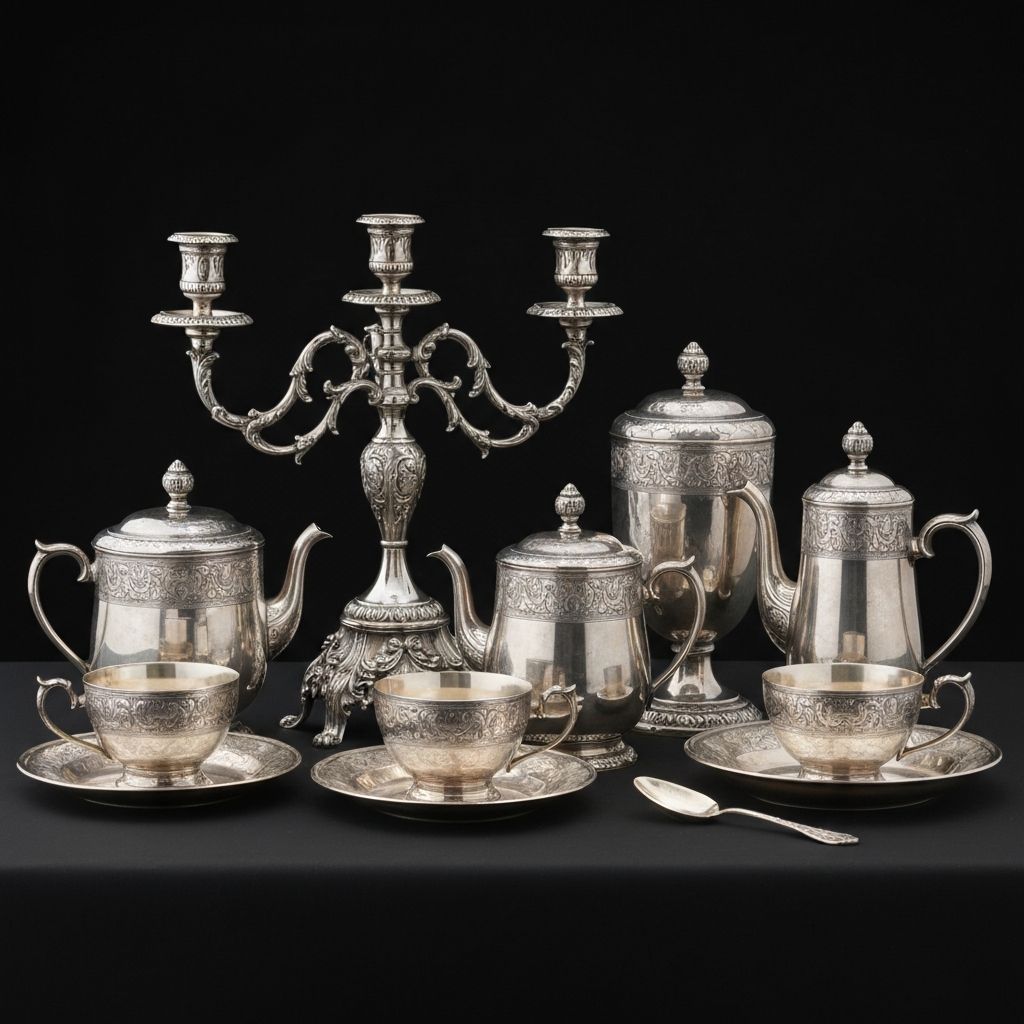
Victorian Silver Hallmarks Guide: Date Letters, Assay Offices and Maker's Marks 1837–1901
No category of antique metalwork is more precisely documented than Victorian British silver. Between 1837 and 1901 every piece that left an assay office legally carried up to five compulsory stamps, each one an independently verifiable fact: the metal's purity, the town where it was tested, the exact year it passed through the assay office, the workshop that made it, and whether the silver duty had been paid to the Crown. No comparable documentation exists for furniture, ceramics, or paintings of the same period. That density of information is why Victorian silver attracts serious collectors and why reading the marks correctly separates a hundred-euro flea-market find from a piece that belongs in a Christie's or Bonhams sale. This guide walks you through every element of the Victorian silver hallmarks system, office by office and mark by mark.
The Five Compulsory Victorian Hallmarks Explained
British assay law during the Victorian period required up to five separate marks on sterling silver. Understanding what each one is, and what it tells you, is the foundation of the entire system.
1. The standard mark (lion passant). A walking lion facing left, right foreleg raised, is the British purity guarantee. It has appeared on English silver since 1544, making it the most enduring hallmark in the world. During the Victorian period the lion passant appeared in a plain rectangular cartouche, a simplification introduced in 1821. It confirms that the silver is at minimum 925 parts per thousand pure: sterling standard. Any piece claiming to be Victorian sterling silver without the lion passant should be treated with serious suspicion.
2. The date letter. A single letter of the alphabet, set in a specific typeface and enclosed in a specific shield shape, denotes the year the piece was assayed. Each assay office ran its own alphabetical cycle, and the shields and typefaces changed with each new cycle. This is deliberately complex, and that complexity is exactly why date letters are so precise: once you match the letter, typeface, and shield to the correct office and cycle, you have the exact assay year.
3. The assay office mark. Each of the six active offices during the Victorian period used its own distinctive pictorial symbol stamped alongside the other marks. London used a leopard's head. Birmingham used an anchor. Sheffield used a crown. Edinburgh used a castle. Glasgow used a combination of tree, fish, bell, and bird. Dublin used Hibernia (a seated female figure) alongside a crowned harp. These marks are the first thing to identify when reading an unfamiliar piece, because they govern the interpretation of the date letter.
4. The maker's mark. Usually two or three initials in a cartouche, the maker's mark identifies the silversmith or manufacturing firm responsible for the piece. From 1739 onward, British law required makers to strike their mark in a new cartouche every time they changed premises or entered a new partnership, creating a historical record of workshops. The cartouche shape is itself a clue: broad rectangles and cut-corner shields are common Victorian forms.
5. The sovereign's head duty mark. An intaglio portrait of the reigning monarch in profile, struck in an oval or rectangular cartouche, confirmed that the silver duty had been paid. Its history runs from 1784 to 1890. Its presence or absence is one of the most reliable quick-dating tools in Victorian silver, described in detail in the section below.
Quick check: a full complement of five marks means the piece predates 1890. Four marks (no duty head) after 1890. Three marks (no duty head, no date letter cycle match) raise questions worth investigating before purchase.
Reading the Date Letter System
The British date letter system is the most sophisticated annual dating mechanism ever applied to a craft object. It was not designed to be uniform across offices; each office ran its own independent alphabetical cycles, with its own start date within the year, its own typefaces, and its own shield forms. The result is a system that rewards careful study and ruthlessly punishes casual identification.
The basic principle is simple: at the start of each new assay year (which did not coincide with 1 January), the office began a new letter. London's assay year traditionally started in May; Birmingham's started in July; Edinburgh's in October. A piece with a London 'A' in a particular cycle and a Birmingham 'A' in the same cycle will therefore have been assayed in different calendar years.
Cycles typically ran from A to U or A to V, omitting certain letters (J was commonly omitted to avoid confusion with I; in some cycles W, X, Y, and Z were also dropped). When the alphabet was exhausted, the office started a new cycle with a new typeface and a new shield shape. This means there are many distinct 'A' shields across Victorian silver, and identifying the right one requires looking at three things simultaneously: the letter itself, the typeface (Roman upper case, script, Old English, Gothic, block), and the shield outline (plain rectangle, shield with cut corners, shaped top, cusped base, oval, square).
The single most common error made by buyers at auction is identifying the letter without checking the office mark. An 'M' in a plain Roman typeface in a London rectangular shield could be 1867. The same 'M' in a Birmingham shield is a different year entirely. Always establish the assay office mark first, then consult the date letter table for that specific office.
The most reliable printed reference for date letters remains Jackson's Silver and Gold Marks of England, Scotland and Ireland. Online, the 925-1000.com database and the ASCAS reference pages provide searchable date letter tables organised by office. The Goldsmiths' Hall in London holds the authoritative historical registers.
Practical tip: when photographing a piece for identification, always take a separate macro shot of each individual mark. Victorian hallmarks are often small, especially on spoons, vinaigrettes, and card cases. Raking light (the light source at a low angle to the surface) reveals strikes that direct or diffuse light obscures entirely.
The Six Active Victorian Assay Offices
In 1837, when Victoria came to the throne, six assay offices were operating in Britain and Ireland. Each had its own mark, its own date letter cycle, and its own regional character. Understanding which office struck a piece is essential before any further reading can be reliable.
London
London's assay office at Goldsmiths' Hall in Foster Lane is the oldest and most prolific of the British offices. Its mark is a leopard's head: a forward-facing feline head, crowned until 1822, uncrowned thereafter throughout the Victorian period. The removal of the crown in 1822 means that any London piece with a crowned leopard's head predates Victoria's reign.
London's Victorian date letter cycles ran in alphabetical sequences using letters A through U, skipping J. Each cycle used a different typeface and shield combination. The cycle covering 1856 to 1875 used Old English (Black Letter) typefaces in shields with shaped tops. The cycle from 1876 to 1895 returned to Roman capitals in plain rectangular shields. Knowing these broad phase boundaries allows quick preliminary dating even before precise table consultation.
London was particularly dominant for high-end presentation silver: racing trophies, civic plate, ecclesiastical silver, and the elaborate tea and coffee services that filled Victorian upper-class sideboards. Major retail names including Hunt & Roskell and later Garrard & Co. had their pieces assayed in London, even when manufacturing happened elsewhere.
Birmingham
The Birmingham Assay Office was founded in 1773, later than London, Edinburgh, and Dublin, but it grew rapidly to become the dominant office for small silver objects. Its mark is an anchor, struck upright for most pieces. On exceptionally small items, including the tiny vinaigrettes, nutmeg graters, and card cases for which Birmingham became famous, the anchor sometimes appears on its side to fit within the available surface area.
Birmingham's date letter cycle during the Victorian period ran from July to June, meaning a piece struck in August 1855 would carry the same date letter as one struck in April 1856 by London's calendar. The city's silversmithing trade developed a speciality in small decorative objects that required the assay office to develop particular expertise in stamping miniature marks without distorting thin metal. A Birmingham-assayed vinaigrette from 1840 to 1870 typically carries the full five marks compressed into a space sometimes smaller than one centimetre, which is a remarkable feat of the assayer's craft.
Birmingham silversmiths who registered at the office during the Victorian period include a significant number of family firms whose continuity can be traced through successive maker's mark registrations. The Birmingham Assay Office's own archive holds registration books that allow maker identification for marks that do not appear in published references.
Sheffield
Sheffield's assay office, founded in the same Act of Parliament as Birmingham in 1773, used a crown as its office mark throughout the Victorian period. The crown can cause confusion for collectors who encounter it alongside the sovereign's head duty mark (also crown-related in its subject matter) and alongside date letter shields that sometimes themselves incorporate a crown motif. The solution is to read all the marks in sequence and identify each by function, not just by the presence of regal imagery.
Sheffield was the dominant office for flatware and cutlery, and for Old Sheffield Plate (a pre-electroplate technique discussed further below). The city's industrial capacity produced enormous quantities of Victorian silver cutlery for middle-class households and institutions. Large sets of Victorian silver flatware with Sheffield marks are among the most frequently encountered items at estate sales and auction houses including Bernaerts in Antwerp.
Sheffield's date letter cycle used a full alphabet with some omissions, and the office maintained its own independent start date for each assay year. A piece of Sheffield silver assayed in September carries a date letter that already reflects the new cycle year, while a Birmingham piece assayed in the same month might still be on the previous letter.
Edinburgh
The Edinburgh Assay Office uses a castle as its mark: a three-towered castle in elevation, closely resembling the Edinburgh Castle silhouette. Edinburgh silver occupies a distinct position in the Victorian market because Scottish silver carried its own aesthetic traditions (notably the distinctive thistle-pattern spoons and the quaich form) alongside the standard British hallmarking requirements.
Edinburgh's assay year began in October, making it the latest start date of the main British offices. Scottish silver from prominent Victorian makers including Hamilton & Inches, who received their Edinburgh assay marks throughout the period, consistently achieves strong results at Scottish specialist sales. The Edinburgh Assay Office continues to operate today and maintains archives that allow identification of makers registered in the Victorian period.
One specific difference between Edinburgh and the English offices: Edinburgh silver sometimes carries the deacon's mark or the assay master's mark alongside the standard set, particularly on pieces from the first half of the Victorian period. These additional marks can look confusing to a buyer expecting exactly the English five-mark system.
Glasgow
Glasgow's office mark is famously complex: a combination of four elements derived from the city's coat of arms. The tree (an oak tree), the fish (a salmon with a ring in its mouth), the bell, and the bird (a robin) all appear, though not always together and not always in the same arrangement across different periods. Glasgow used its own independent date letter cycles with start dates and alphabetical sequences that differed from all other offices.
Glasgow silver tends to be less familiar to Continental European collectors than London or Birmingham pieces, but the Scottish market, particularly through Edinburgh auction houses, values it highly. The Merchants House and Trades House of Glasgow commissioned significant quantities of presentation silver throughout the Victorian period, providing an interesting category of documented civic objects.
Glasgow's assay office closed in 1964, so all Victorian-period Glasgow silver was assayed during the office's active years. Post-1964 Scottish silver is generally sent to Edinburgh.
Dublin
The Dublin Assay Office, founded in the 17th century, used two marks that together distinguish Irish silver from British: Hibernia (a seated female figure with a harp) and a crowned harp. The crowned harp is the Irish equivalent of the lion passant as a standard mark; Hibernia was originally a duty mark specific to Ireland, introduced in 1730, which continued to be struck even after the British duty mark system changed.
Irish silver from the Victorian period has its own distinct character. Dublin silversmiths maintained craft traditions that differed from Birmingham or London production methods, and Irish silver often shows a heavier, more robust construction than comparable English pieces of the same period. The Waterford and Cork silver traditions, though largely pre-Victorian, influenced makers who continued working in Dublin through 1837 to 1901.
One practical note for buyers: Irish silver with its Hibernia mark is sometimes misidentified by collectors who do not recognise the seated female figure and mistake it for an unusual or foreign duty mark. The presence of both Hibernia and the crowned harp together with a date letter and maker's mark is the definitive Irish sterling silver signature.
The Sovereign's Head Duty Mark
The sovereign's head duty mark has a precise historical span that makes it one of the most useful dating tools in the entire hallmarking system. It was introduced on 1 December 1784 as a visible confirmation that the silver duty (set at 6d per ounce in 1784, raised to 1s per ounce in 1797, and maintained at 1s 6d per ounce through most of the Victorian period) had been paid to the Crown. It was abolished on 30 April 1890.
During the Victorian period, the duty mark showed the reigning sovereign's head in profile. From 1837 until the mark's abolition, this was Queen Victoria herself. Early Victorian duty marks (1837 to approximately 1850) show a young Victoria; later marks show the slightly more mature portrait used in the later decades of the reign. This subtle difference in the portrait can assist in narrowing dates on pieces where the date letter is ambiguous or worn.
The duty mark was struck as an intaglio (sunken) impression, meaning the raised metal around the edge of the punch was cut away, leaving the portrait in relief. This is the opposite of the lion passant and the assay office marks, which are typically in intaglio overall with raised detail. The duty mark therefore has a slightly different visual character, which helps distinguish it from the other marks in a cluster.
Dating shortcut: five marks present (including duty head) = the piece dates to between 1784 and 30 April 1890. Four marks (no duty head, but lion passant, assay office mark, date letter, and maker's mark) = the piece dates to after 30 April 1890. Applied to Victorian silver specifically: a full five-mark piece dates to 1837-1890; a four-mark piece to 1890-1901 or later.
The abolition of the silver duty in 1890 was welcomed by the trade, which had long argued that the tax disadvantaged British silver against imported Continental pieces that entered the country without duty obligations. The Goldsmiths' Hall records from the 1890 to 1901 period show a noticeable increase in the volume of silver assayed, consistent with the trade's claim that the duty had been suppressing production.
Victorian Maker's Marks: Partnerships, Succession, and the Major Houses
The maker's mark on Victorian silver is more than a signature: it is a legal registration, and every change in the underlying business required a new registration and a new mark. This creates a paper trail that, for the careful researcher, illuminates the entire structure of the Victorian silversmithing trade.
When a silversmith died or retired, his partner or successor was required to re-register a new maker's mark. When a partnership dissolved, both parties registered separate marks. When a firm moved premises, a new registration was required. The assay office registration books, held at each respective office and partially published in reference works including Jackson's, allow researchers to trace these transitions. A maker's mark reading "WR" in a rectangular cartouche might belong to William Reid in 1840, but if the business passed to his nephew and widow in 1862, a new "WR" in a different cartouche would appear in the register for that year.
Three names dominate the high end of Victorian London silversmithing and appear frequently in major auction records:
Elkington & Co., based in Birmingham, is responsible for industrialising electroplating and transforming the silver trade from the 1840s onward. Elkington held patents for the electroplating process and licensed those patents to other manufacturers. Their silversmithing work included both sterling silver (fully hallmarked, carrying Elkington's registered maker's mark at the Birmingham office) and electroplated goods (marked EPNS or with their own trade stamps but carrying no assay hallmarks). Distinguishing Elkington sterling from Elkington plate is straightforward: look for the full hallmark set. Any Elkington piece without the lion passant, date letter, and anchor is plate, not silver, regardless of its surface appearance.
Hunt & Roskell (successors to Storr & Mortimer) occupied the top of the London trade from the 1840s through the end of the Victorian period. They supplied presentation plate, racing trophies, and diplomatic gifts at the highest level. Pieces bearing the Hunt & Roskell maker's mark with London assay marks regularly appear at Christie's and Sotheby's sales of Victorian silver. The connection to Paul Storr's estate is important: Storr himself died in 1844, but pieces made in his final years at Storr & Mortimer carry marks from the transitional period, and these early Victorian pieces (1837 to 1844) are documented with particular care by collectors.
Paul Storr's estate pieces require a specific clarification. Storr's own maker's mark (PS in a rectangular cartouche with cut corners) was registered and used by him from 1793 until his retirement in 1839. Any piece with his mark must therefore predate 1839, placing it technically before or at the very start of Victoria's reign. Pieces bearing his mark alongside early Victorian date letters (1837-1839) represent the final years of his production. Later pieces described as "in the manner of Storr" or carrying marks from Storr & Mortimer are works of his successors and collaborators, not Storr himself.
For maker's mark identification at any level, the guide to identifying silver maker's marks online covers the full methodology, including how to use cartouche shapes and initial combinations to narrow attribution.
Victorian Silver Styles and Their Hallmark Implications
The 64-year span of the Victorian period contained several distinct stylistic phases, and each phase has specific hallmark implications for the collector trying to date a piece by visual appearance rather than marks alone. Visual style and the date letter should agree; when they conflict, one of them is wrong.
Early Victorian Rococo Revival (1837 to c.1850). The first decade of Victoria's reign saw a sustained revival of the asymmetrical shell-and-scroll ornament associated with early 18th-century French and English silver. Tea services, sauce boats, and cream jugs of this period show heavily chased surfaces with c-scrolls, shell feet, and floral sprays. Date letters for this period will fall in the first two assay cycles of Victoria's reign. The duty mark will be present, showing the early young-portrait Victoria head.
Mid-Victorian Renaissance Revival and Naturalism (c.1850 to c.1870). The Great Exhibition of 1851 accelerated interest in historical styles. Silver from this period ranges from elaborate Renaissance-inspired presentation pieces (centrepieces, candelabra, epergnes) to the naturalistic casting of plant and animal forms popularised by manufacturers including Elkington. Date letters from this phase show Birmingham and Sheffield production at high volume for the expanding middle-class market. The duty mark remains present throughout this period.
Aesthetic Movement (c.1870 to c.1890). Under the influence of Japanese art and the broader Aesthetic Movement, a significant number of silversmiths began producing work with sparse surface decoration, geometric forms, applied fans and stylised flowers, and a preference for hammered (planished) surfaces over cast ornament. The hammered finish was a deliberate aesthetic choice, distinguishing this silver from the mechanical polishing of Elkington-style production. Pieces from this period carry date letters from the mid-assay cycles of the various offices. The duty mark will be present on pieces up to April 1890 and absent thereafter, providing a useful cross-check against stylistic attribution.
Arts and Crafts (c.1880 to 1901 and beyond). The Arts and Crafts movement's influence on silversmithing is visible in pieces that deliberately emphasise handcraft: uneven hammer marks left visible, simple geometric forms, semi-precious stone settings using wirework rather than cast settings. Birmingham became an important centre for Arts and Crafts silver through makers associated with the Birmingham School of Art. Date letters for Arts and Crafts Victorian silver span the 1880s and 1890s, with the duty mark absent from pieces made after April 1890.
Sheffield Plate, Electroplate, and Sterling: How Hallmarks Distinguish Them
One of the most practically important questions in Victorian silver collecting is whether a given piece is solid sterling silver, Old Sheffield Plate, or electroplated silver. The hallmark (or the absence of it) provides the answer, but the rules governing each category require careful attention.
Sterling silver carries the full British hallmark set: lion passant, date letter, assay office mark, maker's mark, and (if pre-1890) the duty mark. No legitimate sterling silver piece should be offered without these marks. If a dealer claims a piece is sterling but the marks are absent or incomplete, the claim should be tested rigorously before any purchase.
Old Sheffield Plate is a pre-electroplate technique in which a thin sheet of silver is fused under heat and pressure to both sides of a copper ingot, then rolled out and worked. The process was invented around 1742 and dominated the medium-quality silver-substitute market until electroplating made it obsolete from the 1840s onward. Old Sheffield Plate carries no assay hallmarks because it contains no sterling silver: it is a composite material. It was, however, sometimes marked with the maker's name or a series of pseudo-hallmarks designed to resemble genuine marks without reproducing them exactly (a practice that caused legal complications and was addressed by successive legislation). Old Sheffield Plate can be identified by the copper showing through at worn edges, by the characteristic striped appearance visible in cross-section, and by the absence of genuine assay marks.
Electroplated silver (EPNS, EP, A1) carries no assay hallmarks for the same reason: there is no sterling silver to assay. Electroplating deposits a microscopically thin layer of pure silver onto a base metal (most often nickel silver, also called German silver, which contains no silver at all). The trade marks used on Victorian electroplate are entirely different from hallmarks. EPNS stands for electroplated nickel silver. EP alone indicates electroplate on an unspecified base. A1 was a quality designation used by Sheffield platers to indicate their highest-quality electroplate deposit. None of these marks constitutes an assay guarantee, and none should be confused with a genuine hallmark. Elkington, who patented the electroplating process, used its own trade stamps on plated goods that look decoratively similar to its sterling maker's marks but lack the lion passant and date letter that distinguish the real thing.
The value difference between these categories in the current market, based on Bonhams and Catawiki results, is substantial. A hallmarked Victorian sterling silver entree dish by a named London maker might realise 800 to 2,500 euros depending on maker and condition. An equivalent Old Sheffield Plate piece might achieve 100 to 400 euros. An EPNS reproduction of the same form might sell for 20 to 80 euros. Reading the marks correctly is not an academic exercise: it is a direct financial calculation.
The copper test: hold any suspected Sheffield Plate or electroplate piece up to a strong light and examine edges, hinge points, and engraved areas. Copper showing through at wear points confirms Sheffield Plate. Bright white or slightly yellowish base metal showing through at wear points suggests electroplate on a white metal base.
How to Use AntiqBot SilverCheck to Read Victorian Silver Hallmarks From a Photo
AntiqBot's SilverCheck module is configured specifically around the authoritative reference databases for British and Continental silver: 925-1000.com, the ASCAS database, and the Online Encyclopedia of Silver Marks. When you upload a photograph of a Victorian silver piece, SilverCheck attempts to identify each mark in the cluster individually: the assay office mark, the date letter (including its cartouche shape and typeface), the lion passant, the duty mark if present, and the maker's mark.
The module then cross-references the identified marks against its reference base to suggest a date range, confirm or question the assay office attribution, and where the maker's mark initials and cartouche are sufficiently clear, to identify the silversmithing firm. The output follows AntiqBot's standard five-tier verdict system, with the scoring calibrated to the quality and clarity of the photographic evidence rather than to optimism about what the piece might be.
For Victorian silver specifically, the SilverCheck module applies particular attention to the duty mark: its presence or absence is treated as a hard date boundary, and any conflict between the duty mark reading and the date letter cycle is flagged explicitly in the analysis output. A piece with a date letter suggesting 1895 but an apparent duty mark, for example, would generate a specific warning rather than a confident verdict.
To get the best results from SilverCheck on Victorian silver:
- Photograph the full piece first to establish form and scale.
- Take a dedicated macro shot of the complete hallmark cluster with raking light (a phone torch held at a low angle works well on most household objects).
- If individual marks are hard to read together, take a separate ultra-close shot of each one.
- Include a ruler or coin for scale in at least one shot.
- Clean the surface lightly if heavy tarnish obscures the strikes, but avoid polishing that might remove fine detail.
For the full photographic methodology for silver hallmark identification, see the detailed guide at silver hallmark identification from a photo.
Identify Your Victorian Silver Hallmarks Now
Upload a photo of your silver piece and let AntiqBot SilverCheck cross-reference your marks against 925-1000.com, ASCAS, and the Goldsmiths' Hall register. Sign up and get 1 free credit for your first analysis. After that, buy credit packs starting from €0.60 per analysis.
Start Your Free AnalysisCommon Mistakes When Reading Victorian Hallmarks
The Victorian silver hallmarks system is precise, but it is also genuinely complex, and the same complexity that makes it so informative also generates predictable identification errors. These are the mistakes that appear most frequently in auction previews, online marketplaces, and estate sale descriptions.
Confusing assay office marks. The Sheffield crown is the most frequently misread office mark, because buyers associate crowns with royalty and therefore with the sovereign's head duty mark. These are entirely different stamps. The Sheffield crown is a stylised heraldic crown in a square or shaped cartouche; the duty mark is a portrait head. Similarly, the Birmingham anchor is occasionally mistaken for a naval or maritime symbol rather than an office mark. The remedy is simple: learn the six office marks as a distinct visual vocabulary before attempting date letter identification.
Applying London date letter tables to non-London pieces. Because London is the most extensively published office and because most introductory guides default to London date letters, collectors regularly apply the London date letter table to Birmingham or Sheffield pieces and arrive at dates that are one to five years wrong. Always confirm the assay office mark before consulting any date letter table.
Misreading the typeface on date letters. Roman and script capitals look similar when a mark is worn or struck at an angle. Old English (Black Letter) letters are particularly prone to misreading: a Black Letter 'E' can resemble a Roman 'B' to an untrained eye, and a Gothic 'L' can look like a Roman 'I'. Photograph under raking light and compare against dated reference plates rather than trying to read worn marks by eye alone.
Mistaking plate marks for hallmarks. The EPNS, EP, and A1 marks on Victorian electroplate are sometimes misread as abbreviated or partial hallmarks by buyers who have not seen them before. EP in a rectangular cartouche looks superficially similar to a maker's mark. The absence of the lion passant is the immediate disqualifier: no sterling silver piece can legally lack the lion passant, and any "silver" piece without it is not sterling.
Ignoring the cartouche shape on date letters. Two pieces with the same letter, same typeface, but different cartouche shapes may be from different decades even within the same office's output. The cartouche shape changed at the start of each new alphabetical cycle, and it is part of the date identification, not decorative variation. A London 'C' in a plain rectangle and a London 'C' in a shield with an indented base are from different cycles and therefore from different years.
Confusing the Glasgow marks with Continental European marks. The Glasgow tree, fish, bell, and bird combination is unique, but buyers unfamiliar with Scottish silver occasionally interpret the fish or bird as Continental European town or trade marks. If any piece carries an assay mark that does not match the standard six British offices, the first hypothesis should not be Continental European origin but rather an unfamiliar angle or strike quality of one of the six known office marks.
Assuming that a named retailer is the maker. Victorian silver was frequently retailed by firms who did not make it. Tiffany & Co. pieces sold in Britain during the Victorian period were sometimes made by British silversmiths and carry full British hallmarks alongside the Tiffany retail mark. The maker's mark registered at the assay office identifies the manufacturer; the retailer's name engraved or applied to the piece is a separate attribution. Both can be present, and they represent different layers of information.
Frequently Asked Questions
How do I read the date letter on Victorian silver?
Find the letter in a shield-shaped cartouche and note the shield outline, letter style (Roman, script, Old English, Gothic), and which assay office mark accompanies it. Each office ran its own alphabetical cycle with its own typefaces and shield shapes. The London cycle ran A to U omitting J, starting each new cycle in May. Birmingham used a different shield and different font, so the same letter 'A' does not mean the same year in both cities. Cross-reference all three elements against a dedicated date letter table such as those at 925-1000.com or the Goldsmiths' Hall register.
What is the sovereign's head duty mark and when was it used?
The sovereign's head duty mark is an intaglio portrait of the reigning monarch's head in profile, placed inside an oval or rectangular cartouche. It confirmed that the silver duty had been paid to the Crown. It was introduced in 1784 and abolished on 30 April 1890. Its presence on a piece therefore dates it to 1784 to 1890; its absence, combined with other Victorian marks, dates it to 1890 to 1901 or later.
What does the lion passant mean on Victorian silver?
The lion passant (a walking lion facing left, right foreleg raised) is the British sterling silver purity mark, confirming the piece is at minimum 92.5% pure silver. It has appeared on British silver since 1544. On Victorian silver the lion passant appears in a plain rectangular cartouche (after 1821, when the earlier stepped-base cartouche was retired) and faces left. A lion passant facing right would suggest a reproduction or a confused import mark.
How do I tell London silver from Birmingham silver by the hallmarks?
The assay office mark is the key. London uses a leopard's head: a forward-facing feline head, uncrowned during the Victorian period. Birmingham uses an anchor. Both offices also use different date letter cycles, different shield shapes, and different typefaces for their date letters, so a full set of marks from London and Birmingham will look clearly different at a glance once you know what to look for.
Is electroplated Victorian silver (EPNS) worth less than sterling?
Yes, significantly. Electroplated nickel silver contains no silver at the base metal level. It carries no assay hallmarks, only trade marks such as EPNS, EP, A1, or the maker's name. Sterling silver is fully hallmarked. A hallmarked Victorian sterling tea service from a named maker will routinely sell at Bonhams or Christie's for ten to twenty times the price of an equivalent EPNS set in comparable condition.